Horror Film Review: The Vampire Bat (dir by Frank R. Strayer)


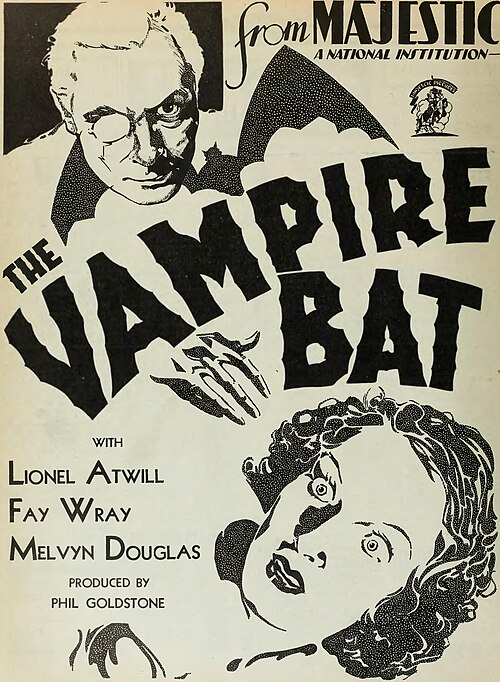
In 1933’s The Vampire Bat, people are dying in a small German village, victims of blood loss.  A woman named Martha Mueller (Rita Carlisle) was recently attacked by a bat, leading to rumors of a vampire.  When the local town eccentric, a twitchy man named Hermann Glieb (Dwight Frye), argues that bats are actually harmless and admits that he likes bats because they are “soft” and “nice,” people start to suspect that he might be the vampire.  Another man named Kringen (George E. Stone) claims that he was attacked by a vampire and insinuates that it was Glieb.  Glieb may seems like a strange man who likes to collect bats but could he be something even more sinister?

Two town leaders have opposite feelings about the claim that a vampire is attacking the town.  Karl Brettschneider (Melvyn Douglas) is the local police inspector and he deals with facts.  He doesn’t believe in superstition and he initially scoffs at the idea that a vampire is attacking the village.  Meanwhile, Dr. Otto von Niemann (Lionel Atwill) is the town’s doctor.  He’s been treating the victims of the bat attacks and he’s even be letting some of his patients live at his home.  Everyone knows that Dr. von Neimann is a kindly man of science.  Karl is even dating Ruth (Fay Wray), one of Otto’s boarders.  But is the doctor as benevolent as everyone assumes?

When answering that question, consider these four facts:

  1.  Dr. von Neimann is the one who encouraged Kringen to spread stories about a vampire haunting the town, despite the fact that Kringen himself said that he didn’t want to start a panic.
  2. Dr. van Niemann is played by Lionel Atwill.
  3. Glieb is played by Dwight Frye.
  4. Karl is played by Melvyn Douglas.

Indeed, for horror fans, the casting of Lionel Atwill gives the game away.  Lionel Atwill appeared in a number of horror films and it was rare that he wasn’t cast as the villain.  (One of his non-villainous role was as the one-armed Inspector Krogh in The Son of Frankenstein.)  From the minute the viewer sees Atwill, he seem to give off sinister vibes and it’s not really a surprise when he turns out to be less than trustworthy.

As for Dwight Frye, horror fans love him for playing a number of unhinged weirdos, like Renfield in the Lugosi-version of Dracula and the torch-bearing servant in Karloff’s Frankenstein.  Frye was good at playing twitchy types but one thing that all of Frye’s characters had in common is that they were pretty much destined to be victims.  Even when Frye played an unlikeable character,  like in Frankenstein, it was obvious that he was going to end up getting killed at the hands of the Monster.

Finally, Melvyn Douglas was the epitome of propriety in every film in which he appeared.  If Douglas thinks that there is something more going on than just a vampire attacking people, there probably is.  And since we know Douglas can’t be the main bad guy, that pretty much just leaves Lionel Atwill.

The Vampire Bat is a short and enjoyable B-movie that puts an interesting spin on the typical vampire legend.  Though the budget may be low, the cast of Atwill, Douglas, Frye, and Wray can’t be beat and all of them give fully committed performances.  Dwight Frye, in particular, gives one of his best performance as the unfortunate Glieb.  As always, Lionel Atwill makes for an entertaining villain.  At its best, The Vampire Bat comments on the power of hysteria.  Convinced that there is a vampire in their midst, the town goes mad and it directs its anger towards those who are seen as being on the outside, men like Glieb.

The Vampire Bat is more than worthy of your Halloween viewing.
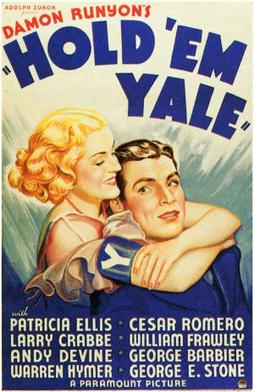
Hold ‘Em Yale (1935, directed by Sidney Lanfield)


Georgie, the Chaser (Cesar Romero) is a con artist who works for a low-level gangster named Sunshine Joe (William Frawley).  When Georgie reads about an heiress named Clarice van Cleve (Patricia Ellis) who impulsively falls in love with any man wearing a uniform, Georgie pretends to be a member of the Foreign Legion and tracks her down.  Georgie thinks that Clarice’s father will pay him off, just as he’s paid off all of her other suitors.  Instead, Clarice’s father disinherits her and Clarice ends up living at Georgie’s place, along with his other criminal associates (Andy Devine, Warren Hymer, and George E. Stone).

Georgie reacts by getting out of town, leaving Clarice behind with his good-natured gang.  However, even the gang gets tired of Clarice insisting that they dress up for dinner and that they all get a good night’s sleep.  After Sunshine Joe cheats them out of their money, the remaining criminals head to the Yale-Harvard football game, hoping to win some bets and to set Clarice up with the player that her father wants her to marry, studious benchwarmer Hector Wilmot (Buster Crabbe).

Just a little over an hour long, HoldEm Yale is actually a pretty amusing movie.  It was based on a short story by Damon Runyon and all of the characters are familiar Runyon types, streetwise but good-natured criminals who enjoy drinking and gambling and the film gets a lot of laughs out of their reactions to Clarice’s attempts to civilize them.  Patricia Ellis is great as the ditzy Clarice and this film provides a chance to see Buster Crabbe playing a character who isn’t a natural-born athlete for once.  It’s a minor film but worth watching for the cast and the snappy dialogue.  Who would have guessed a good movie could be built around Ivy League football?


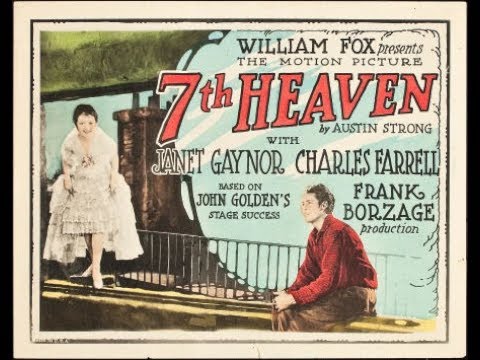
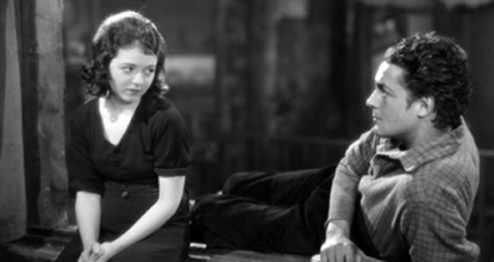
Lisa Reviews An Oscar Nominee: 7th Heaven (dir by Frank Borzage)


The 1927 melodrama 7th Heaven tells the story of two people in Paris.

Chico (Charles Farrell) works in the sewers but lives by the stairs.  Though he spends all of his days under the street and dealing with literally the worst that the world has to offer, Chico remains an optimist.  After all, he has his small apartment, which sits atop seven flights of stairs.  He has his dreams, which involve eventually getting promoted to being a street cleaner.  He doesn’t have much religious faith, which concerns Father Chevillon (Emile Chautard) but who knows?  Maybe something can happen to change that….

Diane (Janet Gaynor) is a desperately sad young woman who lives in squalor with her older sister, the cruel Nana (Gladys Brockwell).  When we first see Diane, she’s lying on the floor while being whipped by Nana and that’s pretty much the way her life goes for the first fourth of the movie.  Nana treats Diane less like a sister and more like a slave, sending her out to steal food and buy absinthe.  Diane and Nana’s father has made a good deal of money overseas but when he sees how they’re living in Paris, he rejects both of them.

How bad of a sister is Nana?  She’s so bad that, when she’s eventually arrested by the Paris police, she points out her sister on the street and demands that they arrest her as well.  Fortunately, Chico just happens to present at the scene.  Having already protected Diane from Nana’s abuse once before, Chico steps forward and announces that Diane is his wife!  The police ask Chico if he’s sure and then remind him that, if it’s found that he’s lying, both he and Diane could go to prison.  Chico, however, insists that it is true.

To keep the deception going, Chico allows Diane to move in with him.  When Father Chevillon arranges for Chico to get promoted to street cleaner, he also requests that Chico keep an eye on Diane.  Chico agrees and slowly but surely, the two of them fall in love.  Chico’s apartment, sitting atop 7 flights of stairs, becomes their 7th heaven.

However, World War I looms in the distance.  With all of Chico’s friends and coworkers receiving their draft notices and being sent to fight, Chico and Diane knew that it’s only a matter of time before the same thing happens to Chico….

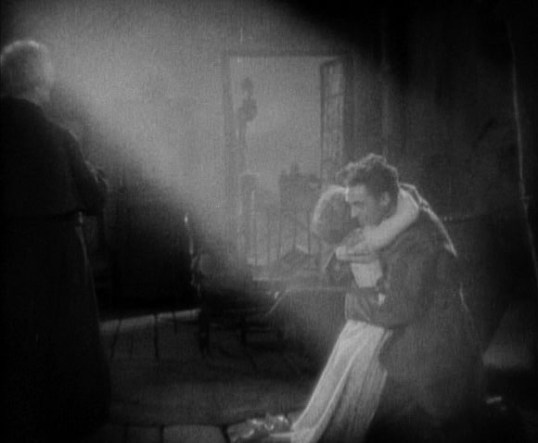
As in so many other silent films, the shadow of World War I looms over every minute of 7th Heaven.  In the 20s, the Great War was still the main trauma that has shaped most viewer’s lives and one can imagine those viewers watching 7th Heaven and falling in love with the characters of Chico and Diane, all the while knowing that their happiness is only temporary.  If the 1st hour of 7th Heaven is a romantic mix of melodrama and comedy, the 2nd hour becomes a rather grim war film.  Even separated by war, Chico and Diane remain soulmates.  When Diane is told that Chico has been listed as having been killed in action, she knows that it’s not true because she can still feel their connection.  And yet, the final fourth of the film is so stylized and the final shot is both so beautiful and yet so artificial that the audience is left to wonder whether Diane is correct or if she’s simply dreaming what she (and, undoubtedly, the many other members of the audience who had also lost loved ones in the war) wishes to be true.

7th Heaven is a deliriously romantic film and watching it actually requires a bit less of an adjustment on the part of modern audiences than other silent films.  Director Frank Borzage keeps the action moving quickly and, even more importantly, Janet Gaynor and Charles Farrell both give sincere and naturalistic performances.  Never do they resort to the type of theatrical overacting that was featured in so many other silent films.  Instead, you watch the film and you truly believe that you are watching two people fall in love.  You’re happy when they’re happy and when tragedy strikes, you cry for them.  Their love is your love and their sadness is your sadness.

7th Heaven was one of the first films to even be nominated for Best Picture.  While Gaynor won Best Actress and Frank Borzage won Best Director, the award for Best Picture went to another World War I romance, Wings.

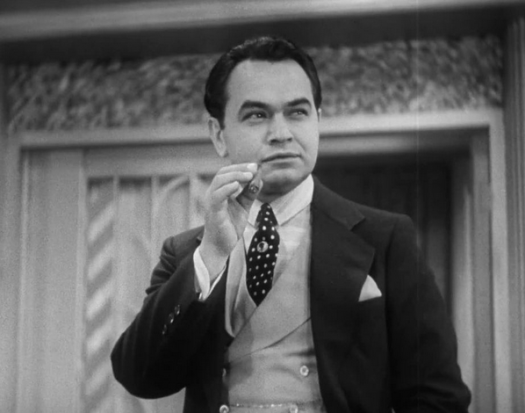
Pre Code Confidential #28: Edward G. Robinson in LITTLE CAESAR (Warner Brothers 1931)


gary loggins's avatarcracked rear viewer

Gangster movies were nothing new in 1931. Josef von Sternberg’s UNDERWORLD (1927), Lewis Milestone’s THE RACKET (1928), and Bryan Foy’s LIGHTS OF NEW YORK (1929) had all dealt with urban organized crime onscreen (and Foy’s drama was the first “all-talking picture” to hit cinemas). But when Edward G. Robinson rat-a-tatted his way through Mervyn LeRoy’s LITTLE CAESAR, the gangster genre had finally arrived – with a vengeance! This highly influential flick opened the floodgates for a variety of films about mobsters, killers, and other assorted no-goodniks, and made an unlikely star out of the pugnacious Eddie G.

The film concerns the rise and fall of Rico “Little Caesar” Bandello, a small-time hood from the sticks who, along with partner in crime Joe Massara, moves to the big city and blasts his way up the ranks to become a gang boss. The diminutive Robinson exudes star power as the psychotic sociopath…

View original post 472 more words

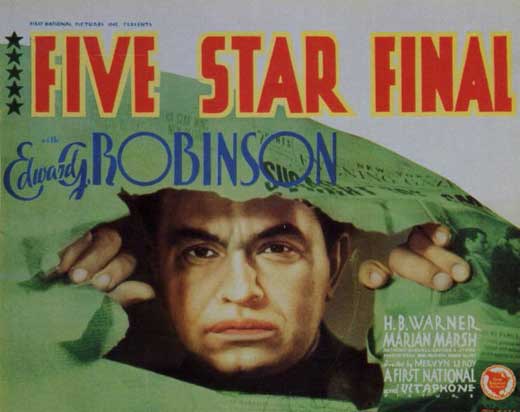
Pre Code Confidential #18: FIVE STAR FINAL (Warner Brothers 1931)


gary loggins's avatarcracked rear viewer

Tabloid journalism has been around far longer than the cable “news” channels of today, with their 24 hour a day barrage of nonstop sleazy scandals and “fake news”. A circulation war between publishers Joseph Pulitzer (New York World) and William Randolph Hearst (New York Journal) in the 1890’s, filled with sensationalized headlines and mucho muckraking, gave birth to the term “Yellow Journalism”, derived from Richard Outcault’s guttersnipe character The Yellow Kid in his comic strip Hogan’s Alley, which appeared in both papers. This legacy of dirt-digging and gossip-mongering continued through the decades in supermarket rags like The National Enquirer and World Weekly News, leading us to where we are today with the so-called “mainstream media” stretching credibility to the max and bogus Internet click-bait sites abounding. All of which leads me to FIVE STAR FINAL, a Pre-Code drama about headhunting for headlines starring Edward G…

View original post 608 more words

Lisa Reviews An Oscar Winner: Cimarron (dir by Wesley Ruggles)


(With the Oscars scheduled to be awarded on March 4th, I have decided to review at least one Oscar-nominated film a day.  These films could be nominees or they could be winners.  They could be from this year’s Oscars or they could be a previous year’s nominee!  We’ll see how things play out.  Today, I take a look at the 1931 best picture winner, Cimarron!)

“Be careful, Hank!  Alabaster may be a little dude but he’ll mess you up.”

“No offense … but he’s from Oklahoma.”

— King of the Hill Episode 5.13 “Ho Yeah”

Some best picture winners are better remembered than others.  Some, like The Godfather, are films that will be watched and rewatched until the end of time.  Others, like Crash, seems to be destined to be continually cited as proof that the Academy often picks the wrong movie.  And then you have other films that were apparently a big deal when they were first released but which, in the decades to follow, have fallen into obscurity.

1931’s Cimarron would appear to be a perfect example of the third type of best picture winner.

Based on a novel by Edna Ferber (who would later write another book, Giant, that would be adapted into an Oscar-nominated film), Cimarron is an epic about Oklahoma.  The film opens in 1889 with the Oklahoma land rush.  Settlers from all across America rush into Oklahoma, searching for a new beginning.  Among them is Yancey Cravat (Richard Dix) and his wife, Sabra (Irene Dunne).  Yancey is hoping to become a rancher but, upon arriving at the settlement of Osage, he discovers that the land he wanted has already been claimed by Dixie Lee (Estelle Taylor).

So, Yancey gives up on becoming a rancher.  Instead, he becomes a newspaper publisher and an occasional outlaw killer.  Soon, Yancey and Sabra are two of the most prominent citizens in Osage.  Under the guidance of Yancey, Osage goes from being a wild outpost to being a respectable community.  It’s not always easy, of course.  Criminals like The Kid (William Collier, Jr.) still prey on the weak.  As the town grows more respectable, some citizens try to force out people like Dixie Lee.  Struck by a combination of personal tragedy and wanderlust, Yancey occasionally leaves Osage but he always seems to return in time to make sure that people do the right thing.  When even his wife reveals that she’s prejudiced against Native Americans, Yancey writes a vehement editorial demanding that they be granted full American citizenship.

The film follows Sabra and Yancey all the way to the late 1920s.  Oklahoma becomes a state.  Sabra becomes a congresswoman.  Oil is discovered.  Throughout it all, Yancey remains a firm voice in support of always doing the right thing.  In fact, he’s such a firm voice that you actually start to get tired of listening to him.  Yancey may be a great man but he’s not a particularly interesting one.

By today’s standards, Cimarron is a painfully slow movie.  The opening land rush is handled well but once Yancey and Sabra settle down in Osage, the film becomes a bit of a chore to sit through.  Richard Dix is a dull lead and the old age makeup that’s put on Dix and Dunne towards the end of the movie is notably unconvincing.  Considering some of the other films that were eligible for Best Picture that year — The Front Page, The Public Enemy, Little Caesar, Frankenstein — Cimarron seems even more out-of-place as an Oscar winner.

And yet, back in 1931, it would appear the Cimarron was a really big deal.  Consider this:

Cimarron was not only well-reviewed but also a considerable box office success.

Cimarron was the first film to ever receive more than 6 Academy Award nominations.  (It received seven and won 3 — Picture, Screenplay, and Art Direction.)

Cimarron was the first film to be nominated in all of the Big Five categories (Picture, Actor, Actress, Director, and Screenplay).

Cimarron was the first film to be nominated in every category for which it was eligible.

Cimarron was the first RKO film to win Best Picture. The second and last RKO film to win would be The Best Years of Our Lives, a film that has held up considerably better than Cimarron.

Cimarron was the first Western to win Best Picture.  In fact, it would be 59 years before another western took the top award.

Though Cimarron may now be best known to those of us who watch TCM, it’s apparent that it was a pretty big deal when it was first released.  Though it seems pretty creaky by today’s standards, they loved it in 1931.

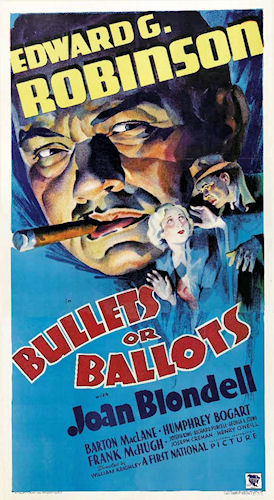
A Movie A Day #180: Bullets or Ballots (1936, directed by William Keighley)


Johnny Blake (Edward G. Robinson) was one of the toughest cops in New York City, until he punched out his new captain (Joe King) and was kicked off the force.  That punch was witnessed by racketeer Al Kruger (Barton McLane).  Kruger has long wanted to get Blake to join his organization and, with Blake now out of work, Kruger makes an offer.  Blake goes to work for Kruger, much to the consternation of Kruger’s second-in-command, Bugs Fenner (Humphrey Bogart).  Bugs says that anyone who was once a cop will always be a cop.  Bugs is right.  Blake is working undercover, trying to expose and take down the mob from the inside.

Bullets or Ballots is an entertaining if predictable gangster film from the 1930s.  After making his career playing bad guys, Robinson makes the transition to the side of law and order without losing any of his trademark attitude.  Bogart plays one of the many remorseless killers that he played before Casablanca reinvented him as a hero.  Bullets or Ballots may be predictable but it’s impossible not to enjoy watching Robinson and Bogart snarl hard-boiled insults at each other.

Second-billed Joan Blondell does not have much screen time but her role is still an interesting one, as a tough businesswoman who runs a numbers racket with her former maid (played by Louise Beavers).  I would have enjoyed seeing a full movie just about Blondell’s character but she mostly takes a back seat to Robinson and Bogart.

Unfortunately, unlike Little Caesar, The Public Enemy, and Scarface, Bullets or Ballots was made after Hollywood started to enforce the infamous Production Code and, as a result, Bullets or Ballots never reaches the gritty, violent heights of those earlier films.  Still, fans of Robinson, Bogart, and Blondell will find much to enjoy here.

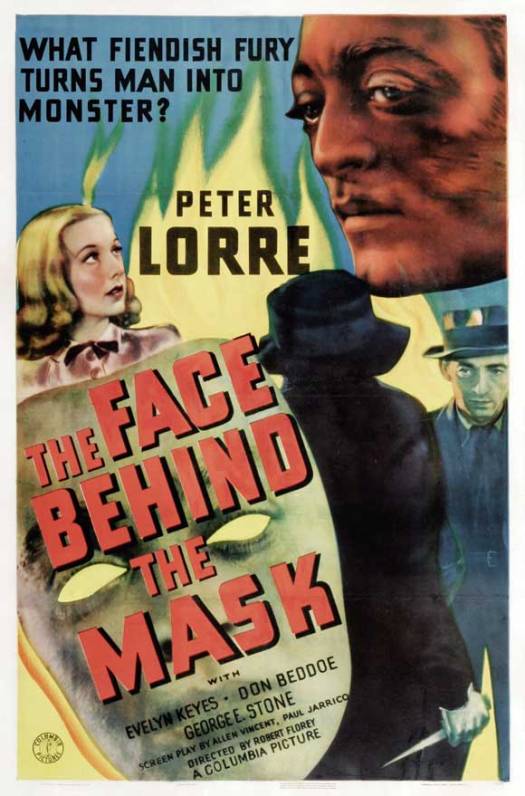
Happy Birthday Peter Lorre: THE FACE BEHIND THE MASK (Columbia 1941)


gary loggins's avatarcracked rear viewer

In honor of Cracked Rear Viewer’s second anniversary, I’m re-presenting my first post from June 26, 2015. I’ve re-edited it and added some pictures, something I didn’t know how to do at first. My, how times change! Anyway, I hope you enjoy this look at an early noir classic. (Coincidentally, this is also Mr. Lorre’s birthday!)

The sinister star Peter Lorre was born in Hungary on June 26, 1904. He became a big screen sensation as the child killer in Fritz Lang’s German classic M (1931), and like many Jews in Germany at the time, fled the Nazi regime, landing in Britain in 1933. Lorre worked with Alfred Hitchcock there in the original THE MAN WHO KNEW TOO MUCH, then immigrated to America, starring in films like MAD LOVE  , CRIME AND PUNISHMENT, and the Mr. Moto series. In 1940, the actor starred in what many consider the first film noir, STRANGER ON THE…

View original post 836 more words

A Movie A Day #126: Baby Face Nelson (1957, directed by Don Siegel)


The place is Chicago.  The time is the era of Prohibition.  The head of the Chicago Outfit, Rocca (Ted de Corsia), has arranged for a career criminal named Lester Gillis (Mickey Rooney) to be released from prison.  A crack shot and all-around tough customer, Gillis has only two insecurities: his diminutive height and his youthful appearance.  Rocca wants to use Gillis as a hit man but Gillis prefers to rob banks.  When Rocca attempts to frame Gillis for a murder, Gillis first guns down his former benefactor and then goes on the run with his girlfriend, Sue Nelson (Carolyn Jones).  Because they are both patients of the same underworld doctor (played by Sir Cedric Hardwicke), Gillis eventually meets public enemy number one, John Dillinger (Leo Gordon).  Joining Dillinger’s gang, Gillis becomes a famous bank robber and is saddled with a nickname that he hates: Baby Face Nelson.

While it is true that Lester “Baby Face Nelson” Gillis was an associate of John Dillinger’s and supposedly hated his nickname, the rest of this biopic is highly fictionalized.  The real Baby Face Nelson was a family man who, when he went on the run, took his wife and two children with him.  While he did get his start running with a Chicago street gang, there is also no evidence that Nelson was ever affiliated with the Chicago Outfit.  (The film’s Rocca is an obvious stand-in for Al Capone.)  In real life, it was Dillinger, having just recently escaped from jail, who hooked up with Nelson’s gang.  The film Nelson is jealous of Dillinger and wants to take over the gang but, in reality, the gang had no leader.  Because Nelson killed three FBI agents (more than any other criminal), he has developed a reputation for being one of the most dangerous of the Depression-era outlaws but, actually, he was no more violent than the typical 1930s bank robber.  Among the era’s outlaws, Dillinger was more unique for only having committed one murder over the course of his career.  In this film (and practically every other film that has featured Baby Face Nelson as a character), Nelson is a full on psychopath, one who even aims his gun at children.

Baby Face Nelson may be terrible history but it is still an excellent B-movie.  Don Siegel directs in his usual no-nonsense style and Mickey Rooney does a great job, playing Baby Face Nelson as a ruthless but insecure criminal with a perpetual chip on his shoulder.  As his fictional girlfriend, Carolyn Jones is both tough and sexy, a moll that any gangster would be lucky to have waiting for him back at the safe house.  B-movie veterans like Thayer David, Jack Elam, Elisha Cook Jr., and John Hoyt all have colorful supporting roles but the most unexpected name in the cast is that of Cedric Hardwicke, playing an alcoholic surgeon with broken down dignity.

Don’t watch Baby Face Nelson for a history lesson.  Watch it for an entertaining B-masterpiece.


Lisa Reviews An Oscar Nominee: 42nd Street (dir by Lloyd Bacon and Busby Berkeley)


forty-second-street-1933

If you’re a regular reader of this site, it will not take you by surprise to learn that the 1933 Best Picture Nominee, 42nd Street, is one of my favorite films of all time.

I mean, how couldn’t it be?  Not only is it a pre-Code film (and we all know that pre-Code films were the best) and one the features both Ginger Rogers and Dick Powell in early roles but it’s also a film that depicts the backstage world of a stage musical with such a combination of love and snark that it will be familiar to everyone from community theater nerds to Broadway veterans.  42nd Street is a classic musical, though I have to admit that I think the majority of the songs are a bit overrated.  Even more importantly, 42nd Street is the ultimate dance film.  The film’s big production number, choreographed and filmed in the brilliant and flamboyant Busby Berkeley style, is such an iconic moment that it’s still being imitated and lovingly parodied to this day.

Every dance movie owes a debt to 42nd Street but few have come close to matching it.  Remember how much we all hated Smash?  There were a lot of reasons to hate Smash but the main reason was because it tried to be 42nd Street and it failed.  There can only be one 42nd Street.

It’s hard to estimate the number of show business clichés that currently exist as a result of 42nd Street.  Then again, it can be argued that they were clichés before they showed up in 42nd Street but 42nd Street handled them in such an expert fashion that they were transformed from being urban legends to immortal mythology.

42nd Street takes place in the backstage world, following the production of a Broadway musical through casting to rehearsals to opening night.  It’s an ensemble piece, one populated by all the usual suspects.  Julian Marsh (Warner Baxter) is the down-on-his-luck producer who desperately needs a hit.  Dorothy Brock (Bebe Daniels) is the celebrated star who is dating a rich, older man (Guy Kibbee, who made quite the career out playing rich, older men) while secretly seeing her ex, a down-on-his-luck Vaudevillian (George Brent).  From the minute that we first see Dorothy, we know that she’s eventually going to end up with a boken ankle.  It’s just a question of which chorus girl will be promoted to take her place.  Will it be “Anytime” Annie (Ginger Rogers) or will it be the naive and wholesome Peggy (Ruby Keeler)?  You already know the answer but it’s still fun to watch.

If you had any doubts that this was a pre-code film, the fact that Ginger Rogers is playing a character named “Anytime” Annie should answer them.  42nd Street is often described as being a light-hearted camp spectacle but there’s a cynicism to the film, a cynicism that could only be expressed during the pre-code era.  The dialogue is full of lines that, just a few years later, would never have gotten past the censors.

(This is the film where it’s said that Anytime Annie “only said no once and then she didn’t hear the question!”  This is also the film where Guy Kibbee cheerfully tells Annie that what he does for her will depend on what she does for him.  Just try to get away with openly acknowleding the casting couch in 1936!)

The menacing shadow of the Great Depression looms over every glossy production number.  Julian needs a hit because he lost all of his money when the Stock Market crashed and if the show is not a hit, everyone involved in the production will be out on the streets.  The chorus isn’t just dancing because it’s their job.  They’re dancing because it’s an escape from the grim reality of the Great Depression and, for the audience watching, the production numbers provided a similar escape.  42nd Street said, “Yes, life is tough.  But sometimes life is fun.  Sometimes life is sexy.  Sometimes, life is worth the trouble.”  Someday, 42nd Street promises, all the misery will be worth it.

Ultimately, 42nd Street is all about that iconic, 20-minute production number:

42nd Street was nominated for best picture but it lost to the nearly forgotten Cavalcade.