April Noir: Blue Velvet (dir by David Lynch)


First released in 1986 and still regularly watched and imitated, Blue Velvet is one of the most straight forward films that David Lynch ever made.

For all the talk about it being a strange and surreal vision of small town America, the plot of Blue Velvet is not difficult to follow.  After his father has a stroke that leaves him confined to a hospital bed, Jeffrey Beaumont (Kyle MacLachlan) returns home from college.  Lumberton appears to be a quiet and friendly little town, with pretty houses and manicured lawns and friendly people.  Jeffrey, with his dark jacket and his expression of concern, appears a little out-of-step with the rest of the town.  He’s been away, after all.  One day, while walking through a field, Jeffrey discovers a rotting, severed ear.  Jeffrey picks up the ear and takes it Detective Williams (George Dickerson).  Detective Williams, who looks like he could have stepped straight out of an episode of Dragnet, is such a man of the innocent 1950s that his wife is even played by Hope Lange.

“Yes, that’s a human ear, alright,” Williams says, deadpan.
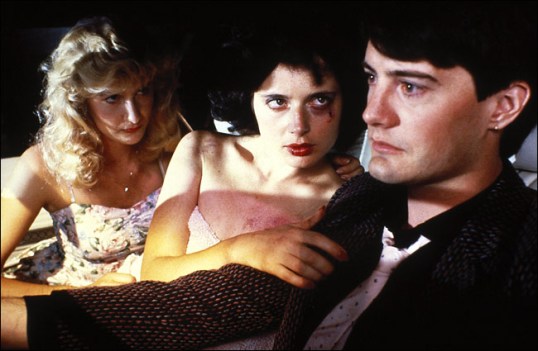
Blue Velvet (1986, dir by David Lynch, DP: Frederick Elmes)

With the help of Detective Williams’s blonde and seemingly innocent daughter, Sandy (Laura Dern), Jeffrey launches his own investigation into why the ear was in the field.  He discovers that Lumberton has a teeming criminal underworld, one that is full of men who are as savage as the ants that we saw, in close-up, fighting over that ear in the field.  Jeffrey discovers that a singer named Dorothy (Isabella Rossellini) is being sexually blackmailed by a madman named Frank Booth (Dennis Hopper).  When Dorothy discovers Jeffrey hiding in her closet (where he had been voyeuristically watching her and Frank), it leads to Jeffrey and Dorothy having a sadomasochistic relationship.  “Hit me!” Dorothy demands and both the viewer and Jeffrey discover that he’s got his own darkness inside of him.  “You’re like me,” Frank hisses at Jeffrey at one point and, if we’re to be honest, it almost feels like too obvious a line for an artist like David Lynch.  Lynch once described the film as being “The Hardy Boys in Hell,” and the plot really is as straightforward as one of those teenage mystery books.

That said, Blue Velvet also features some of Lynch’s most memorable visuals, from the brilliant slow motion opening to the moment that the camera itself seems to descend into the ear, forcing us to consider just how fragile the human body actually is. The film goes from showcasing the green lawns and blue skies to Lumberton to tossing Jeffrey into the shadowy world of Dorothy’s apartment building and suddenly, the entire atmosphere changes and the town becomes very threatening.  We find ourselves wondering if even Detective Williams can be trusted.  That said, my favorite visual in the film is a simple one.  Sandy and Jeffrey walk along a suburban street at night and the camera shows us the dark trees that rise above them, contrasting their eerie stillness to Sandy and Jeffrey’s youthful flirtation.
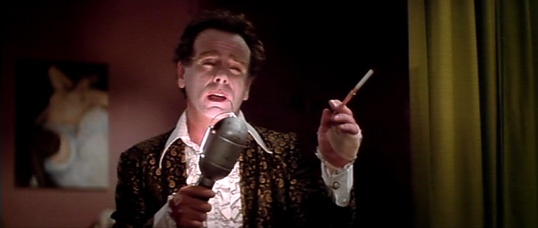
Dean Stockwell in Blue Velvet

Dean Stockwell shows up as Ben, an associate of Frank’s who lip-synchs to Roy Orbison’s In Dreams while Frank himself seems to have a fit of some sort beside him.  In retrospect, Blue Velvet played a huge role in Dennis Hopper getting stereotyped as an out-of-control villain but that doesn’t make him any less terrifying as Frank Booth.  Hopper, recently sober after decades of drug abuse and self-destructive behavior, summoned up his own demons to play Booth and he turns Frank into a true nightmare creature.  Isabella Rossellini is heart-breaking as the fragile Dorothy.  That said, the heart of the film belongs to Kyle MacLachlan and Laura Dern and both of them do a wonderful job of suggesting not only the darkness lurking in their characters but also their kindness as well.  For all the talk about Lynch as a subversive artist, he was also someone who had a remarkable faith in humanity and that faith is found in both Jeffrey and Sandy.  MacLachlan and Dern manage to sell moments that should have been awkward, like Sandy’s monologue about the returning birds or Jeffrey’s emotional lament questioning why people like Frank have to exist.  Both Jeffrey and Sandy lose their innocence but not their hope for a better world.

Blue Velvet is a straight-forward mystery and a surreal dream but mostly it’s an ultimately hopeful portrait of humanity.  The world is dark and full of secrets, the film says.  But that doesn’t mean that it can’t be a beautiful place.
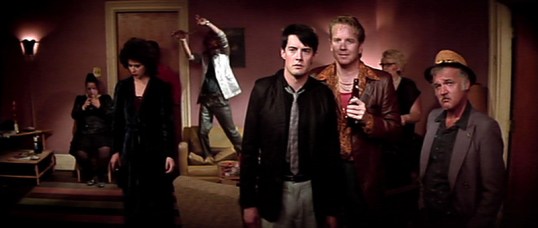
 

Blue Velvet (1986, dir by David Lynch, DP: Frederick Elmes)

Retro Television Review: Miami Vice 3.24 “Heroes of the Revolution”


Welcome to Retro Television Reviews, a feature where we review some of our favorite and least favorite shows of the past!  On Mondays, I will be reviewing Miami Vice, which ran on NBC from 1984 to 1989.  The entire show can be purchased on Prime!

This week, season 3 comes to a close with a threat from the past!

Episode 3.24 “Heroes of the Revolution”

(Dir by Gabrielle Beaumont, originally aired on May 8th, 1987)

The Vice Squad is investigating Orrestes Pedrosa (Shawn Elliott), a former Fidel Castro henchman who has since come to Miami and is now trying to set himself up a major drug supplier.  There’s also a mysterious German named Klaus Herzog (Jeroen Krabbe) who appears to be following Pedrosa around Miami.

After getting wounded in a nearly-successful drive-by shooting, Herzog breaks into Gina’s apartment and introduces himself as the ex-boyfriend of Gina’s mother.  He goes to explain that Pedrosa was also in love with Gina’s mother and that he killed her when Gina was just a baby.  Pedrosa is still obsessed with Gina’s mother so Herzog suggests that Gina should get a job singing at a club.  Pedrosa will come out of hiding to see her and Herzog will get his chance for revenge.

Gina agrees, even though it means violating every rule in the Vice book.  The end result is that we get a lot of scenes of Saundra Santiago singing and eventually, she shoots Pedrosa dead when he attempts to shoot Herzog.

It’s an interesting choice for a season finale.  Crockett and Tubbs are barely present in this episode, allowing Gina to finally have center stage.  (Interestingly enough, the third season opened with a Gina episode as well.)  Saundra Santiago was often underused by the show so it’s always good to see her getting a chance to do something other than telling Sonny that he got a call.  She and the wonderful Jeroen Krabbe have an interesting chemistry in this episode.  Pedrosa isn’t the only one who is still in love with Gina’s mother.

On the one hand, I was happy that Miami Vice finally featured a villainous communist.  Politically, Miami Vice tends to be so left-wing that it sometimes verges on parody so a villainous Castroite was a change of pace.  But then Krabbe’s character introduced himself by saying, “I am a communist.”  It was as if the show had to make sure we understood that it was still on the side of Marx.  It felt kind of silly, to be honest.

Anyway, the third season ended on a fairly good note.  Neither Don Johnson nor Philip Michael Thomas really seemed that invested in their characters for much of the third season so it’s been nice to see Michael Talbott, Saundra Santiago, and Olivia Brown each get an opportunity to show off what they could do when given the opportunity.  This was an uneven season but it had its share of good episodes.  I’m still struggling to deal with the death of Larry Zito.

Next week, we begin season 4!

DEATH WISH 4: THE CRACKDOWN – a missed opportunity in my life!


I’m on Day 4 of my discussion of Charles Bronson’s DEATH WISH series in chronological order. This series has brought me countless hours of entertainment over the last 40 years, so enjoy and let me know your thoughts!

DEATH WISH 4: THE CRACKDOWN was a bit of a missed opportunity in my early years of Bronson fandom. Let me explain. In the mid-80’s I became Charles Bronson’s biggest fan, an honor I possibly share with a few others. As a part of that fandom, a 14-year-old Brad would scour every available source for information about my hero, which at that time was mainly the entertainment section of the Arkansas Democrat, my grandma’s tabloids, and, when I could get a ride, the magazine rack at the Hastings Entertainment Superstore. This in-depth search for information eventually lead to me discovering that DEATH WISH 4: THE CRACKDOWN would be playing at the movie theater in Conway, AR in November of 1987. I was so excited that I might actually get to see Charles Bronson on the big screen for the first time ever. Unfortunately, there were several factors working against me. First, it was rated R, so I was completely dependent on an adult taking me. Second, it was released in November which was in the heart of basketball season, and the only thing that was above Bronson in my life was the basketball court, especially since my dad was my coach. And third, my parents would only consider taking me to the movies on “dollar night,” which was Tuesday and almost always conflicted with my basketball game schedule. I remember driving by the theater and seeing DEATH WISH 4: THE CRACKDOWN listed on the marquee and longing to go see it.  Alas, the stars, and the factors above, all aligned against me, and I would not be able to watch the film during its 2-week run in Conway, Arkansas. At this point in his career, Cannon would give Bronson’s films a short theatrical release and then release them to the home video market where Bronson was still a true moneymaking superstar.  DEATH WISH 4 earned the equivalent in today’s dollars of around $20,000,000 at the box office before going on to sale over 100,000 VHS cassettes to rental stores. It was Bronson’s most successful rental release of the franchise.  

DEATH WISH 4: THE CRACKDOWN opens with Paul Kersey (Charles Bronson) having nightmares about the man he has become after a decade of meting out vigilante justice. He has moved back to Los Angeles where he keeps himself busy with his work as an architect, as well as his relationship with his new lady friend, Karen (Kay Lenz). When Karen’s daughter Erica dies of a drug overdose, Kersey immediately finds the drug dealer who sold her the stuff and shoots him dead. Unfortunately, soon after it seems that someone has pictures of Kersey doing his vigilante deeds, and he finds himself being coerced by millionaire Nathan White (John P. Ryan) into pitting the two primary criminal drug organizations against each other in a turf war in an attempt to get them to take each other out. Nathan White’s own granddaughter had been destroyed by drugs, and this is his way of getting back at the criminals responsible for her death. Kersey begins killing drug dealers, suppliers, day laborers, security detail, you name it; if you’re associated with drugs in any way, whether it be at a video store, fish packing plant, fine restaurant, or skyscraping apartment complex, you are fair game for death. Kersey is able to sufficiently convince the heads of the competing drug organizations that they are at war with each other. This all culminates at the oil fields, where Kersey, armed with a high-powered rifle, is perched above the meeting of the two gangs. With one fateful shot, he is able to ignite the all-out war he and Nathan White have been looking for. Finally, the streets of Los Angeles are free from the drugs that are sucking the life out of its citizens, right. Or are they?

It was on VHS in April of 1988 that I finally got to see DEATH WISH 4: THE CRACKDOWN. It’s the first movie in the series not directed by Michael Winner. J. Lee Thompson took over the reins and created a slick action film that lacked the odd, but interesting touches that Winner provided, but made up for it with stronger craftmanship. DEATH WISH 4 is a balls to the wall action extravaganza that barely rests long enough for the audience to catch their breath. My personal favorite scene of the film is the oil field shootout that produced some really cool, iconic images of Bronson walking with his rifle as he was finishing off the bad guys. I’ve heard DEATH WISH 4 referred to as the “lost Death Wish” film because it is spoken of less than parts 1, 2, or 3, and that may even be true, but it’s actually a very strong entry in the series.  

As Paul Harvey might say, this is the “rest of the story” of me finally getting to see Charles Bronson on the big screen.  After DEATH WISH 4 ended its run, I don’t know of another Bronson film playing at my local theater from that point forward, and I would have to settle to watch MESSENGER OF DEATH, KINJITE, THE INDIAN RUNNER, and DEATH WISH V all on home video. Then, in the summer of 2022, I became aware that the Mahoning Drive-In in Lehighton, PA was programming a Charles Bronson night featuring THE MECHANIC, MR. MAJESTYK and DEATH WISH 3.  My wife and I drove 17 hours from our home in Arkansas to watch those three movies on the big screen.  It was the greatest “movie-night” of my life and something I’ll never forget.  So, all’s well that ends well!

BONUS: Jesse Dabson had a part in DEATH WISH 4: THE CRACKDOWN. Jesse was interviewed on the THIS WEEK IN CHARLES BRONSON PODCAST, where he told my partner Eric Todd, and fellow Buchinsky Boys Chris Manson and Ryan Voss, about his experiences working on DEATH WISH 4, as well as other projects like PLATOON LEADER and ONE FALSE MOVE. Give it a listen if you get a chance!

Death Warrant (1990, directed by Deran Sarafian)


A series of murders have occurred at Harrison State Prison in California.  What better way to investigate the crimes and catch the guilty than to send in an undercover cop?  Who can enter a California prison and investigate the crime without drawing too much attention to himself?  It would have to be someone who could blend in with the population without seeming out of place.

How about Jean-Claude Van Damme?

Van Damme, in one of his early films, stars as Louis Burke, a Canadian with a Belgian accent who comes to Los Angeles to track down a serial killer known as the Sandman (Patrick Kilpatrick, who was last seen running for governor of California in 2021) and then just sticks around.  Burke enters the prison and somehow, he is not immediately tagged as being a B-movie star who is working for the police.  I guess California prisons are full of Belgian kickboxers.

A realistic portrait of prison and police work, this is not.  But it is Van Damme at his most berserk, flexing his muscles and shouting at his enemies and getting hit in the head by a flying wrench at one point.  To the surprise of no one, the Sandman eventually ends up in the prison with Burke and it leads to an epic showdown that takes place in the middle of a prison riot.  The fight is exciting because Van Damme and Kilpatrick were two tough actors who, at that point in their careers, had nothing to lose by going all out on screen.

(Of the three major B-action stars of the 90s, Dolph Lundgren was the one you watched because he could actually act.  Steven Seagal was the one you watched because you hoped someone would beat him up.  Jean-Claude Van Damme was the one you watched because he could actually do everything he did in the movies in real life as well.)

There are many good actors to be found in Death Warrant, playing paper-thin characters.  Robert Guillaume is the one-eyed clerk who takes Burke under his wing.  Larry Hankin is the biggest weasel in the prison.  Art LaFleuer is the prison guard from Hell.  George Dickerson is the obviously corrupt official.  Abdul Salaam El-Razzac is the voodoo priest who watches over the prison.  Cynthia Gibb is the attorney who pays Burke a conjugal visit.  It’s good to see them all.

Death Warrant is a dumb and entertaining B-movie that doesn’t take itself too seriously.  It’s not Van Damme’s best but it’s not his worst either.  It’s Damme fun.

Bronson’s Rich: Death Wish 4: The Crackdown (1987, directed by J. Lee Thompson)


To quote The Main With No Name, “When a man’s got money in his pocket, he begins to appreciate peace.”

Two years have passed since Paul Kersey (Charles Bronson) last visited and cleaned up New York.  He is back in Los Angeles, the president of his own successful architectural firm.  Now a rich man, he has retired from killing criminals, though he still has dreams where he shoots muggers in parking garages.  Paul has a new girlfriend, journalist Karen Sheldon (Kay Lenz).  When Karen’s teenage daughter, Erica (Dana Barron), dies of a cocaine overdose, it’s time for Paul to get his gun out of storage and blow away a drug dealer.

Shortly after shooting that drug dealer, Paul finds a note on his front porch.  “I know who you are,” it reads.  Paul then gets a call from a mysterious man (John P. Ryan) who identifies himself as being a reclusive millionaire named Nathan White.  Nathan explains that his daughter also died of a cocaine overdose.  He wants to hire Paul to take out not just the drug dealers but also the men behind the dealers, the bosses.  Using his vast resources, Nathan has prepared a file on every major drug operation in Los Angeles.  He offers to share the information with Paul.

“I’ll need a few days to think about it,” Paul says but we all know he’s going to accept Nathan’s offer just as surely as we know that Nathan White has an ulterior motive that won’t be revealed until the movie’s final twenty minutes.

For the first time, Paul is no longer just targeting muggers and other street criminals.  This time, Paul is going after the guys in charge and trying to bring an end to drug trade once and for all.  (The idea that the best way to win the war on drugs was just to kill anyone involved in the drug trade was a very popular one in the late 80s.)  L.A.’s two major drug cartels are led by Ed Zacharias (Perry Lopez) and the Romero Brothers (Mike Moroff and Dan Ferro).  Along with their own activities, Paul and Young work the turn the two cartels against each other.

It’s not just the criminals that have changed in Death Wish 4.  Paul has changed, too.  Paul used to just shoot criminals and run away.  In Death Wish 4, he gets more creative.  He sneaks into Zacharias’s mansion and bugs the phone so that he can keep track of what’s going down.  When it comes time to kill a table full of drug dealers (one of whom is played by Danny Trejo), Paul doesn’t shoot them up.  Instead, he sends them a bottle of champagne that explodes when they open it.  By the end of the movie, Paul is blowing away the bad guys with a grenade launcher!  How many former conscientious objectors can brag about that?

The biggest difference between Death Wish 4 and the films that came before it is the absence of director Michael Winner.  Winner and Bronson had a falling out following Death Wish 3 and, as a result, Winner had little interest in returning to the franchise.  Instead, Winner was replaced by J. Lee Thompson, who had already directed Bronson in several other Cannon films.  As a result, Death Wish 4 is less “heavy” than the previous Death Wish films.  Whereas Winner’s direction often felt mean-spirited and exploitive, Thompson plays up the film’s sense of airy adventure.

Though it barely made a profit at the box office and has been dismissed by critics, Death Wish 4 is an enjoyable chapter in Paul’s story.  If you’re looking for mindless 80s mayhem, Death Wish 4 gets the job done with admirable efficiency.  It would have made a great ending for the franchise but Bronson would return to the role one last time.

Tomorrow: Death Wish V: The Face of Death!