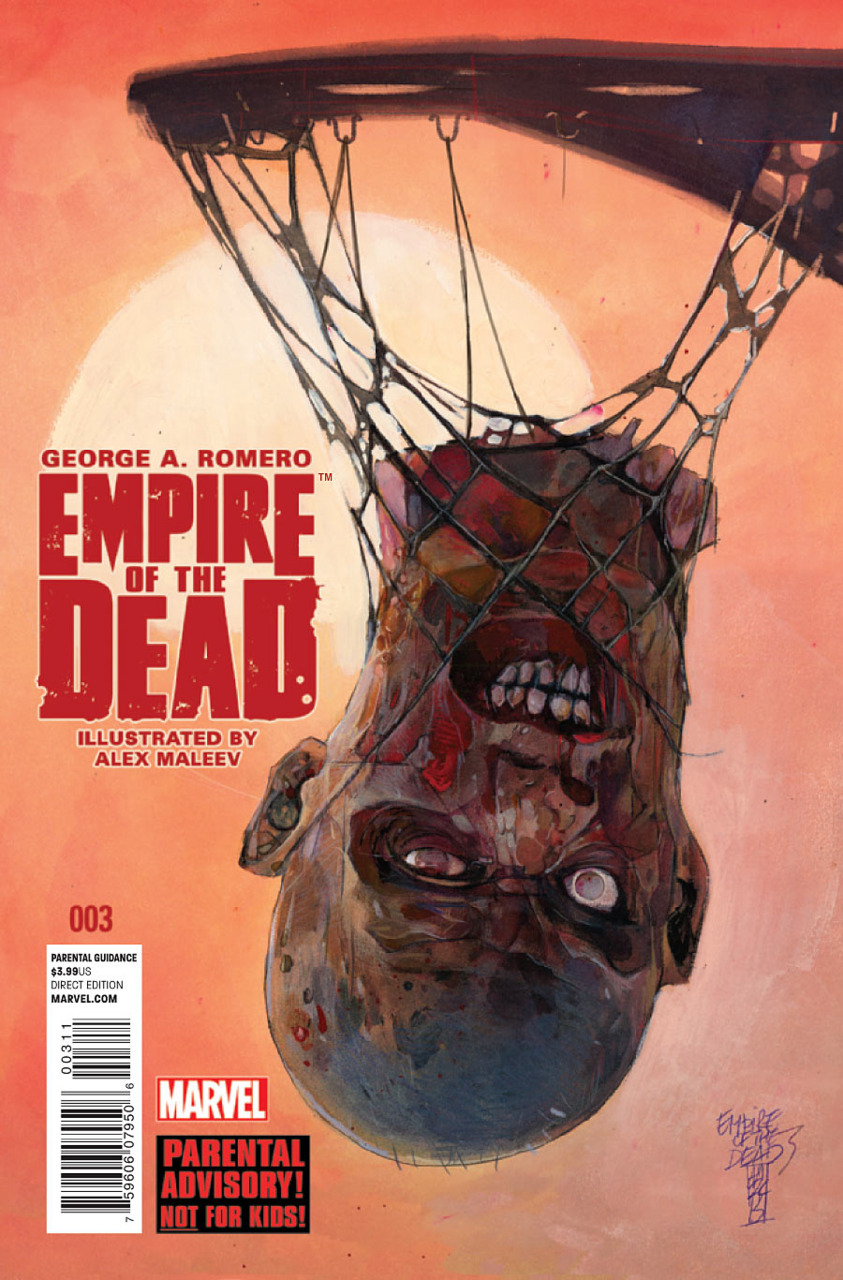
“Empire Of The Dead” #3 Shambles Back In The Right Direction


3718046-03

If you’ll recall — and, hell, it remains true even if you don’t — the second issue of Marvel’s “event” mini-series Empire Of The Dead left me feeling decidedly unenthusiastic about this book”s future, given that all it really managed to do was tread water for 20 pages and then stop. But hey — maybe I’ve been a little too quick to judge. It’s been known to happen before.

I’m not here to tell you that Empire Of The Dead #3 (or, to be true to the copyright indicia, George A. Romero’s Empire Of The Dead Act One, #3) regains all the momentum we lost after a really solid first issue, but it does go some way toward explaining a few head-scratching things left over from last time around, like what all those rat slaughterhouses all over town are about (rat blood is provided as nourishment for the vampires who can’t afford the real, human stuff) and why certain factions of the city council are, shall we say, less than taken with Mayor Chandrake’s leadership (turns out they’re all fucking vamps and feel he might be hoarding all the choicest — supplies, shall we say — for himself and his family), and actually does manage, in the midst of all this palace intrigue (some of which, in fairness, is dialogued in incredibly clumsy fashion) to propel the main narrative forward in some interseting new directions, which is a heck of a lot more than the second installment was able to do.

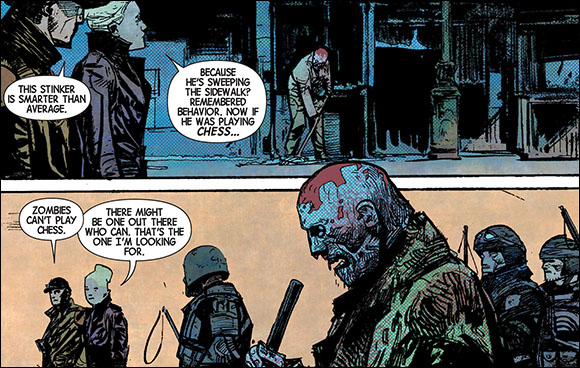
As predicted by anyone and everyone who knows anything about Romero, the relationship between Dr. Penny Jones and former-SWAT-officer-turned-zombie Frances Xavier has quickly become the central focus of this series, since questions of “how different are they from us, anyway?” have been foremost on the father of the modern zombie mythos’ mind at least since he introduced the world to Bub in Day Of The Dead, if not earlier (recall the “this place must have been important to them” line as the undead make their leisurely way through the mall in Dawn for perhaps the first verbalization of this obsession), and it turns out that Xavier is probably even more advanced than we already thought, given that she actually gets bored with some of her less-challenging training exercises/tests and decides she’d rather play some basketball instead (hence that awesome cover art shown at the top of this post).

Things get a little out of hand, though, when — well, that would be telling. Suffice to say this issue ends on a nice cliffhanger that sufficiently whets the appetite for next month’s installment and definitely leaves the reader with a pleasant-enough “hey, maybe things are back on the right track here after all” feeling.
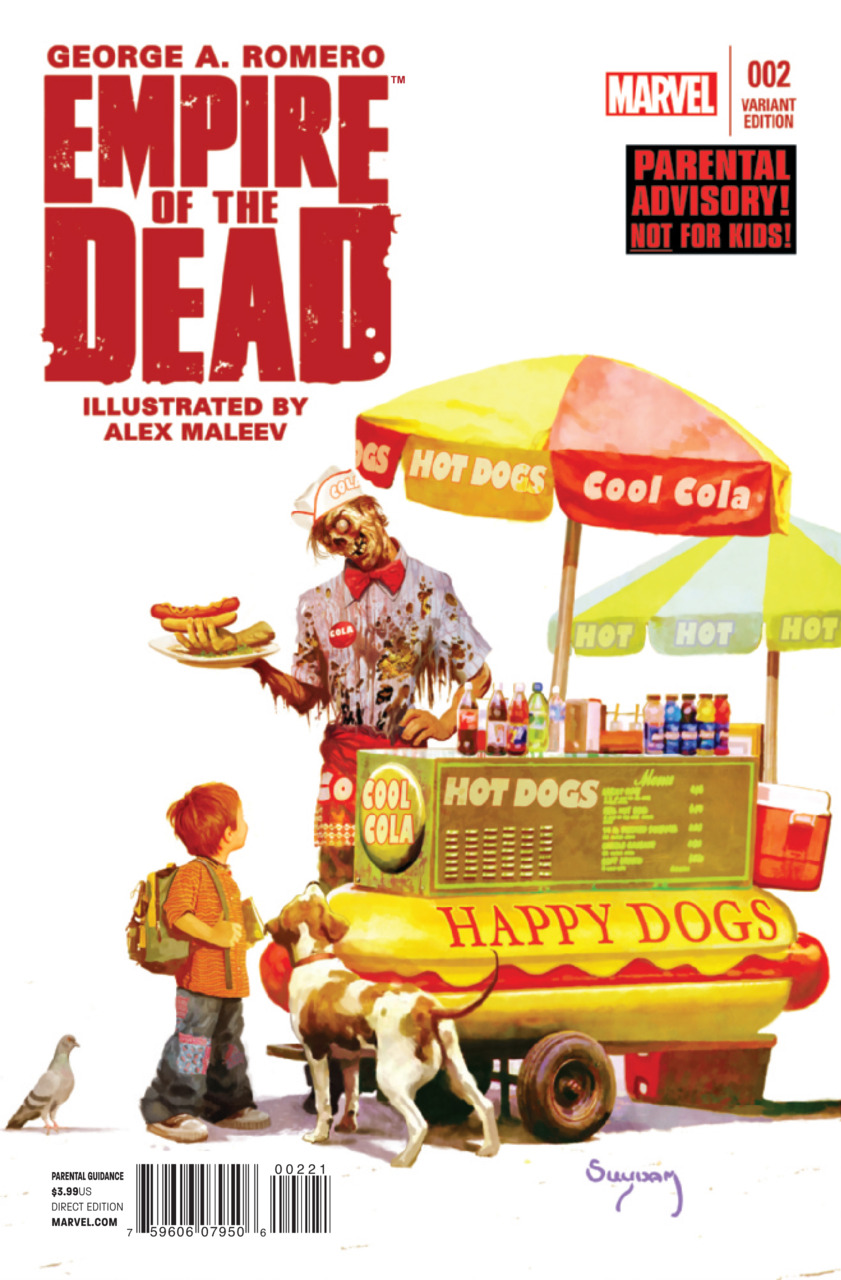
3718333-03-variant

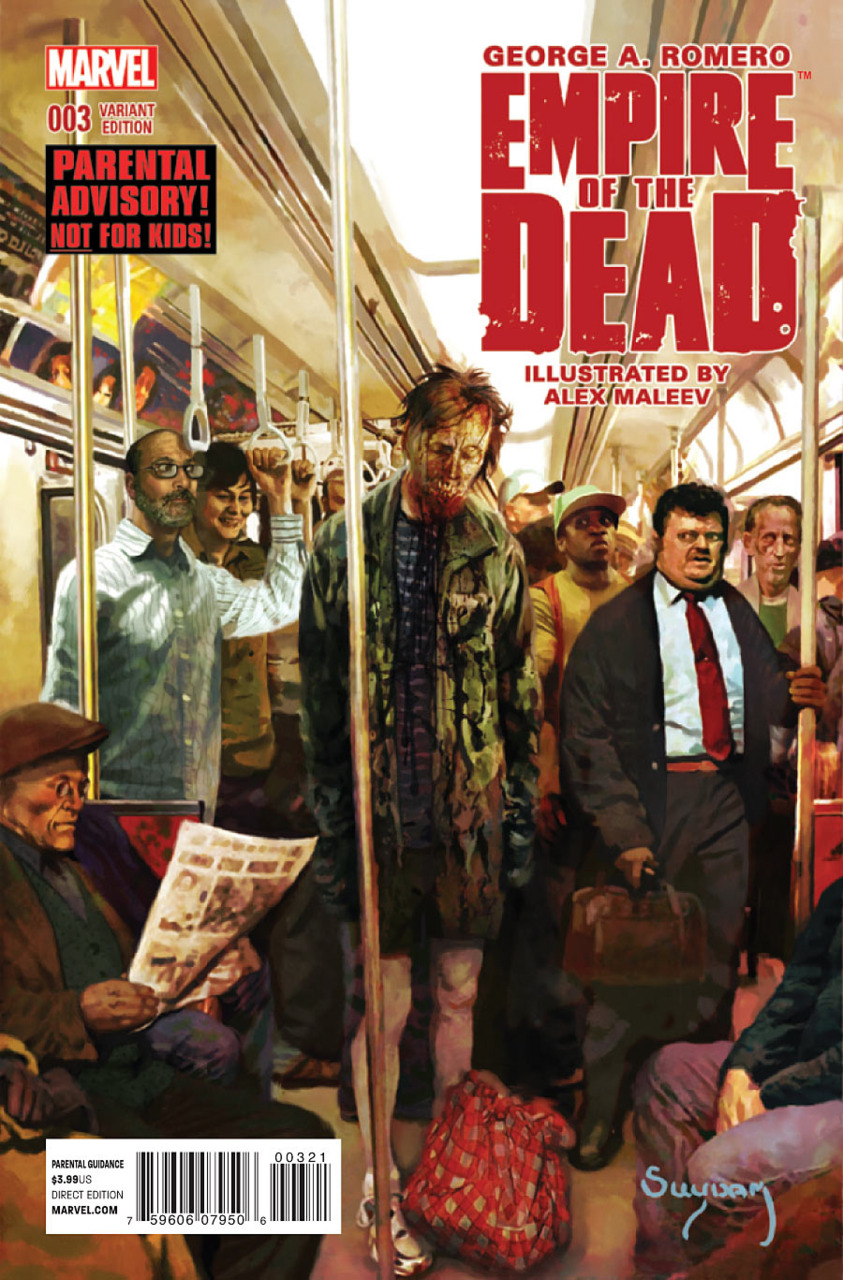
As far as the art goes, I’ve got no cause for complaint whatsoever. Alex Maleev’s “rough sketch” style continues to grow on me, and it’s nice to see a world this un-stylized depicted in such an honest, non-flashy, “warts and all” fashion. Everybody looks as worn down by life (or unlife, as the case may be) as they ought to, and every panel of every page oozes a kind of post-apocalyptic “we’re doing the best we can, but shit, it’s getting tiresome” feel. I dig it a lot — and I dig the heck out of Arthur Suydam’s variant cover (shown directly above) as well — as, I assume, anyone with working eyeballs will.

So yeah — my optimism about this series has returned, and with two issues to go in the opening five-part “act,” it’s safe to say I’ll be on board for both to see how things play out. Some of the major characters — specifically Paul Barnum — still seem under-utilized, but hopefully they’ll get some more to do soon, as well. All in all I have to confess that I should have known better than to doubt The Master — I have renewed  faith  that, wherever he’s taking us, the trip will be worth it.
Treading Water And Sucking Blood : “Empire Of The Dead” #2


3664134-02a


Looking at things in strictly structural terms, second issues are often a tricky wicket in the comic book racket. In today’s marketplace, especially, it’s a pretty safe bet that you’re going to lose nearly half your readership (at the very least) between the first and second installments of any given book simply because cover prices are so fucking high (the going rate for the series under discussion here today, Empire Of The Dead, or as it’s known to Marvel Comics’ legal department, George Romero’s Empire Of The Dead Act One, is $3.99 per 28-page issue, with only 20 of those pages devoted to actual story and art) that a title has to be seriously flawless right out of the gate in order for everybody to shell out their hard-earned cash for a second serving.  So you’d better give the diminished-yet-loyal cadre who have showed up for the second round good reason to keep coming back for more — a nifty plot twist or two never hurts — and you’ve also gotta put in some serious work on fleshing out the world you showed in only the broadest strokes in the series’ debut installment.

With those two admittedly impromptu standards in mind, it’s safe to say that Empire whiffs on the first — badly, in fact — but connects rather nicely on the second, and therefore the end result is a decidedly mixed bag indeed.

3664441-02b


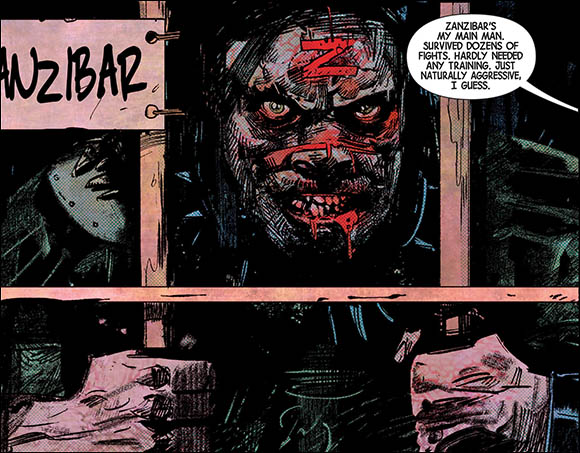
Nothing much happens here in terms of plot progression, with Romero choosing instead to paint a more complete picture of his zombie-and-vampire-infested future New York City. We learn that the devious Mayor Chandrake, his even more devious nephew Bill, and their ghoulish entourage live, appropriately enough, at the infamous Dakota apartment building, and that Bill is a bit reckless in terms of his procurement methods for new flesh (and blood). We learn that SWAT-officer-turned-zombie Francis Xavier is displaying even greater signs of intelligence (or at least more successfully mimicking learned behaviors, as she proves when she arrests a criminal) than previously thought. We learn that uber-zombie Zanzibar is an even bigger bad-ass in the coliseum than we figured by way of a particularly gruesome fight sequence. And we learn that Dr. Penny Jones can be somewhat ruthless in pursuit of her research goals, even going so far as to enlist her feminine wiles to aid her cause.

But that’s about as far as things go here. There is some impressively Bacchanalian excess going on in the Chandrake suites, with carnal blood-letting taking up most of the issue, and there’s some political “court intrigue” introduced in the New York city council, but there’s no real story advancement taking place in the traditional sense, with Romero apparently being content to take this opportunity to merely expound upon his characters and their various situations a bit more fully (except for poor Paul Barnum, who’s scarcely given anything to do). That might work reasonably well for one issue, I suppose,  but we’re going to need more the next time around — a lot more, in fact, especially given that part three will mark the more-than-halfway-point of this initial five-issue arc. I’m not ready to say this second issue was a failure so much as a missed opportunity, but it all hinges on what happens (or doesn’t) next.

3664439-02c

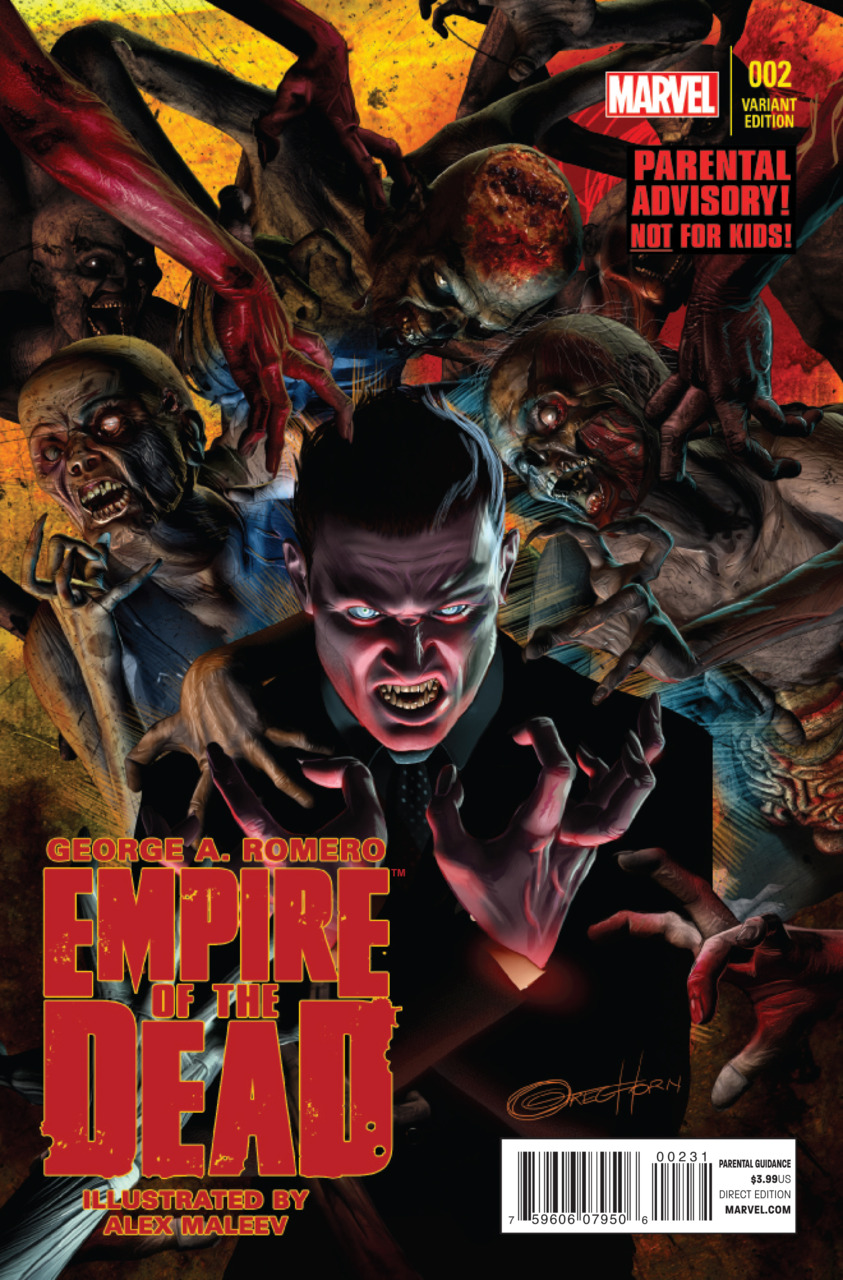
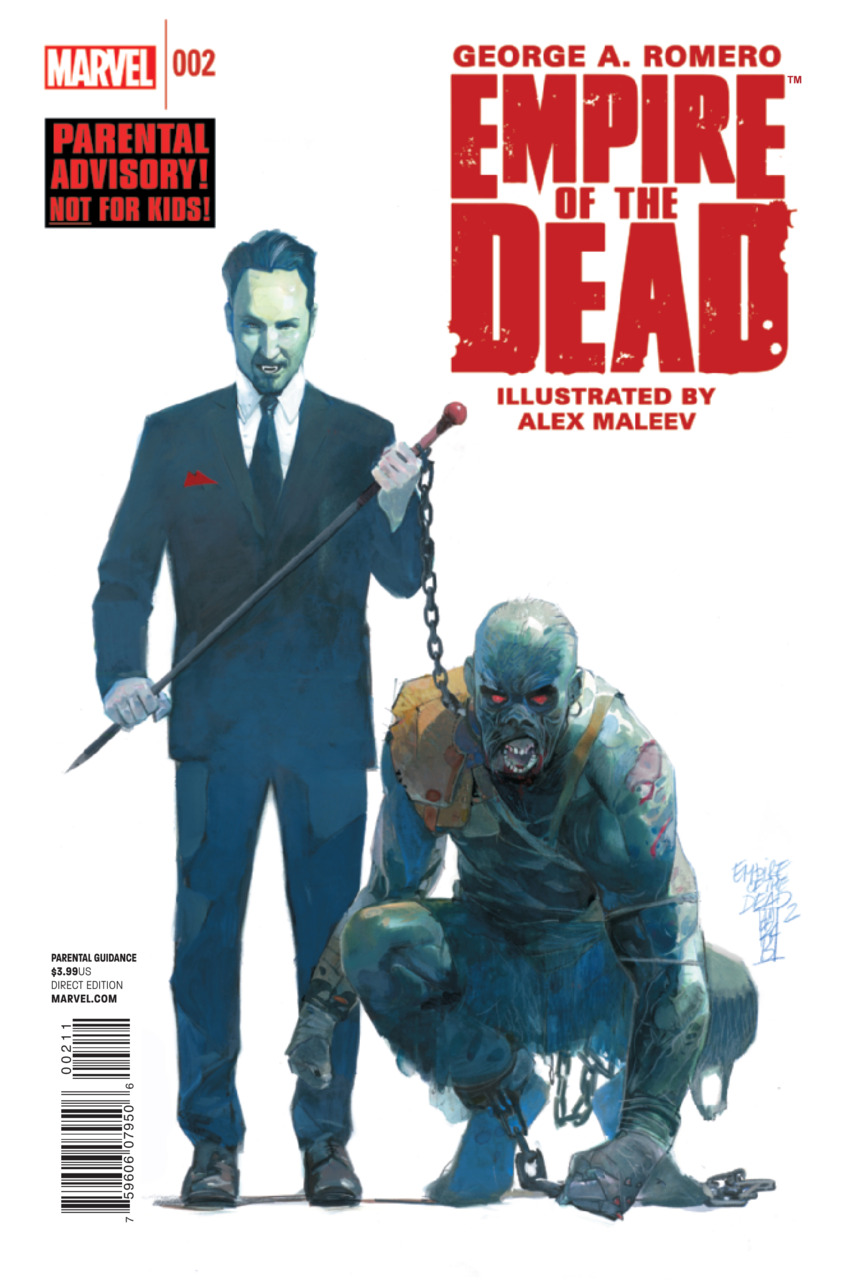
At least the art doesn’t let the side down, though. Alex Maleev’s rough. sketchy illustrations are rich with atmosphere and convey a genuine sense of both brutality and foreboding, while the variant covers (by Maleev, Arthur Suydam, and Greg Horn,  respectively, as shown) are all pretty goddamn cool in their own way. Now it’s just up to “Mr. Zombie” himself, George A. Romero, to give his artist some more interesting things to draw. I’m down for another issue, but the go-nowhere nature of this one has tempered my initial enthusiasm for this series quite a bit.

The ball’s in your court, George. You haven’t let me down yet (as mentioned in my review of issue one I was even a fan of Diary Of The Dead), but this is a  new format for you with new demands — and new possibilities.  I’ve still got exactly $3.99 worth of faith that you won’t disappoint me now, either.


“Empire Of The Dead” : George Romero Brings His Newest Zombie Epic To The Printed Page


3588356-01a

Normally I’m not one for hype, but Marvel’s advertising tagline describing their new series from the father of the modern zombie genre, George A. Romero, as a “comics event” actually strikes me as being a fairly accurate one. I mean, when the guy who gave us Night Of The Living DeadDawn Of The Dead, and Day Of The Dead eschews the silver screen to tell his newest “living dead” story in the comic book format, that’s big news, right?

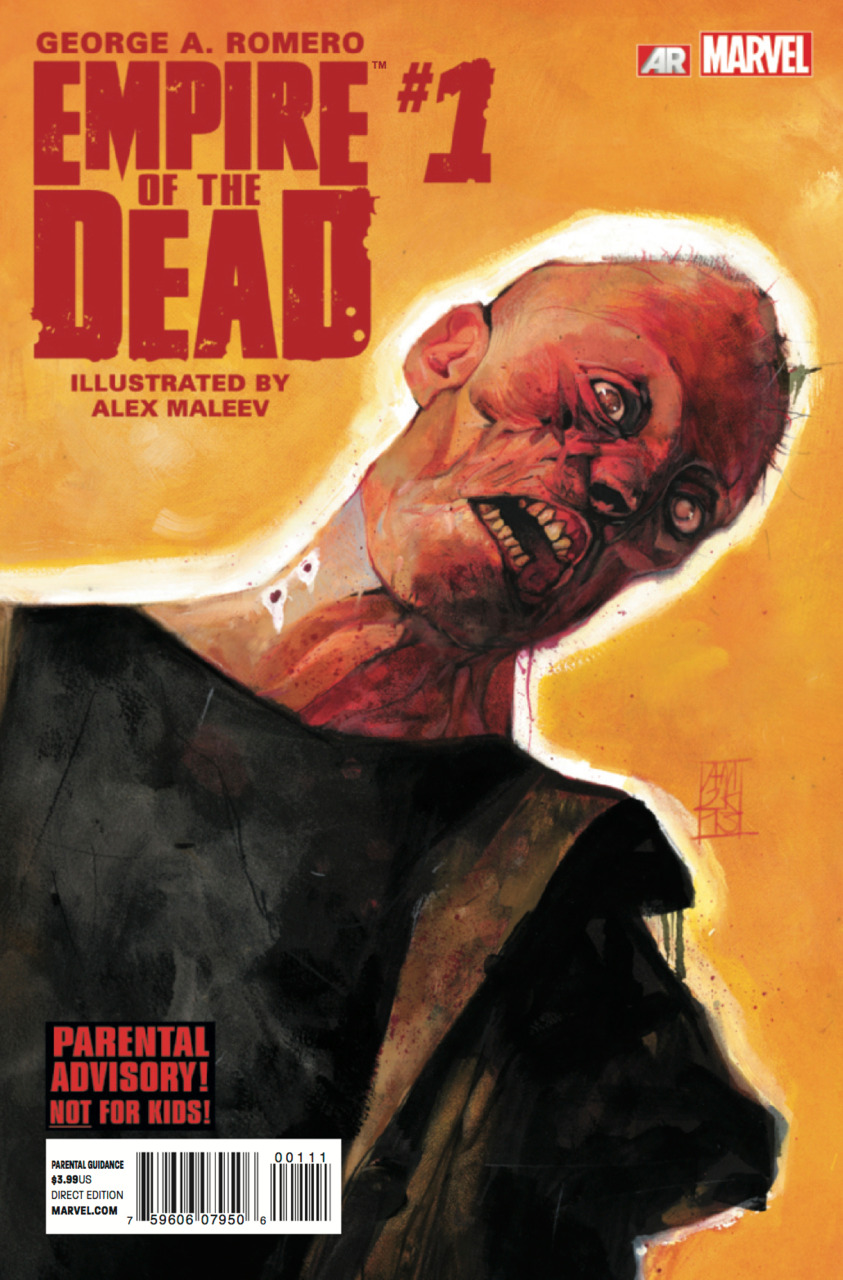
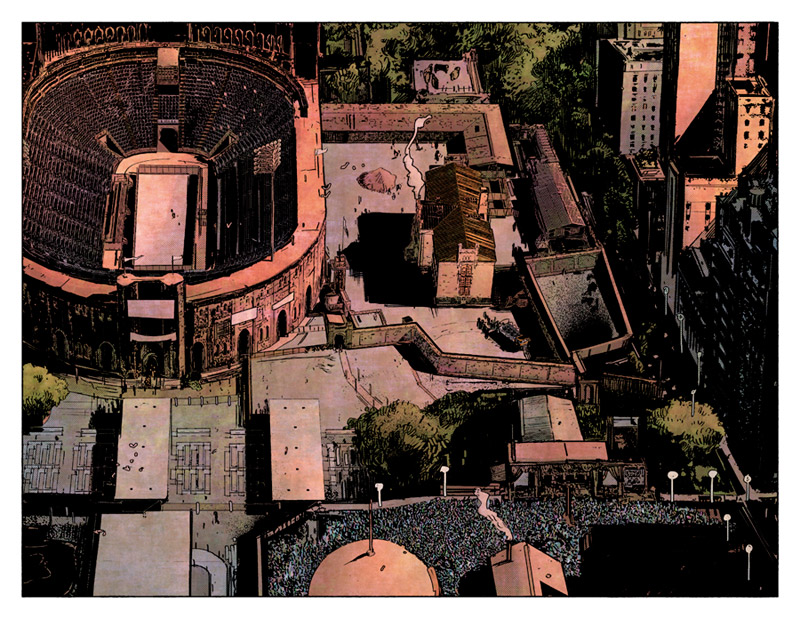
And from the word “go,” issue #1 of Empire Of The Dead (okay, fair enough, its complete title, according to the copyright indicia,  is George Romero’s Empire Of The Dead Act One, Number 1) has a suitably “big” feel to it, and even though artist Alex Maleev approaches his work in a sketchy, rough, “stripped-down” style — which is flat-out gorgeous, by the way — the overall tone here is much more, if you’ll forgive the term, “epic,” than certainly Romero’s last two (very much under-appreciated) film efforts, Diary Of The Dead and Survival Of The Dead, were.

The setting is New York City, five years after the dead began to walk, and things are, as you’d expect, a mess. Corrupt Mayor Chandrake and his creepy nephew hold the city in their thrall by providing Roman Gladiator-style “Zombie Fights” in Yankee stadium that serve to distract a weary populace from the fact that all the resources — well, all the resources that remain, at any rate — are flowing right to the top. A moneyed elite lives in luxury while the populace starves. Sound familiar?

Our two main points of audience identification in the midst of this neo-feudalistic dystopia are Columbia University research scientist Dr. Penny Jones, who’s looking for a zombie with the potential to be, if not educated, at least domesticated, and her guide through the undead part of town, a privateer of sorts who captures zombies for use in the arena named Paul Barnum, whose main claim to fame is having “discovered” current champion fighter Zanzibar.

Empire-of-the-Dead-1-Remembered

Obviously, even at this early stage (Act One is slated to run five issues, with further mini-series to follow) parallels to previous Romero works abound. Penny shares the same research obsessions as Richard Liberty’s Dr. Logan character from Day Of The Dead, while Barnum is essentially a stand-in for Simon Baker’s Riley Denbo from Land Of The Dead. There’s a flashback sequence that intimates strongly that this story takes place in the same fictional “universe” as Night Of The Living Dead, and the economic set-up is, again, essentially the same 1%-vs.-99% scenario that the more-seemingly-prescient-by-the-day Land offered up, with Mayor Chandrake filling the role of Dennis Hopper’s Kaufman. Meanwhile  Zanzibar, for his part, seems to be being groomed for a role not too dissimilar from that of Bub in Day.

Don’t think it’s all re-hash, though — for one thing, moving things from Pittsburgh and its immediate environs to the Big Apple ups the scale quite a bit, the text blocks Romero employs to flesh out how the zombies “think” provide intriguing new insight into the workings of their rudimentary “consciousness,” the martial-law-type scenario that pervades on the streets adds a new , thematically-relevant wrinkle, and the surprising climax to issue one shows — and I sincerely hope that I’m not giving too much away here — that zombies aren’t the only ghouls in town.

empire_of_the_dead_001_preview_2

So, yeah — there’s enough “newness” here to imbue the proceedings with a reasonably fresh take on things, but for those of us who are old-school Romero die-hards, the story is chock-full of enough familiar themes and tropes to keep us both smiling and anxious for more. The set-up is inherently and immediately topical and politically charged (Occupy The Living Dead, anyone?), and, like all of the maestro’s best work, Empire promises to use its zombies as a stand-in for ourselves, and to utilize its post- apocalyptic sworld to shine some welcome light on uncomfortable, but essential, truths about our own current socio-economic predicament.

Empire-of-the-Dead-1-Zanzibar


For my part, I’m all in on this one, despite having numerous ethical qualms about spending so much as a single dollar (not to mention a hefty $3.99 per issue) on any Marvel product. I think we’re looking at another Romero classic-in-the-making here, and I can’t wait to see where it goes.


Review: The Walking Dead S4E04 “Indifference”


TheWalkingDeadS4

“You can’t be afraid to kill.” — Carol Peletier

This week the godfather of the zombie genre was interviewed and the question of The Walking Dead was brought up. Well, it would seem that George A. Romero turned down the offer to direct a couple of episodes of The Walking Dead. His answer was that the show was really just a soap opera with the occasional zombie. His answer hasn’t sit well with fans of the show while those who have been major critics and detractors of it feel content at hearing their argument validated. Yet, it’s those very words that probably just gave the best answer as to why The Walking Dead the show continues to get huge ratings and just gain more and more fans with each new season…with each new episode.

Yes, it is a soap opera with zombies and we all know just how ridiculously popular soap operas can be when it hits a particular button with the general public. I think the writers and producers of the show know this to be true.

“Indifference” marks the fourth episode of the new season and it focuses on that very soap opera-ish aspect of the show that Romero spoke about in his interview. Yet, as the show delves more on the character interactions and conflicts with this episode it does so minus the flaws from past attempts which led to nowhere and no growth for the characters involved. Tonight’s episode explores the theme of not just the indifference which has settled on some of the survivors but also the concept of entropy which the zombie apocalypse itself has ultimately brought to the world from it’s very onset.

We see the time spent between Carol and Rick during this episode a battle of wills between two characters who become integral part of the groups survival dynamics since season 1. Yet, we see only true growth with Carol in this season. She has come a long way from the meek, silent abused housewife from season 1 to a battle-hardened leader-type who’s willing to make the difficult decision in behalf of the group. This used to be Rick’s role in the past three season, but the burden of leadership seemed to have weighed too much on this father of two. His decision during the timeskip to stop being the group’s leader and just become a farmer looks more and more like the very indifference and entropy tonight’s episode has been exploring.

Does Carol’s actions in killing both Karen and David make her out to be villain or does it just goes to show that she’s learned not to be afraid to kill if it means saving the rest of the group. She knows that what she did many wouldn’t understand, but she also knows that Karen and David were already dead and a danger to everyone. Her decision to unilaterally kill the two might have been correct when thought through logically, but Rick doesn’t see it that way. His reaction and decision to exile Carol was Rick’s emotional and attempt to hold onto the concept of humanity for the sake of Carl and Judith. Even as he drives away he understand that his decision might be wrong, but his narrow vision on trying to protect his children from calculated and logical decisions was another form of Rick’s indifference at the world as it is now and not as he wants it to be.

There’s change coming on the show’s group dynamics and we just don’t see it between Carol and Rick, but just as important between Tyreese and the rest of the scavenging group, Bob and Daryl and between Daryl and Michonne. We see Tyreese’s continue his change from the compassionate survivor who confessed to not having the stomach to killing the zombies day in and day out. His inconsolable rage from losing Karen (to a certain extent one of his last grasps in keeping his humanity) has made him a liability as he loses focus in his rage. yet, it’s this very indifference to whether he lives or dies that could become Tyreese’s ultimate wake-up call to become a better survivor in the long-run. The same couldn’t be said for Bob who we find out has already seen two groups of survivors not make it through with him being the only survivor. Just like Rick he has retreated back from trying to make things work through the very bottle he himself confessed probably killed Zach in the season’s premiere episode.

The show has improved from season to season. Season 4 looks to be more focused than seasons past. It still has some problems with having too many characters who do nothing but act as cannon fodder and/or plot devices (example Ana and Sam just for tonight’s episode). But even with the show looking like it’s just about talking and more talking it still manages to move the story forward when in the past it led things in circles. Yes, it’s this very dialogue-heavy and interpersonal conflicts that gives the show it’s soap opera label, but this season it’s this very drama that has made it very interesting on top of entertaining.

While Romero’s decision to turn down directing episodes of the show was based on this very soap opera-ish part of the show one has to remember that zombie fiction, even Romero’s very own classic films from Night of the Living Dead, Dawn of the Dead to Day of the Dead lived off of the very soap opera-like narrative and conflicts that The Waling Dead just happens to use and mine with each new episode. I don’t think the show will ever shed this part of it’s storytelling style. It’s a major appeal to the legion of fans who love and follow the show. It’s both a pro and con for the series. The question that continues to be explored with each new episode is whether Scott M. Gimple as the series’ new showrunner will be able to sustain this pace and not lose it in the end the way Mazzara did in season 3.

Notes

  • Tonight’s episode, “Indifference”, was directed by Tricia Brock and written by Matt Negrete.
  • A great cold opening with Carol doing her best warrior-mom role to make sure Lizzie doesn’t fear what needs to be done to survive. All the while this is happening we see Rick walking through the crime scene of Karen and David’s death and imagining just exactly how Carol did the deed.
  • Tyreese is really raging in tonight’s episode and doesn’t bode well for his long-term well-being if he continues to put the rest of the group in danger.
  • It looks like tonight’s episode will only use a small part of the cast which should keep irrelevant interactions to a bare minimum.
  • Bob confesses to having to bear witness to two previous groups of survivors he’s been a part of lose their fight against the zombies (and maybe other humans). I know that there’s been no sign of the Governor since the final episode of last season, but could Bob be talking of having been part of the Woodbury group.
  • We get two new redshirts in tonight’s episode with the very happy and wanting to help to a fault Ana and Sam. The story they told Rick and Carol about how they’ve survived in the housing community for so long sounds credible enough, but one could see Rick and Carol (especially Rick) not believing most of what’s being told to them.
  • It will be interesting to see how Rick will explain to the group in the prison (and to Daryl) just exactly what happened to Carol and whether he will tell them the truth of why she’s not with them anymore.
  • Talking Dead Guests: WWE wrestler Chris Jericho and Community‘s own Britta, Gillian Jacobs.

Season 4

R.I.P. Richard Matheson


Richard-Matheson-author

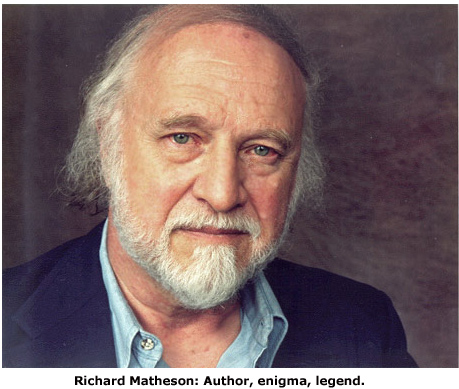
News hit the internet today that legendary author Richard Matheson passed away at the age of 87.

Matheson has been instrumental and influential in horror and dark fantasy pop culture of the 60 or so years. Stephen King and George A. Romero, undoubtedly two of the most recognizable masters of horror of their generation, has called Matheson a major influence in their work. Where would the zombie genre of today be without Matheson’s groundbreaking vampire novel, I Am Legend, which gave Romero the idea to make his Night of the Living Dead. It is also this very same vampire novel whose influence could be seen throughout King’s own classic vampire tale with Salem’s Lot. Even King’s own foray into a zombie novel, Cell, would be dedicated to Matheson.

Yet, Matheson’s influence wouldn’t just be felt in the literary world. He would pen some of the best Twilight Zone episodes and would also provide Roger Corman with screenplay adaptations of Edgar Allen Poe’s short stories and novellas. He would also provide Hollywood with screenplays based on his own stories that would become classic horror and dark fantasy films in their own right.

There’s no way to quantify just how many people Richard Matheson has touched and influenced with his work, but one would be hard pressed not to find someone who hasn’t come across something that had Matheson’s fingerprint whether it was one of his stories, films based on his works or a tv episode that he didn’t have a hand in writing. Then there’s those who have seen or read something that had been influenced by his work.

Today the world has lost of the giant’s in his field of work. Yet, as his best known work says as it’s ending, Matheson will survive far longer than he had lived: HE IS LEGEND.

On a personal note, I count Matheson as one of the biggest influences in my life. Everything he has done or touched have had a hand in showing me the power of the written word. Much of what I watch and read has been influenced by his work. Where would horror and dark fantasy be without him to set the path for future writers and filmmakers. Whether they care to admit it or not they, just like myself, owe Richard Matheson a debt of gratitude for work in the field.

A giant of a man has passed into legend and it’s now up to us, his admirers and fans, to continue on his work of providing the world with quality genre entertainment.

Scenes I Love: Dawn of the Dead (Original 1978)


I know this latest “Scenes I Love” is quite an extended one. It’s pretty much the entire opening to the original George A. Romero classic where we see the four main leads of the story introduced dealing with the crisis that’s been on-going around them for what could be weeks.

I could have easily taken so many smaller scenes from this extended sequence and used them as favorites since they’re all that and more. This sequence was Romero at his best as a screenwriter. While some of the heavy handedness would later plague his writing in his later zombie films in this one they take on the right balance. He’s telling the audience through the screaming outbursts, arguments and general chaos of every scene that we as a society were fucked the moment the zombie apocalypse began. It doesn’t matter whether it’s the civilian expert trying to explain how to deal with the crisis in such logical terms while everyone around him reacts with irrational outbursts of disagreements. Or it could be how the police and the civilians they’re sworn to protect and serve become warring tribes on opposite sides when the true enemy is shambling all around them.

This makes the crippled priest’s words in the end of the scene even more telling.


Scenes I Love: Dawn of the Dead (1978)


[spoilers]

Tonight’s latest episode of The Walking Dead had a climactic scene which mirrored something similar in one of my favorite films ever. I’m not talking just favorite horror film ever, but just favorite film in general with George A. Romero’s original Dawn of the Dead that was released in 1978.

This was the film which codified what to me was what every zombie apocalypse stories and films should be. It was epic in scope despite having such a small leading cast. The film’s story expanded on the rules of the zombie apocalypse but also expanded on the idea that its not even zombies who are the biggest threat to other survivors. It’s almost become a cliche in zombie films nowadays that every major threat to the main group of survivors would be bikers and/or raiders who used chopper bikes to get around.

The scene I always saw as one of my many favorites in this film occurs around the 7:00min mark after the video starts. It’s the raiders and bikers finally getting their comeuppance for bursting into the secured mall compound the survivors sacrificed so much to make their own. This scene matches the same scene spiritually since make-up effects work had improved from 1978 to 2012 where The Walking Dead lives in. the effects work may look cartoonish and fake, but it still doesn’t minimize the impact of seeing someone disemboweled and eaten while still alive and screaming.

Horror Classic Review: Night of the Living Dead (1968)


Lisa Marie has been posting some very good pubic domain horror films for the past couple weeks and I think it’s about high time I posted one of the best public domain films. This one happens to be a horror film and also happens to be one of the best horror films ever made. I would be of the mind to call this one of the most important films ever made in the last hundred years.

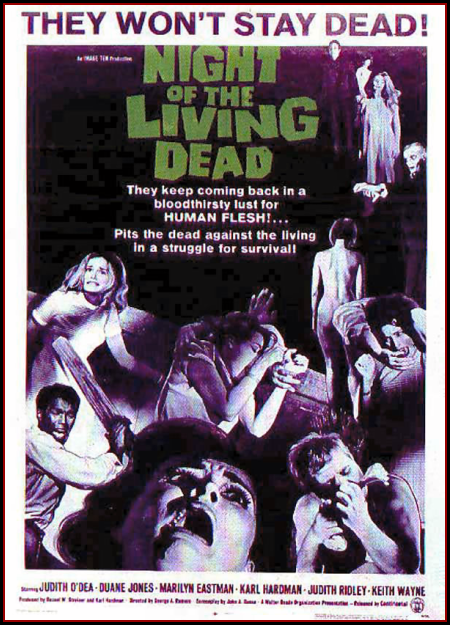
The film I speak of is George A. Romero’s classic and iconic horror film from 1968 simply called Night of the Living Dead. I’ve reviewed and posted this film from over a year ago, but it’s only been recently that Youtube has had a quality HD version of the full film uploaded to its site. Now, people don’t need to go find and buy the countless DVD versions of this film floating around in almost every store imaginable. I think even 7-11 and corner mom-and-pop stores carry a dvd of this film. This is why public domain films can be such a boon to films of the past (though also a curse since some transfers of pubic domain films are beyond awful) that tend rarely get a video release.

Fortunately, Night of the Living Dead is not one of those films. It’s the opposite in that it’s a film that many consider the birth of modern horror cinema and one of the perfect example of guerrilla filmmaking. It’s a film that didn’t just change how we look at horror now (gone are the gothic trappings that most horror had prior), but it also was one of the few horror films to successfully marry not just scares but thought-provoking themes and ideas. Even now most horror films fail to do one of the other let alone both at the same time.

The modern zombie genre of entertainment (films, stories, video games and even protest movements) owe it’s existence to this little low-budget horror film from the late 60’s by a Pittsburgh native and his friends who decided to pool their money together and make a horror flick. It’s a film that still stands the test of time. When all the hoopla over the Paranormal Activity nonsense, remakes of horror (both good and bad) and teen-sanitized horror goes by the wayside this film will continue to impress, remain relevant and still scare (pardon my French) the shit out of young people discovering it for the first time.

Horror Scenes I Love: Day of the Dead


[spoiler]

As I sit here collecting my thoughts on my next horror film review I went over on YouTube to look at a few favorite film scenes to help inspire me. One such scene I came across remains one of my favorite horror scenes ever. In fact, I would consider this one of my favorite film scenes I have ever seen and I have seen more than what’s considered normal.

The film the latest “Scenes I Love” comes from the classic and under-appreciated Day of the Dead. This would be his third zombie film and when it first came out was considered too dark and depressing. I don’t think I would disagree with those descriptions, but that’s not to say the film wasn’t great. The film just took awhile for people to finally appreciate it’s greatness and utter grindhouse vibe.

Now onto the scene that continues to be my favorite from this film. It involves the character of Capt. Rhodes as he tries to flee fro the horde of zombies which has breached the underground haven he and his men had called home. Just like the inspiring leader he was throughout the film, Rhodes leaves his men to fend for themselves as he goes for the cache of weapons and ammo to make a run for it. What he hadn’t counted on was the arrival of one smarter-than-the-average-zombie named Bub who has a bone to pick with dear old Capt. Rhodes.

What happens once the two get to doing their stand-off still remains one of the best scenes in horror ever. What made the scene great was how Rhodes reacted to the final situation he found himself in. If I ever meet such an end I would hope I go out with such words to utter.


Song of the Day: The Man Comes Around (by Johnny Cash)


We’ve now reached the final day of what has been a week-long horror-themed “Song of the Day” feature for the site. It’s quite appropriate that this final day also lands on Halloween and I’m sure many will approve of this final choice to cap off the week.

A week which has seen Italian film composers and prog-rock bands chosen for creating and contributing some of the best and most memorable themes to horror films which will stand the march of time. We’ve seen an epic song from a Montreal band whose music has the apocalyptic sound to it. There’s also two entries from films created by a master of the horror genre in John Carpenter.

The week began with Goblin’s main title theme for George A. Romero’s original Dawn of the Dead. With Halloween night the premiere of the long-awaited and heavily-hyped tv adaptation of Robert Kirkman’s The Walking Dead comic book series (by none other than Frank Darabont himself) I thought what better way to bookend Goblin’s theme for the Romero zombie epic than by picking Johnny Cash’s song “The Man Comes Around”. One of the last songs penned and sang by The Man In Black himself and properly used by filmmaker Zack Snyder to  be the intro music for his remake of Dawn of the Dead.

This song with its gospel-like (though not as hopeful as most) sound and it’s apocalyptic and Biblical lyrics just speaks of the apocalypse like no other song from this past week has done. It comes off almost like a prophecy come down and spoken by one of God’s main dudes. This song when paired with the scenes of the zombie apocalypse crashing down on an unsuspecting world in Snyder’s film instantly made it a favorite with all zombie fans everywhere and introduced The Man In Black to a whole new set of fans.

I would like to think that when the zombie apocalypse does arrive it would be to this song as I and those who share my belief in how to survive such an event ready ourselves for whatever may come.

The Man Comes Around

And I heard as it were the noise of thunder
One of the four beasts saying come and see and I saw
And behold a white horse

There’s a man going around taking names
And he decides who to free and who to blame
Everybody won’t be treated all the same
There’ll be a golden ladder reaching down
When the Man comes around

The hairs on your arm will stand up
At the terror in each sip and in each sup
Will you partake of that last offered cup?
Or disappear into the potter’s ground
When the Man comes around

Hear the trumpets, hear the pipers
One hundred million angels singing
Multitudes are marching to the big kettledrum
Voices calling, voices crying
Some are born and some are dying
It’s Alpha and Omega’s kingdom come

And the whirlwind is in the thorn tree
The virgins are all trimming their wicks
The whirlwind is in the thorn tree
It’s hard for thee to kick against the pricks

Till Armageddon no shalam, no shalom
Then the father hen will call his chickens home
The wise man will bow down before the throne
And at His feet they’ll cast their golden crowns
When the Man comes around

Whoever is unjust let him be unjust still
Whoever is righteous let him be righteous still
Whoever is filthy let him be filthy still
Listen to the words long written down
When the Man comes around

Hear the trumpets, hear the pipers
One hundred million angels singing
Multitudes are marching to the big kettledrum
Voices calling and voices crying
Some are born and some are dying
It’s Alpha and Omega’s kingdom come

And the whirlwind is in the thorn tree
The virgins are all trimming their wicks
The whirlwind is in the thorn tree
It’s hard for thee to kick against the pricks

In measured hundredweight and penneypound
When the Man comes around.

Close (Spoken part)
And I heard a voice in the midst of the four beasts
And I looked and behold, a pale horse
And his name that sat on him was Death
And Hell followed with him.