Welcome to Retro Television Reviews, a feature where we review some of our favorite and least favorite shows of the past! On Mondays, I will be reviewing Miami Vice, which ran on NBC from 1984 to 1989. The entire show can be purchased on Prime!
This week, Bill Paxton and Wesley Snipes walk the streets of Miami!
Episode 3.10 “Streetwise”
(Dir by Fred Walton, originally aired on December 5th, 1986)
I was excited to see that this week’s episode of Miami Vice featured guest turns from not only Wesley Snipes but Bill Paxton as well! Then I remembered that guest stars never survive their episode and I felt a little bit sad. I know what was coming. Miami Vice is not a show that features happy endings. Anyone who gets involved in Miami’s vice trade is destined to end up dead, regardless of how innocent or guilty they may be. It’s a dark world in Miami.
Paxton plays Vic Romano, a vice cop from a neighboring precinct who is arrested during a prostitution bust. Romano has been having an affair with Carla Cappoletti (Alice Adair), an emotionally fragile prostitute who is abused by both her pimp, Silk (Wesley Snipes), and almost all of her clients. She knows that Vic is a cop and Vic knows that she’s a prostitute but neither one of them cares. As Vic puts it, they’re in love.
The Vice Squad is shocked to find that Carla is carrying cocaine that is almost totally pure. Trying to track down who is supplying Silk with the cocaine, the squad discovers that neither Carla nor Vic want to cooperate. While Vic tries to explain things to his wife, Tubbs goes undercover as a pimp. He bails Carla out of jail and tells her that she works for him now. When Silk shows up to object, Tubbs easily beats him up. Silk may talk tough but, without a gun to back him up, he’s not much of a fighter.
When Tubbs demands that Carla go to Silk and find out where he’s been getting his cocaine from, Carla refuses. Tubbs, still pretending to be a pimp, proceeds to yell at her and tear up a hotel room. A sobbing Carla begs Tubbs not to hurt her “too much,” and Tubbs realizes that he’s gone too far in trying to maintain his cover. He shows Carla his badge. It’s always kind of easy to laugh at the way that Tubbs trots out his fake Caribbean accent whenever he’s pretends to be Rico Cooper but Thomas does a really good job in this episode and he is genuinely frightening when he starts yelling at Carla. I found myself wondering just how far Tubbs actually would go to maintain his cover and I was actually relieved when he pulled out that badge.
It ends, as things often do with this show, in a shootout. Silk is gunned down by Crockett and Tubbs but not before Romano is shot by Silk. Romano dies in Carla’s arms and I felt a little teary-eyed. Bill Paxton was a wonderful actor and he gave a likable and sincere performance as Vic Romano. Watching the episode, I never once doubted Romano’s love for Carla. Both Snipes and Paxton were well-cast as their doomed characters. Neither one survived the hour but I doubt anyone who watched the show ever forgot them.
The 1993 film, When A Stranger Calls Back, opens with the recreation of an urban legend.
A teenager babysitter named Julia Jenz (Jill Schoelen) arrives at a big suburban house for a routine baby-sitting gig. The two children are already asleep in bed. All Julia has to do is sent in the living room and do her homework until the parents return from their party. Julia settles in. She gets one mysterious phone call but hangs up.
Then, someone knocks on the door.
The man on the other side of the door explains that his car has broken down and he asks if he can come inside to call his auto club. (This is one of those films that could have only worked in the age of landline phones.) Julia doesn’t want to let the man into the house but the man is insistent that he needs Julia’s help. Finally, Julia says that she’ll call the auto club for him but, when she goes to the phone, she finds that the line is dead. Rather than tell the man the truth, Julia lies to him and says that she called the auto club. The man thanks Julia and says that he’s returning to his car.
(What is an auto club?)
Eventually, the man returns, knocking on the door and asking if Julia really called the auto club. Julia continues to lie, even as the man becomes increasingly belligerent. What Julia doesn’t know but soon discovers is that the man is not outside talking to her but he’s actually inside of the house. And he’s abducted the children!
The opening scene, which of course harkens back to the original When A Stranger Calls, is a genuinely well-done and suspenseful sequence. Again, much like as if with the first film, the opening of When A Stranger Calls Back is so strong that the rest of the film can’t really keep up.
WhenA Stranger Calls Back is indeed a sequel to When A Stranger Calls, which means that, after Julia’s terrifying night of babysitting, the film jumps forward five years. The children are never found and the man who knocked on the door is never identified. Julia is now a college student but she’s still traumatized by the night and has a difficult time trusting anyone. When she starts to suspect that someone has been in her apartment, she turns to Jill Johnson (Carol Kane), who is a counselor at the college and also the protagonist from When A Stranger Calls. Jill helps Julie out, teaching her how to shoot a gun and also calling in the man who killed her stalker, John Clifford (Charles Durning). Clifford figures out that Julia’s stalker is probably a ventriloquist. Personally, I think the film made a huge mistake by making the stalker a ventriloquist instead of the ventriloquist’s dummy.
Despite strong performances from Carol Kane, Charles Durning, and Jill Schoelen, When A Stranger Calls Back suffers from the same problem as When A Stranger Calls. After a scary and effective opening sequence, the rest of the film just feels like a letdown. The killer in When A Stranger Calls Back is not quite as wimpy as the phlegmatic British guy from the first When A Stranger Calls but still, how intimidated can you be by a ventriloquist? An even bigger problem is that When A Stranger Calls Back cheats at the end, suddenly revealing that a character who we had every reason to believe to be dead is actually alive. It feels a bit as cop out on the part of the film, an attempt to slap an improbable happy ending on a film that would otherwise be pretty dark.
These films make me happy that I was never responsible enough to be a babysitter.
“Have you checked the children?” the stranger on the phone asks the terrified babysitter, who is unaware that the children are already dead and that the call is …. COMING FROM INSIDE THE HOUSE!
That’s the premise behind both an oft-repeated urban legend and the opening of the 1979 film, When A Stranger Calls. I’ve often seen the original When A Stranger Calls described as being one of the scariest films ever made. That’s not quite true, of course. The first 20 minutes or so are effective. The final scene has a few intense moments. The majority of what lies in-between feels like filler, albeit well-acted filler.
When A Stranger Calls opens with Carol Kane as Jill, a teenage babysitter who is terrified one night by a caller who keeps asking her if she’s checked on the children. This sequence — really, a mini-movie all of its own — is so well-executed and suspenseful that many people assume that the entire film is just Jill dealing with the mystery caller. Actually, that’s just the first few minutes and, once the location of the killer has been revealed, Kane disappears from the film for an extended period. That’s a shame since Kane’s empathetic performance is perhaps the best thing that When A Stranger Calls has going for it. She’s so convincing as the emotionally shattered babysitter that it doesn’t matter that, at the start of the film, she’s obviously not a teenager.
Instead, the middle part of the film focuses on John Clifford (Charles Durning). Clifford is a former policeman-turned-private investigator. He is obsessed with Duncan (Tony Beckley), the man who called Jill at the start of the film. Duncan has just escaped from a mental institution and Clifford has been hired to track him down. Clifford is convinced that Duncan will try to find Jill. Duncan, meanwhile, wanders through the sleaziest sections of downtown Los Angeles, briefly living with a pathetic alcoholic named Tracy (Colleen Dewhurst). Clifford, of course, is right about Duncan wanting to find Jill. And Clifford is so determined to kill Duncan that he might even be willing to use Jill as bait….
After the brilliantly horrific opening sequence, it’s impossible not to be disappointed with the drawn-out middle section of When A Stranger Calls. Durning, Dewhurst, and especially Beckley all give good performances and downtown Los Angeles is so repellent that you’ll want to take a shower afterwards but, narratively, there’s really not much happening. Clifford finds Duncan. Duncan runs away. Duncan acts like a jerk and gets in a fight. Tracy drinks. The old school cop Clifford scowls at the sleaziness of the world while Duncan continues to lose what little sanity he has left. Give the film some credit for not portraying Duncan as being some sort of charming, loquacious master criminal. He’s a total loser, as all serial killers are despite the later popularity of fictional characters like Hannibal Lecter. Duncan hates both himself and the world with equal fury. But, that said, the narrative stalls during the middle part of the film. There’s only so many time you can watch two men chase each other down a trash-strewn street before it gets dull.
Fortunately, Jill does eventually show up again and, after an hour of relentless sleaziness, you’re happy to see Carol Kane, again. Jill is now married and has children of her own. And soon, she’s again getting a phone call asking if she’s checked on the children….
And, again, the closing sequence is scary, even if it’s not quite as intense as the opening. (The opening was scary because we didn’t know what the killer looked like. By the time Duncan finds Jill a second time, we now know that Duncan is a sickly-looking alcoholic who can’t handle himself in a fair fight.) The film does have one great jump scare left in its arsenal of tricks. And yet, it’s impossible to watch When A Stranger Calls without wishing that the whole thing had just focused on Jill instead of getting sidetracked with Clifford searching Los Angeles.
When A Stranger Calls will always have a place in horror history. “Have you checked the children?” will always produce chills. It’s just unfortunate that the film spends a good deal of its running time ignoring what makes it scary in the first place.
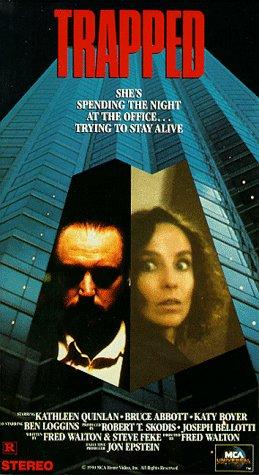
A man (Ben Loggins) leaves his home one day, thinks about how his life has recently gone wrong, and then goes to an unfinished office building where he kills not only the people who he considers responsible but also anyone else who gets in his way. Trapped in the building with him and trying to survive through the night until the doors automatically unlock in the morning are the building’s manager, Mary Ann Marshall (Kathleen Quinlan), and a corporate spy who is only willing to say that May Ann should call him John Doe (Bruce Abbott).
Trapped was produced for and originally aired on the USA network and it went on to become a USA mainstay for most of the 90s. It’s a surprisingly violent and gory for a made-for-TV film from 1989 and the nearly-empty office building is an appropriately creepy setting. Director Fred Walton does a good job of creating and maintaining a sense of suspense and he’s helped by three excellent lead performances from Kathleen Quinlan, Bruce Abbott, and especially Ben Loggins. Loggins is credited as simply being “The Killer” and the film keeps his motives murky. If you pay attention, you can discover what has driven him over the edge but the film is smart enough to concentrate on the cat-and-mouse game that he plays with Quinlan and Abbott. One thing that sets Trapped‘s Killer apart from other psycho move stalkers is that Trapped‘s Killer is ambidextrous, carrying a dagger in one hand and a baseball bat in the other, making him even more intimidating than the typical movie psycho. Kathleen Quinlan, an underrated actress who is probably best-known for playing Tom Hanks’s wife in Apollo 13, is also a feisty and likable heroine.
Don’t let its origin as a made-for-TV film scare you off. Trapped is a good and suspenseful thriller.
(Because of the nature of the 1986 pseudo-slasher film, April Fool’s Day, it’s impossible to really talk about the film without talking about the film’s ending. As a result, this review will have spoilers. The ending will be revealed. The entire plot will be spoiled. Do not read on if that’s going to be an issue for you.)
(Did you read the warning above?)
If not for the way that the film ends, April Fool’s Day would probably be a forgotten film. It’s a slasher film that doesn’t feature much blood, sex, or any particularly flamboyant kills (though there’s a good reason for that). Compared to most low-budget slasher films from the mid-80s, April Fool’s Day does have a surprisingly charismatic and likable cast but it’s rare that anyone watches a holiday-themed slasher film for the acting. Up until the final ten minutes or so, April Fool’s Day is professionally done but somewhat generic…
But then you hit that ending and it totally changes the whole film. It’s not a perfect ending. In many ways, it’s probably one the most imperfect endings that I’ve ever seen. It requires a massive suspension of disbelief. It makes no logical sense. But dammit, I love it. Almost despite itself, it’s a great ending and it confirms that April Fool’s Day is meant to be a satire and not a straight horror film.
For the first 80 minutes or so, April Fool’s Day plays out like the 100th variation on And Then There Were None. Heiress Muffy St. John (Deborah Foreman, giving a wonderfully odd performance) invites a group of college friends to her island mansion. They arrives on April Fool’s Day and they spend the first night dealing with Muffy’s strange sense of humor. (Actually, Muffy and I both find the same things funny but I’ve been told that I have a strange sense of humor so, therefore, I assume that Muffy must have one too.) Harvey, who prefers to be called Hal (Jay Baker), smokes an exploding cigar and discovers his bedroom has been decorated with newspaper articles about a car accident that he was involved in. Jock Arch Cummings (Thomas F. Wilson) finds steroids hidden away in a medicine cabinet. Nikki (Deborah Goodrich) comes across handcuffs in a dresser. Nan (Leah Pinset), a serious-minded drama student, hears a baby crying in the distance and is reminded of her abortion, something that she believes that only Muffy knows about.
The next day, Muffy is now wandering around in a daze and her brother, Skip (Griffin O’Neal), has vanished. Kit (Amy Steel, playing a similar role to her character in Friday the 13th Part Two) and Rob (Ken Olandt) think that they see Skip’s decaying body floating under the boathouse. As the day progresses, Arch and Nan vanish and later turn up at the bottom of a well. Harvey is found hanging from a rope. Chaz (Clayton Rohner) is castrated and, while we’re not quite sure what exactly happens to Nikki, we do see that it involves a large puddle of blood. Kit and Rob discover Muffy’s head in the basement and realize that they are being stalked by Muffy’s crazy twin, Buffy.
(Deborah Foreman is great in both of the roles. As Muffy, she delivers all of her lines with just a hint of sarcasm and constantly seems to be silently laughing at a private joke that only she understands. And when she’s Buffy — well, she’s totally batshit crazy.)
Being pursued by a knife-wielding Buffy, Kit runs through the mansion and finds herself in the drawing room. And who is waiting for her but all of Buffy’s victims? No, they’re not dead! Instead, they’re alive and they’re all in a very good mood. And Buffy is not Buffy. She’s Muffy and she’s been Muffy all along.
That’s right, it’s all a huge elaborate joke! Muffy does spend a few minutes explaining how the whole weekend was a dry run for her plan to turn her estate into a resort, one that will offer a weekend of fake horror. But, ultimately, it all comes down to the entire movie being an elaborate joke. I know, just from perusing some of the comments at the imdb, that there are some horror fans who hate the ending of April’s Fool’s Day. But, really, that’s the only “honest” way that a film like April Fool’s Day could end. If the movie was called Thanksgiving, I could understand being upset. But this is an April Fool’s Day movie! It has to be a joke.
Of course, if you think about it too much, the ending makes no sense. Muffy specifically states the no one was in on the joke until the last minute. Whenever one of her friends would wander off on their own, Muffy would grab them, explain the joke, and get them to play along. When you consider the size of the island and where, at various points, the victims are in relation to the other characters, Muffy must be a very fast explainer, as well as being very persuasive. (As well, Harvey brings a gun with him to island. Muffy jokes about nearly getting shot by him but imagine if he had been successful?) Even if you accept that all of the friends — even Arch and Harvey, who are both kinda dumbasses — would be able to play along without screwing things up, you have to wonder why Muffy thought it would be a good idea to use dark secrets from everyone’s past.
If you search far enough online, you can find all sorts of rumors about the film that April Fool’s Day was originally meant to be. In the finished film, Skip is a bit of a cipher but, in the original script, he was a much more complex character. While Muffy was busy playing her elaborate prank, Skip was planning on killing Muffy and claiming their parent’s inheritance for himself. The crying baby, the drugs, the incriminating newspaper articles; all of them were originally meant to be the work of Skip. While Skip’s subplot was dropped, the dark secrets of the past were not. As a result, Muffy comes across as being a lot more cruel than was originally intended.
Originally, the film was also meant to end with Skip killing Muffy but the ending was apparently changed at the last-minute. (Reports differ on whether or not the original ending was ever filmed.) Instead, the film now ends with Muffy stumbling into her bedroom, playing with a jack-in-the-box, and then getting a knife drawn across her throat by Nan. It’s just another elaborate practical joke and, once Muffy realizes that she’s not dying, Nan gives her a quick kiss and smiles enigmatically.
(A lot of imdb commenters — mostly males — have read a lot into that kiss, obsessing on a subtext that really isn’t there. As opposed to being the homage to Blue Is The Warmest Colour that many commenters appear to believe it to be, it’s really just a friendly kiss, a way of saying, “I got you.” Sorry, guys, that’s all there is to it.)
It’s an ending that would never be done today. Today, all horror films have to end with the promise of a sequel. Muffy might still get away with pulling an elaborate prank but Nan would definitely have killed her at the end of the film. Her little smile would have said, “Wait for the sequel.” And the modern version of that ending definitely would not be as effective. In fact, it would be so expected that it would be damn near infuriating. Instead, the ending of April Fool’s Day is good-natured and likable, which is appropriate because April Fool’s Day is a surprisingly good-natured and likable film.
After Nan’s final joke, April Fool’s Day ends with a song. And here it is! Enjoy and I hope everyone had a great April Fool’s Day!


 Through the Shattered Lens