Retro Television Review: The American Short Story #12: The Man That Corrupted Hadleyburg


Welcome to Retro Television Reviews, a feature where we review some of our favorite and least favorite shows of the past!  On Saturdays, Lisa will be reviewing The American Short Story, which ran semi-regularly on PBS in 1974 to 1981.  The entire show can be purchased on Prime and found on YouTube and Tubi.

This week, we have an adaptation of a Mark Twain novella.

Episode #12: The Man That Corrupted Hadleyburg

(Dir by Ralph Rosenblum, originally aired in 1980)

In this loose adaptation of one of Mark Twain’s darkest novellas, Robert Preston stars as The Stranger.  When we first meet The Stranger, he’s looking down on the small town of Hadleyburg and it’s hard not to notice that he looks a lot like Mark Twain.  The Stranger explains that the people of Hadleyburg consider themselves to be honest and free of sin.  The town’s motto is “Lead us not into temptation!”  The Stranger has a plan to test them.

Riding into town, the Stranger stops at the home of Edward and Mary Richards (Tom Aldredge and Frances Sternhagen).  The Stranger gives them a sack that he claims is filled with $40,000 worth of gold bars.  The Stranger says that he was once a poor man and someone in Hadleyburg gave him $20 and some meaningful advice.  Now that’s he rich, he wants to pay back the person who helped him.  The Stranger explains that there is an envelope inside the sack.  In the envelope, the Stranger has written out the advice he was given by his benefactor.  The Stranger’s instruction is for the man who helped him to write out that advice and give it to Rev. Burgess (Fred Gwynne), who recently lost his church when the citizens of Hadleyburg tired of him calling them out for their hypocrisies.  The honest man who remembers the advice he gave the Stranger will be very rich as a result.  The Stranger then leaves.

News of the sack and the gold travels throughout town and eventually the rest of the nation.  The most powerful families in Hadleyburg, including the Richards family, receive a letter telling them that the advice given to the stranger was “You are far from being a bad man, go and reform.”  Burgess is soon swamped by notes, all featuring that same phrase.  At the town meeting, Burgess reads each note, revealing that everyone wrote down the same phrase and that none of the town leaders is as honest as they claim.

The Man That Corrupted Hadleyburg is one of Twain’s most stinging satires, featuring an ending that is surprisingly dark.  This adaptation takes a much lighter approach to the material, altering Twain’s ending to something much more gentle and friendly.  Unfortunately, changing the ending causes the adaptation to lack the bite of the original short story.  Twain’s portrayal of greed and guilt instead becomes a mild story about a quirky town that learns a lesson.  It’s well-acted, especially by Fred Gwynne, but this adaptation doesn’t honor Twain’s intentions.  It just doesn’t add up to much.
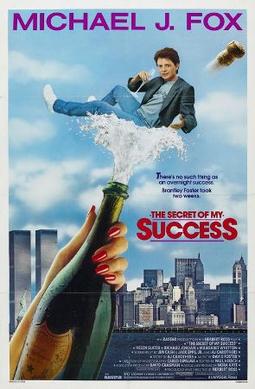
The Secret of My Success (1987, directed by Herbert Ross)


ȋ‚˜é

Brantley Foster (Michael J. Fox) heads to New York City with his business degree from the University of Kansas and the promise of an entry-level job as a financier.  He arrives to discover that the company that hired him no longer exists and that Brantley is out of a job.  New York is a harsh town for someone who is down on his luck and all of out of money.  Brantley eventually gets a job working in the mail room of a company owned by his wealthy uncle (Richard Jordan).  His uncle doesn’t even know who he is but soon, Brantley becomes just as rich and successful as he always dreamed.

What’s the secret of Brantley’s success?

Screwing his Aunt Vera (played by Margaret Whitton).

What’s the other other secret of his success?

Pretending to be named Carlton Whitfield and claiming that he’s a new executive at the corporation.

I remember when Kramer did the same thing on Seinfeld.  It didn’t work out for Kramer.  He got fired after turning in his first report.

“This is gibberish,” his boss said, “It’s almost as if you have no business training at all.  I’m afraid we have to let you go.”

“I don’t actually work here,” Kramer replied.

“That’s what makes this so hard.”

Seinfeld, never topped.

Back to The Secret of My Success, this is the most 80s film ever made, complete with montages of Brantley exploring New York and a saxophone playing on the soundtrack.  Brantley’s all about TCB, taking care of business.  He screws his aunt but falls in love with Christy Wills (Helen Slater).  Brantley doesn’t learn anything but he gets the best office and becomes a success without actually doing any real work.  It’s the ultimate fantasy and, like many fantasies, The Secret of My Success is superficially appealing.  Michael J. Fox is likable as Brantley.  Margaret Whitton is outrageously sexy as Vera.  Helen Slater is pretty and boring, traits that made her the ideal “good” girlfriend for Brantley’s story.

The Secret of My Success is your ticket to the 80s.

MY COUSIN VINNY (1992) – Joe Pesci heads way down south!


There are certain movies in my life that I consider “comfort movies.” These are the movies that I love so much that they always help me relax because I feel better just by watching them. I often turn on a comfort movie when I really need to fall asleep. Examples in my life include most of Charles Bronson’s filmography, RIO BRAVO, the ZATOICHI films, THE OTHER GUYS, and pretty much anything directed by Alex Kendrick. MY COUSIN VINNY fits comfortably under my categorization of a comfort movie.

The movie opens with friends Bill Gambini (Ralph Macchio) and Stanley Rothenstein (Mitchell Whitfield) taking the scenic route down south as part of a cross-country trip to attend college at UCLA. Unfortunately, while in Alabama, the two are arrested soon after leaving a convenience store. Thinking they are being charged for accidentally shoplifting a can of tuna, it turns out the actual charges are robbery and murder as the place was robbed and the clerk killed soon after they left. Knowing they are in big trouble, Bill calls his cousin Vinny Gambini (Joe Pesci), who’s pretty much the only lawyer that he knows. The problem, Vinny has never actually tried a murder case. Vinny heads down south with his fiance Mona Lisa Vito (Marisa Tomei) where he must contend with a judge (Fred Gwynne) who doesn’t like him, a prosecutor (Lane Smith) who has way more experience than him, and a mountain of circumstantial evidence that he has almost no hope of contradicting. Will Vinny be able to prove his cousin’s innocence before they end up with life in prison, or even worse?

There are many reasons that I love MY COUSIN VINNY. The cast consists of a couple of my personal favorite actors in Joe Pesci and Ralph Macchio. GOODFELLAS is certainly one of the best movies ever made, and Joe Pesci gives an unbelievably powerful performance, a performance that would win him the Academy Award. Pesci took a short break from filming MY COUSIN VINNY to attend the Acadamy Award ceremony and pick up the gold. He even took the statue to the set to show the cast and crew. Maybe that helped inspire Marisa Tomei to give her own Academy Award winning performance in this film. My favorite scene of the entire movie is when Vinny is treating Mona Lisa as a hostile witness on the stand, just before she proceeds to prove that nobody knows more about cars than she does. It’s such a satisfying scene as she makes the prosecutor’s “expert” look like a novice. As for Ralph Macchio, many times in my life I’ve made the statement that I wanted to be the karate kid when I was growing up. I think I was in the fifth grade when I saw the film for the very first time. I’ve been a fan of Ralph Macchio, and in love with Elisabeth Shue, ever since. It’s the kind of movie I’d just sit around thinking about when I was a kid. I even wanted to learn karate, but being just a little over 4 feet tall at the time, I didn’t need to be getting into any fights. I also like that MY COUSIN VINNY was partially filmed in the town of Covington, GA. My wife and I were driving from Arkansas to Myrtle Beach back in 2020 and we stayed the night in Covington. I had done a little research while I was looking for a place to stop for the night, and I found out that Covington is sometimes referred to the “Hollywood of the South” due to the large number of movies and TV shows that are filmed there. We snapped a couple of shots of the downtown before heading on down the road. But I think the thing I love most about MY COUSIN VINNY is also the reason I love movies like THE KARATE KID and ROCKY so much. I love movies where a person is completely underestimated, and rightfully so. But then, through some combination of intelligence, hard work, heart, and will, that same person is able to rise to the occasion and prevail against those very same people who underestimated them. Vinny has no business in the courtroom, but somehow, he’s able to win the case, and he does it in a smart, funny and exciting way. I love an underdog, and MY COUSIN VINNY just makes me feel good!  

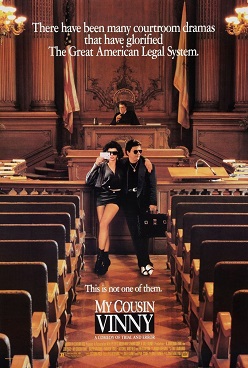
Film Review: My Cousin Vinny (dir by Jonathan Lynn)


In the 1992 film, My Cousin Vinny, two college students from New York City, Bill Gambini (Ralph Macchio) and Stan Rothstein (Mitchell Whitfield), make the mistake of driving through Alabama.  The two students stop off at a convenience store.  When the clerk is subsequently shot dead during a robbery, Bill and Stan are arrested for the crime.  The viewers know they’re innocent.  Bill and Stan know they’re innocent.  But the entire state of Alabama seems to be determined to send Bill and Stan to prison for life.

Fortunately, Bill’s cousin, Vinny (Joe Pesci, star of Half Nelson), is a lawyer.  Unfortunately, he just recently passed the bar exam and he has yet to actually try a case.  Still, Vinny and his fiancée, Mona Lisa Vito (Marisa Tomei), come down to Alabama.  Vinny takes the case, lying to the judge (Fred Gwynne) about his qualification as a trial attorney.  Vinny is momentarily impressed when the prosecutor (Lane Smith) shares with him all of the files about the case.  “It’s called disclosure, dickhead!” Lisa snaps at him, revealing that she actually has more common sense than Vinny.  That becomes increasingly important as Vinny tries to keep Bill and Stan from spending the rest of their lives in prison.

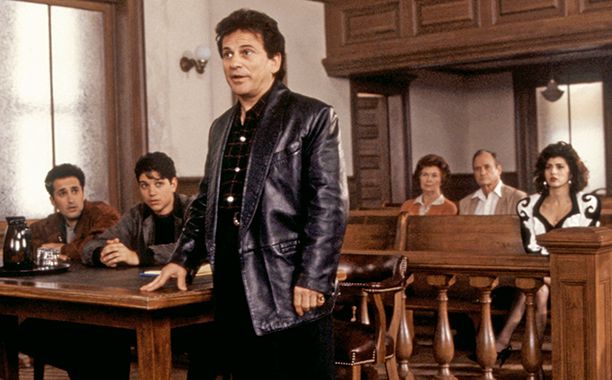
To be honest, considering how much I complain about stereotypical portrayals of the South, I really shouldn’t like My Cousin Vinny as much as I do.  Almost every character in the film is a stereotype to some extent or another, from the farmers and rednecks who take the witness stand to Fred Gwynne’s no-nonsense judge who rules that Vinny is in contempt of court because he’s wearing a leather jacket.  Fortunately, though, the Southern stereotypes don’t bother me because both Vinny and Lisa are New York stereotypes.  Just as the judge and the townspeople seem to confirm every prejudice that someone like Vinny would have against the South, Vinny seems to be the epitome of everything that people in the South dislike about the North.  When Vinny first shows up on the scene, he’s loud and brash and obnoxious.  But, as the film progresses, Vinny reveals himself to not only be a better attorney than anyone was expecting but he also calms down and adjusts to the more relaxed pace of life in the country.  Just as Vinny reveals himself to be not as bad as everyone originally assumed, both the Judge and the prosecutor are also allowed to reveal some hidden depths.  Neither one is the cardboard authority figure that viewers might expect.  The Judge does sincerely want justice to be done and the prosecutor sincerely wants to keep the county safe, even if he is prosecuting two innocent men.  Just as Vinny learns not to be too quick to judge them, they learn not to be too quick to judge Vinny.  The end message is that everyone is innocent until proven guilty and deserves a fair hearing, whether in a court of law or just in the courts of public and private opinion.  It’s not a bad message.  In fact, it’s one that more than a few people could still stand to learn today.

Of course, the best thing about the film is Marisa Tomei, who not brings a lot of energy to the film but whose hair is amazing and whose clothes are to die for.  Tomei won an Oscar for her performance in My Cousin Vinny, a victory that was so controversial that there were unfounded rumors that presenter Jack Palance had read the wrong name by mistake.  (As we all learned a few years ago when Warren Beatty and Faye Dunaway actually did read the wrong winner, the accountants aren’t going to let anyone get away with that.)  Watching the film last night, it was obvious to me that Tomei deserved that Oscar because Lisa is the heart of the film.  Pesci, Gwynne, and Lane Smith are all give good performances but, without Marisa Tomei’s performance, My Cousin Vinny would ultimately just be another culture clash comedy.  A lesser actress would have just played Lisa as being a stereotype.  But Tomei turned Lisa into the most believable and sincere character in the film.  While Lisa won the case, Tomei saved the movie.

(And needless to say, I’m a fan of any movie that features a Lisa saving the day.)

My Cousin Vinny holds up as an enjoyable film.  Watch it the next time you’re losing faith in humanity.

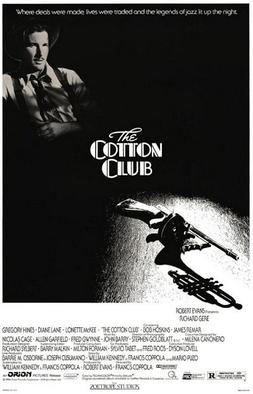
A Movie A Day #264: The Cotton Club (1984, directed by Francis Ford Coppola)


The time is the 1930s and the place is New York City.  Everyone wants to get into the Cotton Club.  Owned by British gangster Owney Madden (Bob Hoskins), the Cotton Club is a place where the stage is exclusively reserved for black performers and the audience is exclusively rich and white.  Everyone from gangsters to film stars comes to the Cotton Club.
It is at the Cotton Club that Dixie Dwyer (Richard Gere) meets everyone from Dutch Shultz (James Remar) to Gloria Swanson (Diane Venora).  Shultz hires Dixie to look after his girlfriend, Vera (Diane Lane).  Swanson arranges for Dixie to become a movie star.  Meanwhile, Dixie’s crazy brother, Vincent (Nicolas Cage), rises up through the New York underworld.  Meanwhile, dancing brothers Sandman and Clay Williams (played by real-life brothers Gregory and Maurice Hines) are stars on stage but face discrimination off, at least until Harlem gangster Bumpy Rhodes (Laurence Fishburne) comes to their aid.

The Cotton Club was a dream project of the legendary producer, Robert Evans, who was looking to make a comeback after being famously charged with cocaine trafficking in 1980.  Having commissioned a screenplay by his former Godfather collaborators, Mario Puzo and Francis Ford Coppola, Evans originally planned to direct the film himself.  At the last minute, Evans changes his mind and asked Coppola to direct the film.  After working with him on The Godfather, Coppola had sworn that he would never work with Evans again. (When he won an Oscar for The Godfather‘s screenplay, Coppola pointedly thanked everyone but Robert Evans.)  However, by 1984, a series of box office flops had damaged Coppola’s standing in Hollywood.  Needing the money, Coppola agreed to direct The Cotton Club.

Evans raised the film’s $58 million budget from a number of investors, including Roy Radin.  Roy Radin was best known for putting together Vaudeville reunions in the 70s and being accused of raping an actress in 1980.  Radin and Evans were introduced to each other by a drug dealer named Lanie Jacobs, who was hoping to remake herself as a film producer.  During the production of The Cotton Club, Radin was murdered by a contract killer who was hired by Jacobs, who apparently felt that Radin was trying to muscle her out of the film production.

While all of this was going on, Coppola fell into his familiar pattern of going overbudget and falling behind schedule.  This led to another investor filing a lawsuit against Orion Pictures and two other investors, claiming fraud and breach of contract.  When the film was finally released, it received mixed reviews, struggled at the box office, and only received two Oscar nominations.

With all of the murder and drama that was occurring offscreen, it is not surprising that the film itself was overshadowed.  The Cotton Club is a disjointed mix of gangster drama and big production numbers.  As always with post-Apocalypse Now Coppola, there are flashes of brilliance in The Cotton Club.  Some of the production numbers are impressive and visually, this movie has got style to burn.   However, among the leads, neither Richard Gere nor Diane Lane seem to be invested in their characters while the talented Hines brothers are underused.  The supporting cast is full of good character actors who are all in a search of a better script.  A few do manage to make an impression: James Remar, Bob Hoskins and Fred Gwynne as veteran gangsters, Nicolas Cage as the film’s stand-in for Mad Dog Coll, and Joe Dallesandro as Lucky Luciano.  The Cotton Club is sometimes boring and sometimes exciting but the onscreen story is never as interesting as what happened behind the scenes.


Lisa Marie Reviews An Oscar Winner For Labor Day: On The Waterfront (dir by Elia Kazan)


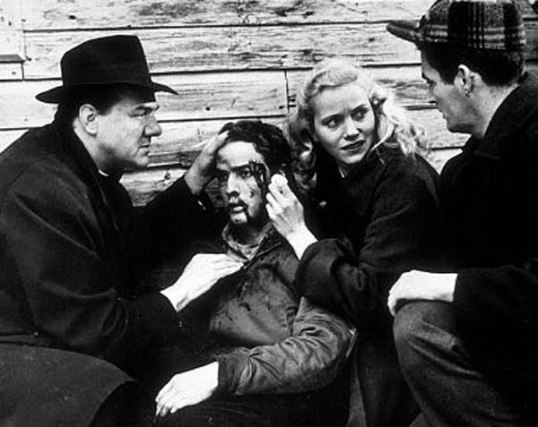
On-the-Waterfront

I like On The Waterfront.

Nowadays, that can be a dangerous thing to admit.  On The Waterfront won the Oscar for Best Picture of 1954 and Marlon Brando’s lead performance as boxer-turned-dockworker Terry Malloy is still regularly cited as one of the best of all time.  The scene where he tells his brother (played by Rod Steiger) that he “could have been a contender” is so iconic that other films still continue to either parody or pay homage to it.  On The Waterfront is one of those films that regularly shows up on TCM and on lists of the greatest films ever made.

And yet, despite all that, it’s become fashionable to criticize On The Waterfront or to cite it as an unworthy Oscar winner.  Certain film bloggers wear their disdain for On The Waterfront like a badge of honor.  Ask them and they’ll spend hours telling you exactly why they dislike On The Waterfront and, not surprisingly, it all gets tedious pretty quickly.

Like all tedious things, the answer ultimately comes down to politics.  In the early 50s, as the House UnAmerican Affairs Committee conducted its search for communists in Hollywood, hundreds of actors, writers, and directors were called before the committee.  They were asked if they were currently or ever had been a member of the Communist Party.  It was demanded that they name names.  Refusing to take part was career suicide and yet, many witnesses did just that.  They refused to testify, apologize, or name names.

And then there was the case of Elia Kazan.  When he was called in front of HUAC, he not only testified about his communist past but he named names as well.  Many of his past associates felt that Kazan had betrayed them in order to protect his own career.  On The Waterfront was Kazan’s answer to his critics.

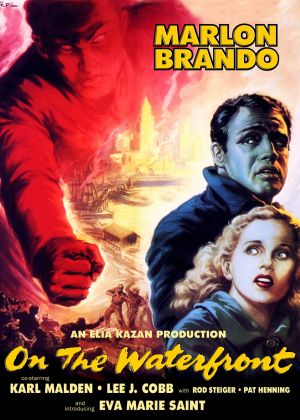
In On The Waterfront, Terry Malloy’s dilemma is whether or not to voluntarily testify before a commission that is investigating union corruption on the waterfront.  Encouraging him to testify is the crusading priest, Father Barry (Karl Malden), and Edie (Eva Marie Saint), the saintly girl who Terry loves.  Discouraging Terry from testifying is literally every one else on the waterfront, including Terry’s brother, Charlie (Rod Steiger).  Charlie is the right-hand man of gangster Johnny Friendly (a crudely intimidating Lee J. Cobb), who is the same man who earlier ordered Terry to throw a big fight.

At first, Terry is content to follow the waterfront of code of playing “D and D” (deaf and dumb) when it comes to union corruption.  However, when Johnny uses Terry to lure Edie’s brother into an ambush, Terry is forced to reconsider his previous apathy.  As Terry gets closer and closer to deciding to testify, Johnny order Charlie to kill his brother…

The issue that many contemporary critics have with On The Waterfront is that they view it as being essentially a “pro-snitch” film.  It’s easy to see that Elia Kazan viewed himself as being the damaged but noble Terry Malloy while Johnny Friendly was meant to be a stand-in for Hollywood communism.  They see the film as being both anti-union and Kazan’s attempt to defend naming names.

And maybe they’re right.

But, ultimately, that doesn’t make the film any less effective.  Judging On The Waterfront solely by its backstory ignores just how well-made, well-acted, well-photographed, well-directed, and well-written this film truly is.  Elia Kazan may (or may not) have been a lousy human being but, watching this film, you can’t deny his skill as a director.  There’s a thrilling grittiness to the film’s style that allows it to feel authentic even when it’s being totally heavy-handed.

And the performances hold up amazingly well.  Marlon Brando’s performance as Terry Malloy gets so much attention that it’s easy to forget that the entire cast is just as great.  Rod Steiger makes Charlie’s regret and guilt poignantly real.  Karl Malden, who gets stuck with the film’s more pedantic dialogue, is the perfect crusader.  Eva Marie Saint is beautiful and saintly.  And then you’ve got Lee J. Cobb, playing one of the great screen villains.

The motives behind On The Waterfront may not be the best.  But, occasionally, a great film does emerge from less than pure motives.  (Just as often, truly good intentions lead to truly bad cinema.)  Regardless of what one thinks of Elia Kazan, On The Waterfront is a great work of cinema and it’s on that basis that it should be judged.

On_the_Waterfront_poster

Embracing the Melodrama #36: Fatal Attraction (dir by Adrian Lyne)


fatal-attraction

(This review has spoilers because I felt like it and I’ll do whatever the Hell I want.)

Today, we continue embracing the melodrama by taking a look at the 1987 best picture nominee, Fatal Attraction.

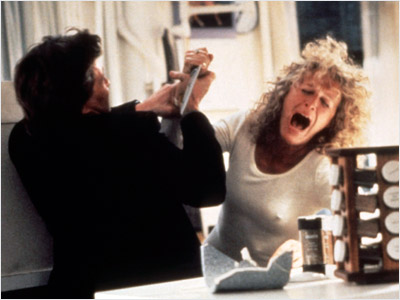
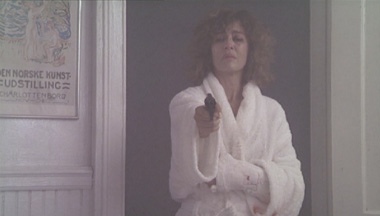
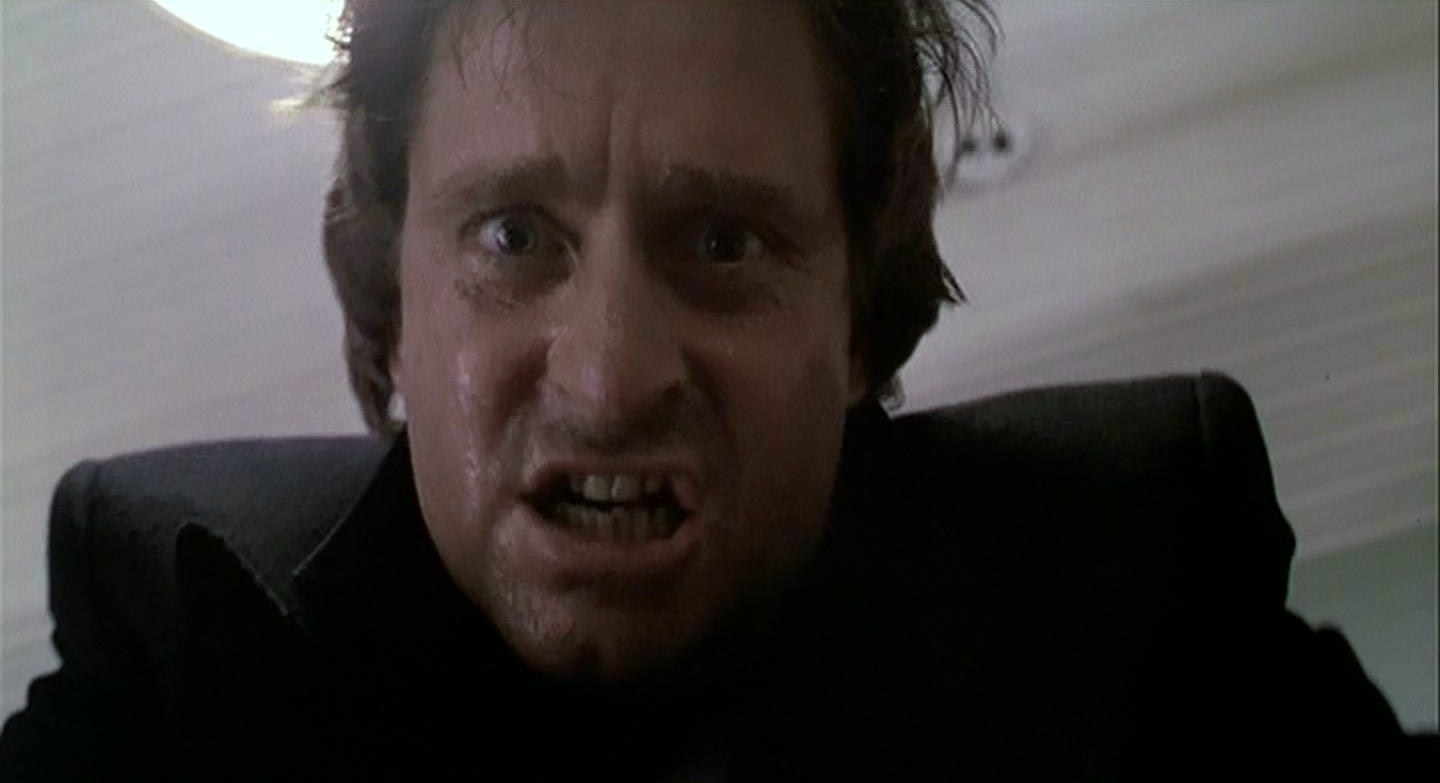
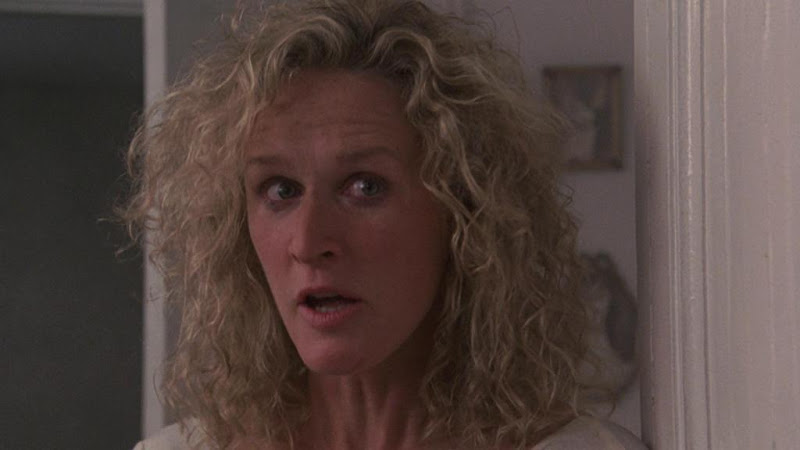
Fatal Attraction opens on a scene of domestic bliss, with lawyer Dan Gallagher (Michael Douglas) and his wife Beth (Anne Archer) in their luxurious Manhattan apartment, getting ready to go out for the night and waiting for the babysitter to arrive.  Dan would appear to have it all: a successful career, a fat best friend, and a beautiful wife.  However, when Beth and their daughter go out of town for the weekend, Dan ends up having an affair with Alex (Glenn Close).  Dan assumes that it was just a weekend thing but Alex is soon stalking Dan.  Trying to escape her, Dan moves his family out to the suburbs but Alex follows them.  Soon, pet rabbits are being killed, Alex is breaking into the house with a knife, and it’s up to Beth to step up and reclaim her man.

I have to admit that I have mixed feelings about Fatal Attraction.  On the one hand, it’s an undeniably well-made film.  It’s well-acted and director Adrian Lyne pushes all of the right emotional buttons and keeps the action moving quickly.  That the film is predictable doesn’t make it any the less effective.  As a lover of horror movies, I appreciated the skill with which Lyne crafted the film’s scare scenes.  Watching the movie, it was easy to see why Fatal Attraction was a huge box office success and why it continues to influence our culture to this very day.

fa05

And yet, at the same time, Fatal Attraction really annoys me.

The film is so well-made and so manipulative that it’s easy to miss the fact that Dan Gallagher is not only never punished for betraying his wife but he’s actually not held responsible for his actions in any way.  Instead, the only person who is truly punished for their transgression is Alex.  The film, after all, makes clear that Alex is the one pursuing Dan.  In fact, it could be argued that when it comes to Dan and Alex, the traditional gender roles have been reversed.  Alex (who, as opposed to the idealized Beth, has a name that is both masculine and feminine) is the aggressive one while Dan is the passive one who gives into temptation and, afterwards, feels guilty.  After admitting his transgression, Dan is allowed to reclaim his manhood and continue on with his perfect life.  However, Alex has no place in conventional society and therefore, she must be destroyed.

And so much the better if she’s destroyed by Beth, a woman who has no problem with accepting a traditionally domestic role.

Far too often, in the past, I know that my girl friends and I always assumed that men were simply incapable of resisting temptation.  Therefore, if your boyfriend cheated on you, it really was not his fault.  He was just being a guy.  Instead, it was the other woman’s fault because she was the one who tempted him.  (And, though we acknowledged this a lot less, it was also his girlfriend’s fault for allowing him to get into a position where he could be tempted in the first place.)  But it was never truly guy’s fault and, as long as you made him suffer for a bit, it was always expected that you would forgive him and take him back.

ff562f_50a74289f9f696cf59a7125eec69b111

That’s the same mentality that runs through Fatal Attraction (not to mention countless daytime talk shows where girlfriends and wives always beat up mistresses while their boyfriend or husband stands over to the side and watches, untouched).  Yes, Dan did cheat on his perfect wife and yes, he feels terrible about it.  But the real threat comes from the woman who pursued him despite knowing that he was married and then, afterwards, had the nerve to demand not to be ignored.  (If anything, the film seems to be suggesting that everything would have been okay if Dan had just fucked someone who works in his office, as opposed to someone who he can’t control through money or the threat of societal shaming.)  When, at the end of the film, Beth shoots Alex, it’s a crowd-pleasing moment but it’s also Beth’s way of reclaiming her man.  Since Dan — being male — can’t be expected to exercise any sort of self-control, it’s the responsibility of Beth to step up and destroy the temptation.

For not respecting the vows of marriage, Alex is a monster who must be destroyed.  Dan, on the other hand, is merely inconvenienced and ultimately, he ends up with a far stronger marriage as a result of having strayed.

In Fatal Attraction, the only thing more dangerous than sex with Alex is examining subtext.

Fatal Attraction-22