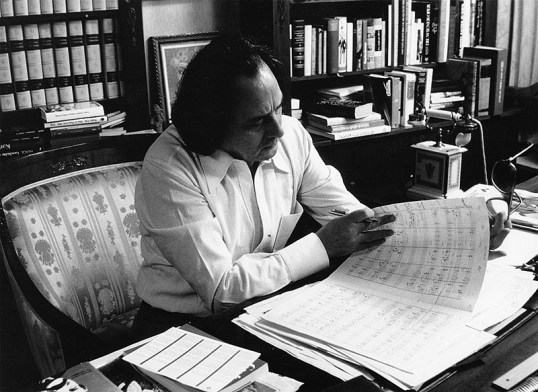
The latest “Song of the Day” is dedicated to a great film composer who passed away today. Riz Ortolani is well-known in the virtual and brick-and-mortar halls of Through the Shattered Lens. In fact, I would say that his work would be a perfect soundtrack for the site if it ever decided to have one.
Ortolani was born in March 25, 1926. Music seemed to be in his blood as his musical career first began as part of an Italian jazz band before he eventually move to composing scores for Italian films. While many grindhouse and exploitation film fans got to know Ortolani through his work on Ruggero Deodato’s famous (infamous in some circles) cannibal exploitation film Cannibal Holocaust ( especially for it’s serene-like opening theme) his film scores ranged through several genres from mondo films, spaghetti westerns, eurospy flicks and Italian giallos.
For someone in elite circles would considered as beneath their notice for doing work in the so-called video nasty genre, ORtoani’s work has been hailed as genius and one of his compositions even won him an Academy Award in 1964. It’s this award-winning song that I’ve chosen to focus on.
“More” from the shockumentary Mondo Cane won Ortolani an Oscar in 1964 and even had an admirer in the Chairman of the Board himself that he would cover the song the very same year.
With each passing year the film and entertainment community loses one more of the earlier generation who were instrumental in making many at this site in falling in love with film and music. Time to appreciate what they’ve contributed to film and music and remind ourselves that sometimes just because something is old and dated doesn’t mean it’s still not better than something newer and more advanced.
R.I.P. Riz Ortolani and thanks for the music and memories.
Even the Ol’ Blue Eyes covered the song…
More (Theme From Mondo Cane)
More than the greatest love the world has known, This is the love I give to you alone, More than the simple words I try to say, I only live to love you more each day. More than you’ll ever know, my arms long to hold you so, My life will be in your keeping, waking, sleeping, laughing, weeping, Longer than always is a long long time, but far beyond forever you’re gonna be mine. I know I’ve never lived before and my heart is very sure, No one else could love you more.
[musical interlude]
More than you’ll ever know , my arms they long to hold you so, My life will be in your keeping, waking, sleeping, laughing, weeping, Longer than always is a long long time, but far beyond forever you’ll be mine, I know that I’ve never lived before and my heart is very sure, No one else could love you more, no one else could love you more.
With only five entries left in the 44 Days of Paranoia, now seems like the perfect time to look at one of the best conspiracy films ever made. First released in 1962, this film is not only one of the most influential thrillers ever made but it’s also a fiercely sardonic political satire that remains just as relevant today as when it was first released. It was also remade in 2004 and, while we’ll get to the remake, today we’re focusing on the original.
I’m speaking, of course, of the John Frankenheimer-directed classic, The Manchurian Candidate.
The Manchurian Candidate tells the story of Raymond Shaw (Laurence Harvey). The son of the wealthy and ambitious Eleanor (Angela Lansbury) and the stepson of the moronic Senator Johnny Iselin (James Gregory), Raymond is also a decorated war hero who has been credited with saving an entire platoon during the Korean War. When asked about Shaw, all of the members of the platoon respond with: “”Raymond Shaw is the kindest, bravest, warmest, most wonderful human being I’ve ever known in my life.”
Of course, that’s not true. It only takes a few minutes of screen time for the audience to realize that Raymond Shaw is none of those things. Instead, he’s a rather depressed loner who is full of resentment towards his mother and his stepfather. Shaw is so socially awkward that even he is shocked when he manages to successfully tell a joke. (“I just told a joke, didn’t I?” Shaw says in amazement.)
While Shaw pursues a career as a journalist, the fellow members of his platoon — including Maj. Marco (Frank Sinatra) — start to have disturbing nightmares, in which they find themselves observing a genteel garden show, during which Raymond is ordered to strangle one soldier and shoot another one in the head. Marco comes to suspect that the platoon may have been captured and brainwashed with communists. With the backing of Army Intelligence, Marco starts to investigate.
Meanwhile, Sen. Iselin has come to national prominence by claiming to have information about a communist conspiracy deep within the U.S. government. As becomes obvious in some of the film’s best scenes, Iselin is less concerned with fighting communists and more focused on keeping Raymond’s mother happy. Eleanor has decided that her husband is going to be the next President and her brainwashed son is going to help make it happen.
I think sometimes we tend to assume that, up until 1967, all movies were safe and predictable. The Manchurian Candidate, however, proves that is simply not true. In fact, with its cynical view of politics and its cast of fragile and damaged characters, The Manchurian Candidate is one of the most subversive films ever made. Rejecting the boring partisanship that typifies most politically themed films, The Manchurian Candidate presents us with a world where both the left and the right are equally corrupt and ultimately equally meaningless. It’s a political satire that transcends ideology and that’s certainly something of which America could use more.
It’s also an amazingly entertaining film. George Axelrod’s screenplay is full of wonderfully snarky moments while John Frankenheimer’s directs with an appreciation for both absurdity and melodrama. Angela Lansbury is both hilarious and chilling as one of the worst maternal figures to ever appear in the movies and she more than deserved the Oscar nomination that she received for this film. However, the entire film is brilliantly acted. Laurence Harvey is both sympathetic and off-putting as Raymond while Frank Sinatra (who previously appeared in another entry of the 44 Days of Paranoia, Suddenly) brings a wonderful blue-collar humanity to the role of Marco. Janet Leigh has a small role as Marco’s lover and the scene where they first meet on a train and have a charmingly nonsensical conversation is wonderfully odd and romantic. Finally, James Gregory gives a hilarious performance as the type of stupid but bombastic politician who will be familiar to anyone who has ever watched C-Span.
If you’ve never seen the original Manchurian Candidate, drop everything you’re doing and go watch it now.
We are halfway through the 44 Days of Paranoia! In order to mark this special occasion, I’d like to feature one of the first true American conspiracy films, the 1954 film noirSuddenly.
Suddenly takes place in the small town of Suddenly, California. (If only the town had been named Tranquility, so much trouble could have been avoided.) On the day that President of the United States is scheduled to visit the town, a group of gangsters led by John Baron (Frank Sinatra) takes over the house of the Benson family. It turns out that the Benson House overlooks the train station where the President will be arriving and Baron is planning on assassinated the President as soon as he steps off the train. Baron sets up his rifle in the family dining room and, while he waits for his target to arrive, he also has to deal with a steadily growing number of hostages who do not want the President to be assassinated in Suddenly.
Clocking in at just 70 minutes and basically taking place on only one set, Suddenly is a grimly suspenseful film that is all the more effective because it deliberately keeps Baron’s motives obscure. We know that someone has hired Baron to kill the President but we’re never quite sure who. In the role of John Baron, Frank Sinatra gives one of his best performances and invests the character with subtle menace.
Frighteningly, Suddenly has apparently recently been remade by Uwe Boll. That’s the type of news that will make any lover of classic film go, “Agck!” However, the original Suddenly has entered into the public domain so, if you have 70 minutes to spare, please feel free to watch it below.
Summer is still months away. Hell, Spring still won’t arrive for another five or so days, but I’m on a Frank Sinatra kick tonight and what better choice for the latest “Song of the Day” than one of Ol’ Blue Eyes’ seasonal songs.
“Summer Wind” remains one of the classic Sinatra tunes and also one of my favorite songs of his. I think most of his songs are favorites of mine which just goes to show just how much of an icon he has become. Growing up with a father who was a Sinatra fan through and through it didn’t surprise many that I would also end up becoming a fan of the Chairman of the Board.
This particular song wasn’t even originally sung by Sinatra. Wayne Newton had made the song a No. 1 hit single a full year before Sinatra, but it’s once Sinatra had gotten a hold of the song and made it his own that people will forever remember “Summer Wind” as Sinatra and Sinatra-only. The Newton version is not bad and very good as well.
Now, time to pour me a glass of absinthe and mellow out to the coming of the summer wind even if it’s still three months away…
Summer Wind
The summer wind came blowin’ in From across the sea It lingered there to touch your hair And walk with me
All summer long we sang a song And then we strolled that golden sand Two sweethearts and the summer wind
Like painted kites, those days and nights They went flying by The world was new beneath the blue Umbrella sky
Then softer than a piper man One day, it called to you I lost you I lost you to The summer wind
The autumn wind And the winter winds They have come and gone And still those days Those lonely days They go on and on And guess who’s sighs His lullabies through nights that never end My fickled friend, The summer wind The summer wind warm summer wind Mmm the summer wind
I stayed up way too late last night but it was totally worth it because I was watching a film from 1966, The Oscar.
Among those of us who love bad and campy movies from the 50s and 60s, The Oscar is a legendary film. It has a reputation for being one of best so bad-its-good-films ever made. The Oscar is a film that I’ve read about in several books but, until last night, I had never gotten a chance to actually see it. When I saw that the film was going to be on last night, I said “Sleep be damned!” and I stayed up and watched. What other choice did I have?
The Oscar takes place in a world where women are “dames” and men are “fellas” and everyone acts as if they’re a character in a Rat Pack-themed fanfic. One look at Frankie Fane (played by Stephen Boyd) and you know he’s the type of guy who snaps his fingers when he walks and probably uses pig Latin when he flirts. He’s one cool cat and as the film begins, he’s been nominated for an Academy Award for Best Actor.
The film begins at the Oscars. Frankie sits out in the audience, surrounded by Hollywood royalty and nervously waiting for the envelope to be opened. The camera pans over to Frankie’s personal manager, Hymie Kelley. Hymie stares bitterly at his former friend and suddenly, we hear his thoughts and do they ever let us know what type of movie we’re about to see.
As Hymie himself puts it:
“You finally made it, Frankie! Oscar night! And here you sit, on top of a glass mountain called “success.” You’re one of the chosen five, and the whole town’s holding its breath to see who won it. It’s been quite a climb, hasn’t it, Frankie? Down at the bottom, scuffling for dimes in those smokers, all the way to the top. Magic Hollywood! Ever think about it? I do, friend Frankie, I do…”
Hymie, incidentally, is played by the singer Tony Bennett. This was Bennett’s first dramatic film role and it was also his last. Whatever talent or magnetism Bennett may have had as a singer, it didn’t translate into screen presence. Bennett goes through the entire film looking embarrassed but who can blame him when the script calls for him to constantly tell Frankie that, “You lie down with pigs, you stand up smelling like garbage…”
As we discover through the use of flashback, Frankie has had to lay down with a lot of pigs to get his chance at winning an Oscar. After starting out his career working at sleazy clubs, Frankie, Hymie, and Frankie’s stripper girlfriend (Jill St. John) find themselves in New York. Frankie dumps his girlfriend (unaware that she’s pregnant with his child) after he meets artist Elke Sommer at a “swinging party.”
“Are you a tourist or a native?” Frankie asks her.
“Take one from column A and one from column B. You get an egg roll either way,” Sommer replies.
No wonder Frankie tells her, “You make my head hurt with all that poetry.”
Eventually, Frankie is discovered by a talent agent who takes him to see studio mogul Joseph Cotten (who went from Citizen Kane, The Magnificent Ambersons, and Third Man to this). Cotten is so impressed with Frankie that he says, “Once in a while, you bring me meat like this. It all has different names: prime rib of Gloria, shoulder cut of Johnny. MEAT!”
With the help of savvy talent agent Milton Berle, Frankie becomes a film star but he’s still a total heel who cheats on Sommer and takes advantage of Hymie’s loyalty. When Frankie gets nominated for an Oscar, he hires a sleazy private investigator (Ernest Borgnine, of course) to leak a story about Frankie’s criminal past. Frankie assumes that one of his fellow nominees will be blamed for the leak and that he’ll be able to ride a wave of sympathy to victory.
And who are Frankie’s fellow nominees? We only learn the identity of three of them – Frank Sinatra, Richard Burton, and Burt Lancaster. We never find out what movie Sinatra was nominated for but we’re told that Burton was nominated for The Grapes of Winter (which, I’m going to assume, was a film version of a Shakespeare play about Tom Joad) while Lancaster was nominated for his amazing performance in The Spanish Armada. Doesn’t that sound like an amazing film?
Oh, how to describe the delirious experience of watching The Oscar? In many ways, it is a truly terrible movie but it’s fun in the way that only a “racy” film from the mid-60s can be. Nobody plays his or her role with anything resembling subtleness. Instead, everyone spends the entire film yelling, screaming, and gritting their teeth while flaring their nostrils. Everyone, that is, except for Tony Bennett who gives a performance that has a definite community theater feel to it. Even better is the dialogue. People in this film don’t just say their lines – they exclaim them. If you’ve ever wanted to spend two hours in a world where every sentence ends with an exclamation point, watch The Oscar.
For a film that was apparently meant to be something of a love letter to the Academy, The Oscar was only nominated for two Oscars. It received nominations for Best Art Design and Best Costume Design. While I had a hard time seeing what was so impressive about the film’s art design (in the world of The Oscar, Hollywood has a definite Ikea feel to it), the costumes were fairly impressive in a tacky, 1966 type of way.
Finally, I think it’s time that somebody remake The Oscar. David Fincher can direct it, Aaron Sorkin can write the script, Jessie Eisenberg can play Frankie Fane, and Justin Timberlake would make for an adorable Hymie Kelley. For the supporting roles, I think Billy Crystal would be a natural for Milton Berle’s role and perhaps Philip Baker Hall could step into the shoes of Joseph Cotten. Perhaps veteran film blogger and self-described very important person Sasha Stone could make her film debut in Ernest Borgnine’s role.
If there ever was a song one should live their life by it would be this song. A song written by singer-songwriter Paul Anka whose melody was based off of the French song “Comme d’habitude” by French musicians Claude François and Jacques Revaux, but in the end popularized by the Chairman of the Board himself, Frank Sinatra. I speak of the classic song, “My Way” and it’s my pick for the latest song of the day.
The song was released in 1969 from Sinatra’s album of the same name. It became Sinatra’s signature song and has become a staple of karaoke bars everywhere and the one song guys are more than willing to belt out sober or not (though the more alcohol consumed the louder and more forceful the singing which always adds to the effect). The lyrics and theme of the song speak about a man (or one can also say woman as well) looking back at his life at the tail end of his days and liking what he’s seen and how he’s lived.
It’s a song so beloved by many music lovers that it’s been covered by so many musicians from so many differing musical backgrounds. From Elvis Presley, Nina Simone and Nina Hagen and even punk and symphonic metal versions by Sid Vicious and Northern Kings, respectively. There’s nothing about this song that doesn’t speak to a man about how one should conduct themselves through their life. And this is perfectly pointed out by this particular lyric in the song which also happens to be my favorite: “Regrets, I’ve had a few; But then again, too few to mention.”
So, this very early October morning of 2010, the latest song of the day also happens to be my favorite song ever. Long live Ol’ Blue Eyes.
My Way
And now, the end is near;
And so I face the final curtain.
My friend, I’ll say it clear,
I’ll state my case, of which I’m certain.
I’ve lived a life that’s full.
I’ve traveled each and ev’ry highway;
And more, much more than this,
I did it my way.
Regrets, I’ve had a few;
But then again, too few to mention.
I did what I had to do
And saw it through without exemption.
I planned each charted course;
Each careful step along the byway,
But more, much more than this,
I did it my way.
Yes, there were times, I’m sure you knew
When I bit off more than I could chew.
But through it all, when there was doubt,
I ate it up and spit it out.
I faced it all and I stood tall;
And did it my way.
I’ve loved, I’ve laughed and cried.
I’ve had my fill; my share of losing.
And now, as tears subside,
I find it all so amusing.
To think I did all that;
And may I say – not in a shy way,
“Oh no, oh no not me,
I did it my way”.
For what is a man, what has he got?
If not himself, then he has naught.
To say the things he truly feels;
And not the words of one who kneels.
The record shows I took the blows –
And did it my way!


 Through the Shattered Lens