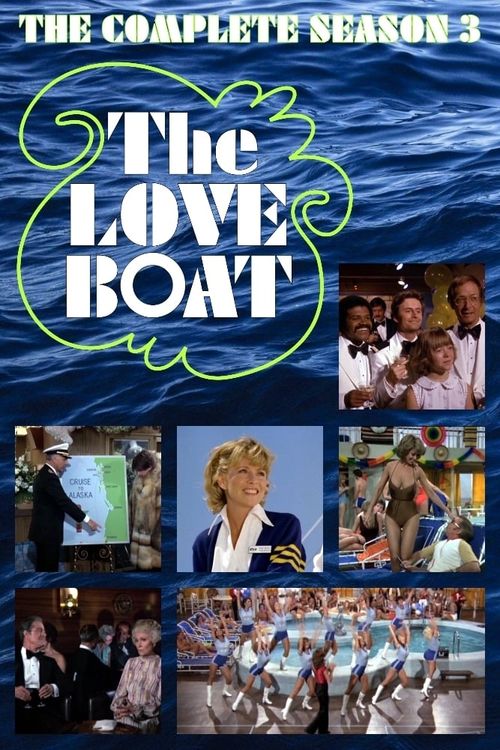
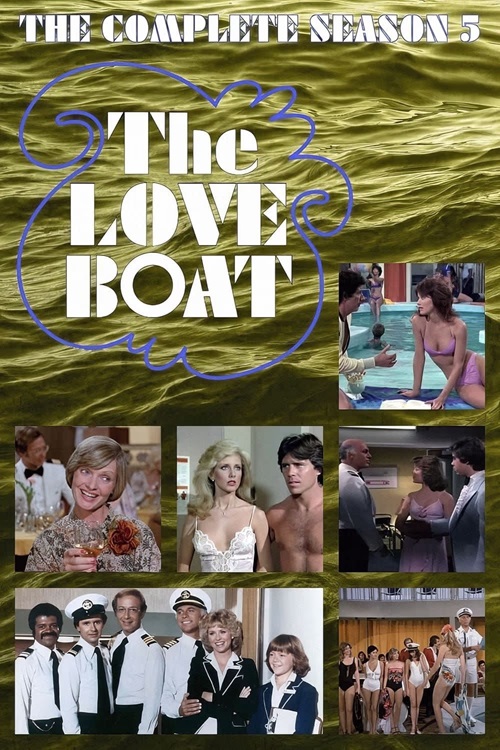
Retro Television Review: The Love Boat 5.28 “A Dress To Remember”


Welcome to Retro Television Reviews, a feature where we review some of our favorite and least favorite shows of the past!  On Wednesdays, I will be reviewing the original Love Boat, which aired on ABC from 1977 to 1986!  The series can be streamed on Paramount Plus!
It’s time set sail for adventure!

Episode 5.28 “A Dress To Remember”

(Dir by Robert Scheerer, originally aired on May 8th, 1982)

This week’s episode features three stories and one dress.

The dress, a lovely blue gown, is brought on board by diet doctor Dr. Alfred Farney (Kelly Monteith), who claims that his “muskmullet” diet will lead to Donna Baker (Markie Post) losing 10 pound by the end of the cruise.  The proof will be that Donna will be able to fit into the dress.  Alfred’s former partner-turned-rival Dr. Tucker Martin (Lyle Waggoner) is also on the ship and his plan is to tempt Donna into eating so much that she’ll instead gain 11 pounds and the dress will rip.  Boooo!  Shame on both of those doctors!  Seriously, Donna looks miserable for the entire cruise.  That said, despite the efforts of Dr. Martin, Donna still loses the weight …. in fact, she loses even more than 10 pounds.  She loses 11!  Doctors Farney and Martin agree to partner up again and Donna, who looks like she’s about to faint, suggests that they celebrate over pizza.  The doctors make some money and Donna gets an eating disorder but at least the dress looks good.

That dress goes through a lot over the course of one episode.  For some reason, Gopher and Isaac have been tasked with keeping it safe.  Why would you trust those two with something important?  Actually, Isaac is usually pretty smart and Gopher’s actually been behaving a bit more like a professional than usual this season so I guess they were just having an off-cruise.

Norman Lomax (Bob Denver) wears the dress (and a wig) to keep his ex-father-in-law, Tom (Forrest Tucker), from recognizing him.  Tom must be an idiot because Bob Denver in a wig and dress still looks and sounds like Bob Denver.  Norman’s ex-wife, Nancy (Brianne Leary), is also on the cruise.  Norman tries to win her back.

Finally, Tom falls for Rosie Strickland (Eleanor Parker), who makes her living selling flowers to people boarding the cruise.  When Rosie’s daughter (Catherine Parkes,) shows up, Rosie doesn’t want her to know that Rosie isn’t rich.  So, the Captain gives her the dress to wear and helps Rosie pretend to be a rich woman.  Fortunately, it turns out that Rosie’s daughter loves her regardless of whether or not she’s rich.  And so does Tom!

Myself, I’m a little bit concerned by the fact that the Captain just gave away a piece of clothing that belonged to one of the passengers.  That doesn’t really seem very professional and it kind of goes against everything that we know about Captain Stubing.  He’s a good man but he’s not exactly a rule-breaker.  That said, everything works out in the end.  Stubing even gets to perform a triple wedding.

The third story, I actually liked it.  It’s heart was in the right place, even if it was basically just a remake of Lady For a Day.  Eleanor Parker actually gave a really good performance, finding some much needed reality in Rosie’s character.  The other two stories were pretty forgettable (or, in Bob Denver’s case, annoying) but Eleanor Parker’s story made up for both of them, making this a very nice and ultimately rather touching cruise.

Retro Television Review: Fantasy Island 5.1 “Show Me A Hero/Slam Dunk”


Welcome to Retro Television Reviews, a feature where we review some of our favorite and least favorite shows of the past!  On Tuesdays, I will be reviewing the original Fantasy Island, which ran on ABC from 1977 to 1984.  Almost the entire show is currently streaming on Daily Motion, YouTube, Plex, and a host of other sites.

Smiles, everyone, smiles!  It’s time to start the 5th season!

Episode 5.1 “Show Me A Hero/Slam Dunk”

(Dir by Phillip Leacock, originally aired on October 10th, 1981)

The fifth season brings some changes to Fantasy Island.

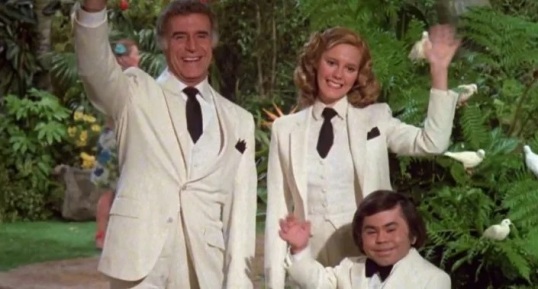
For instance, at the start of the season premiere, Roarke gifts Tattoo a platform that he can stand on while greeting and saying goodbye to the guests and so that he can, visually, be on equal footing with Mr. Roarke.  From what I’ve read, this was something that Herve Villechaize specifically requested as a condition for agreeing to continue with the show.  Considering that the previous season didn’t give Tattoo much to do, I can understand Villechaize’s logic.

The other big change is that Roarke has a new assistant.  His goddaughter, Julie (Wendy Schaal), has spent the summer working on Fantasy Island.  She only appears briefly in this episode, asking Mr. Roarke if she can greet the guests with him.  Roarke tells her that she’s not quite ready but perhaps next week, she will get the opportunity….

And really, Julie should feel good about that because neither fantasy is really that interesting this week.

Matt Kane (Sonny Bono) is a short sportswriter who wants to become a great basketball player and play for a team called the California Top Hatters (who the Hell came up with that name?) because he thinks that’s the only way that he’ll be able to win the heart of Ginger Donavon (Jenilee Harrison), the daughter of the team’s coach (Forrest Tucker).  Mr. Roarke warns Matt that there’s more to love than being able to play basketball but he still gives Matt a pair of magic sneakers.

Matt becomes a great basketball player.  (For some reason, the team is practicing on Fantasy Island).  Coach Donavon says that, if Matt wants a place on the team, he’ll have to beat out rookie sensation Skyhook Schuyler (Peter Isacksen).  Fortunately, Matt comes to realize that he can’t win Ginger by being the best player.  Instead, he has to be a better person.  He removes his shoes and bombs the try out.  But he gets to leave the island with Ginger.

Sonny Bono was a frequent guest star on both this show and The Love Boat.  He always played dorky guys who tried too hard to be cool.  That’s certainly the case here but what should be charming is made a bit bland by the total lack of chemistry between him and Jenilee Harrison.  On the plus side, Tattoo actually gets to do something in this fantasy, serving as a confidante to Skyhook.  It turns out that Skyhook is just as insecure about being tall as Tattoo is about being short.  To help Skyhook, Tattoo paints a picture of him so that Skyhook can see his kind soul.  Awwww!  Seriously, Herve Villechaize totally earned his right to stand on that platform.

As for the other fantasy, Helen Ross (Connie Stevens) is engaged to Ted Kingman (Martin Milner) but she can’t get over her former lover, John Day (David Hedison).  She thinks that John died while serving in the military but Mr. Roarke reveals that John actually survived the war and he lives on a nearby island.  Helen is reunited with John, just to discover that he’s a cad who faked his own death and became a deserter.  Helen leaves the Island feeling confident in her decision to marry Ted.

It’s only after she leaves that the truth is revealed.  Ted is currently serving a prison sentence.  Mr. Roarke arranged for Ted to have a weekend with freedom, on the condition that he lie about his situation to Helen so that she could move on from their failed romance.  So, basically, Mr. Roarke took Helen’s money and then lied to her.  Uhmm …. seriously, what the Hell, Mr. Roarke?

This was a bit of an underwhelming start for the fifth season but fear not!  Next week …. Roddy McDowall returns as the Devil and he wants Mr. Roarke’s soul!

Til then….

Retro Television Reviews: The Love Boat 3.17 “April’s Love/We Three/Happy Ending”


Welcome to Retro Television Reviews, a feature where we review some of our favorite and least favorite shows of the past!  On Wednesdays, I will be reviewing the original Love Boat, which aired on ABC from 1977 to 1986!  The series can be streamed on Paramount Plus!

This week, a special guest returns!

Episode 3.17 “April’s Love/We Three/Happy Ending”

(Dir by George Tyne, originally aired on January 12th, 1980)

Let’s see.  This week’s episode is entitled April’s Love/We Three/Happy Ending and….

Wait?

Whose love?

April?

Oh no (or oh yes, depending on how you view things), it’s a Charo episode!

Charo was hardly the only celebrity to frequently appear on The Love Boat but she was the only one to always play the same character.  April first boarded the ship as a stowaway and then she returned as an entertainer.  She appeared at least once in almost every season.  In many ways, Charo was the perfect fit for The Love Boat.  She was loud, flamboyant, and shameless.  She was sexy but innocent.  She was the epitome of The Love Boat aesthetic.  At the same time, a little Charo went a long way and, whenever she boarded the ship, you knew the episode was pretty much going to be 75% Charo.

That’s the case here, in which the crew makes such a big deal over April that you have to wonder if they’re aware that there are other passengers on board.  April boards the ship with her manager and fiancé, Honest Tex (Forrest Tucker).  The crew doesn’t trust Honest Tex, especially when they find out that he was a used car salesman before he met April.  When Honest Tex hears Julie playing her flute and offers to get her a recording contract, the crew assumes that he wants to cheat on April!

(Side note: Since when did Julie start playing the flute?)

Fortunately, Honest Tex turns out to be sincere and he really does have a heart as big as Texas.  After April tells him what the crew has been saying about him, Honest Tex admits that he has been lying about something.  He was actually born in New Jersey.  April sings a song, the crew apologizes, and April and Honest Tex leave the boat a happy couple.

While this is going on, William and Betty Robinson (Don Adams and Juliet Mills) board the boat so they can get some work done.  They are married screenwriters but they are on the verge of divorce.  Once they finish their current script, they can split up.  The only problem is that William doesn’t want to split up with her.  Isaac suggests that William just never finish the script.  William hides the script in his nightstand and then, saying that it’s been lost, he works with Betty to write a new script in which a couple stays together.  Betty and William realize that they still love each other.  Betty discovers that William hid the script but she then confesses that she had another copy of the original script the whole time.  Awwwwwww!  This was a cute story.  Don Adams was a lot more likable here than he is on Check It Out! and Juliet Mills is a lot less annoying than her sister Hayley.

(Admittedly, I really only know Hayley from her time as Miss Bliss on those weird episodes of Saved By The Bell.  But seriously, Miss Bliss was the worst!)

Finally, Tom Thornton (Ross Martin) boards the boat and is surprised to see his ex-girlfriend, Martha (Marjorie Lord), and Martha’s adopted daughter, Laura Rogers (Laurie Walters).  Laura happens to be Tom’s daughter!  Tom isn’t sure whether or not he should reveal he is Laura’s father but meeting Vicki and hearing about how happy Vicki was when she discover Captain Stubing was her father leads to Tom telling Laura the truth.  Laura is happy to have a father and Martha is happy to reunite with Tom.  This was another sweet story, featuring sincere performances from both Ross Martin and Marjorie Lord.  (Plus, Vicki finally did something to justify breaking all of the labor laws that are undoubtedly being violated by having a 12 year-old working on a cruise ship.)

This episode featured two sweet and sincerely-acted stories but both of them are overshadowed by April and Honest Tex.  Personally, I think April is an amusing character and, as I said, Charo was the epitome of the ideal Love Boat celebrity guest.  But it’s still hard not to feel that the other passengers deserved just as much attention as Charo received in this episode.  That said, this was still an enjoyable cruise.  A good time was had by all.  I know Charo will return in future episodes but I have a feeling we’ll never hear from Honest Tex again.

Retro Television Reviews: Fantasy Island 2.17 “The Stripper/The Boxer”


Welcome to Retro Television Reviews, a feature where we review some of our favorite and least favorite shows of the past!  On Tuesdays, I will be reviewing the original Fantasy Island, which ran on ABC from 1977 to 1986.  The entire show is currently streaming on Tubi!

Smiles, everyone, smiles!  This week, we’ve got stripping and boxing!

Episode 2.17 “The Stripper/The Boxer”

(Dir by Lawrence Dobkin, originally aired on February 10th, 1979)

This week, Tattoo is wearing a monocle because his cousin Igor has discovered that they are descended from royalty.  Roarke is not impressed.  Indeed, he seems to be genuinely angered by Tattoo’s suggestion that he’s somehow better than him.

As for the fantasies, first off the plane is Maureen Banning (Laraine Stephens).  Maureen is a runaway heiress.  Her father doesn’t want her to marry a poet named Barnaby (William Beckley) so she has snuck off to Fantasy Island so that she can get married over the weekend.  Unfortunately, her father’s private detectives have followed her to the island.  In a panic, Maureen hops onto the first bus that she sees.  It turns out the bus is the tour bus for a burlesque show and the show’s manager, Russ McCoy (Michael Callan), has a fantasy that concerns bringing the show to Broadway.  Maureen is mistaken for a famous burlesque dancer.  Fortunately, Sheba Palumbo (Mamie Van Doren) and Betty (Beverly Powers) are avid tabloid readers and they immediately recognize Maureen as the runaway heiress.  They agree to teach her how to dance so that she can stay on the island and marry Barnaby.  Except, of course, Maureen is now starting to feel more attracted to Russ….

This fantasy was okay.  I enjoyed the dancing and I also enjoyed thinking about how much Gary Loggins would have enjoyed watching his favorite actress, Mamie Van Doren, teach Maureen all the moves.  I think the main problem with this fantasy is that, even after she ran way, Maureen never seemed to be in control of her own fate.  The appeal of dancing on stage, whether you’re an old school burlesque performer or a modern-day stripper, is that it gives you all the power but, for Maureen, it just seemed like something to do until she finally got around to getting married.

The other fantasy involves Billy Blake (Ben Murphy), a boxer who only has three years to live.  He wants a chance to fight the other leading leading championship contender.  Even though the fight will be unofficial, Billy just wants a chance to show that, if not for his fatal disease, he could have been a champ.  Of course, if he takes too many hits to the head, Billy could die in the ring.  Billy is okay with that until he discovers that his former high school girlfriend, Jennie Collins (Maureen McCormick), is working on the Island.  Billy’s trainer (Forrest Tucker) tells Jennie to stay away from Billy and Jennie is ashamed of all of the “things” she did when she ran off to Hollywood to try to become a star.  (Like starring on The Brady Bunch Hour, perhaps….)  But, in the end, Billy realizes that his real fantasy is to spend his last remaining years with Jennie.  Personally, I found myself wondering why Billy didn’t consider a fantasy where he was cured of his terminal but unnamed disease.  Then he could both be champion and spend the rest of his life with Jennie.

There weren’t many surprises with this fantasy but Ben Murphy and Maureen McCormick were an undeniably cute couple.  I hope they had many good times before Billy’s agonizing and tragic death.

Next week …. John Saxon comes to Fantasy Island!

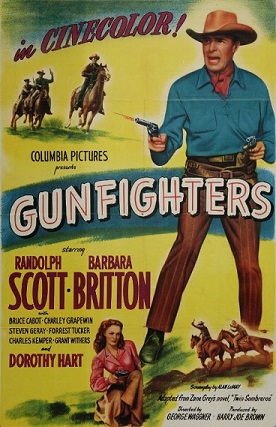
Gunfighters (1947, directed by George Waggner)


Brazos Kane (Randolph Scott) is a legendary gunfighter who has more notches on his gunbelt then he can count.  His reputation is so fearsome that he can’t even enter a town without having to worry about someone drawing a gun on him in an attempt to make a name for themselves.  When he’s forced to shoot his own best friend when the latter tries to outdraw him, Brazos says that he’s had enough.  He tosses aside his guns and he heads to the home of his friend, Bob Tyrell.  Brazos says he’s going to retire from gunfighting and just “ride the range.”

When Brazos reaches Bob’s cabin, he discovers that Bob has been murdered.  When Brazos rides to the nearby Banner ranch to report the crime, he’s arrested and accused of shooting Bob.  When it’s pointed out that Brazos doesn’t have a gun, corrupt Deputy Yount (Grant Withers) says that Brazos most have tossed it in the creek after he shot Bob.

With the help of Bob’s employer, a rancher named Inslip (Charley Grapewin), Brazos narrowly avoids getting hung.  Both Yount and the sheriff (Charles Kemper) encourage Brazos to leave town but Brazos isn’t going anywhere until he gets justice for Bob.  His investigation leads to him getting involved with two sisters (Dorothy Hart and Barbara Britton) and a young cowhand named Johnny (John Miles), who wants to become a famous gunslinger.  It also leads Bob into conflict with Bard Macky (Bruce Cabot) and Hen Orcutt (Forrest Tucker), who are both determined to run Brazos out of town.  Brazos finds himself tempted to go back on his word and pick up his guns yet again.

Based on a novel by Zane Grey, Gunfighters is a surprisingly mature and multi-layered western.  Brazos’s refusal to carry a gun and his genuine dislike of violence makes him a far more interesting protagonist than the typical B-western hero and Randolph Scott, one of the best of the cowboy actors, is appropriately world-weary in the role.  The villains are also written and played with an unexpected amount of depth, with Bruce Cabot the stand-out as Bard Macky.

Gunfighters is full of good scenes.  The opening sequence, featuring the pivotal gunfight between Brazos and his best friend, is excellently directed and captures how quickly violence can erupt in the old west.  Later, when Brazos first meets Johnny, the younger man is engaged in target practice and talking about how a man named Brazos Kane murdered Johnny’s best friend.  Johnny is practicing so he can kill Brazos himself.  Without revealing his identity, Kane gives Johnny a few pointers on how to draw and aim his gun.  It’s only after Johnny has perfected the quick draw that Kane laconically introduces himself and explains that he had nothing to do with Bob’s death.  Later, in a powerfully acted scene, Kane explains to Johnny just what exactly it means to be a famous gunfighter and to know that everyone you see is a potential threat.

Directed by George Waggner, Gunfighters is an intelligent and well-acted western and one of Radolph Scott’s best.

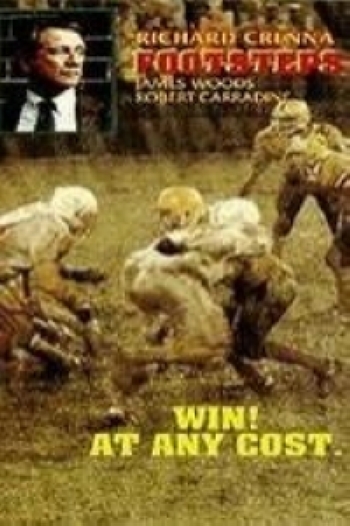
Footsteps (1972, directed by Paul Wendkos)


Paddy O’Connor (Richard Crenna) is a former football player-turned-coach whose record of success has been overshadowed by his own arrogance and heavy drinking.  O’Connor has such a bad personal reputation that he’s found himself unemployable.  Only one man is willing to give him a chance.  Jonas Kane (Clu Gulager) played football with Paddy and he’s now coaches for a small college.  Kane may not like O’Connor but he knows that O’Connor might be the key to turning around his team’s fortunes and, at the same time, saving Kane’s job.  Kane hires O’Connor to serve as a his defensive coordinator.

At first, O’Connor’s cockiness rubs people the wrong way.  It’s not until O’Connor moves offensive player J.J. Blake (Bill Overton) to defense that the team starts to win.  And once the team stars to win, everyone’s problems with O’Connor disappear.  Kane can only watch helplessly as O’Connor moves in on his girlfriend (Joanna Pettet), knowing that he owes his job to O’Connor remaining at the school.

However, when Blake gets a concussion, O’Connor is forced to decide whether or not to let him play.  Boosters like Bradford Emmons (Forrest Tucker) want Blake to play, regardless the risk.  The NFL scouts, who are looking for the next number one pick, want to see Blake on the field.  Blake says he wants to play but O’Connor can tell that he’s lying about the extent of his injury.  With everyone breathing down his neck and a syndicate of gamblers pressuring O’Connor to shave points so that the spread pays off, O’Connor has to decide what to do.

Though this made-for-TV movie may not be as well-known as some other films, it’s one of the best movies ever made about college football.  Though it may be short (only 74 minutes), it still examines all of the issues that have always surrounded college football.  Despite not getting paid for their efforts, the players risk serious and permanent injury during every game, just on the slight hope that they might someday make it to the NFL.  The coaches, who are supposed to be looking after the players, are more interested in padding out their win-loss record and hopefully moving onto bigger and better-paying jobs.  Meanwhile, aging alumni and boosters demand that the team win at all costs, regardless of what happens to the men on the field.  Footsteps intelligently explores all of those issues and suggests that the risks are ultimately not worth the rewards.

Along with an intelligent script, Footsteps is helped by a talented cast.  Crenna and especially Gulager both give excellent performance as the two rival coaches.  Al Lettieri (Sollozzo from The Godfather) plays one of the gamblers.  Beah Richards plays Blake’s mother, who makes the mistake of believing O’Connor when he says that he’s going to always have Blake’s best interests at heart.  Ned Beatty has a small role as another assistant coach who is forced to make an important decision of his own.  Keep an eye out for Robert Carradine and James Woods, both of whom have tiny roles.

As far as I know, Footsteps has never officially been released on DVD.  I saw it late one night on the Fox Movie Channel.

A Real American Hero (1978, directed by Lou Antonio)


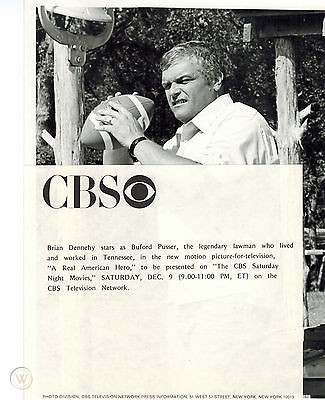
Based on the title, you might think this made-for-TV movie is about G.I. Joe but instead it’s about Buford Pusser, the club-wielding sheriff who battled bootleggers in Tennessee and who might have been murdered by them.  While he was still alive, Pusser was played by Joe Don Baker in the original Walking Tall.  After Pusser’s mysterious death, Bo Svenson took over the role for two sequels and a Walking Tall television series in 1981.  Meanwhile, in A Real American Hero, the role is played by Brian Dennehy.

Though Pusser may be played by a different actor than in the original movies, A Real American Hero finds him still dealing with same threats.  As a result of getting some bad moonshine at the Dixie Disco, two teenagers are dead and two are blind.  Buford is determined to take down the owner of the Disco, Danny Boy Mitchell (Ken Howard).  Unfortunately for Buford, Danny Boy has a mole in the sheriff’s department and always manages to clean up his club before Buford arrives.  When Buford does arrest Danny, the case is thrown out of court because Buford didn’t have probable cause or any real evidence beyond hearsay.

Buford’s solution is to start enforcing every single law on the books, even the ones that haven’t been relevant for over a century.  Buford knows that stopping Danny Boy for a misdemeanor would give him probable cause to search him for any evidence of smuggling moonshine.  For instance, Buford pulls Danny Boy over because he’s driving a vehicle but, in violation of a law written in 1908, he doesn’t have a man walking in front of the car and waving a red flag.  Another time, he gives Danny Boy a ticket because, in violation of a law from 1888, he never ties his carriage to a hitching post and a law written in 1910 legally defines all cars as being carriages.

The problem is that, if Buford only enforces the law against Danny Boy, he could be accused of police harassment.  So, everyone in the country has to be held to the same standard, which means that everyone in town is soon getting ticketed and jailed for the minor offenses as Danny Boy and his associates.  Everyone gets angry with Buford but, after Danny Boy tries to assassinate the sheriff while he’s got his kids in the car, they change their minds and support being overpoliced.

A Real American Hero was obviously an early attempt at a pilot for a Buford Pusser TV series.  Bulky Brian Dennehy is physically right for Buford but he’s never as convincing a redneck as Joe Don Baker was in the role.  Plus, it’s impossible to watch Dennehy hauling people into court for not hitching their “horseless carriages” without being reminded of Dennehy harassing Sylvester Stallone at the start of First Blood.  Despite a subplot where Pusser tries to help a former prostitute re-enter society, Buford comes across more like a jerk than a real American hero.  Meanwhile, Ken Howard does his best but Danny Boy is still just a generic television bad guy.  If he wasn’t selling moonshine in Buford’s county, he’d probably be further down south, trying to frame the Duke boys for a bank robbery.

This one is for Walking Tall completists only.

Special Veterans Day Edition: John Wayne in SANDS OF IWO JIMA (Republic 1949)


gary loggins's avatarcracked rear viewer

Critics of John Wayne gave him a lot of flak for not serving his country during World War II, especially in the turbulent 1960’s, labeling him a phony patriot and celluloid warrior. The truth is Wayne DID try to get into the war, but was stymied in his attempts on two fronts: Republic Studios boss Herbert Yates, who filed for deferments so he wouldn’t lose his cash cow, and Wayne’s first wife Josie, who failed to forward letters from OSS Chief Wild Bill Donovan’s office. Be that as it may, The Duke was no phony, and did what he could on the home front for the war effort.

SANDS OF IWO JIMA was made four years after the war as a tribute to the brave souls of the United States Marine Corps who fought against the Japanese in the South Pacific. Wayne plays the tough top kick Sgt. John Stryker…

View original post 748 more words

Cleaning Out The DVR #10: The Yearling (dir by Clarence Brown)


Original_movie_poster_for_the_film_The_Yearling

After I finished Abduction: The Jocelyn Shaker Story, I decided to watch a film that was shown on TCM as a part of the 31 Days Of Oscars.  When I started the 1946 film, The Yearling, I thought it was going to be a sweet and heartwarming little movie about a country boy raising a deer.  Instead, it turned out to be a rather dark movie about how much it sucks to grow up in the country.  I can only imagine how many childen, back in 1946, were scarred for life by this movie.

The movie is actually about two yearlings.  The main one is Jody (Claude Jarman, Jr.), who lives in the bayous of 1878 Florida.  His family is a farming and hunting family.  They live in a small shack and struggle to make ends meet.  His father, Penny Baxter (Gregory Peck) is … well, he’s Gregory Peck.  He’s stern but warm and speaks with that deep voice that lets you know that you better pay attention to everything he says.  While Penny is generally laid back and enjoys a good laugh, his wife, Ora (Jane Wyman), is far more serious and severe.  Ora has lost three children and, as a result, she is both overprotective and emotionally distant from Jody.

Jody desperately wants a pet but Ora says that they can’t afford to feed any animals.  However, one day, Penny is bitten by a snake.  Apparently, the organs of a deer can be used to draw out snake venom.  (Seriously, until I watched The Yearling, I had no idea this was the case.  I once nearly stepped on a rattlesnake in New Mexico and it totally freaked me out.  It’s good to know that if I ever do get attacked by a snake, all I have to do is kill a deer.)  Penny shoots a doe and has Jody cut out its heart and liver.  After doing so, Jody notices that the doe had a fawn.  He begs to be allowed to adopt it and, overruling Ora, Penny says that he can.

After getting his deer, Jody goes to visit his best friend, Fodderwing (Donn Gift) and ask him what he thinks a good name would be.  However, Fodderwing’s father informs Jody that his friend has just died.  And really, that scene pretty much epitomizes what The Yearling is about.  Because it’s told almost entirely from Jody’s point of view, the film may occasionally look like an old school Disney film.  But death and hardship are very real in the world of The Yearling.  People die, even children.  Having a pet may make the reality easier to take but it doesn’t change the reality.

Jody names the deer Flag.  As the film progresses, both Jody and Flag grow up.  Unfortunately, as Flag gets older and bigger, he causes more and more trouble for both his family and the neighbors.  He eats crops and he destroys fences.  After Penny is injured, Jody is the one who ends up replanting the corn and fixing all the damage.  But, even after all of Jody’s hard work, Flag still knocks down another fence.  That’s when Jody is told that he must shoot his beloved pet…

And that’s why I went, “Agck!  What type of movie is this!?”

Well, it’s a coming-of-age movie and, unfortunately, Jody is living at a time when growing up means giving up childish things.  (That’s always been my least favorite verse in the Bible, by the way.)  The Yearling itself is a pretty good film, though I do have one major problem with it.  The film looks great and both Jane Wyman and Gregory Peck are expertly cast.  If you keep an eye out, you’ll even spot Henry Travers — Clarence the Angel from It’s A Wonderful Life — in a small role.

That said, my main objection to The Yearling — the thing that keeps it from being quite as good as it could be — is the performance of Claude Jarman, Jr.  In the role of Jody, Jarman goes so totally over-the-top with his line readings and his facial expressions that it immediately takes the viewer out of the film’s reality.  Whenever anything happens — whether its Penny getting attack by a snake or his mother throwing a plate at his deer or Flag knocking over a fence — Jarman responds by standing there with his eyes and mouth wide open.  His lines are delivered with a rushed enthusiasm that can’t hide the complete lack of authentic emotion in his performance.  Claude Jarman tries really hard but it’s not surprising to discover that, after The Yearling, he only appeared in a few more films before joining the Navy and then subsequently moving behind the camera as a producer.

Then again, the Academy thought highly enough of Jarman’s performance to give him an honorary Oscar.  The Yearling itself was nominated for best picture but it lost to another sad film about giving up childish things, The Best Years of Our Lives.

Lisa Watches An Oscar Nominee: Auntie Mame (dir by Morton DaCosta)


Oh Lord, Auntie Mame.

There were two reasons why I watched the 1958 film Auntie Mame.

First off, as I’ve mentioned before, TCM has been doing their 31 Days of Oscar this month.  They’ve been showing a lot of films — both good and bad — that were nominated for best picture.  Since it’s long been my goal to see and review every single film that has ever nominated for best picture, I have made it a point to DVR and watch every best picture nominee that has shown up on TCM this month.  Auntie Mame was nominated for best picture of 1958 and was broadcast on TCM this month so I really had no choice but to watch it.

My other reason for wanting to see Auntie Mame was because, when I was 19, I was cast in a community theater production of Mame.  (Mame, of course, is the musical version of Auntie Mame.)  Though everyone who saw the auditions agreed that I should have played the role of Gloria Upson, I was cast in the ensemble.  (Gloria was played by the daughter of a friend of the director.  Typical community theater politics.)  As a member of the ensemble, I didn’t get any lines but I still had fun.  In the opening party scene, I dressed up like a flapper and I got to show off my legs.  And then in another scene, I was an artist’s model and I got show off my cleavage.  (If you don’t use being in the ensemble as an excuse to show off what you’ve got, you’re doing community theater wrong.)  Towards the end of the play, I appeared as one of Gloria’s friends and whenever she delivered her lines, I would make sure to have the most over-the-top reactions possible.  She may have stolen the part but I stole the scene.  It was a lot of fun.

But, even while I was having fun, I have to admit that I didn’t care much for Mame.  It was an extremely long and kind of annoying show and there’s only so many times you can listen to someone sing We Need A Little Christmas before you’re tempted to rip out the hair of the actress who stole the role of Gloria Upson from you.

So, when I recently sat down and watched Auntie Mame, I was genuinely curious to see if the story itself worked better without everyone breaking out into song.  After all, Auntie Mame was the number one box office hit of 1958, it was nominated for best picture, and it was apparently so beloved that it inspired a musical!  There had to be something good about it, right!?

Right.

Auntie Mame tells the story of Mame Dennis (Rosalind Russell, attempting to be manic and just coming across as hyper) who is rich and quirky and irrepressibly irresponsible.  When her brother dies, Mame suddenly finds herself entrusted with raising his son, Patrick (played, as a child, by the charmless Jan Hadzlik and, as an adult, by the stiff Roger Smith).  Mame is a wild nonconformist (which I suppose is easy to be when you’ve got as much money as she does) and she tries to teach Patrick to always think for himself.  However, once Patrick grows up and decides that he wants to marry snobby Gloria Upson, Mame decides maybe Patrick shouldn’t think for himself and goes out of her way to prevent the wedding.

Auntie Mame is an episodic film that follows Mame as she goes through a series of oppressively zany adventures.  When the Great Depression hits, she’s forced to work as an actress, a saleswoman, and a telephone operator and she’s not very good at any of them.  She does eventually meet and marry the wealthy Beauregard Jackson Pickett Burnside (Forrest Tucker).  As you can probably guess from the man’s name, he’s supposed to be from the south.  (And yet Tucker plays the role with a western accent…)  He loves Mame but then he ends up falling off a mountain.  So much for Beau.

(In the production of Mame that I appeared in, Beau was played by this 50 year-old guy who simply would not stop hitting on me and every other girl in the cast and who was always “accidentally” entering the dressing room while we were all changing.  Whenever Mame mentioned Beau’s death, all of us ensemble girls would cheer backstage.)

Anyway, as a film, Auntie Mame doesn’t hold up extremely well.  I can understand, to an extent, why it was so popular when it was first released.  It was an elaborate adaptation of a Broadway play and, in 1958, I’m sure that its theme of nonconformity probably seemed somewhat daring.  When you watch it today, though, the whole film seems almost oppressively heavy-handed and simplistic.  It’s easy to embrace Mame’s philosophy when everyone else in the film is essentially a sitcom creation.

As I mentioned previously, Auntie Mame was nominated for best picture.  However, it lost to the musical Gigi.