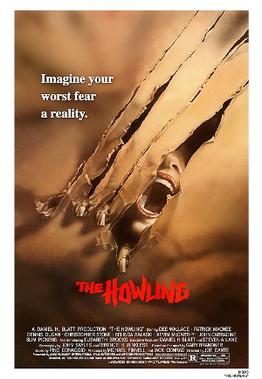
Horror Film Review: The Howling (dir by Joe Dante)


The 1981 film, The Howling, takes place at The Colony.

The Colony is a lovely place, a nice resort out in the middle of the countryside.  It’s a place that celebrity therapist George Waggener (Patrick Macnee) sends his clients so that they can recover from trauma.  It’s a bit of a grown-up version of the ranch to which Dr. Phil used to send juvenile delinquents.  Of course, the Colony is full of adults and they’re an eccentric bunch.  I mean, one of them — named Erle Kenton — is actually played by John Carradine!  That’s just how eccentric the place is.  Sheriff Sam Newfield (Slim Pickens) keeps an eye on the place but everyone knows that there’s nothing to worry about when it comes to The Colony.  Dr. Waggner does good work.

Karen White (Dee Wallace) is a Los Angeles news anchor who was held hostage by a serial killer named Eddie Quist (Robert Picardo).  While she was with Eddie, she was forced to not only watch videos of Eddie’s crimes but she also saw something happen with Eddie that terrified her to such an extent that she has blocked it from her mind.  Karen was rescued by the police but she is haunted by nightmares.  Dr. Waggner arranges for Karen and her husband, Bill Neill (Christopher Stone, who was married to Dee Wallace when they co-starred in this film), to spend some time at the Colony.

Bill loves the Colony, especially after he attracts the eye of Marsha (Elisabeth Brooks), the resort’s resident seductress.  Karen, however, is less enamored of the place.  The Colony feels off to her and she’s not happy about the howling in the distance or the fact that Bill has suddenly started to grow distant from her.  Could it be that The Colony is actually crawling with werewolves and that Bill has become one of them?  (It’s totally possible and, to The Howling‘s credit, it doesn’t waste any time letting us know that.)  Karen’s friend, Terry Fisher (Belinda Balanski), and her boyfriend, Chris Halloran (Dennis Dugan), do some research of their own into Eddie Quist, The Colony, and whether or not werewolves exists and they meet a helpful bookstore owner named Walter Paisley (Dick Miller).

To understand the approach that director Joe Dante and screenwriter John Sayles take to The Howling, one needs to only consider the names of some of the characters.  George Waggner.  Bill Neill. Terry (which can be short for Terence) Fisher.  Fred (or is that Freddie) Francis.  Erle Kenton.  Sam Newfield.  Jerry Warren.  All of these characters are named after horror film directors.  This is the type of werewolf film where Chris Halloran has a copy of The Three Little Pigs sitting on his desk.  Veteran actors like Kevin McCarthy, John Carradine, Slim Pickens, and Kenneth Tobey show up in small roles.  Roger Corman mainstay Dick Miller plays yet another character named Walter Paisley and he kicks Forrest J. Ackerman out of his bookstore.  Roger Corman himself plays a man making a phone call.  After a werewolf is shot on live TV, the program immediately cuts to a dog food commercial and we see a blank-faced child telling his unconcerned parents that someone just turned into a wolf.  The Howling was made by people who obviously love B-horror and that love is present in every frame of the film.

Like Dante’s Piranha, The Howling is a film with a sense of humor but it’s not a comedy.  The werewolves are still impressive, even forty-two years after the film was first released.  The character of Eddie Quist (“I’m going to give you a piece of my mind”) is a terrifying monster and the sight of his signature smiley face will fill you with dread, especially when it shows up in a place where it really shouldn’t be.  The film cynically ends on a note of noble sacrifice that will apparently not make much difference, with the suggestion being that human beings are either too distracted or too jaded to realize that there are monsters among them.  The Howling is a fast-paced and well-directed homage to B-horror and it’s still terrifically entertaining.
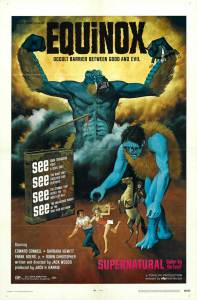
Horror on the Lens: Equinox (dir by Jack Woods and Dennis Muren)


Today’s horror on the lens is a film that Gary reviewed a few years ago.  

First released in 1970, Equinox is a low-budget film about a bunch of kind of dumb teenagers who find a book and end up getting chased around the woods by a bunch of angry monsters.

Equinox is a fun little movie.  The acting may not be the greatest and this is one of those films where everyone always seems to do the stupidest possible thing at the worst possible time but there’s a lot of charm to be found in the monsters.  This film is thought, by many, to have inspired the Evil Dead and there are some definite similarities.

Enjoy!

The TSL’s Horror Grindhouse: Hard To Die (dir by Jim Wynorski)


Do you remember how, a few days ago, I reviewed a silly little movie called Sorority House Massacre II?

Well, it turns out that there’s a sequel and it’s on YouTube!  Both films were directed by Jim Wynorski and featured pretty much the same cast, despite the fact that a few of them were playing new characters.  It was released under several different titles.  Hard To Die is the one that I’m going with for this review.  However, the film was also known as Tower of Terror, which makes sense when you consider that the majority of the film takes place in a hi-rise office building.  It was also apparently released in some places as Sorority House Massacre III, despite the fact that there’s no sorority house in the movie.

Actually, it’s debatable whether or not Hard To Die is actually a sequel.  It’s true that Orville Ketchum (Peter Spellos) does make another appearance.  In the first movie, Orville was the creepy neighbor.  In Hard To Die, he’s the janitor at the office building.  Orville tells the exact same story, with the exact same flashbacks, that he told in Sorority House Massacre II.  (Those flashbacks, of course, were lifted from a totally unrelated movie called Slumber Party Massacre.  There were apparently a lot of massacres in the 80s and 90s.)  The evil spirit of Hockstadder returns as well, though this time he comes flying out of a box that was accidentally delivered to the office building as opposed to a Ouija board.  And, of course, there’s an abundance of lingerie, awkward dialogue, and cheap gore effects.  (At one point, a bucket of fake blood is literally splashed on a wall.)  However, Hard To Die also tells almost exactly the same story of Sorority House Massacre II.  There are so few differences that I’m actually more tempted to say that Hard To Die is a remake of Sorority House Massacre II than a sequel.  The only problem with that theory is whether or not a second movie can be considered remake when the first movie literally came out the exact same year.

(One of the reasons that I love my work here at the TSL is that it allows me to obsess over minutia like this.)

Anyway, the main difference between Hard To Die and Sorority House Massacre III is that there’s no sorority house in Hard To Die.  Instead, Hard To Die takes place in a lingerie shop that just happens to be located on the 7th floor of a skyscraper.  The hard-working employees are spending the weekend doing inventory but it’s not going to well.  For one thing, the sprinklers accidentally go off so everyone decides to take off their wet clothes, put on skimpy lingerie, and order pizza.  Personally, I probably would have waited for the pizza to arrive before getting naked but then again, I’ve never worked retail or dated a pizza deliveryman.

The pizza does eventually arrive but no one gets to eat it because the deliveryperson gets set on fire and ends up falling several floors to her death.  That’s a waste of good pizza, which is kind of depressing.  Meanwhile, Orville keeps trying to warn everyone about Hockstadder but, instead, he keeps getting beaten up.  The end credits of Hard To Die promised that the next film would be called Orville In Orbit.  Apparently, it was never made but I do hope that Orville got a vacation after all of this.

Anyway, Hard To Die is an extremely silly movie but it’s just so sincere in its silliness that it feels somewhat churlish to be too critical of it.  If I had to choose whether to be in Sorority House Massacre II or Hard To Die, I would probably pick Hard To Die because, at least in that movie, I’d get to shoot a machine gun.  Hard To Die is so blatantly and unapologetically over the top that you can’t help but be amused by it all.

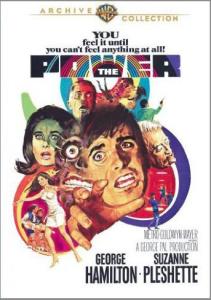
A Movie A Day #278: The Power (1968, directed by Byron Haskin)


Who is Adam Hart?

That is the mystery that Professors Jim Tanner (George Hamilton) and Margery Lansing (Suzanne Pleshette) have to solve.  Someone is using psychic powers to kill their co-workers in a research laboratory.  The police think that Tanner is guilty but Tanner knows that one of his colleagues is actually a super human named Adam Hart.  Hart is planning on using his super powers to control the world and, because Tanner is the only person who has proof of his existence, Hart is methodically framing Tanner for every murder that he commits.

The Power is underrated by entertaining movie, a mix of mystery and science fiction with a pop art twist.  It was also one of the first attempts to portray telekinesis on film.  Similar films, like Scanners, may be better known but all of them are directly descended from The Power.  George Hamilton may seem like an unlikely research scientist but he and Suzanne Pleshette are a good team and The Power makes good use of Pleshette’s way with a one liner.  Also keep an eye out for familiar faces like Arthur O’Connell, Nehemiah Persoff, Michael Rennie, Gary Merrill, Yvonne DeCarlo, Vaughn Taylor, Aldo Ray, and even Forrest J. Ackerman as a hotel clerk.


Horror on the Lens: Dracula vs. Frankenstein (dir by Al Adamson)


Zandor Vorkov is Dracula!

John Blood is Frankenstein’s monster!

Together … THEY SOLVE CRIMES!

No, actually, they don’t.  If anything, they cause crimes to happen.

First released in 1971 and directed by Al Adamson, Dracula vs. Frankenstein may not be a good film but it’s definitely an unforgettable film.  Yes, it may be thoroughly inept but it’s also perhaps the strangest take on the Dracula/Frankenstein rivalry that you’ll ever see.

Plus, it’s one of the final films of Lon Chaney, Jr.  Unfortunately, Lon doesn’t exactly look his best in Dracula vs Frankenstein...

Speaking of slumming celebrities, long before he played Dr. Jacoby and inspired America to shout, “Dig yourself out of the shit!,” Russ Tamblyn played a biker named Rico in this movie.

Also, like every other exploitation film made in 1971, Dracula vs. Frankenstein features hippies, leading to the age old question: who needs the supernatural when you’ve got LSD-crazed hippies running around?

Another age old question: Is Dracula vs. Frankenstein merely inept or is it a classic of bad filmmaking?

Watch below and decide for yourself.

Enjoy!

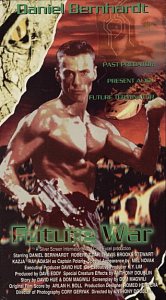
A Movie A Day #78: Future War (1997, directed by Anthony Doublin)


“Four days ago, a fire fell from the sky.”
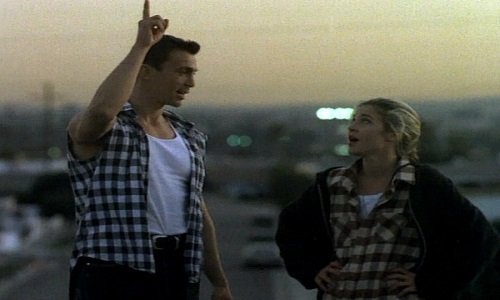
So says Sister Ann (Travis Brooks Stewart), the former prostitute junkie turned nun who narrates Future War.  She says it at least three times.

But what was in that fire?

Was it The Runaway (Daniel Bernhardt), the Swiss kickboxer who was kidnapped by intergalactic slave traders shortly after the writing of the King James’s Bible and who, when he finally escapes, somehow finds himself in 20th Century Los Angeles?

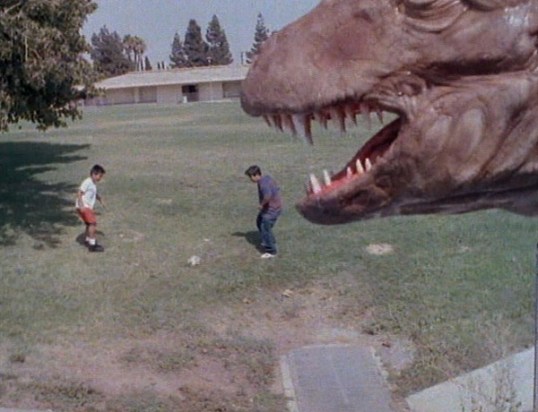
Was it the dinosaurs that were sent down to purse him?

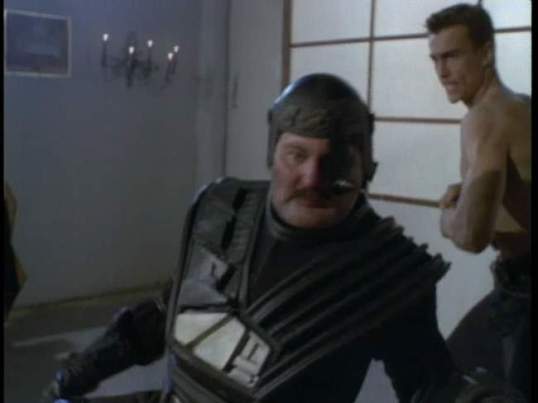
Was it the Cyborg Master (played by Maniac Cop himself, Robert Z’Dar)?

Or was the fire from the sky any hope that Future War would feature consistent continuity and narrative logic crashing down to the Earth and burning up in the atmosphere?

Future War is one of the worst films ever made, which is the main reason to watch it.

Watch as The Runaway points up at the sky and proves incapable of speaking until it is convenient for him to do so!

Thrill to countless fights that take place in warehouses that appear to be full of empty boxes!

Listen as multiple plot holes and inconsistencies are explained away by Sister Ann’s voice over!

Gasp at the sight of The Runaway and The Cyborg Master having a showdown in a church, John Woo-style!

Scream as dinosaur puppets are held really close to the camera in an effort to make them look bigger!

Laugh as the late Forrest J Ackerman makes a cameo, reading Famous Monsters of Filmland before getting eaten!

Wonder why The Runaway’s chest is bloody and injured in one shot but not the next!

Future War has it all!

The TSL’s Daily Horror Grindhouse: Scalps (dir by Fred Olen Ray)


The 1983 film Scalps answers the following question:

What happens when these grad students…

scalps-02

…dig up a sacred Native American burial ground and consider stealing some of the artifacts for themselves?

These grad students right here!

These grad students right here!

Well, they upset this lion…

scalps-1

…and this woman…

scalps-movie-1983-5

…and this guy, as well!

scalps

Needless to say, things don’t end well for anyone involved.

As for why those students were out digging for artifacts in the first place, the blame rests with Prof. Machen.  At first, Machen didn’t go with the students.  He had to take care of stuff back at the university.  When he finally did show up, it was a little bit too late.  Prof. Machen is played by an actor named Kirk Alyn, who was the first actor to play Superman back in the 1940s.

In the picture below, you can tell Prof. Machen is an explorer because of the pith helmet that he’s carrying:

vlcsnap-2014-07-26-09h28m09s26

Scalps is about 80 minutes long.  Most fans of low-budget horror will not be shocked to learn that Scalps is about 60 minutes of filler and 20 minutes of actual action.  Seriously, it takes forever for those grad students to actually reach the site of the dig and then, once they start digging, it seems to take even longer for anything to actually happen.  Occasionally, we get a quick flash forward of someone getting scalped or an insert of either the lion, the witch, or the warrior looking upset.

The grad students themselves are pretty much interchangeable.  As far as the men go, two of them have beards and another likes to drink beer.  As far as the women are concerned, two of them are blonde and one of them is slightly less blonde.  D.J. (Jo-Ann Robinson) is kind of a hippie and she has a bad feeling about everything.

(Stupid hippies!  Bleh!)

What’s odd is that, in the end, the film’s glacial pace actually works to its advantage.  Combined with an 80s synthesizer-of-doom score and some ragged but still effectively desolate shots of the desert, the slow pace actually gives Scalps something of a dream-like feel.  Like a filmed nightmare, the film is suffused with a feeling of impending doom.  Once the killings start, Scalps also makes good use of the slo-mo of doom.  Even the most rudimentary of scenes can be scary when they’re filmed in slow motion.

Scalps has been described as being one of the most censored films in cinematic history.  If you listen to Fred Olen Ray’s director’s commentary (more on that below), you’ll learn that it was largely censored due to the behavior of an unethical producer.  That said, it is a remarkably gory little film.  It may take a while for the blood to start flowing but once it starts, it doesn’t stop.  Admittedly, some of the gore effects worked better than others.  The arrow to the eye didn’t seem authentic.  The scalping, on the other hand, seemed far too authentic.  As for the decapitation …. well, I’d put that somewhere in the middle.

Scalps is something of a historical oddity, because it was one of the first films to be directed by the incredibly prolific Fred Olen Ray.  If you’re lucky enough to find the out-of-print Retromedia DVD, you can listen to a commentary track from Fred.  He’s remarkably honest about the film’s flaws and also discusses how he feels that the film’s producers ruined the film by adding random insert shots and flash forwards.  (“That’s not us doing that!” Fred says during one insert of the lion.)  Fred also points out that he made the mistake of actually shooting some of the night scenes at night.  It’s always interesting listening to a veteran director talk about his first film.  Since they have nothing to lose by openly discussing the mistakes that they made, their commentaries become a sort of a mini-film school.

Scalps is not a lost masterpiece but it is oddly watchable.  Somehow, it manages to be both silly and surprisingly effective at the same time.

210k4rq

Halloween Havoc! Extra: A Centennial Salute to FORREST J ACKERMAN


gary loggins's avatarcracked rear viewer

fja1

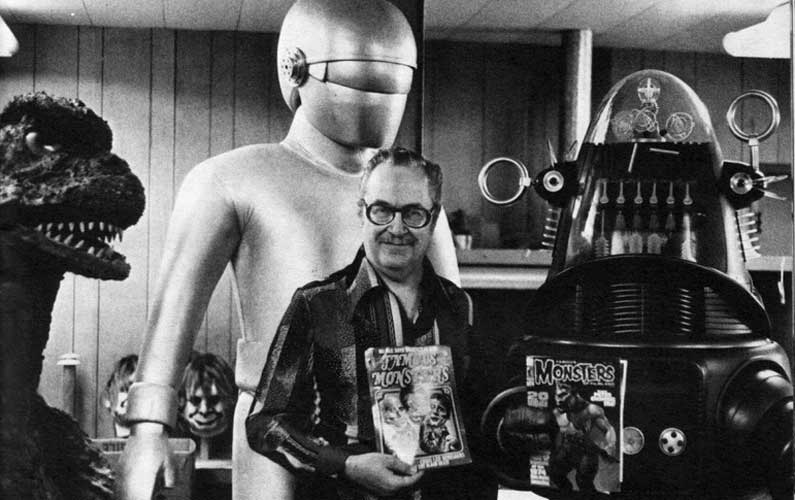
If you’re of a ‘certain age’ (like me), you’ll immediately recognize the gentleman in the above photo. Forrest J Ackerman (affectionately known as Uncle Forry) was the long-time editor of FAMOUS MONSTERS OF FILMLAND, the official magazine for Monster Kids of the 60’s and 70’s. FJA was the world’s #1 science fiction fan (and was given a Hugo Award to prove it!), writer, literary agent, actor, collector, and so much more. He would open his “Ackermansion” to fans who made the pilgrimage to Los Angeles, allowing them access to view his 300,000 piece collection of incredible horror and science fiction movie memorabilia.

fja2 Fritz Lang’s METROPOLIS (1927)

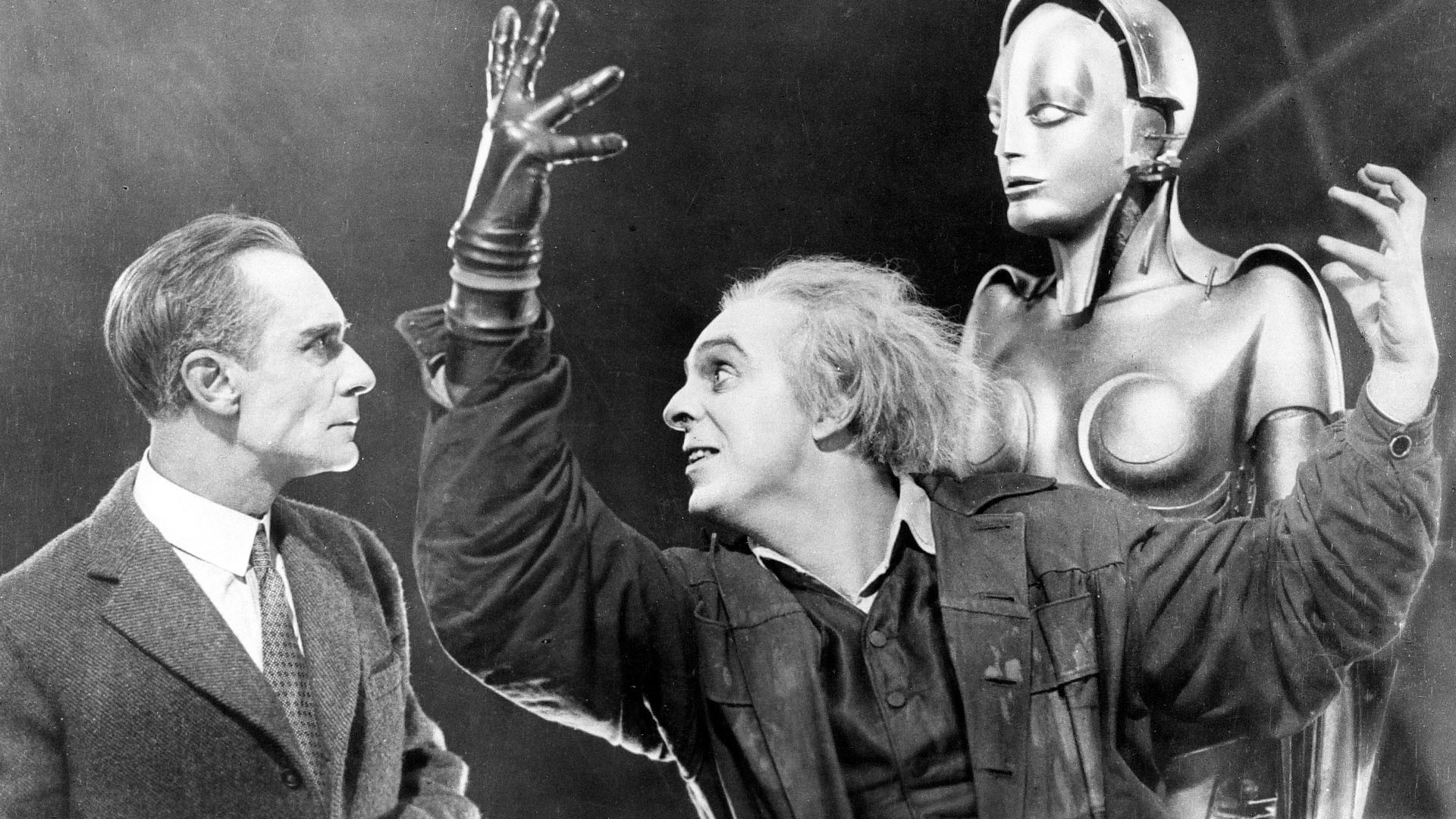
Ackerman was born in L.A. on November 24, 1916, and remained a life-long resident. He was enthralled by sci-fi (a term he coined) early on, always stating his favorite film was Fritz Lang’s silent epic METROPOLIS. As a young man he worked as a…

View original post 508 more words