Scenes That I Love: Lee Marvin on Point Blank


102 years ago today, Lee Marvin was born in New York City.  One of the great screen tough guys, Lee Marvin played stoic and determined men who you didn’t want to upset.

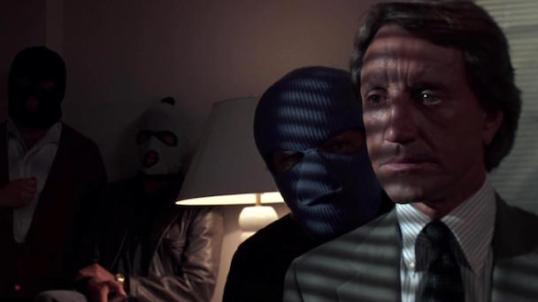
That was certainly true of his role as Walker in 1967’s Point Blank.  A thief who was double crossed by his partner and the organization to which his partner was in debt, Walker is determined to get back the money that he stole from someone else.  Relentlessly, Walker moves from one mob boss to another and repeatedly, those bosses make the mistake of thinking that they can double cross him again.

Point Blank (1967, directed by John Boorman)

In this scene, which was reportedly considered to be shockingly violent by 1967 standards, Carter (Lloyd Bochner) attempts to fool Walker, just to discover that Walker is smarter and far more ruthless than anyone realizes.

4 Shots From 4 Films: Special John Frankenheimer Edition


4 Shots From 4 Films is just what it says it is, 4 shots from 4 of our favorite films. As opposed to the reviews and recaps that we usually post, 4 Shots From 4 Films lets the visuals do the talking!

John Frankenheimer was born 96 years ago today, in New York City.  He got his start working in live television and went on to become one of the best directors of thrillers around.  After getting off to a strong start in the 60s, directing several classic films (many of which had a political subtext), Frankenheimer struggled in the 70s (though even that decade saw him directing the classic Black Sunday) before making a comeback in the 90s.  (1998’s Ronin is regularly cited as having one of the best car chases ever captured on film.)  He was also one of the first film directors to make the transition to regularly working for cable channels like TNT and HBO.  Indeed, the films that he made for HBO played no small part in establishing HBO’s reputation as being a “prestige” network.

It’s time for….

4 Shots From 4 John Frankenheimer Films

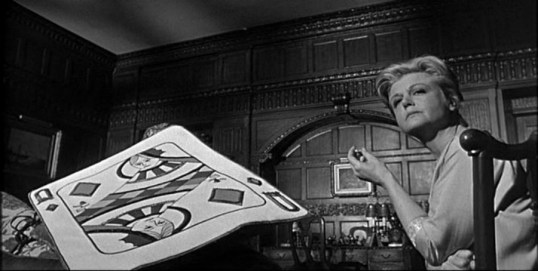
The Manchurian Candidate (1962, dir by John Frankenheimer, DP: Lionel Lindon)

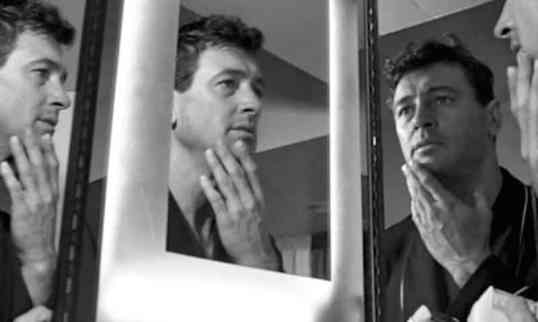
Seconds (1966, dir by John Frankenheimer, DP: James Wong Howe)

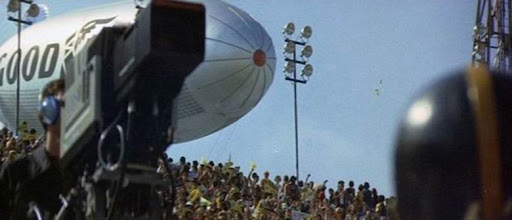
Black Sunday (1977, dir by John Frankenheimer, DP: John A. Alonzo)

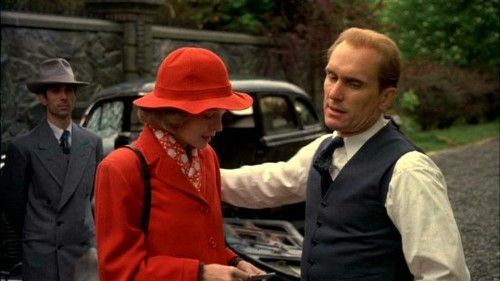
52 Pick-Up (dir by John Frankenheimer, DP: Jost Vocana)

Scenes That I Love: The Opening Credits of Saturday Night Fever


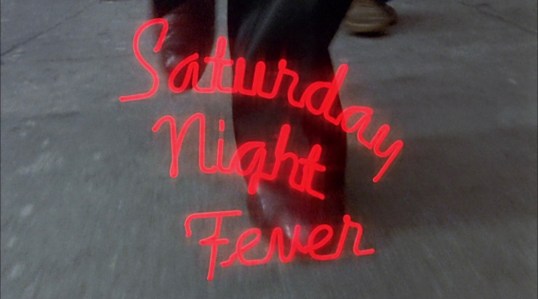
Saturday Night Fever (1977, dir. John Badham)

Today is John Travolta’s birthday!

In honor of this day, here’s a scene that I love, the opening credits of Saturday Night Fever.  Watch as John Travolta, playing the role of Tony Manero, walks down the streets of Brooklyn, not letting the fact that he’s carrying two cans of paint do anything to lessen his strut.  Watch as Tony puts a down payment on a pair of shoes!  Thrill as Tony buys two slices of pizza!  Cringe as Tony bothers a woman who wants absolutely nothing to do with him!

This is one of the greatest introductions in film history.  Not only does it set Tony up as an exemplar of cool but it also subverts our expectations by revealing just how little being an exemplar of cool really means.  I always relate to the woman who gets annoyed with Tony and tells him to go away.  I know exactly how she feels, as does any woman who has ever been stopped in the middle of the street by some guy who thinks she has an obligation to talk him.  It doesn’t matter how handsome he is or how much time he obviously spent working on his hair.  He’s still just some guy carrying two buckets of paint and acting like she should be flattered that he spent half a minute staring at her ass before chasing after her.  For all of his carefully constructed attitude, Tony comes across as being a rather ludicrous figure in this introduction.  He carries those cans of paint like he’s going to war and you secretly get the feeling that he knows how silly he looks carrying them but he’s not going to allow anything to get in the way of his strut.  And yet, as ridiculous as Tony sometimes seems and as bad as behavior does get, you can’t help but want the best for him.  That’s the power of Travolta’s performance.  He shows us who Tony could be if he only had the courage.

Happy birthday to John Travolta!  And here is today’s scene that I love:

4 Shots From 4 Films: Special John Hughes Edition


4 Or More Shots From 4 Or More Films is just what it says it is, 4 shots from 4 of our favorite films. As opposed to the reviews and recaps that we usually post, 4 Shots From 4 Films lets the visuals do the talking!

Director John Hughes would have been 76 years old today.  It’s time for….

4 Shots From 4 John Hughes Movies

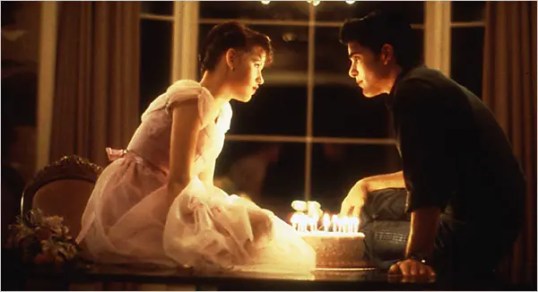
Sixteen Candles (1984, dir by John Hughes, DP: Bobby Byrne)

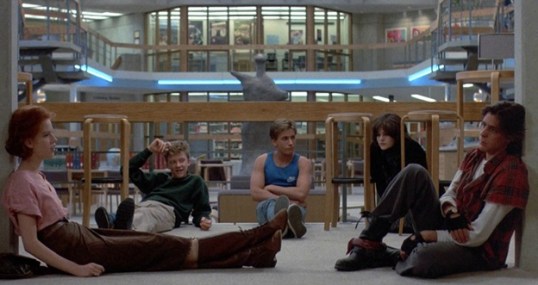
The Breakfast Club (1985, dir by John Hughes, DP: Thomas Del Ruth)

Ferris Bueller’s Day Off (1986, dir by John Hughes, DP: Tak Fujimoto)

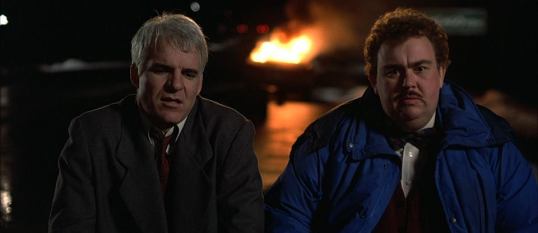
Planes, Trains, and Automobiles (1987, dir by John Hughes, DP: Donald Peterman)


Celebrate Mardi Gras With The Easy Rider Gang


Happy Mardi Gras!

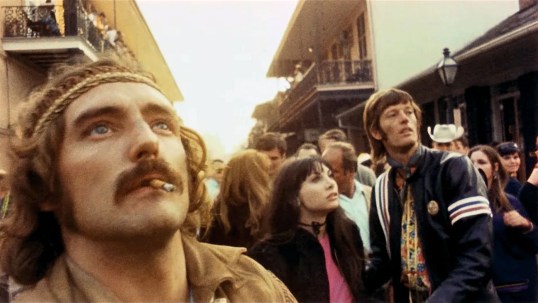
Here is the Mardi Gras sequence from 1969’s Easy Rider.  Featuring Peter Fonda, Dennis Hopper, Karen Black, and Toni Basil walking through the streets of New Orleans, this scene was actually filmed during Mardi Gras.  Those are real Mardi Gras floats and real Mardi Gras participants staring at the camera.  That’s an actual citizen of New Orleans with whom Dennis Hopper appears to have nearly gotten into a fight.  Personally, I relate to Toni Basil in this scene.  She is having a good time no matter what!

I just love how Toni Basil can’t help but dance, no matter what.

4 Shots From 4 Films: Special New Orleans Edition


4 (or more) Shots From 4 (or more) Films is just what it says it is, 4 (or more) shots from 4 (or more) of our favorite films. As opposed to the reviews and recaps that we usually post, 4 (or more) Shots From 4 (or more) Films lets the visuals do the talking.

Today, the Shattered Lens pays homage to the greatest of Mardi Gras cities, New Orleans!

4 Shots From 4 New Orleans-Set Films

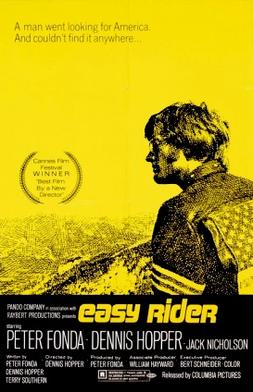
Easy Rider (1969, dir by Dennis Hopper, DP: Laszlo Kovacs)

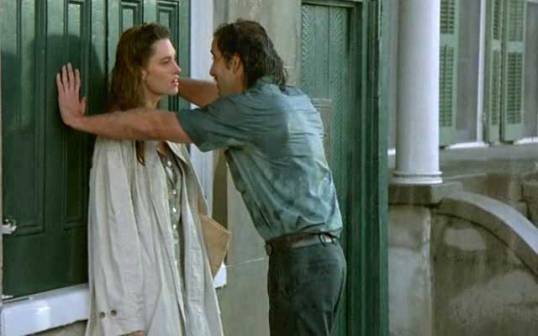
Zandalee (1990, dir by Sam Pillsbury, DP: Walt Lloyd)

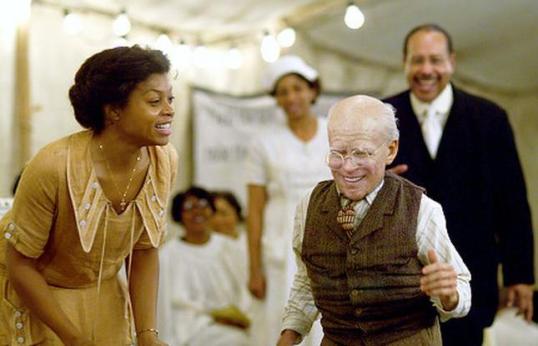
The Curious Case of Benjamin Button (2008, dir by David Fincher, DP: Claudio Miranda)

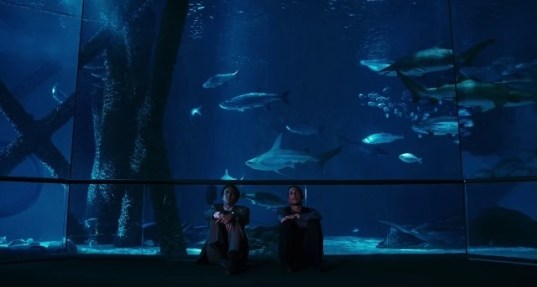
Bad Lieutenant: Port of Call New Orleans (2009, dir by Werner Herzog, DP: Peter Zieitlinger)


Song of the Day: If You’ll Hold The Ladder (I’ll Climb To The Top), performed by Robert Duvall


Robert Duvall missed out on his chance to play Haven Hamilton in Robert Altman’s Nashville but 8 years later, he gave a performance as a country musician that would him his only Oscar.

This is from 1983’s Tender Mercies.

Robert Duvall, RIP


Robert Duvall, RIP


Salud, you glorious actor.

I knew this day was going to come because he was only 5 years away from 100 but still, it breaks my heart.

Rest in peace, Robert Duvall.

In my opinion, Robert Duvall was the best of American actors to come to prominence during the 60s and 70s, someone who was consistently great, who could move you to tears or make you laugh, someone who was just as good at being a villain as he was at being a hero.  It’s hard not to think of a single movie that was not improved by the presence of Robert Duvall.
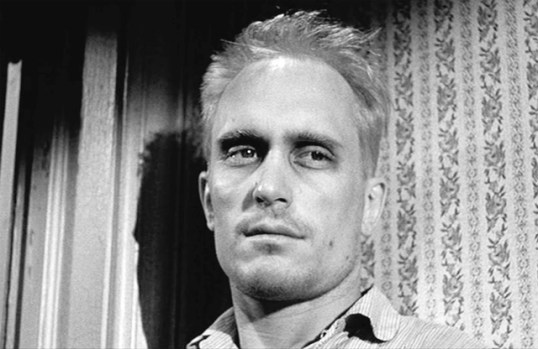
He was the original Boo Radley and, though he was only in To Kill A Mockingbird for a few minutes, his performance was unforgettable.  He captured both the shyness and the compassion of an outcast with a good heart.

In M*A*S*H, he was Major Frank Burns, the dangerously incompetent doctor who drove Bud Cort to tears, got punched out be Elliott Gould, and eventually tried to kill Donald Sutherland.  Burns was the perfect villain and Duvall wisely didn’t play the role for laughs.
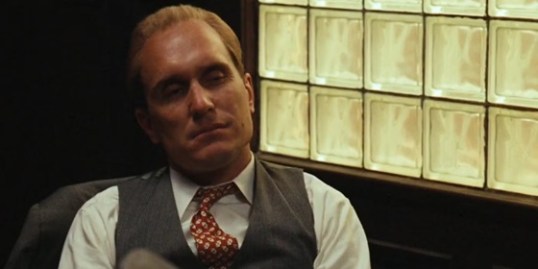
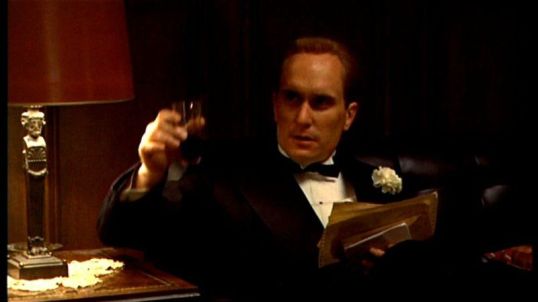
In the original Godfather novel, Tom Hagen was described as being bland and colorless.  In the films, Duvall transformed him into one of the most vibrant characters in the entire saga.  During the first film, when he asks Michael “why am I out?,” he breaks your heart.  When Michael snaps at him in the sequel, you realize that Michael is losing the one person who still cares about him.  His absence in Godfather Part III is so deeply felt that it makes you realize that Robert Duvall was just as important to the saga as Pacino, Caan, Brando, and the rest.
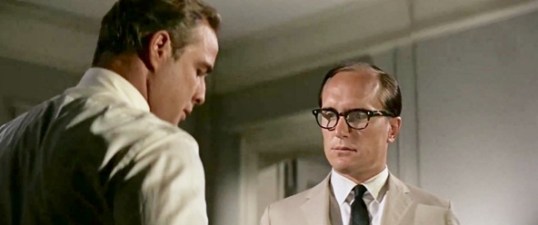
(Robert Duvall had previously worked with Brando in The Chase and, on the set of The Godfather, he was one of the few actors who could call Marlon out.  Once, when Marlon was holding up filming with a hundred nit-picky questions, Duvall said, “Don’t worry, Marlon, we don’t have anywhere to be either.”  Marlon laughed and shot the scene.)

In Apocalypse Now, Duvall delivery of one line — “I love the smell of napalm in the morning,” — summed up everything that the film had to say about war.
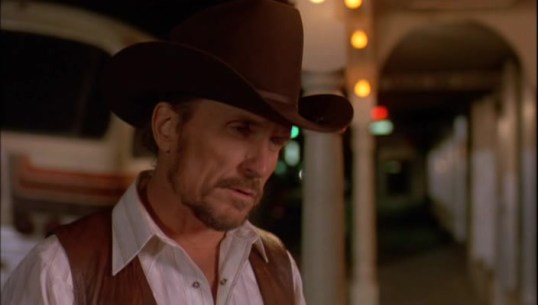
In Tender Mercies, he gave one of the most honest performances that I’ve ever seen and he won a deserved Oscar.  Tender Mercies is one of the great Texas films and that’s largely due to Robert Duvall.
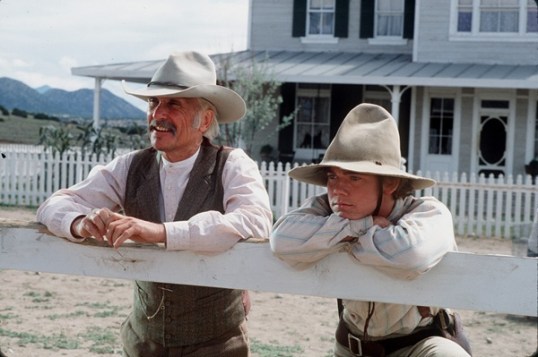
In the miniseries Lonesome Dove, he made you laugh, he made you cry, he made you believe that he had stepped out of the Old West, and he made it all look easy.
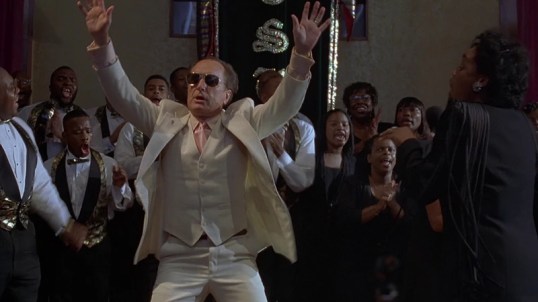
With The Apostle, he proved himself to be as strong a director as an actor.  He crafted one of the best American films about religion to come out in the 90s and he gave a fearless performance that should have won him a second Oscar.

Even in a seriously flawed film like The Judge, he could hold your attention like few other actors.

Robert Duvall was born in California, raised in Maryland, and began his career in New York and yet somehow, he was one of the most authentic Southerners that I’ve ever seen on screen.  Down in my part of the world, we considered him to be something of an honorary Texan.  By most reports, he had the fiercely independent but generous spirit that defines the best of the Southwest.  When he was a struggling actor, his roommates were Gene Hackman and Dustin Hoffman.  His best friend was James Caan.  He knew and worked with the best actors and directors of the past 60 years.
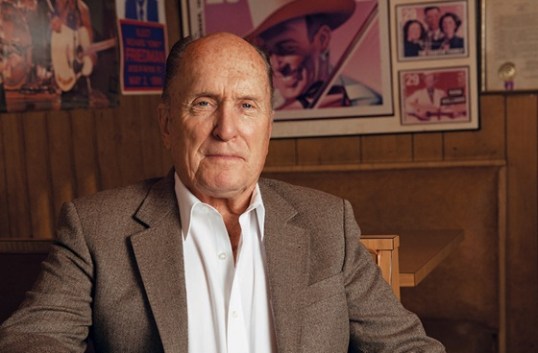
He was a truly one of the greats.  He may be gone but his performances will live forever.