4 Shots From 4 Films is just what it says it is, 4 shots from 4 of our favorite films. As opposed to the reviews and recaps that we usually post, 4 Shots From 4 Films lets the visuals do the talking!
Today, the Shattered Len wishes a happy 80th birthday to the man and the legend, Danny Trejo! Trejo’s journey from being a gang member to an ex-con to a drug counselor to a pop cultural institution is an inspiring one, all the more so because Danny Trejo is so candid about both his past struggles and his present successes.
It’s time for….
4 Shots From 4 Danny Trejo Films
Runaway Train (1985, dir by Andrei Konchalovsky, DP: Alan Hume)
Death Wish 4: The Crackdown (1987, dir by J. Lee Thompson, DP: Gideon Porath)
Heat (1995, dir by Michael Mann, DP: Dante Spinotti)
Machete Kills (2013, dir by Robert Rodriguez, DP: Robert Rodriguez)
Johansen (Dolph Lundgren) is a San Diego cop who remains on the force despite the fact that most of his old friends and former partners have retired. When he’s filmed beating up a Mexican man on the highway, he becomes the latest target of the Defund The Police movement. It doesn’t matter that the man was a human trafficker who was driving truck full of kidnapped women. Johansen has become an embarrassment.
Normally, you would think this would lead to Johansen being fired or, at the very least, suspended. Instead, his bosses decide to send him to Mexico to escort two prisoners back to the United States. Rosa (Christina Villa) and Leticia (Daniela Soto-Brenner) are two sex workers who witnessed the murder of a group of DEA agents. Their testimony could be key to identifying the killers. Despite his friend and former partner, Brynner (Kelsey Grammer), telling him that he should just retire rather than allow the police department to continually push him around, Johansen heads down to Mexico.
It turns out that bringing the women back to the United States is not going to be easy. A roadside ambush leaves Leticia dead and Johansen severely wounded. Though Rosa’s initial instinct is to abandon Johansen in the desert, she eventually takes him to the home of her cousin, a police officer named Miguel (Rocko Reyes). As Johansen recovers, he discovers that the people who want Rosa dead are not going to give up and that he cannot trust anyone.
Let’s give some credit where credit is due. Dolph Lundgren knows how to direct an efficient B-movie. He has an adequate visual eye, he makes good use of the arid desert setting, and he gets believable performances out of the majority of his cast. Christina Villa especially does a good job as the tough but ultimately kind-hearted Rosa. The movie has a bit more going on underneath the surface than the typical B-action film. Johansen is forced to reconsider his own prejudices while the film’s villains argue that they were forced into their actions by a society that refuses to take care of those who are expected to risk their lives to protect the status quo. It’s not a dumb movie, though it does feature a lot of characters doing rather dumb things and the big twist demands that the viewer accept one too many coincidences.
Lundgren not only directed but co-wrote the script. Apparently, he first came up with the idea of the film in 2006. Interestingly, it’s obvious that the film went into production when Defund The Police was still a strong and powerful political movement and the film itself ultimately suggests that the police should be, if not defunded, at least massively reformed. Of course, by the time the film was released in January, the Defund movement was considerably less powerful and was being blamed for the sharp increase in crime across the nation. Chants of “Defund the police” have been replaced by cries of “Fund the police, for the love of God!” That’s the danger which trying to make a film with a political subtext in an age with a 24-hour news cycle. What was popular when a film goes into production will often be a spent force by the time the film actually gets released.
As for Wanted Man, it’s an efficient B-movie that gets the job done. If nothing else, the sight of Dolph Lundgren and Kelsey Grammer playing best friends is just weird enough to keep things watchable.
On this date in 1905, the great actor Joseph Cotten was born in Petersburg, Virginia. A longtime friend and collaborator of Orson Welles, Cotten was one of the most dependable leading men of the 40s and 50s, an actor with the charisma of star and the talent of an artist.
Today’s scene that I love comes from Alfred Hitchcock’s 1943 masterpiece, Shadow of a Doubt, and it features Teresa Wright and Joseph Cotten. Wright plays Charlie. Cotten plays her beloved uncle, who is also named Charlie and who might very well be a serial killer. In this scene, Uncle Charlie drags his niece to a seedy bar, where he confesses that, as she earlier deduced, he is a suspect in a murder investigation. With a mixture of charm and intimidating, Charlie tries to convince his niece to keep his secret to herself.
4 Shots From 4 Films is just what it says it is, 4 shots from 4 of our favorite films. As opposed to the reviews and recaps that we usually post, 4 Shots From 4 Films lets the visuals do the talking!
Today, the Shattered Lens wishes a happy birthday to English director and editor, John Glen! It’s time for….
4 Shots From 4 John Glen Films
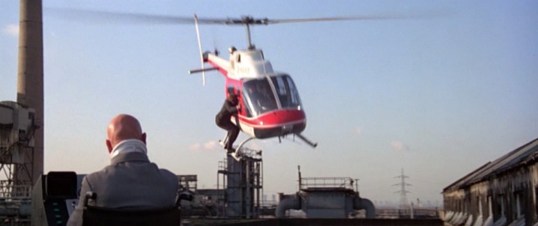
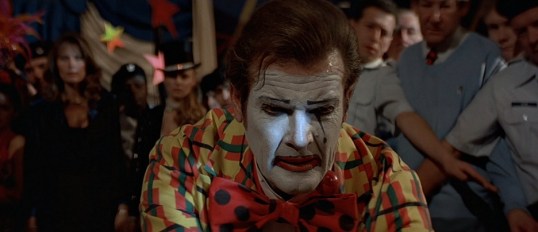
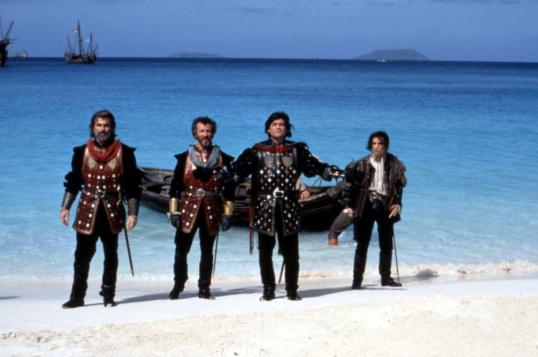
For Your Eyes Only (1981, dir by John Glen, DP: Alan Hume)
Octopussy (1983, dir by John Glen, DP: Alan Hume)
A View To A Kill (1985, dir by John Glen, DP: Alan Hume)
Christopher Columbus: The Discovery (1992, dir by John Glen, DP: Alec Mills)
Cassie Webb (Dakota Johnson) is a paramedic in New York City. Haunted by the fact that her mother died while giving birth to her while looking for a special spider in Peru (and I cannot believe that I just wrote that), Cassie struggles with showing her emotions and opening up to people. In fact, her only friend appears to be her fellow paramedic, Ben Parker (Adam Scott). Ben’s sister-in-law is pregnant and Cassie tells him, “You’ll be a great uncle, Ben.”
After a near-death experience, Cassie discovers that she has the ability to see into the future. She also discovers that a strange man named Ezekiel (Tahar Rahim) wants to kill three teenage girls, Mattie (Celeste O’Connor), Anya (Isabela Merced), and Julia (Sydney Sweeney). Cassie does what anyone would do. She kidnaps the three girls to keep them safe and then hops on a plane to Peru to find out how Ezekiel is connected to her mother’s death.
Madame Web is the latest entry in Sony’s Spider-Man Universe. Because Sony has the rights to Spider-Man, all of the MCU films featuring Spider-Man have been co-productions with Columbia Pictures and have been distributed by Sony. With Spider-Man emerging as one of the few characters to remain a strong box office draw for Marvel, Columbia has produced a series of Spider-Man-adjacent films that feature characters who have appeared in Spider-Man-related media. While Marvel and Disney have Tom Holland swinging his way through New York, Sony has to settle for Adam Scott and Dakota Johnson in an ambulance.
I always assume that the folks at Marvel and Disney probably groan a little whenever they hear that a new Sony film is coming out. The MCU Spider-Man films have been consistently strong, with all three of them proving popular with both audiences and critics. The Sony Spider-Man films, on the other hand, often seem like throwbacks to the bad old days of the early aughts, when most comic book films were still cheap and kind of embarrassing. Madame Web doesn’t do much to change this perception. In fact, the film is even set in 2003, complete with a Blockbuster Video store prominently featured in one scene, Britney Spears’s Toxic playing in a roadside diner, and a totally random reference to American Idol. (What’s funny is that the jokey reference to American Idol would really only work if the show were no longer on the air but actually, it’s still airing on CBS. No one ever seems to notice anymore but it’s still there. If the movie really had any guts, it would have had Dakota Johnson says that she was going home to watch Paradise Hotel.)
Slow-paced and featuring some of the most awkward line readings this side of a community theater production of Bus Stop,Madame Web is not a particularly engaging film. After a truly abysmal prologue set in Peru, the film spends about half-an-hour giving us a tour of Cassie’s not particularly interesting life as a tough New York paramedic before finally getting started on the main story. And even then, the film leaves the viewer feeling cheated because none of three girls — who we are told are all destined to become super heroes — actually become super powered over the course of the film. The film basically says, “They’re all going to be Spiderwoman …. BUT NOT TODAY!” The problem with that approach is that it’s hard not to feel that the only interesting thing about the three girls is that they’re eventually going to have super powers. Without the powers, they’re just kind of boring. Cassie is the only one who has a super power but being able to see three minutes into the future isn’t that much of a power. Dakota Johnson and the rest of the cast all seem to be bored out of their minds and who can blame them?
The main problem with Madame Web is that it’s just not much fun. The best super hero films are fun to watch. That goes for the Marvel films, the DC films, and even the Sony films. (Admit it, the first Venom was kind of fun.) Even with The Dark Knight films, Christopher Nolan understood that the villains had to be flamboyant to make up for Christian Bale’s rather dour Batman. In this film, we’re never quite sure what Ezekiel wants or even who he is. He’s just a random evil guy and not a particularly memorable one. Madame Web does make some attempts at humor but the sitcom-style jokes are negated by Dakota Johnson’s flat delivery. (Oddly enough, sitcom veteran Adam Scott is stuck playing a serious character.) Overall, there’s an overwhelming blandness to Madame Web. It doesn’t engage,. It doesn’t thrill. It doesn’t make you cheer or even jeer. It’s just kind of there.
The film sets up a sequel but, judging from how the film did at the box office and how not even the film’s cast has pretended to be happy with how the film turned out, I’d expect to see Morbius 2 before another installment of Madame Web.
Today, the Shattered Lens wishes a happy birthday to director Robert Zemeckis!
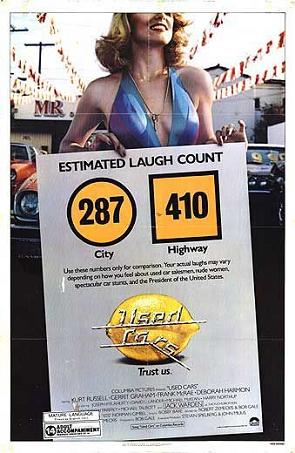
Today’s scene that I love comes from Zemeckis’s 1980 comedy, Used Cars! In this scene, used car salesman Gerrit Graham interrupts a televised presidential address so that he can demonstrate the best way to deal with inflation.
(Of course, he does the demonstration at a rival used car lot.)
Jack Warden watches as his cars blow up while Graham’s boss (Kurt Russell) tries to keep his business partner (Deborah Harmon) from noticing what is happening on the television.
4 Shots From 4 Films is just what it says it is, 4 shots from 4 of our favorite films. As opposed to the reviews and recaps that we usually post, 4 Shots From 4 Films lets the visuals do the talking!
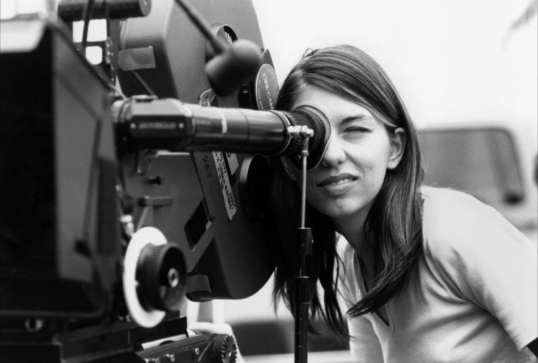
Today is the birthday of one of my favorite American directors, the one and only Sofia Coppola! In honor of this day, here are….
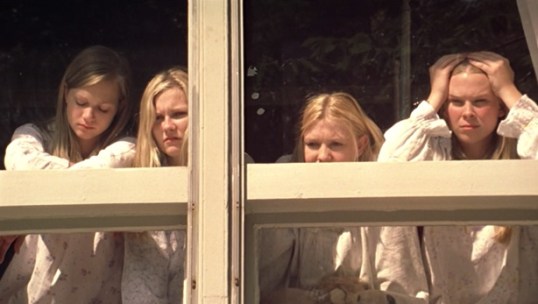
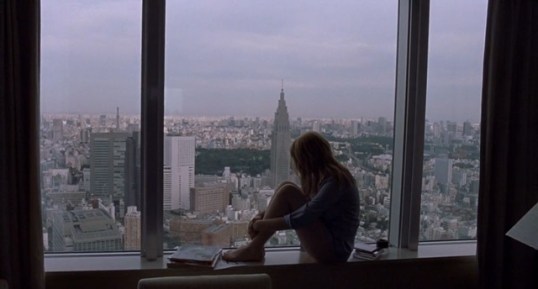
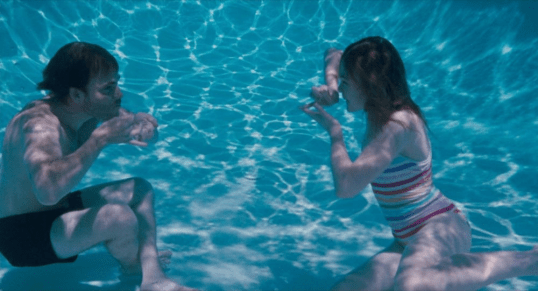
4 Shots From 4 Sofia Coppola Films
The Virgin Suicides (1999, dir by Sofia Coppola, DP: Edward Lachman)
Lost In Translation (2003, dir by Sofia Coppola, DP: Lance Acord)
Marie Antoinette (2006, dir by Sofia Coppola, DP: Lance Acord)
Somewhere (2010, dir by Sofia Coppola, DP: Harris Savides)
The Cannes Film Festival opens today. One of the most anticipated films on this year’s program is Francis Ford Coppola’s Megalopolis, a long-time passion project from Coppola that the studios apparently judged to be unsellable.
I have to admit that, from what I heard about the film, I was a bit skeptical about it. But, earlier today, I saw the trailer and I’ll just say that it won me over. The visuals, the humor, the fact that Coppola seems to be aware that his film is vision is a bit over the top, all of them fill me with a new-found hope for this film.
As some of our regular readers undoubtedly know, I am involved in hosting a few weekly live tweets on twitter and occasion ally Mastodon. I host #FridayNightFlix every Friday, I co-host #ScarySocial on Saturday, and I am one of the five hosts of Mastodon’s #MondayActionMovie! Every week, we get together. We watch a movie. We snark our way through it.
It should make for a night of fun viewing and I invite all of you to join in. If you want to join the live tweets, just hop over to twitter, pull Rope up on Prime, and use the #MondayMuggers hashtag!
In 1995, an 11 year-old boy named Orion (voiced by Jacob Tremblay) lives in Philadelphia.
He has two loving parents. He lives in a nice house. He has his fist crush, on his classmate Sally (voiced by Shino Nakamichi). He has a bully (voiced by Jack Fisher) who enjoys giving him a hard time and he has several notebooks full of his thoughts and drawings. He also has a lot of fears.
Indeed, it’s his fears that largely define Orion. Some of his fears are understandable. I don’t like wasps or murder clowns either. Some of his other fears are a bit more elaborate. He’s scared of his bully but he’s even more scared of fighting his bully because he might accidentally break the bully’s nose and drive a piece of bone into the bully’s brain, therefore killing him. His biggest fear, however, is his fear of the Dark.
In fact, Orion spends so much time talking about how much he hates the dark and how scared he is of the dark that Dark (Paul Walter Hauser) appears to him in human form and explain that he’s getting tired of Orion blaming him for anything. Dark takes Orion with him as he travels across the world, bringing darkness to various countries and overseeing various other elements, like Sweet Dreams (Angela Bassett), Unexplained Noises (Golda Rosheuvel), Insomnia (Nat Faxon), Quiet (Aparna Nancherla), and Sleep (Natasia Demetriou). Dark shows Orion that there’s no need to scared of the dark and that everyone involved is just doing their job. Orion comes to understand and appreciate Dark but, when he makes the mistake of saying that he still kind of likes Light (voice by Ike Barinholtz) better, it leads to a lot of hurt feelings and resignations….
If this sounds a bit weird, one should keep in mind that the story is being told by the adult Orion (voiced by Colin Hanks) to his daughter, Hypathia (Mia Akemi Brown). Adult Orion is telling the story to help Hypathia deal with her own fears and it soon becomes obvious that he’s making it up as he goes along. Hypathia is aware of this and has no hesitation about calling out the stuff that doesn’t make any sense. And when Orion proves incapable of coming up with a satisfactory ending for his story, Hypathia jumps into the story herself in an attempt to bring it all to a proper conclusion. But once she’s in the story, can she get back out?
Orion and the Dark may sound like a standard “conquer your fears and believe in yourself” animated film but the script was written by Charlie Kaufman and, in typical Kaufman fashion, the story is full of twists and turns and more than a few moments of commentary on the whole act of storytelling itself. There’s actually a lot going on in Orion and the Dark, with the film ultimately becoming a tribute to the power of imagination and to all of the parents-turned-storytellers in the world.
I’m a bit notorious for crying while watching animated films and I will say that Orion and the Dark brought tears to my eyes more than a few times. It’s an incredibly sweet movie, one that can be appreciated by both children and adults. It’s a movie about not just conquering fears but also using those fears to make oneself stronger. The final message is that light cannot exist without the dark and vice versa but that’s okay. There’s much to love in the light but the dark can be lovable too. Fear is a part of life but it’s not the only part of life.
Creatively-animated and featuring a strong cast of voice actors, Orion and the Dark is definitely one to check out.