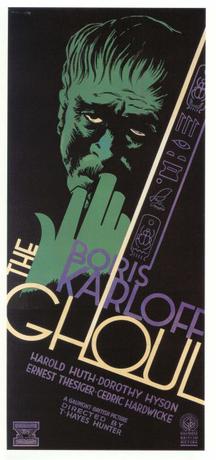
Horror Film Review: The Ghoul (dir by T. Hayes Hunter)


Some actors can make just about anything worth watching.  That’s certainly the case with Boris Karloff and 1933’s The Ghoul.

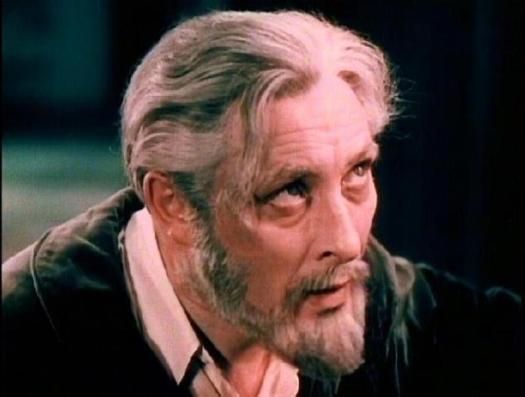
In The Ghoul, Karloff plays Prof. Henry Moriant.  The professor is an Egyptologist, a world-renowned expert on the dead.  Moriant is now facing death himself, sick in bed and ranting about how he wants to be treated after he passes.  Nigel Hartley (Ralph Richardson) stops by the mansion while pretending to be a vicar and offers to comfort Prof. Moriant in his last moments.  The butler, Laing (Ernest Thesiger), explains that Moriant has never had much use for traditional religion.  Instead, Moriant believes in the Gods of Egypt.

In death, Moriant wants to be buried with an Egyptian jewel in his hands.  He believes that, after he dies, he will exchange the jewel with the Egyptian God Anubis and he will be reborn with amazing powers.  However, when Moriant passes, Laing keeps the jewel for himself and attempts to hide it from the countess number of people who show up at the mansion, all seeking either the jewel or just information about Moriant’s estate.  Moriant may not have been loved in life but everyone clearly loves his money.

Boris Karloff is not actually in that much of The Ghoul.  He dominates the start of the film, ranting from his deathbed.  And then, towards the end of the film, he rises from the dead and attacks those who he thinks have betrayed him and stolen the jewel.  He’s only onscreen for a few minutes but he dominates those minutes.  Karloff’s screen presence is undeniable.  When he’s in a scene, he’s the only person that you watch.  When he’s not in a scene, you find yourself wondering how long it’s going to take for Karloff to return.

That’s not to say that the other actors in The Ghoul aren’t good.  The cast is full of distinguished names.  Along with Richardson and Thesiger, Cedric Hardwicke, Anthony Bushnell, Dorothy Hyson, and Kathleen Harrison all wander through the mansion and try to avoid getting caught up in Karloff’s vengeance.  Harrison provides the film’s comic relief and I actually enjoyed her flighty performance.  The film itself is so darkly lit and full of so many greedy characters that it was nice to have someone on a totally different wavelength thrown into the mix.  That said, the majority of the actors are stuck with paper-thin characters and aren’t really allowed the time to make much of an impression.  This is Karloff’s film, from the beginning to end.  And while the film itself is definitely a bit creaky, Karloff is always enjoyable to watch.

The Ghoul was made at a time when Karloff, having become a star with Frankenstein, was frustrated with the roles that he was being offered in America.  He returned to his native UK and promptly discovered that he was just as typecast over there as he was in the United States.  For a long time, The Ghoul was believed to be a lost film.  However, in 1968, a copy was discovered in Egypt of all places.  It’s unfortunate that the film itself isn’t better but there’s no denying the power of Karloff the performer.

 

10 Horror Stars Who Never Won An Oscar


gary loggins's avatarcracked rear viewer

It’s Oscar night in Hollywood! We all may have our gripes with the Academy over things like the nominating process (see my posts on THE OTHER SIDE OF THE WIND STAN & OLLIE and THEY SHALL NOT GROW OLD ), but in the end, we’ll all still be watching – I know I will!

One of my gripes over the years has always been how the horror genre has gotten little to no attention from Oscar over the years. Sure, Fredric March won for DR. JEKYLL & MR. HYDE , but there were plenty of other horror performances who’ve been snubbed. The following ten actors should have (at least in my opinion) received consideration for their dignified work in that most neglected of genres, the horror film:

(and I’ll do this alphabetically in the interest of fairness)

LIONEL ATWILL

 Atwill’s Ivan Igor in MYSTERY OF THE WAX MUSEUM goes…

View original post 1,042 more words

Halloween Havoc!: BRIDE OF FRANKENSTEIN (Universal 1935)


gary loggins's avatarcracked rear viewer

James Whale’s brilliant BRIDE OF FRANKENSTEIN is one of those rare occasions where the sequel is better than the original… and since the original 1931 FRANKENSTEIN is one of the horror genre’s greatest films, that’s saying a lot! Whale’s trademark blend of horror and black humor reached their zenith in BRIDE, and though Whale would make ten more films before retiring from Hollywood moviemaking in 1941, this was his last in the realm of the macabre. It turned out to be his best.

Mary Shelley’s got a story to tell…

William Hurlbut’s screenplay start with a prologue set during the proverbial dark and stormy night, with Mary Shelly (Elsa Lanchester ), Percy Bysshe Shelley (Douglas Walton), and Lord Byron (Gavin Gordon ) discussing Mary’s shocking novel “Frankenstein” as clips from the 1931 film are shown. Then Mary tells them there’s more to the story, and we pick up…

View original post 785 more words

Happy Birthday Boris Karloff: THE OLD DARK HOUSE (Universal 1932)


gary loggins's avatarcracked rear viewer

William Henry Pratt was born on November 23, 1887, but horror movie icon Boris Karloff was “born” when he teamed with director James Whale for 1931’s FRANKENSTEIN. The scary saga of a man and his monster became a big hit, and Universal Studios boss Carl Laemmle Jr. struck while the horror trend was hot, quickly teaming the pair in an adaptation of J.B. Priestley’s 1927 novel THE OLD DARK HOUSE. This film was considered lost for many years until filmmaker and Whale friend Curtis Harrington discovered a print in the Universal vaults. Recently, a 4K restoration has been released courtesy of the Cohen Film Collection, and a showing aired on TCM this past Halloween. I of course, having never seen the film, hit the DVR button for a later viewing.

THE OLD DARK HOUSE has not only been restored to its former glory, but is a delightful black comedy showcasing…

View original post 994 more words

Horror Film Review: The Bride of Frankenstein (dir by James Whale)


brideoffrankposter

1935‘s The Bride of Frankenstein is usually described as being a sequel to Frankenstein, but I think it would be better to call it a continuation.  In much the same way that all modern YA adaptations seem to be split into two parts, Universal split Mary Shelley’s Frankenstein into two separate films.  The bare basics of The Bride of Frankenstein‘s plot — the monster learns to talk and demands that his creator build him a mate — can all be found in the original novel.

(Of course, in the original novel, the monster somehow learns how to speaks like an Oxford grad and Dr. Frankenstein destroys the female monster before bringing her to life.  The monster responds by killing Elizabeth.  Seriously, Frankenstein is a dark book.)

Bride of Frankenstein features one of my favorite openings of all time.  Lord Byron (Gavin Gordon) and Percy Bysshe Shelley (Douglas Walton) are praising Mary Shelley (Elsa Lanchester) and the story that she’s told about how a dedicated scientist played God and created life.  Mary informs them that she’s not finished and then proceeds to tell them the rest of the story.  It’s a great opening because it lets us know that the rest of what we’re seeing is taking place directly inside of Mary’s mind.  It frees the film from the constraints of realism and allows director James Whale to fully indulge his every whim, no matter how bizarre.  When you’re inside someone else’s imagination, anything can happen and that’s certainly the feeling that you get as you watch The Bride of Frankenstein.

The Bride of Frankenstein opens with that burning windmill and a wounded Henry Frankenstein (Colin Clive) being carried back to his wife, Elizabeth (Valerie Hobson, replacing Mae Clarke).  Gone is the original film’s coda, in which Elizabeth announces that she’s pregnant.  And why shouldn’t it be gone?  It felt awkward in the first movie and, like any good writer, Mary Shelley is fixing her story as she goes along.

While Henry is recovering, he is approached by a former mentor, Dr. Pretorious (Ernest Thesiger).  Dr. Pretorious is undoubtedly an eccentric and definitely a little bit crazy but he believes in Frankenstein’s work.  In fact, Dr. Pretorious has even created life on his own!  He’s created a bunch of tiny people that he keeps in several glass jars.  They’re impressive but, sadly, they’ll never conquer the world.  Pretorious wants Frankenstein to, once again, work with him to create life.  As Pretorious explains it, it’s time to usher in a new age of “God and monsters!”

(Interestingly enough, one of Pretorious’s henchmen is played by Dwight Frye, who previously played Frankenstein’s henchman, Fritz, in the first film.  Frye dies in both films.  Reportedly, Universal bestowed upon him the nickname, “The Man of a Thousand Deaths.”  It can perhaps be argued that Dwight Frye was both the Steve Buscemi and the Giovanni Lombardo Radice of Universal horror.)

Meanwhile, the monster (Boris Karloff, credited with just his last name because, just four years after Frankenstein and the Mummy, he was already an icon) has survived the burning windmill.  He’s lonely, he’s afraid, and he actually kills more people in The Bride of Frankenstein than he did in Frankenstein.  And yet, he’s still the film’s most sympathetic character.  With everyone constantly trying to kill him, you can understand why the monster is quick to attack every human being that he sees.  He’s almost like a dog who, after years of abuse, automatically growls and bears his teeth at anyone that he sees.

And yet, the monster does eventually find a friend.  A blind hermit (O.P. Heggie) invites the monster into his own home.  (Of course, the hermit does not know who the monster is.  He just assumes that monster is a normal man who does not know how to speak.)  As time passes, the hermit teaches the monster how to say a few words and also tells the monster that there is nothing worse than being lonely.  The monster learns that “Friend good.”  The monster even learns how to smoke a cigar and Heggie and Karloff play these roles with such warmth (Bride of Frankenstein is not only the film where the Monster learns to talk, it’s also the one where he learns to smile) that you really start to dread the inevitable scene where everything goes wrong.

And that scene does arrive.  Two hunters stop by the hermit’s shack and immediately attack the Monster.  The Monster flees.  The shack burns down.  The hermit is led away from his only friend, apparently destined to be lonely once again.

Eventually, of course, the Monster does get his bride.  The Bride is such an iconic character that it’s easy to forget that she only appears in the final ten minutes of the film.  Elsa Lanchester plays both Mary and the Bride.  She screams when she sees the Monster.  “We belong dead,” the Monster replies and my heart breaks a little every time.

So, which is better?  Frankenstein or The Bride of Frankenstein?  I don’t think it’s necessary to choose one or the other.  To use a metaphor that might be appreciated by Henry and Dr. Petorious, Frankenstein is the brain while The Bride of Frankenstein is the heart.  They’re two good films that, when watched together, form one great film.

A Quickie With Lisa Marie: The Robe (dir. by Henry Koster)


As part of my mission to view every film — good or bad — ever nominated for best picture, I spent last night watching 1953’s The Robe (which was nominated for best picture but lost to From Here To Eternity.)  The Robe is an old school biblical epic, the type of film that used to regularly get nominated for best picture but which you don’t see much of anymore.  If you’re wondering why that genre hasn’t stood the test of time, I’d suggest watching The Robe.

Richard Burton stars as Marcellus, a womanizing Roman centurion who falls in love with young, pure noblewoman Diana (Jean Simmons).  Unfortunately, Diana is set to marry the decadent Caligula (Jay Robinson).  (Yes, that Caligula…)  Burton’s rivalry with Caligula leads to him being reassigned to Jerusalem where he not only witnesses the crucifixion but also wins Jesus’ robe in a dice game.  However, Marcellus soon finds himself being haunted by nightmares of the crucifixion and he discovers that he can’t even wear the robe without having a seizure.  His slave, Demetrius (played by musclebound Victor Mature) has secretly become a Christian and steals The Robe before disappearing into the Holy Land.  As Marcellus, who believes that only by destroying the robe can he free himself from his guilt, searches for Demetrius, he is reunited with Diana and, since this is an old school biblical epic, he also ends up converting as well.  Unfortunately, he does all this around the same time that Caligula becomes Emperor and (in this film if not in actual history) begins to persecute the early Christians.

The Robe was the first film to made in “Cinemascope” and, while that may have been an amazing development back in 1953, when watched today, it’s obvious how much of the film is really just made up of filler designed to show off the new process.  Again, it may have been amazing at the time but today, it just seems like a slow movie.  Even more importantly, The Robe itself is so reverent and respectful of its subject that it’s just not that interesting.  Speaking as a nonbeliever, I’ve still sometimes feel that a lot of contemporary films make it a point to ridicule Christians because they’re an easy target.  Unlike a certain other world-wide religion, most Christians aren’t going to blow you up just because you featured an image of Jesus in your movie.  However, movies like The Robe were not only extremely reverent and respectful but they went out their way to let you know how reverent and respectful they were being.  The result is a film that lack any hint of nuance or anything that might actually challenge the audience.  It’s like Avatar with Jesus

Since he’s best known for being an alcoholic and marrying Elizabeth Taylor, Richard Burton might seem like an odd choice to play an idealistic Christian martyr.  And, quite frankly, he is.  Throughout the film, he’s visibly uncomfortable and, quite frankly, he didn’t have the legs necessary to pull off the ancient Roman look either.  Jean Simmons is also stuck playing a stock character — the virtuous maiden.  As with a lot of the old school biblical epics, the lead characters are so boring that you can’t help but feel they had more fun as pagans.  Meanwhile, poor Victor Mature wanders through the film struggling to show anything resembling emotion.   I mean, he tries so hard that its impossible not to like him.  At the very least, The Robe proves that any film featuring Victor Mature will have some sort of camp value. 

(As I watched The Robe, I kept thinking about a comment that Groucho Marx supposedly made.  Apparently, he said he wouldn’t watch any movie starring Victor Mature because “I won’t watch any movie where the guy’s tits are bigger than the girl’s.”)

The Robe does feature some interesting supporting performances from several wonderful B-movie character actors.  Jay Robinson is obviously having the time of his life playing the Emperor Caligula.  Robinson’s version isn’t quite as effective as Malcolm McDowell’s but Robinson is a  lot more fun to watch.  Richard Boone is effectively slovenly in the role of Pilate and there’s a nice little throw-away scene where Pilate absent-mindedly washes his hands twice.  Meanwhile Ernest Thesiger (who played Dr. Pretorious in the Bride of Frankenstein) is an oddly benevolent Emperor Tiberius while Michael Rennie, the alien from the original The Day the Earth Stood Still, plays none other than St. Peter.  Even Jeff Morrow (from This Island Earth) has a small role.

Like most of the old school Hollywood biblical epics, The Robe seems pretty hokey when viewed today and I get the feeling it probably seemed hokey when it was first released back in 1953.  Still, I remember that my Grandma Meehan used to love to watch these movies whenever they would show up on television.  She would have deep theological debates with the images that flickered across the screen.   I can still remember spending multiple Easters listening to her argue with The Ten Commandments.  I don’t know if Grandma ever saw The Robe but I do know that she believed that the Holy Tunic was presently located in France and not at the Cathedral of Trier in Germany.  Seriously, you did not want to question her on this point. 

To be honest, watching this type of film is always an odd experience for me.  Up until recently, I described myself as a “fallen Catholic” and I always felt so proud of myself afterward.  I could spend hours telling you why I no longer believed in the faith of my childhood and I could get quite smug about it.  I guess I still can but, as of late, I’ve discovered that humility goes well with a lack of faith.  I’ve also been forced to admit that when you’re raised Catholic, you’re a Catholic for life regardless of whether you believe in the Holy Trinity or not.  If pressed, I guess I’d call myself “an agnostic Catholic.”  I’m the type of nonbeliever who still feels the need to go to confession after a long weekend.  It’s not so much that I doubt my doubt as much as I wish that I could still go back to a time in my life when I actually could have faith without feeling like I was in denial.  So, even as I openly scoff at these films, there’s always that small part of my heart that wants to embrace the film in all of its simplistic and hokey glory.

That said, it’s also true that The Robe is a lot easier to resist than a film like Pasolini’s The Gospel According to Saint Matthew or, for that matter, The Exorcist.