“Killian, here’s your Subzero… now plain zero!”
Uhm, excuse me, Mr. Schwarzenegger, but a man just died. He probably had a family who just watched you kill him on national television….
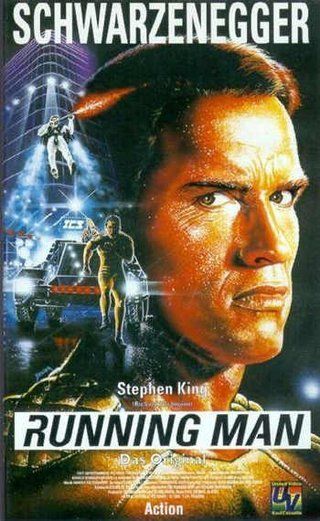
Oh well, it happens! In the role of Ben Richards, Arnold Schwarzenegger kills quite a few people over the course of the 1987 film, The Running Man, but they were all bad. In fact, when we first meet Ben Richards, he’s a cop who is trying to save lives. His superiors want him to open fire on a bunch of protestors who simply want enough food to eat. When Richards refuses to do it, he is framed for perpetrating “the Bakersfield Massacre” and is sent to prison. When he is recaptured after escaping, he is given a chance to compete on America’s number one game show, The Running Man! Hosted and produced by Damon Killian (Richard Dawson, oozing smarm in a performance that — in a fair world — would have received Oscar consideration), The Running Man is a show in which prisoners are given a chance to win prizes like a trial by jury or maybe even a pardon. While the audience cheers and puts down bets, the prisoners are stalked by professional killers like Buzzsaw (Gus Rethwisch), Dynamo (Erland Van Lidth), Fireball (Jim Brown), and Sub-Zero (Professor Toru Tanaka). Along with Killian, Captain Freedom (Jesse Ventura) provides commentary and analysis on how the game is going. Ben soon finds himself joined by Amber (Maria Conchita Alonso), who proves herself to be just as tough as he is.
Seen today, The Running Man feels more than a bit prophetic. Due to worldwide economic collapse, the poor are getting poorer while the rich are getting richer. The American government has become both increasingly corporate and increasingly authoritarian. The citizens are entertained and manipulated by “reality” programming. On camera, Killian is a charismatic host who delivers his lines with faux sincerity and who loves to meet and give away prizes to the public. (There’s something both undeniably creepy and also rather familiar about the way that Killian sniffs the hair, rubs the shoulders and holds the arms of the audience members to whom he’s speaking. It’s all very calculated and one gets the feeling that Killian washes his hands as soon as the camera are off of him.) Behind the scenes, he drinks, smokes, curses, and is full of contempt for everyone around him. He may not be happy when Ben outsmarts and kills the show’s stalkers but he definitely cheers up when he hears how good the ratings are. The film is set in 2017, which was 30 years in the future when The Running Man was first released. Seen today, The Running Man’s 2017 feels a lot like our 2017….
That said, The Running Man is also a big, flamboyant, and undeniably entertaining film. It’s also surprisingly funny, at times. Living in a dystopia ahs turned everyone into a quip machine. None of the bad guys die without Schwarzenegger making a joke about it. (“Buzzsaw? He had to split.” Yes, he did.) The show’s vapid studio audience, who go from cheering the prospect of witnessing a bloody death to crying when their favorite stalker is killed, is both disturbing and humorous. (Also memorable is the faux somber dance number that is performed while the show memorializes all the dead stalkers.) For all the costumed heroes and villains, the film is practically stolen by an older woman named Agnes who becomes Ben Richards’s favorite fan. The gaming “quads” may be dark and dangerous and full of angry people but they’re also full of advertisements for Cadre Cola. Dey Young of Rock and Roll High School and Strange Behavior fame has a cameo as Amy, who pays six dollars for a can of Cadre. (That may seem like a lot for a can of anything but Cadre is the official cola of The Running Man! Damon Killian endorses it! And, of course, when The Running Man was produced, the studio was owned by Coca-Cola so the jokes about Cadre’s corporate dominance also serve as a “take that” towards the corporation who put up money for the film. Either that or Cadre is stand-in for Pepsi.)
It’s easy to compare The Running Man to The Hunger Games films but The Running Man is infinitely more fun, if just because it doesn’t make the mistake of taking itself as seriously as The Hunger Games did. (Add to that, The Running Man manages to wrap up its story in 90 minutes, whereas The Hunger Games needed four movies.) Like The Hunger Game, The Running Man is based on a book, in this case a very loose adaptation of one of the pulpy novels that Stephen King wrote under the name of Richard Bachman. While King said that he enjoyed the film, he also asked that his real name not be listed in the credits because the film had little in common with his book, which is fair enough. The Running Man may have been inspired by a Stephen King novel but it’s an Arnold Schwarzenegger production through-and-through.

Previous Guilty Pleasures
- Half-Baked
- Save The Last Dance
- Every Rose Has Its Thorns
- The Jeremy Kyle Show
- Invasion USA
- The Golden Child
- Final Destination 2
- Paparazzi
- The Principal
- The Substitute
- Terror In The Family
- Pandorum
- Lambada
- Fear
- Cocktail
- Keep Off The Grass
- Girls, Girls, Girls
- Class
- Tart
- King Kong vs. Godzilla
- Hawk the Slayer
- Battle Beyond the Stars
- Meridian
- Walk of Shame
- From Justin To Kelly
- Project Greenlight
- Sex Decoy: Love Stings
- Swimfan
- On the Line
- Wolfen
- Hail Caesar!
- It’s So Cold In The D
- In the Mix
- Healed By Grace
- Valley of the Dolls
- The Legend of Billie Jean
- Death Wish
- Shipping Wars
- Ghost Whisperer
- Parking Wars
- The Dead Are After Me
- Harper’s Island
- The Resurrection of Gavin Stone
- Paranormal State
- Utopia
- Bar Rescue
- The Powers of Matthew Star
- Spiker
- Heavenly Bodies
- Maid in Manhattan
- Rage and Honor
- Saved By The Bell 3. 21 “No Hope With Dope”
- Happy Gilmore
- Solarbabies
- The Dawn of Correction
- Once You Understand
- The Voyeurs
- Robot Jox
- Teen Wolf
 Through the Shattered Lens