The National Board of Review announced their picks for the best films and performance of 2013 earlier today and the results are a bit … unexpected.
For best picture, they picked Spike Jonze’s Her, a film that has not exactly been seen as being an Oscar front-runner. Meanwhile, the two presumptive frontrunners — 12 Years A Slave and Gravity — had to make due with just being mentioned in the NBR’s Top Ten list. Also, it’s interesting to note that the NBR totally snubbed American Hustle which, just yesterday, was named best film of the year by the NYCC.
Despite the impression that one might get from a lot of breathless film bloggers (like me, to cite just one example), winning a critic’s prize does not automatically translate into Academy recognition. It’ll be interesting to see if the acclaimed but reportedly offbeat Her manages to turn the NBR prize into Oscar momentum.
BEST PICTURE
“Her”
BEST DIRECTOR
Spike Jonze, “Her”
BEST ACTOR
Bruce Dern, “Nebraska”
BEST ACTRESS
Emma Thompson, “Saving Mr. Banks”
BEST SUPPORTING ACTOR
Will Forte, “Nebraska”
BEST SUPPORTING ACTRESS
Octavia Spencer, “Fruitvale Station”
BEST ORIGINAL SCREENPLAY
Joel and Ethan Coen, “Inside Llewyn Davis”
BEST ADAPTED SCREENPLAY
Terence Winter, “The Wolf of Wall Street”
BEST ENSEMBLE
“Prisoners”
BEST ANIMATED FEATURE
“The Wind Rises”
BEST FOREIGN LANGUAGE FILM
“The Past”
BEST DOCUMENTARY
“Stories We Tell”
SPOTLIGHT AWARD
Career collaboration of Martin Scorsese and Leonardo DiCaprio
BREAKTHROUGH PERFORMANCES
Adele Exarchopoulos, “#Blue is the Warmest Colo#r”
Michael B. Jordan, “Fruitvale Station”
DEBUT DIRECTOR
Ryan Coogler, “Fruitvale Station”
CREATIVE INNOVATION IN FILMMAKING
“Gravity”
FREEDOM OF EXPRESSION
“Wadjda”
BEST PICTURE NOMINEES (alphabetical)
“12 Years a Slave”
“Fruitvale Station”
“Gravity”
“Inside Llewyn Davis”
“Lone Survivor”
“Nebraska”
“Prisoners”
“Saving Mr. Banks”
“The Secret Life of Walter Mitty”
“The Wolf of Wall Street”
BEST FOREIGN LANGUAGE NOMINEES (alphabetical)
“Beyond the Hills”
“Gloria”
“The Grandmaster”
“A Hijacking”
“The Hunt”
BEST DOCUMENTARY NOMINEES (alphabetical)
“20 Feet from Stardom”
“The Act of Killing”
“After Tiller”
“Casting By”
“The Square”
BEST INDEPENDENT FILMS (alphabetical)
“Ain’t Them Bodies Saints”
“Dallas Buyers Club”
“In a World…”
“Mother of George”
“Much Ado About Nothing”
“Mud”
“The Place Beyond the Pines”
“Short Term 12”
“Sightseers”
“The Spectacular Now”
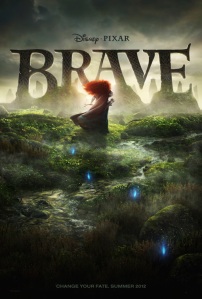
Brave already has a great review by Lisa Marie, check it out to get another insight into the film. One of the great things about the Shattered Lens is that even if a movie’s been reviewed once, another review can create a review as well.
Before Brave starts, Pixar presents their Oscar Nominated short film, La Luna, directed by Enrico Casarosa. La Luna is a simple piece about a little boy (Bambino) on a tiny boat who is taking on the Family Business. Sitting with his father and grandfather, they watch as a full moon rises high in the sky above them. Setting up a ladder, Bambino heads up to the moon, to find it littered with tiny glowing stars. The trio act as cleaners of the Moon. It’s a cute little story that for me, anyway, makes me smile when I look up at the Moon. I’m hoping Pixar maybe considers making a best of video with all their mini stories.
Brave is the story of Merida (brilliantly voiced by Boardwalk Empire’s Kelly MacDonald), a young princess in what appears to be Scotland, who is due to be married off to one of the children of her area’s neighboring lands. Granted, this isn’t something she’s looking forward to, as the wedding plans are being set up by her mother. Honestly, in watching Brave, I got the feeling that Merida really wasn’t into any of the Princess things she was supposed to be following (“No weapons on the table.”, “A princess is proper”, etc.), she seemed to just enjoy her freedom of being a young woman, of just living her life.
Brave marks the second film that wasn’t directed by one of the Pixar Majors (Pete Doctor of Monsters Inc., John Lassiter of Toy Story and Cars, Andrew Stanton of Wall-E, Finding Nemo and John Carter, and newcomer Brad Bird of Ratatouille and The Incredibles), the first being Toy Story 3. With all of the staff that Pixar has, it makes sense that eventually, the Pixar Babies would have to step up and try their hand at feature films – even if this means that Pixar breaks their streak of great animation and filmmaking.
If Brave is any indication, Pixar is in very good hands. Directors Brenda Chapman and Mark Andrews carry Chapman’s story far better than Lassiter did with Cars 2. It’s the story of a daughter, her mother and the connection between them. It’s of wanting to follow your own path vs. the paths that others want us to follow, and it manages to do all of this effortlessly. Like Tangled, our heroine takes charge of her own path, even if it means stumbling here and there. What makes Brave even better (and what my Mom would personally enjoy) is that Merida, much like Drew Barrymore’s character in Ever After, doesn’t need any guys rescuing her from her situation, save for perhaps one key moment that doesn’t count only because it’s family oriented anyway. There’s a great sense of strength in the character.
When Merida decides to fight for herself in an Archery test to ward off the would be suitors, she gets into a huge argument with her mother (Emma Thompson), that ends up with some harsh things being said. Merida eventually finds her way to a witch who lets her change her fate. Like Disney’s Brother Bear, the change in question is that her mother is turned into a bear. With Merida’s father (voiced by The Boondock Saints’ Billy Connolly) swearing vengeance against the black bear that took of his leg, Merida and her mother have to both keep away from him as well as fix the relationship between them or else the mother will stay a bear, forever.
This is where Brave shines. Between the communications between the Mama Bear and Merida and the gravity of their situation, Chapman creates some great emotional opportunities for them. An added touch was the notion that the longer the mother stays a bear, the more she loses her humanity and becomes a real bear. I took this to be similar to someone suffering from dementia or Alzheimer’s in a way, and that was where Pixar really got me on this one.
If there’s anything about Brave that I would change, it would be that there could have been a bit more back story on the legend that the mother told Merida (on the villain). I would have liked to know more about all of that, but in hindsight, the movie tells you all you really need to know, because the focus is still just on Merida and her Mother. There’s also just a hint of nudity, nothing terrible at all, but it’s a different route than other Pixar films have went. Additionally, kids may also find that the bear attack sequences may be a little too scary (at least the younger viewers might).
Overall, Brave’s a wonderful film and I’m ready to pick up the Blu-Ray the moment it comes out.
I want to make one thing very clear before I start this review:
I LOVED BRAVE!
Okay, now that that’s out of the way…
2011 was something of a disappointing year for me because it was the year that I discovered that the people at Pixar Studios are as fallible as any other filmmaker. Cars 2 was cute but, ultimately, rather forgettable and it was the first Pixar movie that failed to move me tears. Certainly, Cars 2 was not a terrible film but, when it comes to Pixar, moviegoers just naturally expect more and it was difficult to watch those expectations dashed.
Well, last night, I saw this year’s offering from Pixar, a little film called Brave. I’m happy to say that Pixar has redeemed itself from Cars 2. I loved Brave. It not only kept me entertained but it made me cry as well. In short, Brave is a film that earns its place in the Pixar library.
Set in a beautifully animated version of the Scottish highlands, Brave tells the story of Merida (voiced, quite brilliantly, by Kelly MacDonald), the red-haired daughter of King Fergus (Billy Connolly) and Queen Elinor (Emma Thompson). Merida takes after her extroverted, stubborn father and can’t understand why her refined mother isn’t as enthusiastic as Merida is about things like archery, hunting, and exploring the wilderness.
When Merida finds that, by tradition, she is to be married off to the first-born son of one of the kingdom’s three lords, she devises a plan to prove just how unfair this practice is to her. She announces that the winner of an Archery competition shall be her suitor, However, during the actual competition, Merida announces that she will compete “for her own hand” and proceeds to out-shoot all three of her moronic suitors. After an argument with an enraged Elinor, Merida flees the castle in tears.
Merida eventually meets a witch (voiced in perfect busy-body style by Julie Walters) who offers to cast a spell that will change Elinor. Merida impulsively agrees and then returns to the castle where Elinor is eventually transformed into a gigantic bear.
I have to admit that Brave nearly lost me when Elinor turned into that bear. Pixar’s trademark has always been that they make animated films that feel like live-action films and Elinor’s transformation felt almost too predictably cartoonish. However, as close as the film came to losing me at that moment, the important thing is that it didn’t. That’s due to both the impeccable animation (which managed to give the bear some very recognizable Elinor-like facial expressions) and the strength of Kelly MacDonald’s vocal performance, which brings a true sense of reality to a very unreal situation.
(Perhaps my favorite moment was when Merida hastily explained to her three younger brothers, “Mum’s turned into a bear but it’s not my fault!” That’s exactly the same thing I would have said if I had been responsible for turning my mom into a bear. And yes, I have to admit that as a stubborn redhead, I very much identified with Merida throughout the entire film.)
Merida and the Elinor Bear flee from the castle (and from King Fergus who doesn’t know that the bear is actually Elinor and who is known as the Bear-killer) and start to bond as Merida tries to find a way to turn Elinor back into a human being. It was here that Brave turned into a rather emotional experience for me and it didn’t take long for the tears to come. (What’s a Pixar film without plenty of tears?) So much of Brave hit home for me, from Merida’s desire to be independent to her complicated relationship with her mom and the fear and regret that she feels when she realizes that she might lose her mom forever. Like the best fairy tales, Brave uses a fantastic situation to tell a story about some very basic and simple human truths.
Whenever you review an animated film, there always seems to be one question that has to be answered: will boring old adults get as much out of the film as kids? Well, I know that I certainly enjoyed it but I’m not sure if I’m ready to admit to being an adult. The main thing to remember about Brave is that it’s not Toy Story 3 and it’s not Up. At the same time, it’s not Cars 2 either. Instead, it’s a heartfelt film for kids (and girls, especially) that won’t transform adults into bears.
Finally, I have to note that between Brave and the Hunger Games, 2012 is turning out to be a pretty good year for girl power. For once, we’re actually seeing films where girls can be heroes without being cast as either emotionally damaged refugees (like in the David Fincher version of The Girl With The Dragon Tattoo) or as perpetual virgins just waiting for the right man to come along and give their life meaning (like in just about every other movie that comes out of Hollywood). This is a good trend and I hope it continues.
Men In Black 3, which was released into theaters last month, is an unexpected surprise, a genuinely entertaining film that breathes some new life into an old franchise.
If you’ve seen the trailer then you pretty much know the plot of Men In Black 3. An alien war criminal named Boris (played, in wonderfully over-the-top fashion, by Jermaine Clement) escapes from imprisonment on the moon. He goes back to the year 1969 and kills the man who originally imprisoned him, Agent K. In the present day, Agent K (played, of course, by Tommy Lee Jones) vanishes from existence. The only person who remembers him is his longtime partner, Agent J (Will Smith). Agent J and Agent O (played by Emma Thompson) quickly figure out what has happened (one of the best things about Men In Black 3 is that everything happens quickly — there’s very little padding) and J is sent back to 1969 where he ends up teaming up with the young Agent K (now played by Josh Brolin). Together, J and K attempt to prevent Boris from changing history.
As I hinted at earlier, I wasn’t really expecting much from Men In Black 3. Yes, the trailer was cute and I was looking forward to seeing Josh Brolin’s impersonation of Tommy Lee Jones but otherwise, I had no reason to suspect that this film would be anything more than a somewhat disheartening collection of CGI and superstar egos.
But you know what?
Men In Black 3 isn’t half-bad.
Now, don’t get me wrong. Men In Black 3 doesn’t rewrite the rules of a familiar genre (like Cabin In The Woods). And it’s certainly not an idiosyncratic expression of one man’s personal artistic vision (like Moonrise Kingdom). No, Men In Black 3 is pure Hollywood entertainment but, at the very least, it’s a well-made example of pure Hollywood entertainment. This is the type of film that could easily have been made (and watched) on autopilot but director Barry Sonnenfeld and his talented cast have actually made the effort to make an entertaining film and they’ve succeeded.
Both Will Smith and Tommy Lee Jones have reached a point where they could play their roles in their sleep (and, in other movies, that’s what they both often seem to be doing) but both of them seem to be having fun in Men in Black 3 and they’ve got such a strong chemistry that they’re enjoyable to watch. Jones even brings a sense of reality to his character’s world-weary resignation and, if Will Smith’s main talent seems to be the fact that he’s likable, he still does likeable pretty well. The new additions to the cast — Emma Thompson, Jermaine Clement, Alice Eve, and especially Michael Stuhlbarg and Bill Hader — are all fun and interesting to watch. The film, however, is truly stolen by Josh Brolin, who not only perfectly captures Tommy Lee Jones’ voice and mannerisms but also manages to hint at his sense of gravitas as well. Sonnenfeld keeps the story moving quickly and, for once, the impressive CGI is used in the service of the story as opposed to just providing an excuse for that story to exist.
As usually seems to happen with franchise films, the whole thing ends on a sentimental note and, I have to admit, it actually brought tears to my eyes.
Then again, I’ve been told that I cry at anything.
Regardless of whether my tears were honestly earned or if they were just a Pavlovian response, Men In Black 3 is an entertaining film and I’m glad I saw it.
Well, here’s your chance to, once again, tell me what to do. I’ve randomly selected 12 films from my film collection. Whichever film gets the most votes will be watched and reviewed by me next Tuesday, March 20th.
Here are the films up for consideration:
1) Black Jesus (1968) — This Italian film stars Woody Strode as an African rebel leader who is captured by his country’s right-wing, American-backed dictatorship.
2) Capote (2005) — Philip Seymour Hoffman was an Oscar for best actor for playing writer Truman Capote in this film that details how Capote came to write his true crime classic, In Cold Blood. This film was also nominated for best picture.
3) Chappaqua (1966) — In this underground cult classic, drug addict Conrad Rooks seeks treatment in Switzerland while being haunted by a scornful William S. Burroughs. This film features cameo from Allen Ginsberg, The Fugs, and just about every other cult figure from 1966.
4) Crazy/Beautiful (2001) — Jay Fernandez and Kirsten Dunst have lots and lots of sex. This was like one of my favorite movies to catch on cable back when I was in high school. 🙂
5) An Education (2008) — In my favorite movie from 2008, Carey Mulligan is a schoolgirl in 1960s England who has a secret affair with an older man (played by Peter Sarsgaard), who has plenty of secrets of his own. Co-starring Rosamund Pike, Emma Thompson, Alfred Molina, and Dominic Cooper (who is to die for, seriously).
6) Female Vampire (1973) — In this atmospheric and ennui-filled film from the infamous Jesus Franco, a female vampire spends the whole movie wandering around naked and dealing with the lost souls who want to join the ranks of the undead.
7) Nightmare City (1980) — In this gory and fast-paced film from Umberto Lenzi, an accident at a nuclear plant leads to a bunch of blood-thirsty zombies rampaging through both the city and the countryside. Hugo Stiglitz plays Dean Miller, zombie exterminator! Nightmare City is probably most remembered for introducing the concept of the fast zombie and for serving as an obvious inspiration for Danny Boyle’s 28 Days Later.
8) The Other Side of Midnight (1977) — Based on a best-selling novel, The Other Side of Midnight tells the story of a poor French girl who becomes a world-famous actress and who ends up sleeping with apparently every wealthy man in the world. Meanwhile, the man she loves ends up marrying Susan Sarandon. Eventually, it all ends with both a hurricane and a murder. Apparently, this film cost a lot of money to make and it was a notorious box office bomb. It looks kinda fun to me.
9) Peyton Place (1957) — Also based on a best-selling novel, Peyton Place is about love, sex, and scandal in a small town. Lana Turner is a repressed woman with a past who struggles to keep her daughter from making the same mistakes. At the time it was made, it was considered to be quite racy and it was even nominated for best picture. This film is a personal favorite of mine and it’s pretty much set the template for every single film ever shown on Lifetime.
10) Rosebud (1975) — From director Otto Preminger comes this film about what happens when a bunch of rich girls on a yacht are taken hostage by Islamic extremists. The film’s diverse cast includes Peter O’Toole, Richard Attenborough, Cliff Gorman, former New York Mayor John Lindsay, former Kennedy in-law Peter Lawford, Raf Vallone, Adrienne Corri, Lalla Ward, Isabelle Huppert, and Kim Cattrall.
11) Valley of the Dolls (1967) — Oh my God, I love this movie so much! Three aspiring actresses move to the big city and soon become hooked on pills and bad relationship decisions. Every time I watch this movie, I spend hours yelling, “I’m Neely O’Hara, bitch!” at the top of my lungs.
12) Zombie Lake (1981) — From my favorite French director, Jean Rollin, comes this extremely low budget film about a bunch of Nazi zombies who keep coming out of the lake and attacking the nearby village. Some people claim that this is the worst zombie films ever made. I disagree.
Please vote below for as many or as few of these films as you want to. The poll will remain open until March 20th and whichever film gets the most votes will be watched and reviewed by me.
Well, we all knew it would have to end someday and now, it’s over. The Harry Potter film series, which began way back in 2001, is concluding right now in a theater near you. On Friday night, me, Jeff, my sister Erin, and our friend Evelyn went down to the AMC Valley View and we saw Harry Potter and the Deathly Hallows, Part 2.
The cinematic story of Harry Potter is over and yes, I did cry as I watched it end. I didn’t just cry because of the movie, though the movie itself is one of the best of the year and it has one of those wonderful endings that just makes it impossible to remain dry-eyed. No, I cried because — with this film — an era of my life is truly over.
When the first Harry Potter film came out, I was only 16 and still trying to deal with the fact that I had been diagnosed as being bipolar just a few weeks earlier. I felt alone and broken and destined to spend the rest of my life on the outside looking in. The three hours that I spent watching Harry Potter and the Sorcerer’s Stone were three hours when I didn’t have to worry about suddenly bursting into tears and having everyone around me worrying about whether or not I was actually taking my hated medication. For three hours, I could escape to another world where those who were different were celebrated precisely because they were different. For three hours, I could imagine that just maybe I had a special purpose for existing too and maybe I had benevolent wizards and witches looking out for me too. And I’m sorry if all that sounds trite in retrospect but, when you’re 16 and you think you’re too damaged to love, anything that gives you hope and pleasure in the present is a precious treasure.
Over the years, I eventually came to realize that being bipolar was hardly a curse and, as I matured and grew up and discovered new things, there was always a Harry Potter film either playing or about to come out. Whether I was escaping high school, graduating college, or dealing with just every good or bad thing that makes up life, Harry Potter — this character who I first met (in book form) when I was 13 — was always there. So, at the risk of sounding overdramatic, the end of Harry Potter is the end of a chapter of my life.
One final personal note: As I watched Harry Potter and the Deathly Hallows, Part Two, I had three dolls (or action figures, as boys insist on calling them) in my purse. These dolls — Harry, Hermione, and Ron — came out around the same time as the second Harry Potter film and my mom (who collected dolls) ordered them off of Ebay three years ago, shortly before she entered the hospital for the final time. Now, my mom was not a huge fan of the Harry Potter series but she knew that I loved it and that’s why she made those dolls her final gift to me.
And those are some of the reasons why I found myself crying as I watched the finale of Harry Potter. However, there’s another reason why I cried and that’s that this is just a great film and the perfect conclusion to the series.
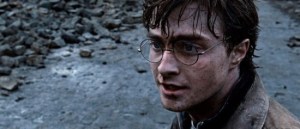
Essentially, Harry Potter and the Deathly Hallows, Part Two starts up immediately after the conclusion of Part One. Dobby is dead, Lord Voldemort (a wonderfully neurotic Ralph Fiennes) and the Death Eaters are intent on destroying everything, and Severus Snape (Alan Rickman, wonderful as always) is in charge of Hogwarts. After spending the first part of Deathly Hallows as fugitives, Harry Potter, Ron Weasley, and Hermione Granger (Daniel Radcliffe, Rupert Grint, and Emma Watson) return to Hogwarts to take a final stand against Voldemort. Things end in a surprisingly bloody battle (this film is not for children) that leaves several characters dead and ultimately reveals that one wizard wasn’t the saint we always assumed he was while another is revealed to be the secret hero of the entire series.
Let’s get one question out of the way right now: will non-Harry Potter fans be able to follow this film? Uhmmm…no. Sorry. Then again, why would a non-Harry Potter fan be at a film called Harry Potter and The Deathly Hallows Part Two anyway? I mean, seriously, if you’re just going to film because everyone else is doing it than who are you to bitch anyway? This is what you non-Harry Potter fans need to do. Stop reading this review. Go watch the previous Harry Potter films. Watch them in order. Take your time because Deathly Hallows is going to be in theaters for a while. And then, once you’ve become immersed in the story, go see how it all concludes. And then come back here and read rest of this review.
Okay, so is everybody up to date?
Cool.
One of the more interesting features of the Harry Potter series is that so many different directors (each with his own definite, individual style) have been involved in bringing these films to the screen. Among Harry Potter fans, hours can literally be spent debating the merits (and weaknesses) of Chris Columbus, Alfonso Cuaron, Mike Newell, and David Yates. My own theory is that each director was perfectly suited for each film he directed. The audience-friendly vision of Chris Columbus was what the first two films needed, just as Prisoner of Azkaban needed Cuaron’s far darker vision and Mike Newell’s attention to character made Goblet of Fire one of the best of the Harry Potter films. And while David Yates may not be as well-known (or critically acclaimed) as Newell or Cuaron, he brings exactly the right tone to Harry Potter and the Deathly Hallows, a perfect combination of spectacle and humanity. It is to Yates’ credit that the scenes in which the characters simply talk to each other are just as compelling as the dramatic sequences where Voldemort and the Death Eaters attack Hogwarts. Yates understands that this material could easily come across as silly or childish and to his credit, he never allows the audience to simply dismiss this film as a lot of blathering about wands and CGI magic. As opposed to other directors who have given us summer blockbusters, Yates takes his film seriously.
And, fortunately, so does his cast.
One of the great pleasures of the Harry Potter series is that it’s given American audiences the chance to discover (and rediscover) some of the great British character actors and a lot of them show up (some for only a matter of minutes) here in the finale. Maggie Smith, Jim Broadbent, Julie Walters, Robbie Coltrane, Gary Oldman, John Hurt, David Thewlis, Emma Thompson, and Jason Isaacs all put in appearances. Kelly MacDonald has a great scene playing a ghost, Helena Bonham Carter is perfect as the evil Bellatrix Lestrange, and Alan Rickman is brilliantly ambiguous as Severus Snape. (And yes, Snape’s actions are explained in this film and yes, I did cry.)
Ralph Fiennes plays so many villains that I now find myself expecting him to show up killing people in every movie I see. He’s like a British Christopher Walken. Still, it’s easy to take an actor like Fiennes for granted. For the entire Harry Potter series to work, Lord Voldemort can’t just be an ordinary villain. He’s got to be the sum total of all things evil and deadly. You’ve got to believe that people would be scared to speak his name. Great heroes need a great villain and Fiennes’ Voldermort is a great villain.
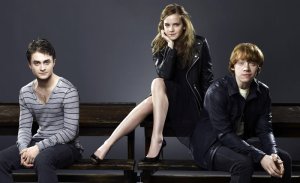
Ultimately, however, the true credit for the success of the Harry Potter series belongs to three actors who have literally grown up on the movie screen — Daniel Radcliffe, Rupert Grint, and Emma Watson. The producers are fortunate indeed that the cute kids that they cast over a decade ago have all grown up to be talented, attractive, and likable actors. If the first part of Harry Potter and the Deathly Hallows seemed to showcase both Grint and Watson (almost to Radcliffe’s expense), part 2 is most definitely centered on Harry Potter. That doesn’t mean that Watson and Grint aren’t good in this film. They are and they get to share one of the best movie kisses of 2011. (As well, for those who keep count, Grint says “Bloody Hell,” three times in the film.) But, for obvious reasons, this film is all about Harry and Radcliffe’s performance as Harry. It’s a challenge for Radcliffe and it’s a challenge that he more than succeeds at conquering. As the film ended, I realized that I was sad to know that the adventures of Harry Potter were done but I was excited to see what the future will hold for Radcliffe, Grint, and Watson.
Incidentally, Harry Potter and the Deathly Hallows Part 2 has been released in both 3-D and 2-D. We saw the 3-D version and if you have any knowledge of how I feel about 3-D (and how motion sick I tend to get while watching 3-D films) then that should show you just much I love the Harry Potter series. I loved it so much that I was even willing to overlook my hatred of 3-D. The 3-D here (which was added after the film has already been filmed) doesn’t really add much to the movie. There were a few cool moments where I was all like, “Look, I can reach out and grab a piece of Voldemort,” but otherwise, the 3-D was a negligible factor as far as the overall film was concerned.
Still, there was one interesting thing about the 3-D. The theater we saw the movie in was half-way empty. At the same time, the neighboring theater — in which the 2-D version was playing — had a line of people waiting to get in. They were not only waiting to see the 2-D version, they were waiting to see a showing that wouldn’t even begin until a full 90 minutes after the 3-D version started. I mention this because, in the wake of Avatar, so many people have taken it for granted that 3-D is the future of movies and soon, as long as a film is in 3-D, we won’t have to worry about the difficult stuff like an interesting plot or compelling characters. However, 3-D has become an overexposed gimmick. For every film like Cave of Dreams that uses 3-D to craft an actual artistic statement, there’s a 1,000 films like Priest which use 3-D just because it’s an easy way to trick sucks into spending an extra dollars to see a crappy film.
What so many filmmakers seem to forget is that the majority of film goers are not looking for 3-D. We’re just looking for a good film. And sometimes — like with Harry Potter and the Deathly Hallows — we get lucky and we find a great film.
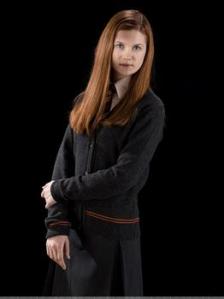
(Oh, and one last thing: I know everyone always expects me to claim to be just like Hermione but actually, I’ve always related more to Ginny Weasley. Like her, I’m the youngest of four siblings, I’ve got red hair, and I always get my man, in the end.)


 Through the Shattered Lens