Embracing the Melodrama Part II #117: Never Let Me Go (dir by Mark Romanek)


NeverletmegoposterquadI can still remember, back in the year 2010, when I first saw Never Let Me Go at the Dallas Angelika.  Going into the film, I didn’t really know what was waiting for me.  I hadn’t read the novel that it was based on.  All I knew was that it had a cool trailer and it starred two of my favorite actresses, Carey Mulligan and Keira Knightley.  Before I watched Never Let Me Go, I didn’t even know who Andrew Garfield was but that changed quickly.  Never Let Me Go took me by surprise.  I figured it would be a sad movie, based on the melancholy trailer and title.  But I had no idea how sad or effective it would be.  By the end of the movie, I was in tears.

And, even though I was already writing for this site at the time, I somehow never wrote up a review of Never Let Me Go.  Oh, I certainly meant to.  I went out of my way to recommend the movie on twitter.  I included it on my list of films that deserved Oscar consideration.  But I never actually got around to writing that full review.  The emotions were just too overwhelming.

Well, I’m going to use this opportunity to recommend that, if you haven’t already, you make an effort to see Never Let Me Go.  It’s a beautifully done film, one that confirms that director Mark Romanek is a major talent who really should have more than just three feature films to his credit.  (True, he does have a lot of music videos…)  As well, the film was written by Alex Garland, which should interest those of you who fell in love with Ex Machina earlier this year.

As for the film itself, it takes place in a world where, we’re told, a medical breakthrough was discovered in 1952 that allows people to live to be over 100 years old.  The details of that medical breakthrough are slowly revealed to us over the course of the film.  Unfortunately, it’s impossible to really talk about this film without revealing those details so consider this to be your SPOILER WARNING.

Basically — much as in Clonus — life has been extended through the use of cloning.  Cloned children are raised outside of the view of “normal” society.  They go to special schools.  And when they turn 18, they are harvested for their organs.  Clones are told that their ultimate goal is to “complete,” which is a polite way to say that most of them die before they ever reach 30.  A few lucky ones are allowed to be “carers.”  They take care of and comfort dying clones and, as a result, they get to put off their first organ donation for a few years.

Unlike Clonus, where the cloning was clandestine and done only to benefit the very rich, the clones are not a secret in Never Let Me Go.  Everyone knows why they exist and everyone knows what is going to ultimately happen to them.  Whenever the clones are allowed to leave their schools and explore the real world, they are greeted with a mix of hostility, fear, and guilt.  Because they are due to be sacrificed, society chooses to believe that the clones are somehow less than human.

As for the clones, the majority of them accept their fate.  You watch Never Let Me Go and you keep waiting for some sort of revolution and it never comes.  Some of the clones are angry.  Many of them desperately believe that there’s some way that they can avoid having to give up their organs.  A good deal of the film is spent listening to people you’ve come to love talk about getting a “deferral” that the audience knows does not exist.  For the most part, though, the clones passively accept their fate because that’s what they’ve been raised to do.

The film itself follows three clones from their childhood to their completion.  Kathy (Carey Mulligan) is a carer.  Ruth (Keira Knightley) starts out as a snob but softens as her fate becomes more and more inevitable.  And, lastly, there’s Tommy (Andrew Garfield).  Tommy starts out as an awkward young boy and he grows up to be an awkward young man.  Of all of them, Tommy is the most convinced that, as a result of the artwork he innocently drew as a boy, he will somehow be given a deferment.  Garfield is so heartbreaking in this role.  When he finally snaps and screams in frustration, you scream with him.

Never Let Me Go is not an easy film to watch but it’s one that I highly recommend.  It’ll make you think and it’ll make you cry.  And after you watch the movie, read Kazuo Ishiguro’s wonderful novel.  It’s even more heart-breaking than the movie.
Embracing the Melodrama Part II #116: The Young Victoria (dir by Jean-Marc Vallee)


Young_victoria_poster

So, earlier, I was having a conversation with my BFF Evelyn and I discovered that we both have a massive girl crush on Emily Blunt.

And really, can you blame us?

First off, Emily Blunt is incredibly talented.  She’s one of those actresses who can play just about anyone and anything.  I have never heard or seen an interview with her where she seemed to be anything less than intelligent and witty.  She speaks her mind and projects an attitude of not really caring what other people think about her.  Add to that, she’s absolutely gorgeous and she has a body and a face to die for.  If I were to ever get a nose job (and that’s always been a temptation for me), I would definitely tell the surgeon to give me Emily Blunt’s nose.

Evelyn and I also love the fact that Emily Blunt always plays characters who kick ass, often times literally.  Whether it was in Looper or Edge of Tomorrow or the upcoming Sicario, one thing remains consistent.  You simply do not mess with Emily Blunt because she’s a fighter.

Finally, Emily Blunt gets to spend every night with Jon Krasinski!

Seriously, how can you not love Emily Blunt?

Emily Blunt first received attention as the result of supporting turns in The Devil Wears Prada and Charlie Wilson’s War.  Her first starring role — or, at the very least, her first starring role to receive wide distribution here in the states — was in the 2009 film, The Young Victoria.

The Young Victoria attempts to do for Britain’s famous Queen Victoria what Elizabeth did for Queen Elizabeth I.  It attempts to humanize an iconic figure and show that, underneath the popular image of Victorian refinement and emotional repression, Victoria was actually a passionate and headstrong woman.  And the film largely succeeds at doing that because Victoria is played by Emily Blunt.

Unfortunately, The Young Victoria is never quite as interesting as Elizabeth.  Whereas both films feature young queens struggling to prove themselves worthy of leading Britain, Elizabeth benefited from being conceived as a renaissance version of The Godfather.  Elizabeth was full of shadowy conspiracies, ominous whispers, and secrets.  When, at the end of the film, Elizabeth had solidified her hold on the British crown, you felt that she had truly accomplished something and that perhaps her victory was worth living the rest of her life as the Virgin Queen.

Whereas in The Young Victoria, the conspiracies basically amount to smug civil servants assuring themselves that Victoria won’t do something and then being shocked when Victoria does exactly what they weren’t expecting her to do.  And, while it’s undeniably fun to watch Victoria refuse to sign away her power and announce that she can decide for herself what her royal role should be, that’s largely because it’s always fun to watch Emily Blunt stand up for herself.

The majority of the film is taken up with Victoria being courted by Prince Albert (Rupert Friend).  Again, there’s no real conflict in Victoria and Albert’s relationship.  We know that Victoria is eventually going to marry Albert.  And, even when the two have an argument towards the end of the film, you know that they are going to reconcile.  What you may not be prepared for is a scene where Albert is gravely wounded while protecting Victoria from an assassin’s bullet.  That’s because it never happened.  A man did attempt to assassinate Victoria but he failed and Albert was not wounded at all.  But then again, why let history get in the way of a good story?

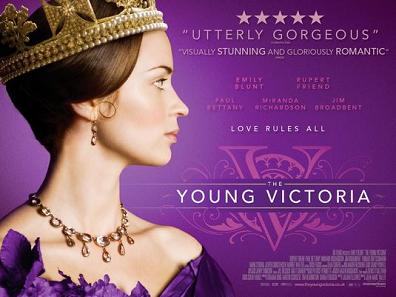
On the poster at the top of the post, The Young Victoria is described as being “gorgeous.”  And really that’s the main reason to see the film.  The film looks really, really good.  The costumes and the sets are wonderfully ornate.  The cinematography is vibrant and lush.  And Emily Blunt’s performance can rightly be called gorgeous.   By the end of The Young Victoria, you really don’t feel like you’ve learned anything new about Queen Victoria.  But you do appreciate Emily Blunt.

Embracing the Melodrama Part II #115: Revolutionary Road (dir by Sam Mendes)


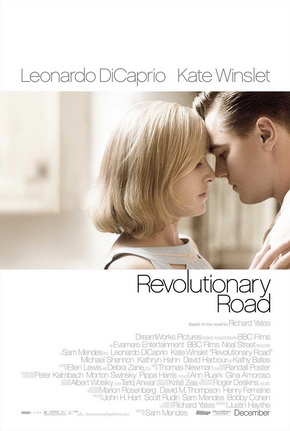
Revolutionary_roadI have such mixed feelings about the 2008 film Revolutionary Road.

As you may remember, Revolutionary Road got a lot of attention because it reunited the Titanic lovers, Kate Winslet and Leonardo DiCaprio.  In Revolutionary Road, they would be playing the type of married couple that we all know Jack and Rose would have become if the boat hadn’t hit that iceberg.

Revolutionary Road also got a lot of attention because it was directed by Sam Mendes and it was a return to the “suburbs-as-Hell” genre of filmmaking that won Mendes an undeserved Oscar for his work on American Beauty.

And finally, Revolutionary Road was based on a 1961 novel by Richard Yates that had originally been declared to be unfilmmable.  After decades of being optioned and then abandoned, Revolutionary Road was finally coming to the screen.

With all that in mind, a lot of critics expected that Revolutionary Road would be one of the best films of the year.  When the film itself was finally released, there were a few ecstatic reviews.  There were predictions of Oscar glory.  But, for the most part, both audiences and critics had a somewhat muted reaction.  The film itself simply did not live up to all of the build up.

That said, Kate Winslet gave a great performance.  In the role of aspiring actress-turned-housewife-turned-prisoner April, Winslet gives a fierce and tragic performance.  The film revolves around April’s struggle to live her own life and pursue her own ambitions in a world that continually tells her that she should simply be happy and content to have a husband, two children, and a house in the suburbs.  When April describes her life as being full of “hopeless emptiness,” we all know exactly what she’s talking about.

Leonardo DiCaprio was a bit less convincing as her husband, Frank.  Then again, that’s not really a surprise.  DiCaprio is always at his worse whenever he has to play a “normal” character.  His screen presence is too off-center for him to be believable as a suburban conformist.  It was obviously good publicity to reunite DiCaprio and Winslet but that doesn’t change the fact that Leo is totally miscast.  Whenever Frank and April fight, Kate Winslet seems to be screaming from her very soul while DiCaprio is just shrill.  Admittedly, Frank is meant to be a shallow character but that doesn’t justify a shallow performance.

Throughout the film, Frank and April are constantly nagged by their real estate agent, Helen Givings (Kathy Bates).  Whenever Helen drops by the house, she goes “Yoo hoo!” in the shrillest way possible and the audiences is reminded that Sam Mendes is not a particularly subtle director.  That willingness to go over-the-top made him the perfect director for Skyfall but, in both American Beauty and this film, it just leads to some talented actors giving very bad performances.

Helen’s son, John (Michael Shannon), has one of those cinematic mental illnesses, the type that gives him the power to explicitly state each scene’s subtext.  John is also one of those overly theatrical characters who works a lot better as a literary conceit than as an actual character.

And really, I guess that sums up why I have never liked Revolutionary Road as much as I wanted to.  The film works whenever it focuses on Kate Winslet, precisely because she gives such a heartfelt and naturalistic performance.  However, at the same time, Winslet is so good that she exposes how artificial and theatrical the rest of the film is.  If only the rest of the production had followed Winslet’s lead, Revolutionary Road could have been something great.

For all the pre-release Oscar hype, Revolutionary Road was largely ignored when it came to the Academy Awards.  Michael Shannon received a surprise nomination for best supporting actor but otherwise, the film was snubbed.  Kate Winslet, however, did finally win an Oscar that year when she picked up the Best Actress award for her performance in The Reader.

Embracing the Melodrama Part II #114: The Wrestler (dir by Darren Aronofsky)


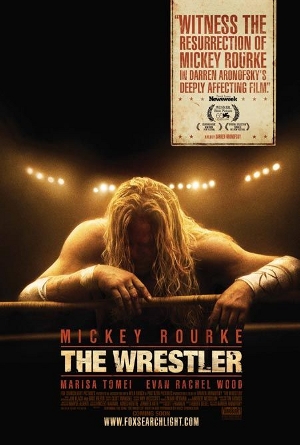
The_Wrestler_poster

I’m always a little surprised by how much I like the 2008 film The Wrestler.

Actually, to be honest, I’m more than a little surprised.  I’m a lot surprise.  First off, The Wrestler takes place in the world of professional wrestling and that’s a world that I not only know nothing about but which I also have very little interest.  (My cousin Gustavo — Hi, Gus! — loved the Rock.  That’s about the extent of my knowledge.)  Add to that, The Wrestler doesn’t take place in the world of televised pro wrestling.  (I may know nothing about wrestling but I do know a lot about television.)  Instead, this is a world of backroom matches, broken dreams, and fading lives.

Secondly, The Wrestler features, as its hero, a man in his 50s who is still a total and complete fuckup.  The character of Randy “The Ram” Robinson (played, in an Oscar-nominated performance, by Mickey Rourke) is perhaps epitomized by the fact that, after going out of his way to try to reconnect with his daughter, Stephanie (Evan Rachel Wood), and setting up a dinner date so that they can finally talk and get to know each other, Randy ends up getting consumed with self-pity, getting drunk, getting high, getting laid, and ultimately standing up his daughter.  And whenever I see that part of the movie, I hate Randy just as much as Stephanie does because I know exactly how she feels.  Stephanie can’t forgive Randy and neither can I.

And yet, oddly enough, I still care what happens to Randy.  Randy is a former wrestling superstar, a guy who was big in the 1980s but now lives in a haze of obscurity and self-pity.  He now wrestles on the weekend, works a demeaning job at a super market deli, and occasionally plays an old video game which features him as a character.  His only real friend (and source of strength) is Cassidy (Marisa Tomei), a stripper who knows what its like to get older in a profession dominated by the young.

Randy does have one final chance at a comeback, when he agrees to an exhibition fight against his former nemesis, a  “villainous” wrestler known at The Ayatollah (Ernest Miller).  (It’s interesting to note that, outside of the ring, “bad guy” Ayatollah seems to be everything that “good guy” Randy is not, i.e., responsible, stable, and content with his life.)

However, there’s one problem.  Randy has a heart condition and he has been told that continuing to wrestle could kill him.  Will Randy give up the only thing that he’s ever been good at or will Randy potentially sacrifice his life to have one last chance to hear the cheers of the crowd?

Randy Robinson is another one of director Darren Aronofsky’s obsessive protagonists, a character who is so obsessed with something that he’s sacrificed everything else to pursue it.  Fortunately, Aronofsky is a master of making these type of characters sympathetic.  Over the course of the film, Randy fucks up so much that you really are tempted to just give up on him but Aronofsky directs the film with such compassion and Rourke gives such a vulnerable and emotionally raw performance that you find yourself giving Randy another chance despite your better instincts.  The film’s melancholy ending is effective because you know that it really is the only way that Randy’s story can end.

I’m always surprised to like The Wrestler.

But I do.

Embracing the Melodrama Part II #113: Gran Torino (dir by Clint Eastwood)


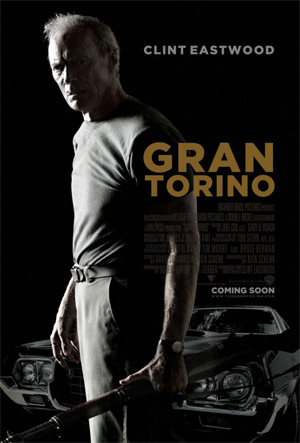
Gran_Torino_posterWalt Kowalski (Clint Eastwood) is a grumpy man.  And by that, I mean that he’s extremely grumpy.  Remember how grumpy Bill Murray was in St. Vincent?  He’s got nothing on Walt Kowalski.

Walt served in the Korean War and, five decades later, his experiences still haunt him.  After the war, he lived in Detroit and he worked on an assembly line.  He’s since retired but he still loves his old Ford Gran Torino, a car that he could very well have helped to build.  His wife has recently passed away and his children are eager to move him into a nursing home.  Walt is slowly smoking himself to death and the only person who visits him regularly is an earnest young priest (Christopher Carley, playing the ideal priest).

Just as Walt’s life has changed as he’s gotten older, so has his neighborhood.  The neighborhood is now dominated by Hmong immigrants.  When Walt catches Thao Vang Lor, a 16 year-old Hmong, attempting to steal his car, it leads to an unlikely friendship between Walt, Thao, and Thao’s sister, Sue.  When the same local gang that put Thao up to stealing Walt’s car subsequently attacks Sue, Thao wants revenge but Walt says that if Thao kills a man, it’s something that he’ll never recover from.  After locking Thao in his house, Walt goes off to confront the gang on his own…

And, since Walt is played by Clint Eastwood, you’d be justified in thinking that Walt’s confrontation would amount to a lot of quips and violence.  But actually, it’s the exact opposite.  Gran Torino does not find Eastwood in the mood to celebrate violence.  Instead, the film is a meditation on both the cost of violence and the impossibility of escaping one’s own mortality.

Whenever people talk about the 2008 Oscar race, the focus always seems to be on the snubbing of  The Dark Knight.  However, I would say that Gran Torino (among other films) was snubbed even more than The Dark Knight.  After all, The Dark Knight may have missed out on best picture but it still received 8 nominations and won an Oscar for Heath Ledger.  Gran Torino, on the other hand, received not a single nomination.

Don’t get me wrong.  I’m not arguing that Gran Torino deserved a best picture nomination.  It’s a fairly predictable film and some of the symbolism, particularly during Walt’s final confrontation with the gang, gets a bit too heavy-handed.  (Any time a character spontaneously strikes a crucifixion pose in a movie, you know that things are starting to get out of hand.)  But I would argue that Clint Eastwood definitely deserved a nomination for best actor.  In many ways, Walt is a typical Eastwood character but, right at the moment when we’re expecting him to behave like every other Eastwood character that we’ve ever seen, Walt surprises us by doing something completely different.  As a director, Eastwood subverts our expectations of Clint Eastwood as both an actor and a character.  As a result, the audience is taken by surprise by Walt, if not by the film’s plot.

I remember, at the time the film was released, there was some speculation that Gran Torino would be the last time we ever saw Clint Eastwood onscreen.  That proved to be false, as he subsequently starred in Trouble With The Curve.  However, even if it wasn’t his final acting role, Gran Torino still serves as the perfect monument to Eastwood’s unique screen presence.

Embracing the Melodrama Part II #112: The Curious Case of Benjamin Button (dir by David Fincher)


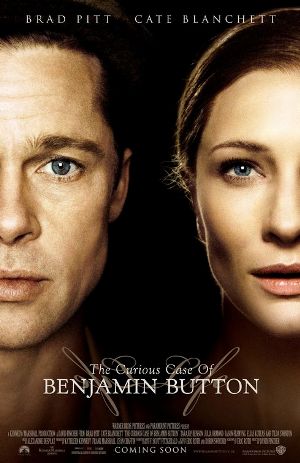
Curious_case_of_benjamin_button_ver32010 will always be considered, by many of us, to be the year that Oscar journalism first jumped the shark.  That was the year that a group of self-styled award divas (which Awards Daily’s Sasha Stone being the most obnoxious culprit) went batshit crazy over a film called The Social Network.  

From the minute that David Fincher-directed film premiered, the Sasha Stones in the world not only declared it to be the greatest film ever made but also insinuated that anyone who disagreed had to be stupid, crazy, and evil.  It actually got rather silly after a while.  That is until The Social Network lost best picture to The King’s Speech.  Suddenly, what was once merely enthusiastic advocacy transformed into fascistic fanaticism.  Suddenly, these people started to view the 2010 Oscar race (and each subsequent Oscar race) as a rather tedious battle between good and evil.  For these people, David Fincher represented the forces of good.  And Tom Hooper, the director of The King’s Speech, represented all that was evil.  They took this to such an absurd extreme that they not only subsequently heaped undeserved praise on Fincher’s bastardization of The Girl With The Dragon Tattoo but also unnecessary scorn on Hooper’s Les Miserables.

Of course, what was forgotten in all of that drama was that — before Hooper and The King’s Speech came along, the 2010 Oscar race was predicted be some to be a rematch between Fincher and Danny Boyle (whose 2010 film, 127 Hours, was indeed nominated for best picture, alongside The Social Network, King’s Speech, and Black Swan).  When Fincher and Boyle previously competed during the 2008 Oscar race, Danny Boyle’s Slumdog Millionaire defeated Fincher’s The Curious Case of Benjamin Button.

And indeed, the case of Benjamin Button was curious one!

Loosely based on a short story by F. Scott Fitzgerald, The Curious Case of Benjamin Button told the story of a man who aged in reverse.  When Benjamin is a baby, he has the wrinkled face of an elderly man.  When he’s a teenager, he’s walking with a cane.  When he’s middle-aged, he looks like Brad Pitt in Legends of the Fall.  (In that regard, it helps that Benjamin is played by Brad Pitt.)  And when he’s an old man, he’s a baby.  Though the film, wisely, refrains from offering up a definite reason why Benjamin ages in reverse, it hints that it could have something to do with a clock that was built to run backwards as an anti-war statement.

Benjamin is born in New Orleans in 1918 and raised in a nursing home by Queenie (Oscar nominee and future Empire star Taraji P. Henson).  The love of Benjamin’s life is Daisy Fuller (Elle Fanning when young, Cate Blanchett as an adult), a dancer who also loves Benjamin but who, unlike him, is not aging in reverse.  For this reason, Benjamin and Daisy cannot be together.  That’s the way tragic love works.

The film itself features a framing device.  Daisy, now an elderly woman, is dying and gives her estranged daughter, Caroline (Julia Ormond), the diary of Benjamin Button.  As Caroline reads, Hurricane Katrina rages outside.  I’ve never really been comfortable with the way that the film uses Katrina as a plot point, for much the same reason that it bothered me when Hereafter used the real-life Thailand typhoon and London terrorist bombings to tell its story.  The real-life tragedy of Katrina feels out-of-place in a story about Brad Pitt aging backwards.

As for the rest of the film, The Curious Case of Benjamin Button is … well, it’s a curious film.  Visually, it’s definitely a David Fincher film but, at the same time, there’s something curiously impersonal about it.  You almost get the feeling that this was Fincher’s attempt to show that he was capable of making a standard big budget Hollywood film without getting too Fincheresque about it.  Brad Pitt and Cate Blanchett have chemistry and they look good together but Fincher has never been a sentimental director and his heart never truly seems to be in their love story.  (Ben Affleck and Rosamund Pike in Gone Girl feel more like a natural couple than Brad Pitt and Cate Blanchett do in this film.)  There’s only a few scenes, mostly dealing with the more morbid aspects of Benjamin’s odd condition, towards which Fincher really seems to feel any commitment.

As a result, The Curious Case of Benjamin Button becomes a curious misfire.  It’s a film that struggles with the big picture but is occasionally redeemed by some of its smaller moments.  (The scenes with the elderly Benjamin as a dementia-stricken baby are haunting and unforgettable.)  Ultimately, The Curious Case of Benjamin Button is probably the weakest of the five 2008 films nominated for best picture but it’s still an interesting film to watch.

Embracing the Melodrama Part II #111: Slumdog Millionaire (dir by Danny Boyle)


Slumdog_millionaire_ver2A few thoughts on the 2008 winner for best picture, Slumdog Millionaire:

First off, whenever I think about Slumdog Millionaire, it’s impossible for me not to think of that episode of The Office where Holly and Michael do an homage to the film at the Dunder Miflin company picnic and, along with traumatizing all of the children in the audience, they also manage to accidentally reveal that half of the employees at the picnic are about to get laid off.  If you need to know just how successful Slumdog Millionaire was here in the United States, just consider that it was popular enough to be parodied by Michael Scott.

Secondly, as I sit here thinking about what I want to say about the film itself, I find myself wondering if it’s really necessary for me to rehash the film’s plot.  I mean, everyone’s seen this movie, right?  It was released 7 years ago.  It won a bunch of Oscars.  It’s on cable constantly!  I mean, everyone already knows what happens, right?

Oh, really?  Okay, apparently there’s one person out there who has never seen Slumdog Millionaire.

For his benefit, I will reveal that Slumdog Millionaire is a British-made film about India.  Jamal (Dev Patel) is an 18 year-old telemarketer, who works from India and calls people in Scotland, reading from a script and saying things like, “I really love Sean Connery.”  When Jamal is selected to compete on the Indian version of Who Wants To Be A Millionaire, he shocks both the audience and the show’s producers by getting every answer right.  However, before he can answer the final question and potentially become a millionaire, he is taken into a backroom and tortured by the police, who are convinced that a “slumdog” like Jamal couldn’t possibly know all the answers.  As Jamal explains how he knew each answer, the film flashes back to Jamal’s childhood in the slums of Bombay.

It’s during these flashbacks that we see how Jamal — and thousands of other poor children like him — were forced by local gangsters to work as beggars.  (In one extremely harrowing scene, a child is blinded specifically so he’ll be a more sympathetic beggar.)  While Jamal eventually escapes this life, his brother Salim (Madhur Mittal) and his childhood love, Latika (Freida Pinto) remain under the power of a cruel crime boss (Mahesh Manjrekar).

So, that’s a relatively spoiler-free plot outline of Slumdog Millionaire.  You’re welcome.

Now, personally, I love Slumdog Millionaire but a lot of people don’t.  It seems to be one of those films that always gets mentioned when certain people talk about unworthy Oscar winners.  Some of that is because Slumdog Millionaire won best picture the same year that The Dark Knight was not even nominated.  In the eyes of some, being upset over the snubbing of The Dark Knight means that you’re also required to insanely resent every film that was not snubbed.  (Looking in your direction, Sasha Stone…)  But even more of the anti-Slumdog sentiment seems to come from the fact that the plot of Slumdog Millionaire revolves around an episode of Who Wants To Be A Millionaire.  They feel that Slumdog Millionaire is essentially a feature-length commercial for a game show.

However, I think those people are overlooking one very important detail.  In Slumdog Millionaire, How To Be A Millionaire is not portrayed in the most positive light.  The whole plot of the film, after all, is that, as a result of doing well on the show, Jamal was taken into a dank room and tortured!  You have to wonder what went on behind the scenes on the American version of the show.

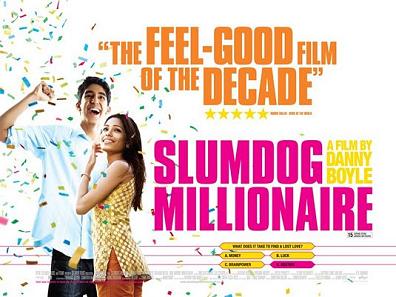
The film’s poster refers to Slumdog Millionaire as being “the feel good film of the decade.”  I don’t know if I’d agree with that description.  It’s a fun film to watch because Danny Boyle is one of those hyperactive directors who can make anything fun.  But, at the same time, Slumdog Millionaire is a pretty dark film.  Happy ending or not, the majority of the film is about children living in extreme poverty and being exploited by rich sadists.

For those who would complain that Slumdog Millionaire gets a bit too melodramatic for its own good — well, can you ever really be too melodramatic?  Along with everything else, Boyle meant for Slumdog Millionaire to serve as an homage to the famously melodramatic cinematic conventions of Bollywood and he largely succeeds.

And, of course, there’s the final dance number!

Seriously, how can you note love that?

http://www.youtube.com/watch?v=vNk2pG7agYE

Embracing the Melodrama Part II #110: Atonement (dir by Joe Wright)


Atonement_UK_posterWhenever I think back on the 2007 best picture nominee Atonement, my first thought is usually, “Oh my God!  Benedict Cumberbatch is in this movie!”

And, indeed, he is.  However, I’m kind of glad that I didn’t know who Benedict was when I first saw this film because, if I had, I doubt I would have ever been able to look at him in quite the same way again.  (Fortunately, I had somehow forgotten that I had previously seen him in Atonement when I first saw Benedict in Sherlock.)  Benedict’s role in Atonement is not a large one but it is pivotal to the film’s plot.  He plays Paul Marshall, a man who has made a fortune as a chocolate manufacturer in pre-World War II England.  Paul is handsome, charming, and rich.  After all, he’s played by Benedict Cumberbatch.  He’s also a rapist who, later in the film, marries one of his victims specifically to make it impossible for her to ever testify against him in court.

Atonement is one of those films where the British upper class meets the lower class and forbidden love and tragedy follow.  Cecilia Tallis (Keira Knightley) is the oldest of the Tallis sisters.  Her family is rich but she’s in love with Robbie Turner (James McAvoy), the son of the housekeeper.  One night, Robbie attempts to write a love note to Cecilia and, growing frustrated with his inability to come up with right words, he writes an over-the-top, sexually explicit letter as a joke.  (And the audience gaps, “Oh my God!  They used that word in the 30s!?”)  He then goes on to write a more standard love note.  However, when he asks Cicilia’s younger sister, 13 year-old Briony (Saorise Ronan) to deliver the note to Cecilia, he accidentally gives her the wrong note.  Briony reads it to her cousin Lola (Juno Temple) and, already jealous of Robbie and Cecilia’s flirtation, she decides that Robbie must be a “sex maniac.”

Briony, who writes plays in her spare time, later spies on Robbie and Cecilia as they have sex for the first time.  Briony, who has a crush on Robbie, grows more and more jealous.  Later that night, while looking for Lola’s twin brothers, Briony sees a man running through the woods.  When she goes to investigate, Briony discovers that the man has raped Lola.  When asked by the police, Briony lies and says that Robbie was the man running in the woods.  She also shows everyone the “joke” letter that Robbie wrote, proving, in their eyes, that Robbie is guilty.  Robbie is sent to prison.  Of the Tallises, only Cecilia believes that Robbie is innocent.  Angered over their quickness to accuse Robbie, Cecilia cuts off all contact with her family.

As the years pass, Briony comes to realize that Paul was the rapist and she struggles to deal with her guilt.  When World War II breaks out, Robbie is released from prison on the condition that he join the army.  Meanwhile, Briony volunteers as a nurse and tries to come up with a way to bring Cecilia and Robbie back together.

I didn’t really appreciate the film the first time that I saw it but, with subsequent viewings, I came to appreciate Atonement as an intelligent and well-acted look at guilt, forgiveness, and redemption.  James McAvoy and Keira Knightley both have amazing chemistry and Saoirse Ronan is amazing in her film debut.  You can see why Atonement‘s director, Joe Wright, subsequently cast her in Hanna.  Compared to the other films nominated for best picture of 2007 — No Country For Old Men, Juno, There Will Be Blood, and Michael ClaytonAtonement is definitely a low-key film.  But it definitely more than deserved its nomination.

Embracing the Melodrama Part II #109: There Will Be Blood (dir by Paul Thomas Anderson)


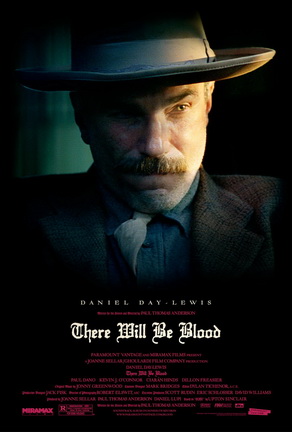
There_Will_Be_Blood_PosterYou know how there are some films that you really want to love and that you know that, given your taste in cinema, you probably should love but yet you somehow just cannot bring yourself to actually love?

To a certain extent, that’s the way I feel about the 2007 best picture nominee There Will Be Blood.  It’s a film that I greatly respect, as I tend to respect all of Paul Thomas Anderson’s movies.  He’s one of the best director working today and also one of the most consistently interesting.  (He’s also probably the only contemporary filmmaker who would actually base a two and half hour epic on the first 150 pages of a forgotten novel by Upton Sinclair.)  And I think that There Will Be Blood is a well-made and well-directed film.  I also think it’s well-acted, though I do think Daniel Day-Lewis goes a bit too far over-the-top at the film’s conclusion.   (If anything, Paul Dano is the one who actually deserved to win an Oscar for his work in this film.)  There Will Be Blood is an original work of cinematic art.  I’m thankful that it was made and that Anderson stayed true to his vision.

But, with all that in mind, it’s never been a film that I’ve been able to love.  Unlike Anderson’s earlier Boogie Nights, There Will Be Blood holds the audience at a distance.  We remains outsiders looking in.  As a result, the film engages intellectually but not emotionally.  It’s a film that earns respect without necessarily winning the audience’s love.

Speaking of respect, that’s something that you have to give to both Daniel Day-Lewis and Paul Thomas Anderson.  From the start of the film, Daniel Plainview (played by Day-Lewis) is a cruel and self-centered bastard and that characterization remains consistent throughout.  Briefly, it does seem that Plainview might truly care about his deaf, adopted son but, by the end of the film, Plainview has even proven that to be wishful thinking on our part.  (The only other character to whom Plainview is consistently pleasant is a young girl named Mary but Day-Lewis plays those scenes with such a corrupt twinkle in his eye that the subtext becomes increasingly creepy.)  Give Anderson and Day-Lewis credit.  They commit to portraying Daniel Plainview as being an almost Satanic character and, at no point, does either one of them waver in that commitment.  As we watch Plainview ruthlessly buy up all the land and drill all the oil that he can find, we wait for him to have some moment of redemption.  It took guts for neither Anderson nor Day-Lewis to allow him one.

Paul Dano plays Eli Sunday, an evangelical preacher who stands in the way of Plainview’s efforts to buy up all the land around the Sunday family farm.  The film presents Eli and Plainview as being two sides of the same coin.  Plainview hides his moral emptiness behind his money.  Eli hides behind his religion.  The two characters hate each other because they alone truly recognize what they truly are.  Dano, who also plays Eli’s brother, gives a mesmerizing performance, one that unfortunately has been overshadowed by Day-Lewis’s work.

It all ends, as all things must, with violent death in a bowling alley.  I know that a lot of my fellow cineastes think that the bowling scene is the highlight of the film but, to be honest, this was the point where the film lost me.  To me, this was the scene where Daniel Day-Lewis’s performance crossed the line from being flamboyant to shrill.  The end just did not work for me.

However, two things that did definitely work for me: Johnny Greenwood’s wonderfully ominous and atmospheric score and Robert Elswit’s amazing cinematography, which made the film’s landscape appear both beautiful and threatening at the same time.  The mix of Greenwood’s music with Elswit’s cinematography created some truly haunting moments.

In the end, There Will Be Blood is a lot like Daniel Plainview.  It is powerful, memorable, unpredictable, flamboyant, overbearing, and at times a little frightening.  And, again much like Daniel Plainview, it’s a film that’s easy to respect and difficult to love.

Embracing the Melodrama Part II #108: The Brave One (dir by Neil Jordan)


Brave_one_2007For our next entry in Embracing the Melodrama Part II, we take a look at Jodie Foster in the 2007 film The Brave One.  And…

Well, how to put this delicately?

I hate hate hate hate HATE this movie, with every last fiber of my being.  I hated it the first time that I saw it and I hated it when I recently rewatched it and right now, I’m hating the fact that I even decided to review this damn film because it means that I’m going to have to think about it.  I’m going to try to get this review over with quickly because, with each minute that I think about this film, I doubt my commitment to cinema.  That’s how much I hate this movie.  If I’m not careful, I’m going to end up joining a nunnery before I finish this review…

http://www.youtube.com/watch?v=6yh8l6ztvAE

So, in The Brave One, Jodie Foster plays Erica Bain.  Erica lives in New York and hosts one of those pretentious late night radio shows that are always popular in movies like this but which, in real life, nobody in their right mind would waste a second listening to.  Erica spends her time musing about life in the big city and hoping that we can all just love one another and expressing a lot of other thoughts that sound like they’ve been stolen from an automated twitter account.

Erica also has a boyfriend.  His name is David and he’s played by Naveen Andrews.  That means that he looks good and he has a sexy accent and when he first shows up, you hope that he’ll stick around for a while because otherwise, you’re going to have to listen to move of Erica’s radio monologues.  But nope — one night, while walking through Central Park, David and Erica are attacked.  David is killed.  Erica is raped.  And their dog is taken by the gang!

(And the film doesn’t seem to know which it thinks is worse…)

When Erica gets out of the hospital, she is, at first, terrified to leave her apartment.  Or, at least, she’s terrified to leave her apartment for about five minutes.  But then she does find the courage to go outside and, of course, the first thing she does is buy a gun.  At first, she’s buying the gun for her own state of mind but, almost immediately after purchasing her firearms, she happens to stumble across a convenience store robbery.

Bang!  Bang!  Erica’s a vigilante now!

But, of course, she’s not really sure if that’s what she wants to be.  Even though she eventually ends up sitting on a subway and waiting for a guy to approach her so she can shoot him, Erica is still never really that comfortable with the idea of seeking vengeance.  And this is why I hated The Brave One.  The film is so damned wishy washy about Erica’s motivations.  Instead of allowing Erica to get any sort of satisfaction or emotional fulfillment out of her actions, The Brave One has her constantly doubting whether or not violence is the answer.  And don’t get me wrong, I’m not saying that violence is the answer.  But if you’re going to make a film about a female vigilante who is out looking for vengeance, why don’t you at least allow her to get some sort of empowerment out of her actions?  That doesn’t mean that the film itself can’t be ambiguous about what she’s doing.  But by having Erica constantly questioning her actions, it makes her into a weak character and it lets the men who raped her and the ones who subsequently threaten to do the same off the hook.  It allows them to be seen as victims, as opposed to products of a society where men are raised to believe that women will never fight back.

There’s a far superior New York-set film that has almost the same plot as The Brave One.  The title of that film was Ms. 45.  It was made for a hundred times less money than The Brave One and, at the same time, it was and remains a hundred times better.  (I previously wrote about Ms. 45 and The Brave One in my essay, Too Sordid To Ever Be Corrupted.)

The difference between the two films can be summed up by the film’s tag lines.  The Brave One was advertised with, “How many wrongs to make it right?”  Ms. 45 was advertised with: “She was abused and violated … IT WILL NEVER HAPPEN AGAIN!”   Ms. 45 features a vigilante who never doubts her actions and, as a result, she becomes a symbol not of violence but of empowerment.  Meanwhile, Jodie Foster is so constantly wracked with guilt and doubt that the film almost seems to be criticizing her for not staying in her apartment and trusting the police (represented by Terrence Howard and Nicky Katt) to do their job.

Oh!  And, of course, at the end of the film, Erica gets her dog back.  Because nobody ever permanently loses their dog in a big budget studio film…

And really, that’s why The Brave One is such a failure.  It takes a subject that was tailor-made for the grindhouse and attempts to give it the slick and self-important studio approach.  And part of that approach is that no one can be offended.  This is a film that both wants to celebrate and condemn at the same time.

And that’s why I say, “Give me Ms. 45!”

At least that movie knows what it wants to say…