Horror On The Lens: The Brain Eaters (dir by Bruno VeSota)


For today’s horror on the lens, we have 1958’s The Brain Eaters!

In this noir-influenced tale of science fiction horror, a con-shaped ship crashes near a small town.  Soon, the residents of the town are vanishing, just to return as mind-controlled zombies!  This one clocks in at 61 minutes and it’s an enjoyable little B-movie.  Like many films from the 50s, the main message seems to be that you should never totally trust anyone.  They could be a communist.  They could be an alien.  They could be a Brain Eater!

Keep an eye out for Leonard Nimoy in an early role.  Or actually, it might be better to keep an ear open.  Nimoy isn’t easy to spot but you’ll recognize his voice towards the end of the film.


Horror On The Lens: Teenage Caveman (dir by Roger Corman)


Future serious actor Robert Vaughn made his film debut in 1958’s Teenage Caveman.  Directed by Roger Corman, Teenage Caveman tells the story of a rebellious young man (that’s Robert Vaughn) who chooses to defy his father’s warnings and venture beyond the caves and into “the forbidden zone.”  He’s told that monsters roam in the forbidden zone and indeed, at least one of them does.  However, neither the Teenage Caveman nor his father are prepared for what lies at the heart of the forbidden zone.

(What will he find out there, Dr. Zaius?)

Robert Vaughn later said that, out of all the bad films that he made, this was the worst.  Personally, I think he was being a bit too hard on the film.  It’s not good but it is definitely fun.  Along with watching all of the dinosaur stock footage, you get to wonder how a caveman — especially a teenage caveman! — could possibly have such perfect hair.  Even more importantly, if you stick with it, this film has a twist ending that has to be seen to be believed.

Here is Teenage Caveman:


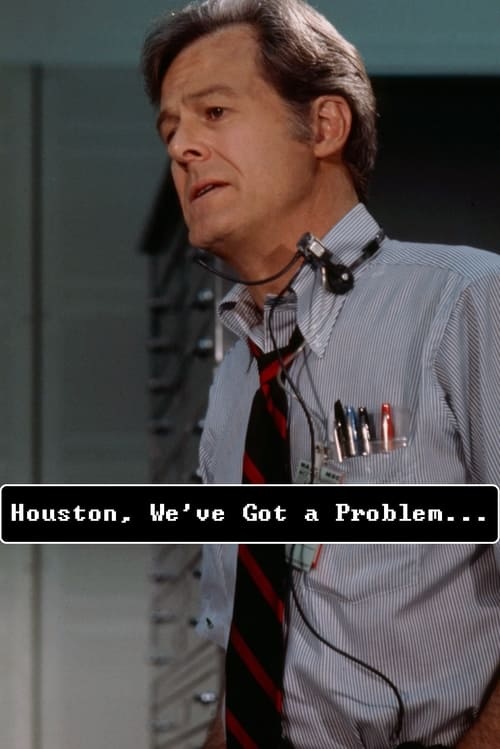
Retro Television Reviews: Houston, We’ve Got A Problem (dir by Lawrence Doheny)


Welcome to Retro Television Reviews, a feature where we review some of our favorite and least favorite shows of the past!  On Sundays, I will be reviewing the made-for-television movies that used to be a primetime mainstay.  Today’s film is 1974’s Houston, We’ve Got A Problem!  It  can be viewed on YouTube!

The year is 1970 and Apollo 13 is the latest manned NASA mission into space.  The head of the mission of Jim Lovell and the destination is the Moon.  Unfortunately, the American public has gotten so used to the idea of men going to the Moon that hardly anyone is paying attention to Apollo 13.  That changes when Lovell contacts mission control in Houston and utters those famous words, “Houston …. we’ve had a problem.”  An oxygen tank has exploded, crippling the spacecraft and leaving the three men in danger.  If Houston can’t figure out how to bring them home, Apollo 13 could turn into an orbiting tomb.

Yes, this film tells the story of the same crisis that Ron Howard recreated in Apollo 13.  The difference between Houston, We’ve Got A Problem and Apollo 13 (beyond the fact that one was a big budget Hollywood production and the other a low-budget made-for-TV movie), is that Apollo 13 largely focused on the men trapped in space while Houston, We’ve Got A Problem is totally Earthbound.  In fact, Jim Lovell does not even appear in the ’74 film, though his voice is heard.  (The film features the actual communications between the crew and Mission Control.)  Instead, the entire film follows the men on the ground as, under the leadership of Gene Kranz (Ed Nelson), they try to figure out how to bring the crew of Apollo 13 home.  Houston, We’ve Got A Problem is a far more low-key film than Apollo 13, one that features narration from Eli Wallach to give it an effective documentary feel but one that also lacks the moments of wit and emotion that distinguished Apollo 13.  

NASA cooperated with the making of the film and it works best when it focuses on the men brainstorming on how to solve the biggest crisis that the American space program had ever faced to that date.  The film is less effective when it tries to portray the effects of the men’s work on their home lives.  Sandra Dee is wasted as the wife who can’t understand why her engineer husband (reliably bland Gary Collins) can’t spend more time at home.  Clu Gulager plays the guy who fears he’s missing out on time with his son.  Robert Culp plays the man with a heart condition who places his hand over his chest whenever anything stressful happens.  Steve Franken has to choose between his religious obligations and his obligation to NASA.  The melodrama of those fictional moments are awkwardly mixed with the based-in-fact moments of everyone calmly and rationally discussing the best way to save the crew.  Jim Lovell, as a matter of fact, complained that Houston, We’ve Got A Problem did a disservice to the flight controllers by presenting them all as being hopelessly inept in their lives outside of mission control.  (Lovell was reportedly much happier with Apollo 13.)

Because it features the actual conversations between the crew and Mission Control, Houston, We’ve Got A Problem is interesting as a historical document but it never escapes the shadow of Ron Howard’s better-known film.

Retro Television Reviews: The Screaming Woman (dir by Jack Smight)


Welcome to Retro Television Reviews, a feature where we review some of our favorite and least favorite shows of the past!  On Sundays, I will be reviewing the made-for-television movies that used to be a primetime mainstay.  Today’s film is 1972’s The Screaming Woman!  It  can be viewed on YouTube!

In this made-for-tv movie from 1972, the great Olivia de Havilland plays Laura Wynant. Laura is a wealthy woman who has just been released from a mental institution. She goes to her country estate to recuperate but, as soon as she arrives, she starts to hear a woman’s voice in the back yard.

“help me …. help me….” the voice cries.

Laura looks around and she soon realizes that the voice is coming from the ground! A woman has been buried alive in the backyard and will soon die if not rescued! At first Laura tries to dig up the woman on her own but her hands are crippled by arthritis. An attempt to get a neighborhood child to help her dig just leads to Laura being confined to her home, under doctor’s orders. No matter how much Laura tries to get the people around her to listen for the sound of the woman crying for help, everyone just assume that Laura must be imagining things.

Further complicating things is the fact that the person who put the woman in the ground is still out there. And, when he discovers that Laura has been hearing voices, he decides that maybe he needs to do something about both Laura and the screaming woman….

The Screaming Woman is an effective psychological thriller and, considering that it was made for early 70s network television, surprisingly suspenseful. If the film were remade today, I imagine it would try to keep us guessing as to whether or not Laura was hearing an actual woman or if it was all in her mind.  However, by revealing early on that Laura actually is hearing what she thinks she’s hearing, The Screaming Woman puts us right into Laura’s shoes and we share her frustration as she desperately tries to get someone — anyone — to take her seriously. It helps that Laura is played by Olivia de Havilland, who gives a very sympathetic and believable performance. De Havilland, who started her career appearing in Errol Flynn movies back in the 30s and who most famously played Melanie in Gone With The Wind, was one of the longest-lived stars of Hollywood’s Golden Age, living to the age of 104 and winning two Academy Awards for Best Actress.

The film is based on a short story by Ray Bradbury. In the story, it’s a little girl — as opposed to an old woman — who hears the voice. I haven’t read the short story so I don’t know how else it compares to this adaptation but, as a film, The Screaming Woman is an entertaining and creepy thriller and, when viewed today, it serves as a reminder of what a good actress Olivia De Havilland truly was.  She takes a simple thriller and turns it into a meditation on aging and the one person’s determination to do the right thing even when the entire world seems to be against her.

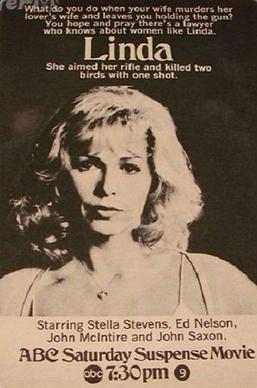
Retro Television Reviews: Linda (dir by Jack Smight)


Welcome to Retro Television Reviews, a feature where we review some of our favorite and least favorite shows of the past!  On Sundays, I will be reviewing the made-for-television movies that used to be a primetime mainstay.  Today’s film is 1973’s Linda!  It  can be viewed on YouTube!

If nothing else, Linda has a wonderfully opening.

Two couples are on the beach.  Paul Reston (Ed Nelson) is talking to Anne Braden (Mary-Robin Redd) about his troubled marriage and his plans to leave his wife.  Paul’s wife, Linda (Stella Stevens), is talking to Jeff Braden (John Saxon) and looking at the rifle that he’s just handed her.  It doesn’t take long to notice that Paul and Linda seem to be closer, respectively, to Anne and Jeff than to each other.

When Anne stands up and walks toward the ocean, Linda shoots her in the back.  When Jeff runs over to Anne’s body, Linda pulls the trigger again and Jeff collapses.  Stunned by his wife’s actions, Paul runs back to his car and drives into town to get the police.  (This is another one of those movies that could have only been made in the pre-smartphone era.)  When Paul and the police return, they find Anne’s body but Jeff and Linda are nowhere to be seen.

Suddenly, Linda and Jeff come walking down the beach.  Jeff is carrying a bunch of fish and a fishing pole.  They look shocked when they see the police.  Then, when Jeff sees Anne’s body, he accuses Paul of killing her and attacks him.  Paul is arrested and taken to jail.

As I said, it’s a wonderful opening, full of twists and entertaining overemoting.  In fact, it’s so good that it’s difficult for the rest of the film to keep up.  After being charged with Anne’s murder, Paul hires a folksy attorney named Marshall Journeyman (John McIntire).  Unlike everyone else, Journeyman believes Paul’s story that he’s being framed by Jeff and Linda.  Journeyman sets out to prove that Paul is innocent.

Of course, the audience already know that Paul is innocent because the audience saw exactly what happened.  Watching the film, it was hard for me to not to feel that the story would have benefitted by a little more ambiguity as to whether or not Paul was a victim or if he truly was the delusional madman that both Linda and Jeff tried to paint him as being.  We know from the start what Jeff and Linda are doing so the only question really becomes how Journeyman is going to trick them into revealing the truth.  Unfortunately, even getting them to do that turns out to be a bit too easy.  The movie suggests that Journeyman is a brilliant investigator but, in the end, it all really just comes down to the villains not being very smart.

That said, the film’s cast does a good job.  Ed Nelson is sympathetic as the confused husband and John McIntire brings so much homespun charm to Journeyman that I got the feeling that this film was probably designed to be a pilot for a possible series.  Best of all, John Saxon and Stella Stevens play the scheming couple.  Saxon gets to wear a swimsuit and dramatically shout to the Heavens as he pretends to be shocked over Anne’s murder.  Stevens smirks at every question and accusation and appears to be having a great time playing an old school femme fatale.  The cast makes this movie worth it.

Retro Television Review: A Little Game (dir by Paul Wendkos)


Welcome to Retro Television Reviews, a feature where we review some of our favorite and least favorite shows of the past!  On Sundays, I will be reviewing the made-for-television movies that used to be a primetime mainstay.  Today’s film is 1971’s A Little Game.  It  can be viewed on YouTube!

Twelve year-old Robert Mueller (played by 13 year-old Mark Gruner, who would later go on to play one of Chief Brody’s kids in Jaws) just hasn’t been the same since his father died.  Robert idolized his father, who was an architect who built bridges and reportedly pushed his workers to take a lot of dangerous risks to get the job done.  Perhaps that explains why Robert is not getting along with his new stepfather, Paul Hamilton (Ed Nelson).  Robert’s mother, Elaine (Diane Baker), is convinced that Robert will eventually come to accept Paul but Paul isn’t so sure.

Robert is a student at a private military academy.  When he comes home for the holidays, he brings his “best friend” with him.  Stu Parker (Christopher Shea) is friendly and polite but he’s also easily led and has a difficult time standing up for himself.  Paul immediately sees that Robert is bullying Stu.  Elaine, however, thinks that Paul is being too critical.  That’s just the way boys are!

In his diary, Robert has written that he killed someone and that he’s sure that he got away with it.  When Paul comes across the entry, he worries that Robert might be telling the truth.  Paul goes as far as to hire a private detective (Howard Duff) to investigate whether there’s been any mysterious deaths at Robert’s school.  Stu, meanwhile, explains that he and Robert sometimes play “a little game” where they imagine that best way to murder someone and get away with it.  But Stu assures Paul that it’s just a game.  They don’t actually kill anyone.

Is Stu telling the truth or is Robert just as dangerous as his deceased father, a man who Paul claims was a psychopath?  Or is Paul himself the one who has become delusional with jealousy of his stepson?

The answer to those questions is pretty obvious from the minute that Robert and Stu show up at the house.  In fact, it’s so obvious that it kind of leaves the viewer wondering how everyone else in the film could be so clueless.  On the one hand, it’s understandable that Elaine would not want to admit that there is something seriously wrong with her son.  On the other hand, how many times can anyone close their eyes to a very obvious truth?  From the minute that Robert shows up, wearing his uniform and curtly ordering around the family’s maid (played by High Noon‘s Katy Jurado, who deserved a better role), he might as well have psychopath tattooed on his forehead.

That said, evil children movies are always somewhat effective, even the ones that are a bit too obvious in their approach.  Psychologically, we’ve been conditioned to always associate children with innocence, optimism, and hope.  Children are the future, so the saying goes. As such, it does carry some impact when they’re portrayed as being a force of danger.  As I watched this film, I did find myself wondering if there was any hope for Robert.  With all that he had done, could someone still reach him and turn him around?  Or was he destined to go from being an evil child to an evil adult?  It really does get to the question of whether evil is a real, almost supernatural force or if it’s something that’s created by a combination of environment and social taboos.  Was Robert born evil or did he become evil?  A Little Game doesn’t answer that question but I doubt that anyone could.  Some questions are destined to be forever unanswered.

Horror on the Lens: Attack of the Crab Monsters (dir by Roger Corman)


For today’s horror on the lens, we have the 1957 science fiction film, Attack of the Crab Monsters!

About a month ago, I watched this film along with Patrick Smith and all of our friends in the late night movie gang.   To be honest, everyone else seemed to enjoy it a lot more than I did.  It was a fun little movie but … well, maybe I was just having a bad night.

Here’s why you should take 62 minutes out of your Saturday and watch Attack of the Crab Monsters on the Shattered Lens.  First off, it’s a Roger Corman film and anything directed by Roger Corman automatically needs to be watched.  Secondly, it’s about giant crabs that communicate through telepathy.  And when was the last time you saw that!?

(“Last night,” someone in the audience shouts, “as the sun went down over the crab-covered beaches of Denmark!”  I pretend not to hear.)

Anyway!  Here, for your viewing pleasure, is Attack of the Crab Monsters!

Police Academy 3: Back in Training (1986, directed by Jerry Paris)


Police Academy 3 opens with a state in the middle of a fiscal crisis.  Money has to be saved somewhere and the governor (Ed Nelson) has decided that it’s not necessary for the state to have two police academies.  I am not sure why the governor would be the one to make that determination since the previous two Police Academy films established that the academies are run by the city but I guess I should remember that I’m watching a Police Academy film and not ask too many questions.

Which academy is going to be closed down?  Will it be the academy run by Commandant Lassard (George Gaynes) or the one run by Commandant Mauser (Art Metrano, returning from the second film)?  Mauser is willing to use any dirty, under-handed trick to keep his academy open.  Meanwhile, Lassard has his most recent graduating class returning to instruct his latest batch of recruits.  Can Mahoney (Steve Guttenberg) and Michael Winslow’s human sound effects machine save the academy?

When I watched Police Academy 3 this weekend, I was surprised to discover that it wasn’t as bad as I remembered.  Maybe it’s because I watched it immediately after the first two films and my senses were dulled but Police Academy 3 turned out to be an amiable and enjoyably stupid comedy. It helped that two of the new recruits were played by Tim Kazurinsky and Bobcat Goldthwait.  Returning to the roles that they first played in the second movie, Kazurinsky and Goldthwait make for a good comedic team.  As for the rest of the Police Academy regulars, they all do their usual comedy bits like pros and without any fuss.  It’s predictable and sometimes, funny.

Police Academy 3 was the first Police Academy film to have a PG-rating and, as a result, the jokes were still as juvenile and crude as the first two movies but, at the same time, Police Academy 3 seems to have made peace with the fact that it’s target audience was a bunch of adolescent boys dropped off at the theater by their mothers.  Mauser is still regularly humiliated but no one gets a blow job while standing in front of a podium.  This is a Police Academy for the entire family, assuming that your family is easily amused and not too demanding.

Police Academy 3 is a dumb movie and the recurring joke about policemen accidentally entering the Blue Oyster Bar is even less funny the third time that it’s used.  There’s also a Japanese recruit who only seems to be included because, back in the 80s, American films were obsessed with making fun of Japan.  Despite all that, Police Academy 3 is still not as bad as the usual Police Academy sequel.

But what about Police Academy 4?  Check in tomorrow to find out if it’s also better than I initially remembered.

(It’s not.)

That’s The Way Of The World (1975, directed by Sig Shore)


Welcome to the down and dirty world of the music industry in the 1970s.

Coleman Buckmaster (Harvey Keitel) is a record producer who is known as the “Golden Ear,” because of his success at discovering new talent.  Coleman is the son of a jazz pianist (to whom he brings a birthday present of cocaine) and he is convinced that consumers are not as dumb as music execs assume that they are.  He believes that his latest group, known simply as The Group (but played by Earth, Wind, & Fire), have what it takes to become a big success despite not having a conventionally commercial image.

Coleman’s boss, Carlton James (Ed Nelson), disagrees.  Carlton orders Coleman to spend less time working with The Group and to instead devote his energy to producing a single for a new band called The Pages.  Led by Franklyn Page (Bert Parks), the Pages present themselves as being a clean-cut and wholesome family band.  Carlton is sure that their innocuous style and feel-good harmonies are going to be “the sound of the 70s.”  Coleman disagrees but he tries to balance working with both groups.  While he tries to make The Group into a success, he also tries to find something worthwhile in The Pages’ new single, “Joy Joy Joy.”  Complicating matters is that, against his better instincts, Coleman has fallen into a relationship with Velour Page (Cynthia Bostick), who is not as innocent as the band’s image makers makes her out to be.

Written by journalist Robert Lipsyte and directed by producer Sig Shore (he did Superfly), That’s The Way Of The World is an interesting look at what was going on behind the scenes of the music industry in the 70s.  It’s not the first film to suggest that the recording industry was run by unethical and corrupt record labels (nor would it be the last) but it feels authentic in a way that a lot of other music industry films don’t.  That’s The Way Of The World emphasizes just how manufactured most popular music is.  Insisting on trying to do something different, as the Group does, will only lead to you being snubbed by the industry.  Play ball and record music that means nothing — like the Pages — and you’ll become a star overnight.  Having a hit has less to do with the work you put into it and more with how many people your label is willing to pay off.  As one exec puts it, getting your record played on the radio (in those days before YouTube and Soundcloud) means resorting “payola, layola, and drugola.”  Harvey Keitel performs his role with his trademark intensity and Bert Parks is brilliantly cast as the thoroughly fake Franklyn Page.

Today, The Way Of The World is best-known for its soundtrack, which was also one of Earth, Wind, and Fire’s best-selling albums.  Though the film was a bomb at the box office, the album was not.  The Group may have struggled to get anyone to listen but Earth, Wind, and Fire became the first black group to top both the Billboard album and singles charts.

Beware The Pages

Film Review: She Gods of Shark Reef (dir by Roger Corman)


Ah, Hawaii!

There is no state more beautiful than Hawaii and there are no people friendlier.  When I was 17 years old, my family spent a summer in Hawaii and it was one of the most wonderful experiences of my life.  I can’t swim to save my life and I have a morbid fear of drowning but, when I was in Hawaii, I happily walked into the ocean.  Not far into the ocean, of course.  But still, everyone in my family was amazed.  Of course, eventually I saw a jelly fish floating towards me and I screamed and ran back to the beach.  (After reaching the safety of the beach, I realized that the jelly fish was actually just seaweed but still, it was scary-looking!)  Hawaii is just the type of state that makes you appreciate life and take risks.

For instance, consider the two main characters in Roger Corman’s 1958 film, She Gods of Shark Reef.  Chris (Bill Cord) and Lee (Don Durant) are brothers who live in Hawaii.  Chris has blonde hair and a good attitude towards life.  Lee has dark hair and a criminal nature.  Chris loves the ocean.  Lee loves to run guns.  After Lee kills two men, he stows away on Chris’s boat.  When the boat then hits a storm, Chris and Lee wash up on the shores of an isolated beach.  It’s a beautiful island but all Lee can think about is how he can make money off of his current predicament.  Bad Lee, bad!

Anyway, it turns out that the island is inhabited by an all-female village of pearl divers.  Everyone is excited by the arrival of two handsome, shirtless men.  Everyone except for Queen Pua (Jeanne Gerson), who doesn’t trust either one of them and who doesn’t appear to want anyone in the world to be happy.  She’s especially upset when Chris interrupts a plan to sacrifice a villager to the shark gods of the sea.  Chris not only rescues but also falls in love with Mahia (Lisa Montell).

While Chris is busy falling in love, Lee is trying to figure out a way to escape from the island before a rescue boat arrives.  Lee, after all, is a wanted criminal and the last thing that he wants is to go from being shipwrecked to imprisoned.  Lee comes up with a plan for himself, his brother, and Mahia to escape the island.  However, Lee being Lee, he just can’t overcome his greedy nature.  As quickly becomes obvious, Karma is not only a bitch but it’s a shark as well.

She Gods of Shark Reef was directed by Roger Corman.  Though the film’s low budget is obvious in every frame, Corman wisely decided to concentrate on the island’s beauty as opposed to the movie’s somewhat haphazard story.  This is one of those films where the action stops for nearly five minutes so that Corman can film a hula dancer.  But you know what?  That’s okay!  The beauty of Hawaii and the surrounding ocean carry the film.  You don’t watch for the plot.  Instead, you watch for the blue water and the green grass and the vibrant skies.  This is a film that you watch for the island scenery and the sharks.  Both of them are quite nice.