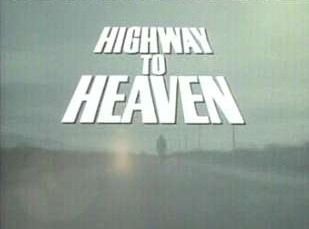
Welcome to Late Night Retro Television Reviews, a feature where we review some of our favorite and least favorite shows of the past! On Thursdays, I will be reviewing Highway to Heaven, which aired on NBC from 1984 to 1989. The entire show is currently streaming on Tubi and several other services!
This week, Mark is abandoned in the park.
Episode 4.13 “A Mother’s Love”
(Dir by Michael Landon, originally aired on January 6th, 1988)
It’s time for Jonathan and Mark to start a new assignment! This week, Jonathan gets to be a teacher (again!) and Mark gets to be …. homeless.
Seriously, Mark is dropped off in the park and told to live there. Eventually, Jonathan shows up and gives Mark a tent and some cooking supplies. That was nice of him but still, you have to wonder why Mark always seems to get assignments that are designed to aggravate him. “Thanks for giving up your independence to work with my angel,” the show’s version of God seems to be saying, “Now, here …. go live in the park.”
Also living in the park are four brothers whose mother has recently died. They’re living in a van and are trying to not get sent to foster care. Fortunately, there’s a teacher at Jonathan’s new school who regrets that she never had a family. Guess who is going to end up adopting four kids!
This was pretty much the epitome of Highway to Heaven, sweet-natured, sentimental, shamelessly manipulative, and so earnest that it worked even when it shouldn’t have. That said, I hope Jonathan will put a good word in for Mark. The guy deserves at least one easy week!
Welcome to Late Night Retro Television Reviews, a feature where we review some of our favorite and least favorite shows of the past! On Mondays, I will be reviewing CHiPs, which ran on NBC from 1977 to 1983. The entire show is currently streaming on Freevee!
This week, Ponch takes a deep breath and he gets real high.
Episode 1.2 “Undertow”
(Dir by Christian I. Nyby II, originally aired on September 22nd, 1977)
On tonight’s episode of CHiPs, a true crisis breaks out.
The California Highway Patrol’s basketball team loses a game!
Now, they would have won the game if Ponch had been playing. I’m only two episodes into this series and it’s already pretty obvious that there’s apparently nothing that Ponch can’t do. However, while at the scene of an accident on the highway, Ponch stood right in front of a leaky cannister of nitrous oxide! He ended up getting so high that he started seeing double, dancing in the halls of the station, and basically just acting like a total jackass. Of course, he smiled the whole time. Baker was less amused.
Because of his temporary high, Ponch was sent home and ordered to stay in bed for a day. He missed the game and the CHiPs lost to some other off-duty branch of California law enforcement. Fortunately, Sgt. Getraer is able to set up a rematch and, with Ponch now able to play, the CHiPs win by two points! And, of course, the winning shot is taken by Ponch because there’s nothing that Ponch can’t do. This episode ends with a series of freeze frames of Ponch winning the game and proving that California has the best highway patrol in the country.
Of course, the basketball game is only the B-plot of this episode of CHiPs. The main storyline deals with fake tow truck driver (Angelo de Meo) who is listening to the police radio for calls from women who have broken down on the highway. The driver goes to wherever the women are calling from but, instead of towing their car, he instead steals their money! The first time that Ponch and Baker chase him, the crooked tow truck driver gets away. The second time, they catch him. Of course, both of the chases lead to multi-car wrecks on the highway. This episode features the first instance of a car flipping over in slow motion on this show. Apparently, that would go on to become a CHiPs trademark.
Of course, there are other little things that Ponch and Baker have to deal with. They pull over a drunk driver (Jim Backus) and Ponch, who is high from the nitrous oxide, struggles to give him a sobriety test. They also pull over an old surfer (Paul Brinegar), who has a talking myna bird in his truck. The bird was cute. These scenes did not add up too much but I imagine they were included to drive home the idea that Ponch and Baker are professionals, even if they do spend a lot of time talking about basketball.
This episode was actually kind of fun. Erik Estrada is not a particularly subtle actor to begin with and this episode actually gives him an excuse to overact even more than usual. As much fun as it is to watch Estrada bounce off the walls, it’s even more interesting to glance over at Larry Wilcox and see just how much he appears to resent having to work with someone who always has to be the center of every scene. Neither Wilcox nor Baker seem particularly unhappy about Ponch being sidelined for a good deal of the episode. Just as in the pilot, the chase scenes were genuinely well-filmed and it was impossible not to enjoy the shots of the motorcycles weaving in and out of traffic.
Next week, Ponch will probably save someone’s life while Baker seethes in the background. We’ll see!
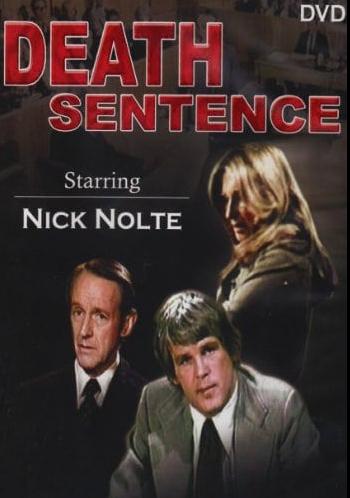
Welcome to Retro Television Reviews, a feature where we review some of our favorite and least favorite shows of the past! On Sundays, I will be reviewing the made-for-television movies that used to be a primetime mainstay. Today’s film is 1974’s Death Sentence! It can be viewed on YouTube!
There’s been a murder!
A young woman has been strangled in her own home. The nosy neighbor (Hope Summers) testifies that the woman often argued with her woman and that she heard the woman yelling on the night of the murder. The husband, John Healy (Nick Nolte), is found in a neighborhood bar and, when he’s brought back to his house, his drunken reaction to seeing his dead wife doesn’t do much to keep him from looking totally guilty.
However, the viewer knows that John is innocent because the viewer has already seen that the woman was murdered by Don Davies (Laurence Luckinbill), the man with whom she was having an affair. She demanded that he leave his wife for her and Don, realizing that his cheating was about to revealed, responded by strangling her.
Don’s wife is Susan Davies (Cloris Leachman), who knows that she and Don have been going through a rough patch but who certainly had no idea that Don was cheating on her. Shortly after the murder, Susan is called up for jury duty. She’s placed on the jury and told that she will be an important part of a major trial. As a result, she and the other jurors will be sequestered in a hotel….
And who is the defendant in this trial? John, of course!
As opposed to the other members of the jury, who are ready to convict John even before the first bit of testimony is heard, Susan pays attention to what is said in the courtroom. She listens to Lubell (Alan Oppenheimer), the prosecutor. She listens to Tanner (William Schallert), the defense attorney. She comes to believe that John is innocent but will she be able to hold her own against the rest of the jury? And will she ever figure out that the murder was actually committed by her husband?
It’s an intriguing premise, even if it is a bit far-fetched. I mean, it really is an amazing coincidence that Susan just happened to end up on the jury for a case involving a murder that was actually committed by her husband. However, this is a made-for-television movie and, as soon as “Produced by Aaron Spelling” appears on the screen, most viewers should be savvy enough to know what they’re getting into. Instead, the main problem with the film is that it opens by showing us who the murderer is. Therefore, there’s really zero suspense as to who actually committed the crime. Instead, the viewer spends the entire movie waiting for Susan to catch up. Since the majority of the film takes place in court, it’s a very talky film but there’s no joy to be found in paying close attention to every word said and picking up on the details that will allow you to solve the crime for yourself. This is a case where the film spoils its biggest twist and, despite good performances from Leachman and Luckinbill, it’s a bit dull.
(Nick Nolte, for his part, spends most of the movie silently sitting in the courtroom. He’s not bad and his look of anguish is believable but it’s hardly a starring role, regardless of what the film’s video packaging might otherwise claim.)
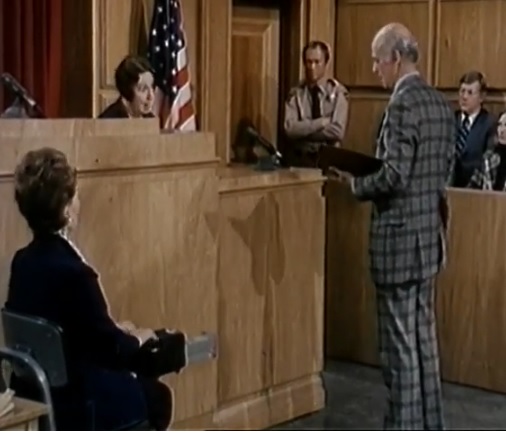
In the end, what I’ll mostly remember about Death Sentence were the atrocious fashion choices made by the prosecutor. Seriously, would you trust a man wearing this suit?
Today’s horror on the lens is a 1970 made-for-TV movie called The House That Would Not Die!
In this film, Barbara Stanwyck and Kitty Winn move into a colonial house that is rumored to be haunted! Seances, possession, and scandal follows! There’s time travel, slow mo, an exaggerated wind effects! It’s all kinda silly but kinda fun too.
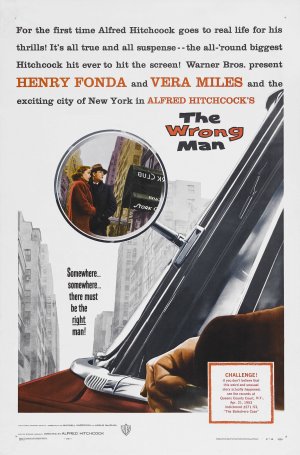
Since today is Alfred Hitchcock’s birthday, I figured why not take a few minutes to recommend one of his films that you may not have seen. First released in 1956 but still painfully relevant today, The Wrong Man is one of Hitchcock’s best but it’s also one of his most underrated.
The Wrong Man deals with a common Hitchcock theme — i.e., an innocent man has been accused of a crime and, despite all of his efforts, cannot seem to convince anyone of his innocence. The difference between The Wrong Man and something like Saboteur or Frenzy is that The Wrong Man is based on a true story.
Manny Ballestro (Henry Fonda) is a struggling musician. He makes $85 a week, playing in a small jazz club. But even though he may not be rich, he’s happy. He loves his job. He loves making music. Even more importantly, he loves his wife, Rose (Vera Miles). But Rose needs to have her wisdom teeth removed and it’s going to cost $300. (As a sign of how much things have changed, I would have been relieved if it had only cost me $300 to get my wisdom teeth taken out.) Desperate for money, Manny tries to borrow money on his wife’s life insurance plan. What Manny doesn’t know is that the insurance office has been held up twice by a man who bears a vague resemblance to him. A clerk calls the police and Manny soon finds himself being taken down to the police station.
Two detectives say that they need Manny’s help but they don’t tell him why. But Manny knows he’s innocent of any crime and he believes that the police are on his side and he agrees to help. When they tell him to walk into a liquor store, he does so. When they take him to a deli, he goes in there as well. When they demand to know why he was trying to borrow money on his wife’s life insurance, he tells them. When they ask him about his financial difficulties, he tells them about that as well. Why shouldn’t he? He’s innocent and the police are just doing their job, right? And when the cops finally ask him to copy down a few words that were used in the note that the robber slipped the clerk at the insurance company, Manny does so. And when they then ask him to take part in a line-up, he does that as well…
And when Manny is arrested and charged with a crime … well, that’s when he finally understands that the system is not on his side. His wife manages to hire a reputable attorney, Frank O’Connor (Anthony Quayle), to defend him but it quickly becomes obvious that the world has already decided that Manny is guilty. When Manny and his wife try to track down some people who could provide Manny with an alibi, they discover that two of them are dead and one of them cannot be found. For once, in a Hitchcock film, it’s not a case of conspiracy. Instead, it’s just bad luck.
And, through it all, Rose continues to blame herself. In fact, she is so wracked with guilt that she has a nervous breakdown.
It all leads to an amazingly disheartening courtroom scene. As quickly becomes obvious, the judge has little interest in what’s happening in his court. Even worse, the jury is unconcerned with the evidence. Most of them are just annoyed at the inconvenience and punishing Manny seems like the perfect way to release their own frustrations…
It’s a bleak picture of the American justice system. Watching The Wrong Man today, it’s tempting to say that the film is just a reflection of society in the 1950s and that things have changed today. But really, have they? True, the police may now be required to read someone their rights when they’re arrested. A suspect can now ask for a lawyer. We’ve got laws against entrapment and all the rest. But that doesn’t matter. We still live in a society where people are still widely presumed to be guilty, even after they’ve been found innocent in a court of law. We still live in a society where the wrong man can have his life ruined because of one mistake.
The Wrong Man doesn’t get as much attention as some of Hitchcock’s other films. In many ways, it’s an atypical example of his work. Hitchcock was notorious for his dark sense of humor and his habit of waving away most plot points as just being mere “macguffins.” With the exception of two scenes, both of which are meant to depict Manny’s mental state, The Wrong Man is filmed in a documentary style, one that occasionally seems more like Sidney Lumet than Alfred Hitchcock. There’s next to no humor, nor are there any big or flamboyant twists. In short, The Wrong Man finds the director of Psycho, Vertigo, and Rear Window at his most sincere. It takes some getting used to.
But, once you do get used to it, The Wrong Man emerges as a powerful and bleak portrait of two innocent people at the mercy of a soulless system. It’s a must see so be sure to see it!

 Through the Shattered Lens