Clash of the Titans (1981, directed by Desmond Davis)


High atop Mt. Olympus, Zeus (Laurence Olivier) and his fellow Gods look down on Earth and jealously manipulate its citizens.  When Zeus impregnates Danae (Vida Taylor), the daughter of the King of Argos, she and her son Perseus (Harry Hamlin) are banished to sea.  Zeus responds by ordering Poseidon (Jack Gwillim) to release the Kraken.

Years later, when Callibos (Neil McCarthy), the son of the Goddess Thetis (Maggie Smith), destroys all but one of Zeus’s flying horses, Zeus transformer Callibos into a tailed monster.  Thetis tries to get her revenge by having Callibos kill Perseus but instead, Perseus chops off Callibos’s hand, comes to possess Pegasus, the last of the flying horses, and also wins the right to marry Andromeda (Judi Bowker).

At the wedding, Cassiopeia (Sian Phillips) declares Andromeda to be even more beautiful than Aphrodite (Ursula Andress).  Big mistake.  Aphrodite demands that Andromeda by sacrificed to the Kraken.  Along with Pegasus, Ammon (Burgess Meredith), Thallo (Tom Pigott-Smith), and robot owl, Perseus goes on a quest to get the snake-haired head of Medusa so he can turn the Kraken into stone.

There’s a lot that I love about Clash of the Titans, from the Ray Harryhausen’s stop-motion special effects to the blind witches who pass one eyepiece among them to Burgess Meredith’s performance as Ammon.  I even like the robot owl.  But the thing that has always made the biggest impression on me is that Mt. Olympus is portrayed as having a shelf that holds a figurine for every human in the world.  The Gods casually move the pieces around and transform them on whims.  Of all the films that have been based on Greek mythology, Clash of the Titans is one of the few that really captures the idea of the Gods essentially being a bunch of petty and jealous libertines who view humans are just being their playthings.

Let’s not overthink Clash of the Titans, though.  The main appeal of Clash of the Titans is that it’s just a good, old-fashioned adventure movie.  In this age of CGI and humorless heroes, it’s hard not love the film’s mix of old-fashion stop-motion animation, strong characters, and occasional moments of humor.  (I like the owl and I won’t apologize for it.)  Also, Medusa has appeared in a lot of movie but she’s never been scarier than in this movie.  Who can forget the yellow glow of her eyes, followed by men turning to stone?  Who can forget the hiss of her tail or the moment when Perseus waits to strike while trying not to look into her eyes?  Beyond Medusa, who can forget the Kraken rising from the sea or the blood of Callibos giving birth to giant scorpions?  Without CGI, Clash of the Titans still captures the feel of living in a different time and a different land.  Clash of the Titans brings mythology to life in a way that few other films have been able to,

I loved the original Clash of Titans when I was a kid.  I rewatched it last month and I happy to say that I love it still.

Film Review: Voyage of the Damned (dir by Stuart Rosenberg)


In 1939, an ocean liner named the MS St. Louis set sail from Hamburg.  Along with the crew, the ship carried 937 passengers, all of whom were Jewish and leaving Germany to escape Nazi persecution.  The ship was meant to go to Havana, where the passengers had been told that they would be given asylum.  Many were hoping to reunite with family members who had already taken the voyage.

What neither the passengers nor Captain Gustav Schroeder knew was that the entire voyage was merely a propaganda operation.  No sooner had the St. Louis left Hamburg than German agents and Nazi sympathizers started to rile up anti-Semitic feelings in Cuba.  The plan was to prevent the passengers from disembarking in Cuba and to force the St. Louis to then return to Germany.  The Nazis would be able to claim that they had given the Jews a chance to leave but that the rest of the world would not take them in.  Not only would the Jews be cast as pariahs but the Germans would be able to use the world’s actions as a way to defend their own crimes.

Captain Schroeder, however, refused to play along.  After he was refused permission to dock in Cuba, he then attempted to take the ship to both America and Canada.  When both of those countries refused to allow him to dock, Schroeder turned the St. Louis toward England, where he planned to stage a shipwreck so that the passengers could be rescued at sea.  Before that happened, Belgium, France, the Netherlands, and the United Kingdom jointly announced that they would accept the refugees.

Tragically, just a few days after the passengers disembarked, World War II officially began and Belgium, France, and the Netherlands all fell to the Nazi war machine.  It is estimated that, of the 937 passengers on the St. Louis, more than 600 of them subsequently died in the Nazi concentration camps.

The journey of the St. Louis was recreated in the 1976 film, Voyage of the Damned, with Max von Sydow as Captain Schroeder and a collection of familiar faces playing not only the ship’s passengers and crew but also the men and women in Cuba who all played a role in the fate of the ship.  In fact, one could argue that there’s a few too many familiar faces in Voyage of the Damned.  One cannot fault the performances of Max von Sydow, Malcolm McDowell, and Helmut Griem as members of the crew.  And, amongst the passengers, Lee Grant, Jonathan Pryce, Paul Koslo, Sam Wanamaker, and Julie Harris all make a good impression.  Even the glamorous Faye Dunaway doesn’t seem to be too out-of-place on the ship.  But then, in Havana, actors like Orson Welles and James Mason are awkwardly cast as Cubans and the fact that they are very obviously not Cuban serves to take the viewer out of the story.  It reminds the viewer that, as heart-breaking as the story of the St. Louis may be, they’re still just watching a movie.

That said, Voyage of the Damned still tells an important true story, one that deserves to be better-known.  In its best moments, the film captures the helplessness of having nowhere to go.  With Cuba corrupt and the rest of the world more interested in maintaining the illusion of peace than seriously confronting what was happening in Germany, the Jewish passengers of the St. Louis truly find themselves as a people without a home.  They also discover that they cannot depend on leaders the other nations of the world to defend them.

Defending the passengers falls to a few people who are willing to defy the leaders of their own country.  At the start of the film, Nazi Intelligence Chief Wilhelm Canaris (Denholm Elliott) explains that Captain Schroeder was selected specifically because he wasn’t a member of the Nazi Party and could not be accused of having ulterior motives for ultimately returning the passengers to Germany.  Canaris and his fellow Nazis assume that anti-Semitism is so natural that even a non-Nazi will not care what happens to the Jewish passengers.  Instead, Schroeder and his crew take it upon themselves to save the lives of the passengers.  It is not Franklin Roosevelt who tries to save the passengers of St. Louis.  Instead, it’s just a handful of people who, despite unrelenting pressure to do otherwise, step up to do the right thing.  Max von Sydow, who was so often cast in villainous roles, gives a strong performance as the captain who is willing to sacrifice his ship to save his passengers.

Flaws and all, Voyage of the Damned is a powerful film about a moment in history that must never be forgotten.

Cleaning Out The DVR: The 300 Spartans (dir by Rudolph Mate)


King Xerxes (David Farrar), the ruler of Persia, is leading his armies across the ancient world, conquering every nation that he comes to. Xerxes is quick to proclaim that his vision is to have “one world ruled by one master” but really, he’s mostly just trying to prove that he’s as fearsome a conqueror as his father was. Like most authoritarians, he’s really just dealing with his own psychological issues.

When Xerxes sets his eyes on Greece, he assumes that he’ll easily be able to conquer the country. Greece, after all, is divided into several city states and everyone knows that the cities are rarely willing to work together. However, 300 Spartan warriors — led by King Leonidis (Richard Egan) — are willing to stand their ground and hold off Xerxes’s forces for as long as possible. Despite the fact that they’re outnumbered and have no way of knowing if reinforcements will ever arrive, the 300 Spartans are willing to do whatever it takes to protect their freedom. They know that they probably won’t survive the battle but none of them are going to surrender. Better to die than be enslaved.

If the plot of 1962’s The 300 Spartans sounds familiar, that’s probably because it’s based on the same historical events that inspired 300. The 300 Spartans essentially tells the same story and even has many of the same themes as Zack Snyder’s later film. The main difference, of course, is that The 300 Spartans tells it story in a much less stylized manner. Indeed, while 300 tended to kind of take place in a dream-world, one that was designed to highlight the legendary elements of the story, The 300 Spartans very much takes place in the real world, with the actors playing the ancient warrions standing on the same ground that Leonidis and his 300 Spartans once stood upon. It’s a choice that works well, giving The 300 Spartans a far more authentic feel than a lot of the other historical epics that came out in the 50s and 60s.

The 300 Spartans has everything that you might expect from a film like this: dancing, harems, swords, armor, a lot of talk of omens and honor, and of course several speeches about the importance of freedom. That said, even if some elements of the story are predictable, the film is well-acted with Richard Egan giving a strong performance as Leonidis while David Farrar turns Xerxes into a villain who you’ll enjoy rooting against. Anne Wakefield is also well-cast as Artemesia, Xerxes’s consort and his main advisor. Perhaps best of all is Ralph Richardson, playing the general Themistocles with the grim determination of a warrior who has learned better than to depend on omens and prophecy.

At the end of the film, the narrator grandly declares that the actions of the 300 Spartans were more than an example of Greek bravery. They were also, “a stirring example to free people throughout the world of what a few brave men can accomplish once they refuse to submit to tyranny!” Maybe a few years ago, I would have said that the narration went a bit overboard but, after the past few years, I’m now more convinced than ever that a lot of people would be fine living in an authoritarian state as long as their side was the one with all of the authority. At a time like this, any film that celebrates freedom is to be appreciated.

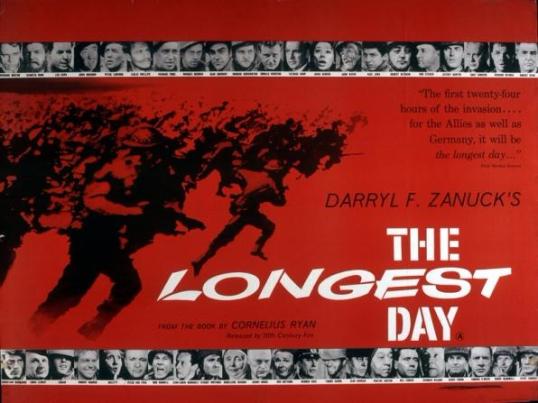
Lisa Reviews An Oscar Nominee: The Longest Day (dir by Ken Annakin, Andrew Marton, Bernhard Wicki, Gerd Oswald, and Darryl F. Zanuck)


As my sister has already pointed out, today is the 73rd anniversary of D-Day.  With that in mind, and as a part of my ongoing mission to see and review every single film ever nominated for best picture, I decided to watch the 1962 film, The Longest Day!

The Longest Day is a pain-staking and meticulous recreation of invasion of Normandy, much of it filmed on location.  It was reportedly something of a dream project for the head of the 20th Century Fox, Darryl F. Zanuck.  Zanuck set out to make both the ultimate tribute to the Allied forces and the greatest war movie ever.  Based on a best seller, The Longest Day has five credited screenwriters and three credited directors.  (Ken Annakin was credited with “British and French exteriors,” Andrew Marton did “American exteriors,” and the German scenes were credited to Bernhard Wicki.  Oddly, Gerd Oswald was not credited for his work on the parachuting scenes, even though those were some of the strongest scenes in the film.)  Even though he was not credited as either a screenwriter or a director, it is generally agreed that the film ultimately reflected the vision of Darryl F. Zanuck.  Zanuck not only rewrote the script but he also directed a few scenes as well.  The film had a budget of 7.75 million dollars, which was a huge amount in 1962.  (Until Steven Spielberg’s Schindler’s List, The Longest Day was the most expensive black-and-white film ever made.)  Not only did the film tell an epic story, but it also had an epic length.  Clocking in at 3 hours, The Longest Day was also one of the longest movies to ever be nominated for best picture.

The Longest Day also had an epic cast.  Zanuck assembled an all-star cast for his recreation of D-Day.  If you’re like me and you love watching old movies on TCM, you’ll see a lot of familiar faces go rushing by during the course of The Longest Day.  American generals were played by actors like Robert Mitchum, Robert Ryan, Henry Fonda, and John Wayne.  Peter Lawford, then the brother-in-law of the President of the United States, had a memorable role as the Scottish Lord Lovat, who marched through D-Day to the sounds of bagpipes.  When the Allied troops storm the beach, everyone from Roddy McDowall to Sal Mineo to Robert Wagner to singer Paul Anka can be seen dodging bullets.  Sean Connery pops up, speaking in his Scottish accent and providing comic relief.  When a group of paratroopers parachute into an occupied village, comedian Red Buttons ends up hanging from the steeple of a church.  When Richard Beymer (who is currently playing Ben Horne on Twin Peaks) gets separated from his squad, he stumbles across Richard Burton.  Among those representing the French are Arletty and Christian Marquand.  (Ironically, after World War II, Arletty was convicted of collaborating with the Germans and spent 18 months under house arrest.  Her crime was having a romantic relationship with a German soldier.  It is said that, in response to the charges, Arletty said, “My heart is French but my ass is international.”)  Meanwhile, among the Germans, one can find three future Bond villains: Gert Frobe, Curt Jurgens, and Walter Gotell.

It’s a big film and, to be honest, it’s too big.  It’s hard to keep track of everyone and, even though the battle scenes are probably about an intense as one could get away with in 1962 (though it’s nowhere near as effective as the famous opening of Saving Private Ryan, I still felt bad when Jeffrey Hunter and Eddie Albert were gunned down), their effectiveness is compromised by the film’s all-star approach.  Often times, the action threatens to come to a halt so that everyone can get their close-up.  Unfortunately, most of those famous faces don’t really get much of a chance to make an impression.  Even as the battle rages, you keep getting distracted by questions like, “Was that guy famous or was he just an extra?”

Among the big stars, most of them play to their personas.  John Wayne, for instance, may have been cast as General Benjamin Vandervoort but there’s never any doubt that he’s playing John Wayne.  When he tells his troops to “send them to Hell,” it’s not Vandervoort giving orders.  It’s John Wayne representing America.  Henry Fonda may be identified as being General Theodore Roosevelt II but, ultimately, you react to him because he’s Henry Fonda, a symbol of middle-American decency.  Neither Wayne nor Fonda gives a bad performance but you never forget that you’re watching Fonda and Wayne.

Throughout this huge film, there are bits and pieces that work so well that you wish the film had just concentrated on them as opposed to trying to tell every single story that occurred during D-Day.  I liked Robert Mitchum as a tough but caring general who, in the midst of battle, gives a speech that inspires his troops to keep fighting.  The scenes of Peter Lawford marching with a bagpiper at his side were nicely surreal.  Finally, there’s Richard Beymer, wandering around the French countryside and going through the entire day without firing his gun once.  Beymer gets the best line of the film when he says, “I wonder if we won.”  It’s such a modest line but it’s probably the most powerful line in the film.  I wish The Longest Day had more scenes like that.

The Longest Day was nominated for best picture of 1962 but it lost to an even longer film, Lawrence of Arabia.