4 Or More Shots From 4 Or More Films is just what it says it is, 4 shots from 4 of our favorite films. As opposed to the reviews and recaps that we usually post, 4 Shots From 4 Films lets the visuals do the talking!
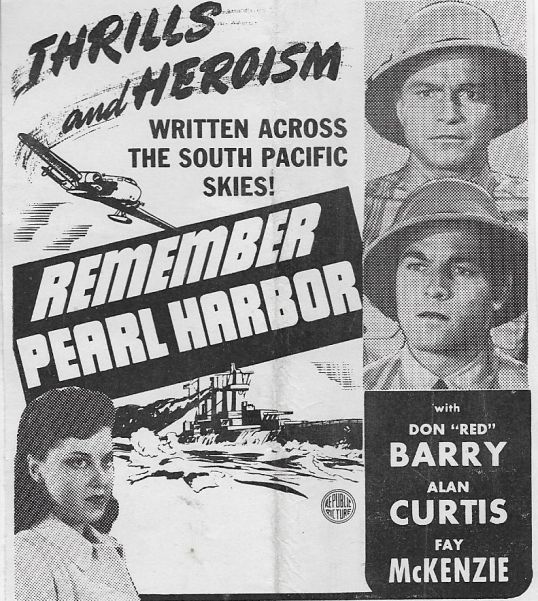
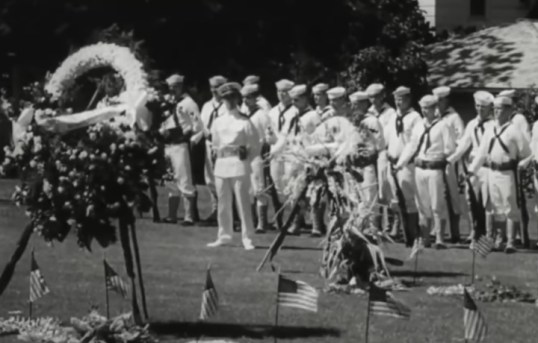
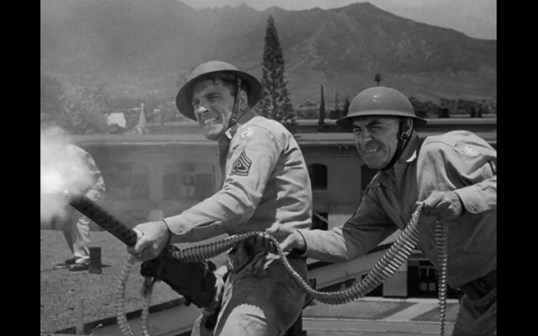
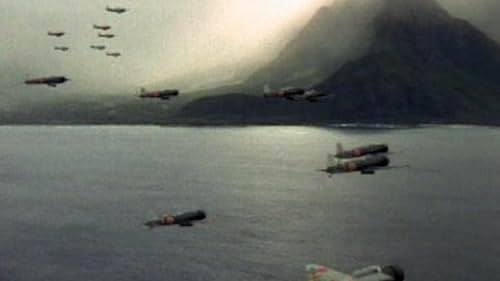
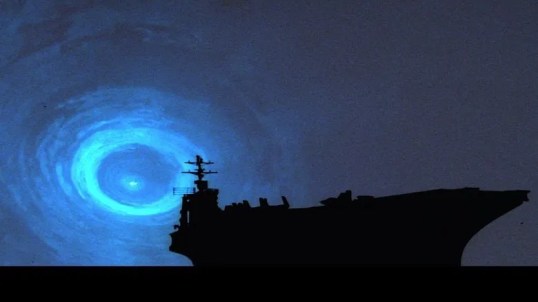
Visiting Pearl Harbor and seeing the remains of the Arizona, still trapped underwater and serving as a tomb for many of its crew, was one of the most moving experiences of my life. It’s not something that you’ll ever forget. You really don’t understand the full tragedy of Pearl Harbor until you visit for yourself. There have been several films made about Pearl Harbor, some better than others. Here are shots from four of them.
4 Shots From 4 Films: Remembering Pearl Harbor
December 7th (1943, Dir. by John Ford)
From Here To Eternity (1953, Dir. by Fred Zinnemann)
Tora! Tora! Tora! (1970, Dir. by Richard Fleischer)
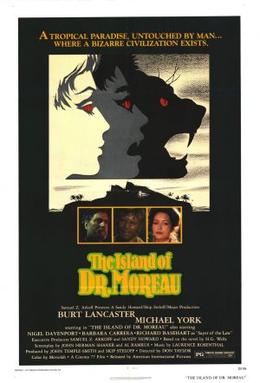
After the ship that he’s working on sinks, engineer Andrew Braddock (Michael York) washes up on an uncharted island. It’s a beautiful island but it quickly proves dangerous as another survivor of the sinking is killed by wild animals. The injured Braddock passes out and when he wakes up, he’s being cared for by a mysterious scientist named Moreau (Burt Lancaster).
Braddock discovers that the island is populated by creatures that are half-human and half-animal. Led by the Sayer of the Law (Richard Basehart), these creatures are the results of experiments conducted by Moreau and his assistant, Montgomery (Nigel Davenport). Moreau’s experiments are expected to obey Moreau’s laws. Should they fail, they will be taken to the House of Pain and punished. When Baddock objects to Moreau playing God, Moreau plots to reverse the experiment on Braddock and turn him into an animal. Even as he falls in love with a former cheetah (played by Barbara Carrera), Braddock realizes that he must escape the Island of Dr. Moeau.
This is the forgotten adaptation of H.G. Wells’s classic novel, as well as being the most faithful. The Island of Lost Souls, from 1932, is considered to be a classic. The third version, directed by John Frankenheimer and starring Marlon Brando and Val Kilmer, is a legendary disaster. This version, though, is usually overlooked. It’s also my favorite of the three but that might be because it was the first version that I ever saw. It’s a straight-forward version of H.G. Wells’s story of science gone mad with director Don Taylor not wasting any time getting the action started. Michael York, always an underrated actor, convincingly portrays Braddock’s outrage and his struggle to maintain his humanity after Moreau starts to experiment on him while Carrera is beautiful and mysterious as Maria. Probably the film’s biggest surprise is Burt Lancaster, who turns out to be ideally cast as Moreau. More subdued than either Charles Laughton or Marlon Brando, Lancaster plays Moreau as a brilliant but callous man who is too arrogant to realize that he’s become as much of an animal as those he claims to be perfecting. What makes Lancaster’s Moreau so disturbing is that he doesn’t have the excuse of being insane. Instead, he’s just too stubborn to admit that he’s potentially made a huge mistake.
It may be forgotten but this still the version of The Island of Dr, Moreau that I would recommend.
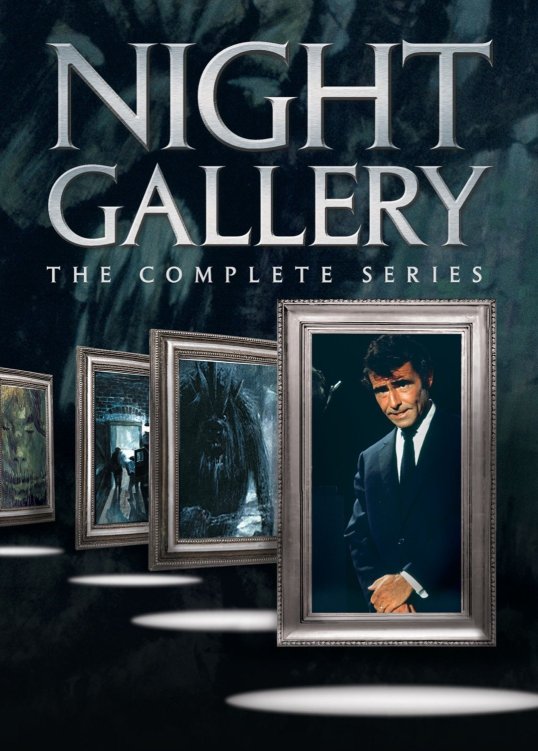
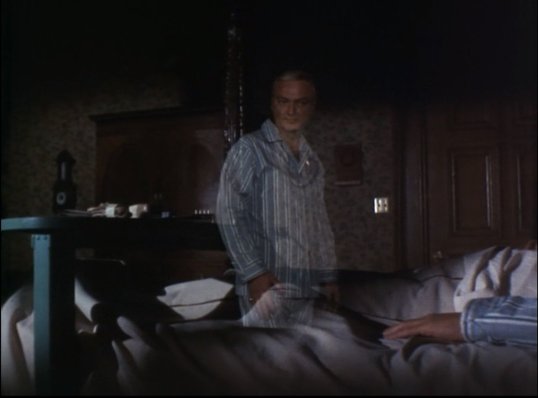
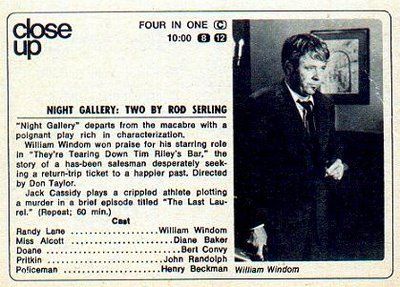
The first season of Night Gallery came to a conclusion on January 20th, 1971. Though the first season was undoubtedly uneven, it did end on a high point. The first segment in the 6th episode, They’re Tearing Down Tim Riley’s Bar, is widely considered to be the best episode of Night Gallery and one of Rod Serling’s best teleplays. It also brought Night Gallery one of it’s few Emmy nominations when it was nominated for Outstanding Single Program of the year. (It lost to The Andersonville Trial, a theatrical adaptation that was produced for PBS.)
They’re Tearing Down Tim Riley’s Bar (dir by Don Taylor, written by Rod Serling)
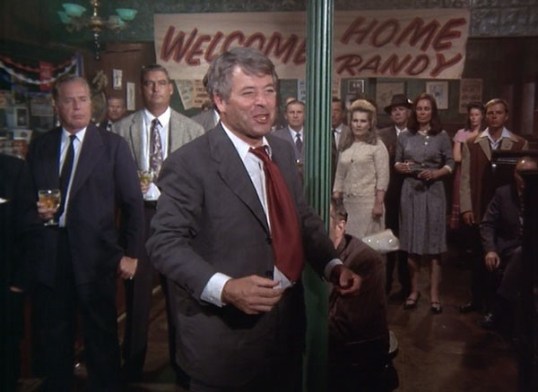
They’re Tearing Down Tim Riley’s Bar tells the story of Randy Lane (William Windom). In 1945, Sgt. Randy Lane returned home from serving in World War II, a war hero who had a wonderful future ahead of him. He had just gotten married. He had just gotten a good job at an up-and-coming company called Pritzker Plastics. When he came home, the first place he went was Tim Riley’s Bar, where his father and the other bar patrons toasted him and told him to look forward to the future.
Twenty-five years later, the middle-aged Randy Lane is looking at his life and asking, “Is this as good as it gets?” He’s now a sales director at Pritzker Plastics but his boss (John Randolph) doesn’t appreciate him, his assistant (Bert Convy) is plotting to steal his job, and the only person who seems to care about him is his sympathetic secretary (Diane Baker). Randy’s wife died in 1952, while Randy was out of a sales call. Randy now lives alone. Even his neighborhood bar — Tim Riley’s Bar — has closed and been abandoned. With the bar schedule to be torn down, Randy wonder what happened to all of the promise and happiness of the past.
When Randy goes by the deserted bar and looks through the front window, he’s shocked to see all of his old friends and his father waving at him. But when Randy rushes into the bar to join them, he discovers the bar is deserted. Later, Randy is at work when suddenly, he sees Pritzker Plastics the way it was back in 1948. Even later, when he enters his house, he finds himself standing in a hospital hallway in 1952, once again getting the news that his wife has died.
In many ways, They’re Tearing Down Tim Riley’s Bar is an atypical Night Gallery segment. Though there are hints of the supernatural throughout the story, it’s hardly a work of horror. Instead, it’s a rather melancholy meditation on aging, disappointment, and regret. Is the past forever lost? Can things ever be as good as they once were? These are the questions that are raised in this well-directed and well-acted segment.
The Last Laurel (dir by Daryl Duke, written by Rod Serling)
Clocking in at 8 minutes, The Last Laurel is yet another segment about a bitter man (in this case, Jack Cassidy) who suspects that his wife (in the case, Martine Beswick) is cheating on him with his doctor (in this case, Martin E. Brooks) so he teaches himself a supernatural skill in order to get revenge. In this case, it involves astral projection. Not surprisingly, it ends with a twist that’s pretty much dependent on one of the characters doing something extremely stupid.
The Last Laurel is well-acted but predictable. It’s not bad but, especially when compared to something like They’re Tearing Down Tim Riley’s Bar, it feels rather insubstantial. It feels like filler.
The first season of Night Gallery came to an end with an excellent episode. Starting tomorrow — season 2!
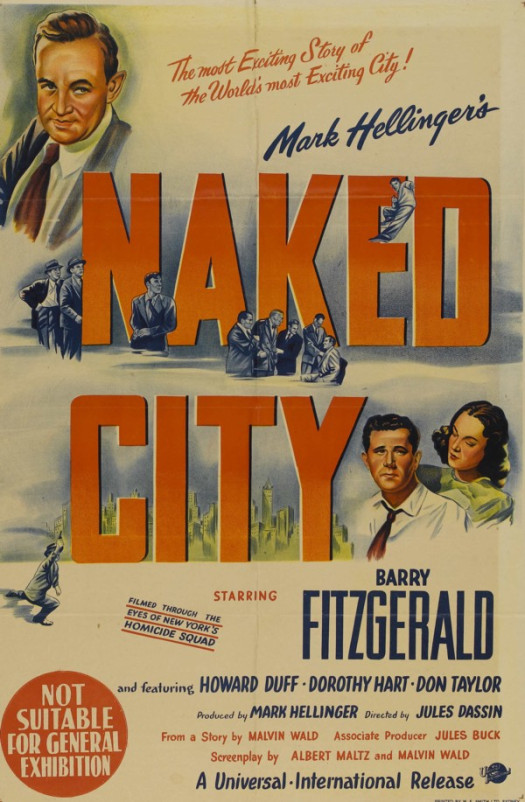
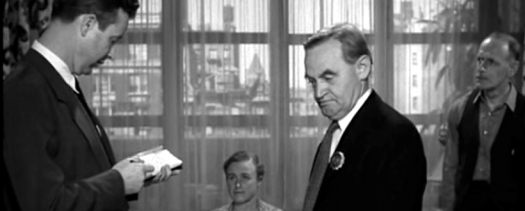
Producer Mark Hellinger, who brought you the film noir classics THE KILLERS and BRUTE FORCE , traveled to the mean streets of New York City to shoot NAKED CITY, along with director Jules Dassin and a solid cast led by Barry Fitzgerald. The movie, though fiction, is shot in docu-drama style, with Hellinger himself providing narration throughout. It was an attempt to do something boldly different with the genre, and it succeeds thanks to the talents in front and behind the cameras.
Beautiful young model Jean Dexter is found in her bathtub brutally murdered by her housekeeper. The homicide squad, with veteran Lt. Dan Muldoon and rookie detective Jimmy Halloran, gets to work investigating the case. They discover Jean had been seeing a mysterious man from Baltimore named Henderson. The team then begins the slow, methodical process of catching a killer, pulling on the loose strings of Dexter’s life. Their number one…
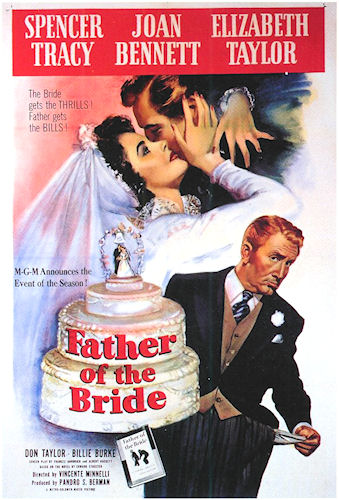
After I watched King Solomon’s Mines, I watched yet another 1950 best picture nominee, Father of the Bride.
In Father of the Bride, Spencer Tracy plays a lawyer named Stanley Banks. As you might expect of any character played by Spencer Tracy, Stanley Banks is a no-nonsense type of guy. He’s set in his ways and not particularly enthusiastic about the idea of change. Stanley has worked hard to get a good job and a nice house in the suburbs. He loves his wife, Ellie (Joan Bennett) and is a firm but good father to his two boys, Tommy (Russ Tamblyn) and Ben (Tom Irish). If Stanley does have a soft spot, it’s for his daughter, Kay (17 year-old Elizabeth Taylor). Stanley admits that he’s always given Kay everything that she’s ever wanted and that she is his favorite of all his children.
However, Kay has been acting strangely as of late. She just seems to be so happy! Stanley can tell that she’s in love, though he has no idea with whom. (He is, however, happy that it’s probably not the bespectacled political radical who Kay apparently dated at some point in the past.) Finally, during an otherwise typical family dinner, Kay announces that not only is she in love but she’s also engaged to be married!
His name is Buckley (Don Taylor, who would later direct Escape From The Planet of the Apes and Damien: Omen II) and, at first, Kay refuses to even introduce him to her parents. Eventually, however, Stanley does meet Buckley and he’s happy to discover that not only does Buckley come from a wealthy family but he also owns a small business of his own.
However, just because Buckley is the perfect 1950 man, that doesn’t mean that the wedding is going to be easy. As a befuddled Stanley watches, the wedding grows more and more elaborate (not to mention, expensive!). All of the expected complications ensue: Buckley and Kay have a fight, a wedding planner makes things difficult, and Stanley does not immediately get along with Buckley’s parents. But, for the most part, Father of the Bride is about Stanley struggling to accept that his daughter has grown up and is ready to start a life of her own.
Father of the Bride is a sweet little comedy, though it seems a bit out-of-place as a best picture nominee. It’s definitely a film of its time. For all of the scenes of Stanley worrying about the extravagance of modern weddings, there’s not a subversive moment to be found in Father of the Bride. (One can only imagine what Nicholas Ray or Douglas Sirk would have done with the material.)
Fortunately, this is also a Spencer Tracy film and whatever gravitas that the film may have comes from Tracy’s honest and straight forward performance. Tracy never begs for laughs but he gets them anyway, because of the honesty that he brings to the character. Perhaps his best moment comes after Buckley and Kay have had a fight. After comforting his daughter, Stanley discovers that Buckley is at the front door. At first, the protective Stanley tells Buckley that Kay doesn’t want to see him. Suddenly, Kay comes running down stairs and embraces Buckley. Between sobs and kisses, Buckley and Kay dramatically swear to each other that they will never fight again. The camera pans over to Stanley, standing a little to the side and listening. At first, Stanley seems befuddled by how overdramatic the two of them are acting over a relatively minor fight but there’s also just a hint of sadness in Stanley’s eyes as he realizes that his daughter truly has moved on.
Father of the Bride was nominated for best picture but it lost to the far more subversive All About Eve.
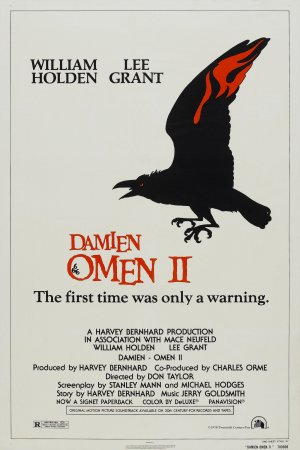
The first sequel to The Omen was 1978’s Damien: Omen II. Damien: Omen II is an odd film, one that is not very good but yet remains very watchable.
Damien: Omen II takes place 7 years after the end of the original Omen. Antichrist Damien Thorn (now played by Jonathan Scott-Taylor) is now 12 years old. He lives with his uncle Richard (William Holden) and Richard’s 2nd wife, Ann (Lee Grant). His best friend is his cousin Mark (Lucas Donat). In fact, the only problem that Damien has is that his great-aunt Marion (Sylvia Sidney) can’t stand him and views him as a bad influence. Fortunately, as usually seems to happen whenever someone puts an obstacle in Damien’s life, there’s always either a black dog or a black crow around to help out.
Damien and Mark are cadets at a local military academy where Damien deals with a bully by glaring at him until he falls to the ground, grabbing at his head. In history class, Damien shocks his teacher by revealing that he knows the date of every battle ever fought. Damien’s new commander, Sgt. Neff (Lance Henriksen), pulls Damien to the side and tells him to stop showing off and to quietly bide his time.
Meanwhile, Richard is busy running Thorn Industries. One of his executives, Paul Buhler (Robert Foxworth), wants to expand Thorn’s operations into agriculture but his plans are opposed by Richard’s executive vice president, Bill Atherton (Lew Ayres), who considers Paul to be unethical. However, during an ice hockey game, Bill falls through the ice and, despite the efforts of everyone to break through the ice and save him, ends up floating away. Paul is promoted and pursues his plans to make money off of world famine. In between all of this, Paul finds the time to speak to Damien and tell him that he has a great future ahead of him.
Along with Thorn Industries, Richard also owns the Thorn Museum in Chicago. The museum’s curator is Dr. Charles Warren (Nicholas Pryor) who was a friend of the archeologist Karl Bugenhagen (Leo McKern) who, in the first film, revealed that not only was Damien the antichrist but that the only way to kill him was by stabbing him with the Seven Daggers of Meggido. Dr. Warren is also friends with Joan Hart (Elizabeth Shepherd), a reporter who both knows the truth behind Bugenhagen’s death and who has also seen an ancient cave painting that reveals that the Antichrist looks exactly like a 12 year-old Damien Thorn.
Much as in the first film, just about everyone who comes into contact with Damien ends up getting killed in some odd and grotesque way. Crows peck out eyes. Trucks run over heads. One unfortunate victim is crushed between two trains. Another is chopped in half by an elevator cable. At times, Damien: Omen II feels less like a sequel to The Omen and more like a forerunner to Final Destination.
Damien: Omen II is one of those films that I like despite myself. It’s bad but it’s bad in a way that only a film from the 1970s could be and, as such, it has some definite historical value. The script is full of red herrings, the acting is inconsistent, and the film can never seem to make up its mind whether Damien is pure evil or if he’s conflicted about his role as Antichrist. As I watched the film, I wondered why the devil could so easily kill some people but not others.
And yet, Damien: Omen II is so ludicrous and silly that it’s undeniably watchable. If the first film was distinguished by Gregory Peck’s defiant underplaying, the second film is distinguished by the way that William Holden delivers every line through manfully clenched teeth. Everyone else in the cast follows Holden’s lead and everyone goes so far over-the-top that even the most mundane of scenes become oddly fascinating.
For me, the film is defined by poor Lew Ayres floating underneath that sheet of ice while everyone else tries to rescue him. On the one hand, it’s absolutely horrific to watch. I’m terrified of drowning and, whenever the camera focused on Ayres desperately pounding on the ice above him, I could barely bring myself to look at the screen. But, at the same time, we also had William Holden screaming, “OH GOD!” and Nicholas Pryror enthusiastically chopping at the ice with a big axe and dozens of extras awkwardly skating across the ice. Somehow, the scene ended up being both horrifying and humorous. It should not have worked but somehow, it did.
And that’s pretty much the perfect description of Damien: Omen II. It shouldn’t work but, in its own way, it does.
Why? Well, first off, we all know that February is the most romantic month of the year. February is Valentine’s Day, romantic movies, flowers, lingerie, and chocolate. February is also the month when, in a lead up to the Oscars, TCM devotes a good deal of its programming to showing Oscar nominees of the past.
As I’ve mentioned in the past, one of my dreams is to watch and review every single film that has ever been nominated for best picture. Now, realistically, I’ll never be able to accomplish this goal because the 1929 Best Picture nominee The Patriot is currently a lost film. But, even if it does mean that I’ll only be able to see 510 out of the 511 nominated films, it’s still a dream that I’m pursuing and, with the help of TCM and the month of February, it’s a dream that’ll come true.
Take, for instance, Battleground. This 1949 Best Picture nominee (it lost All The King’s Men) recently aired on TCM. I’m not exactly a fan of war films but, since it was a best picture nominee, I still made sure to DVR and watch it.
Set during the final days of World War II, Battleground follows one platoon of soldiers as they fight and attempt to survive the Battle of the Bulge. The platoon is made up of the type of characters that we usually expect to find in a WWII film but, fortunately, they’re played by an ensemble of likable actors who all bring their familiar characters to life. There’s Jim Layton (Marshall Thompson), the newest member of the platoon who nobody wants to run the risk of getting close to. There’s Holley (Van Johnson), the cheerful soldier who is unexpectedly thrust into a position of leadership that he might not be right for. Roderiques (Ricardo Montalban) is from Los Angeles and is amazed by the sight of snow. “Pops” Stazak (George Murphy) is the type of older soldier who you would totally expect to be nicknamed “Pops.” Bettis (Richard Jaeckel) is scared of combat. Kippton (Douglas Fowley) spends nearly the entire film looking for his lost teeth. And finally, of course, there’s the hard-boiled but warm-hearted Sgt. Kinnie (James Whitmore).
In some ways, Battleground is a very conventional film and it’s easy to wonder how it ended up getting nominated for best film of the year. (Among the eligible films that were not nominated: The Bicycle Thief, Champion, The Fountainhead, On The Town, Sands of Iwo Jima, She Wore A Yellow Ribbon, They Live By Night, and White Heat.) However, the film’s nomination makes a bit more sense when you consider that it was released just four years after the end of World War II. It was a film that appealed both to the veterans who were able to relate to the film’s story and to the patriotic spirit of a country that had just defeated the greatest evil of the 20th Century.
Battleground did not exactly make me a fan of war movies but it’s still a well-made and effective film. As opposed to a lot of other war films, Battleground never makes war look like fun. For the most part, the emphasis is less on strategy and combat and more on the soldiers who are simply trying to survive from day-to-day. The end result is a film that serves as a moving tribute to the soldiers who fought in World War II.