Film Review: And The Band Played On (dir by Roger Spottiswoode)


I live in a very cynical time.

That was one of my main thoughts as I watched 1993’s And The Band Played On.

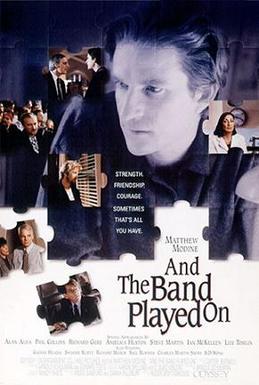
Directed by Roger Spottiswoode and featuring an all-star cast, And The Band Played On deals with the early days of the AIDS epidemic.  It’s a film that features many different characters and storylines but holding it all together is the character of Dr. Don Francis (Matthew Modine), an epidemiologist who is haunted by what he witnessed during the Ebola epidemic in Africa and who fears that the same thing is going to happen in America unless the government gets serious about the mysterious ailment that is initially called “gay cancer” before then being known as “GRID” before finally being named AIDS.  Dr. Francis is outspoken and passionate about fighting disease.  He’s the type who has no fear of yelling if he feels that people aren’t taking his words seriously enough.  In his office, he keeps a track of the number of HIV infections on a whiteboard.  “Butchers’ Bill” is written across the top of the board.

Throughout the film, quite a few people are dismissive of Dr. Francis and his warnings.  But we, the audience, know that he’s right.  We know this because we know about AIDS and but the film also expects us to trust Dr. Francis because it’s specifically stated that he worked for the World Health Organization before joining the Center For Disease Control in Atlanta, Georgia.  As far as the film is concerned, that’s enough to establish his credentials.  Of course, today, after living through the excesses of the COVID pandemic and the attempts to censor anyone who suggested that it may have begun due to a lab leak as opposed to some random guy eating a bat, many people tend to view both the WHO and the CDC with a lot more distrust than they did when this film was made.  As I said, we live in a cynical time and people are now a lot less inclined to “trust” the experts.  To a large extent, the experts have only themselves to blame for that.  I consider myself to be a fairly pragmatic person but even I now find myself rolling my eyes whenever a new health advisory is issued.

This new sense of automatic distrust is, in many ways, unfortunate.  Because, as And The Band Played On demonstrates, the experts occasionally know what they’re talking about.  Throughout the film, people refuse to listen to the warnings coming from the experts and, as a result, many lives are lost.  The government refuses to take action while the search for a possible cure is hindered by a rivalry between international researchers.  Alan Alda gives one of the best performances in the film, playing a biomedical researcher who throws a fit when he discovers that Dr. Francis has been sharing information with French scientists.

It’s a big, sprawling film.  While Dr. Francis and his fellow researchers (played by Saul Rubinek, Glenne Headly, Richard Masur, Charles Martin Smith, Lily Tomlin, and Christian Clemenson) try to determine how exactly the disease is spread, gay activists like Bobbi Campbell (Donal Logue) and Bill Kraus (Ian McKellen) struggle to get the government and the media to take AIDS seriously.  Famous faces pop up in small rolls, occasionally to the film’s detriment.  Richard Gere, Steve Martin, Anjelica Huston, and even Phil Collins all give good performances but their fame also distracts the viewer from the film’s story.  There’s a sense of noblesse oblige to the celebrity cameos that detracts from their effectiveness.  All of them are out-acted by actor Lawrence Monoson, who may not have been a huge star (his two best-known films are The Last American Virgin and Friday the 13 — The Final Chapter) but who is still heart-breakingly effective as a young man who is dying of AIDS.

Based on a 600-page, non-fiction book by Randy Shilts, And The Band Played On is a flawed film but still undeniably effective and a valuable piece of history.  Director Roger Spottiswoode does a good job of bringing and holding the many different elements of the narrative together and Carter Burwell’s haunting score is appropriately mournful.  The film ends on a somber but touching note.  At its best, it’s a moving portrait of the end of one era and the beginning of another.
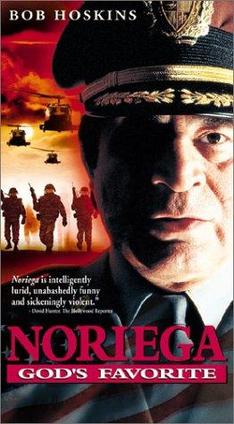
Film Review: Noriega God’s Favorite (dir by Roger Spottiswoode)


Everyone’s an expert on the Panama Canal nowadays.

Largely, that’s a result of President-elect Donald Trump openly musing about taking the canal back from Panama.  As soon as Trump uttered those words, every self-appointed pundit on every social media site in existence immediately jumped over to Wikipedia and skimmed over the articles on Panama, the Panama Canal, and Teddy Roosevelt.  Then, after Jimmy Carter died, those same people jumped onto Wikipedia and skimmed articles about Carter selling the canal to Panama for a dollar and the controversy that followed.  For weeks, it has been impossible to look at Twitter or Bluesky or even Mastodon without seeing someone giving their opinion on the canal, the 1989 American invasion of Panama, and the connection between the CIA and Manuel Noriega, the man who served as Panama’s military dictator for most of the 80s before being deposed and tossed into prison for being a drug smuggler.

Myself, I know better than to get my information from Wikipedia.  Instead, I get my information from movies.  For that reason, I attempted to educate myself on Panama and the canal by watching 2000’s Noriega: God’s Favorite.

Directed by Roger Spottiswoode, Noriega: God’s Favorite opens with a title card informing us of the story so far.  Manuel Noriega was born in the slums of Panama.  He grew up in poverty and was shunned because his mother was not married to his father.  Noriega spent his youth doing whatever he had to do in order to survive.  He was clever and ruthless but it wasn’t until he entered the Panamanian National Guard that he was able to really use those skills to his advantage.  Noriega became a CIA asset and worked his way through the ranks.  In 1983, with the support of American intelligence, Noriega became the de facto dictator of Panama, even though he never officially held any sort of title or executive position.

The film follows Manuel Noriega (Bob Hoskins) over the course of his final years as Panama’s dictator.  He’s portrayed as being a ruthless man who often pretends to be a buffoon in order to get his enemies to underestimate him.  He works with the CIA but still passes along intelligence to Fidel Castro (Michael Sorich), who is seen hitting on Noriega’s wife (Denise Blasor) during a visit to Cuba.  Noriega presents himself as a family man while having a number of mistresses.  He claims to an ally in the United States’s War on Drugs while attending cocaine-fueled parties.  He presents himself as being a pragmatist while actually being very superstitious.  A CIA agent (Edward Ellis) wins Noriega’s trust by manipulatively interpreting Bible verses for him.  When an army officer (played by Nestor Carbonell) tries to lead a coup against Noriega, he can only watch helplessly as Noriega personally executed all of his co-conspirators, going so far as to even chop off one man’s hands.  By the end of the scene, Noriega is drenched in blood but he’s undeniably happy.  Everyone knows that Noriega is an impulsive and dangerous dictator but the CIA allows him to stay in power until he starts to become an inconvenience.  Once Noriega’s notoriety starts to overshadow his usefulness, the U.S. promptly invades and Noriega’s power crumbles around him.

Bob Hoskins might seem like a strange choice to play a South American dictator but he does a good job in Noriega, playing the title character as being both a charismatic dictator and also an overgrown child who has never gotten over the struggles of his youth.  (Early on in the film, he is seen getting treatments to smooth his pockmarked skin, an indication that all the power in the world can’t cure lifelong insecurity.)  In the end, Noriega has much in common with the gangster that Hoskins played in The Long Good Friday.  Noriega is ruthless enough to become powerful but he ultimately falls victim to his own hubris.  When you’re in charge of something as valuable as the Panama Canal, the last thing you should do is anger the country that built it.

Horror on TV: The Hitchhiker 6.10 “Windows” (dir by Rene Manzor)


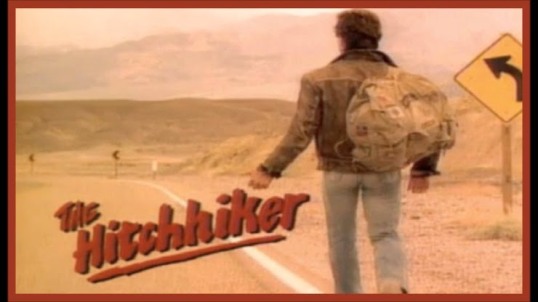
On tonight’s episode of The Hitchhiker, David Marshall Grant plays an artist who comes to believe that his paintings are actually visions of the future.  The Hitchhiker is not impressed but it’s rare that he is.

The episode originally aired on November 23rd, 1990.

Retro Television Reviews: What She Doesn’t Know (dir by Kevin James Dobson)


Welcome to Retro Television Reviews, a feature where we review some of our favorite and least favorite shows of the past!  On Sundays, I will be reviewing the made-for-television movies that used to be a primetime mainstay.  Today’s film is 1992’s What She Doesn’t Know!  It  can be viewed on YouTube!

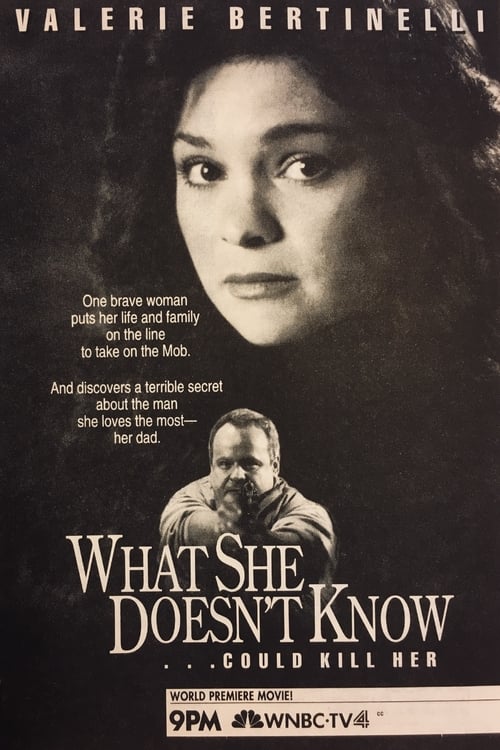
Molly Kilcolin (Valerie Bertinelli) has graduated from law school!

In fact, she’s not only graduated from law school but she’s graduated from Harvard Law School, the most prestigious and most expensive law school out there.  And she’s graduated at the top of her class.  She’s the one who gets to give the speech at graduation, where she says that everything she knows about justice she learned from her father.

It’s really quite an accomplishment when you consider that Molly isn’t even from a rich family.  She’s from a family of blue collar, New York City cops.  Her father, Jack Kilcoin (George Dzundza), certainly never had a chance to go to Harvard.  How did Molly even afford to go to Harvard?  Apparently, her tuition was paid out of a trust fund that her aunt set up for her when she was a child.  Seriously, that must have been a helluva trust fund because Harvard is not cheap or easy to get into.

Unfortunately, Molly disappoints her father when she tells him that she will not be accepting a job with a high class law firm but instead, she plans to work for the District Attorney’s office.  Her fellow prosecutors are skeptical of her as well.  Why does she want to go from Harvard to making next to no money in the trenches?  Someone asks her if she has political ambitions but no, Molly just wants to do the right thing.  She grew up in the neighborhood, don’t you know.  She knows the people who are getting caught up in the Mafia’s schemes.

After Molly convinces a young mobster named Joey Mastinelli (Peter Dobson) to testify against his boss, she is shocked to discover that over half of the NYPD is on the Mob’s payroll.  She is even more shocked to discover that her father is one of those dirty cops.  For years, her father has been taking bribes and hiding the money away in Molly’s trust fund.  Molly’s Harvard education was paid for by the Mafia!

As you can probably guess, family dinners are about to get awkward!

I usually enjoy films like What She Doesn’t Know because I’m always interested in the Mafia and there was a time when I briefly thought it might be fun to grow up and go to law school.  I don’t know if I would have wanted to become a prosecutor, of course.  Unlike Molly, I probably would have taken that ritzy law firm offer.  The idea behind What She Doesn’t Know had potential but it was let down by the execution.  Valerie Bertinelli tries hard but she’s just not convincing as a tough-as-nails Harvard grad.  George Dzundza is a bit more believable as an aging New York cop but he’s still a bit on the dull side.  (It would have been nice if this film could have been made a few years later, with Mira and Paul Sorvino in the lead roles.)

The film’s biggest flaw is that it portrays Molly as being so totally clueless about her father’s activities that it makes her seem to be impossibly naïve.  I mean, did she never wonder how she could possibly afford to go to Harvard?

Seriously, Harvard’s expensive!

Citizen Cohn (1992, directed by Frank Pierson)


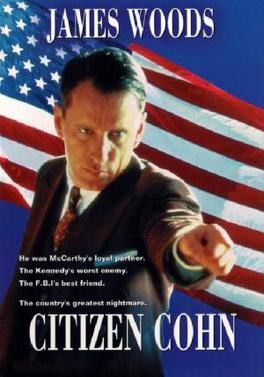
The year is 1986 and the powerful attorney Roy Cohn (James Woods) is dying.  The official story is that Cohn has liver cancer but the truth is that he’s dying of AIDS.  As he lies in his hospital bed, he thinks about his past and the events the led to him becoming one of the most feared and powerful men in America.  He is haunted by the ghosts of his many enemies, people like communist spy Ethel Rosenberg (Karen Ludwig) and his former colleague, Bobby Kennedy (David Marshall Grant).

Not surprisingly, a good deal of Cohn’s memories center around his association with Sen. Joseph McCarthy (Joe Don Baker), a charismatic alcoholic who, in the 50s, charged that he had a list with the names of communist spies deep within the government.  Cohn and Kennedy served as the counsels on McCarthy’s committees.  Cohn is with McCarthy from the beginning and he’s with him until the end of the senator’s career.  In fact, it’s Cohn’s own shadowy relationship with an army private that ultimately leads to McCarthy’s downfall.

Except for one aspect of the film, Citizen Cohn is one of the best films to ever be produced by HBO.  The film covers a lot of history in a little less than 2 hours and it does so in a way that is always interesting and easy to follow.  By including incidents from every phase of Cohn’s life, as opposed to just focusing on his time as McCarthy’, the film also shows how someone like Roy Cohn can become a behind-the-scenes power player despite the majority of the country having no idea who he is.  James Woods gives one of his best performances as the hyperactive and unapologetically corrupt Cohn while Joe Don Baker is perfect as the self-pitying Joseph McCarthy.

The problem with the film, and your mileage may vary on how big an issue this is, is that it almost presents Cohn’s final days — dying of AIDS in a lonely New York hospital room — as being some sort of deserved fate for everything that he did wrong in life.  For me, even in the case of someone like Roy Cohn, that’s a step too far and it comes very close to presenting AIDS as some sort of divine punishment (which, itself, comes dangerously close to mirroring the homophobic statements that were made — and still are being made — by anti-gay activists).  That may not have been the film’s intention but, with the flashback structure and all of his dead enemies materializing to taunt Cohn as he lies dying, it’s still a very valid interpretation.

Some of that is perhaps unavoidable.  Cohn, in both real life and the film, died largely unrepentant for anything he did during his life.  As the central character of a biopic, Cohn never has the type of big moment that you would hope for, where he would realize that it was wrong for him to destroy so many lives and show at least a hint of contrition for his past behaviors.  That Roy Cohn is even a compelling character is a testament to the talent of James Woods because it’s certainly not due to any sort of hidden goodness lurking underneath the surface of Cohn’s snarling personality.  The lack of apologies and regrets that made Cohn a powerhouse in real life also makes him an ultimately unsatisfying subject for a movie.