4 Shots From 4 Horror Films: The 1980s Part 3


This October, I’m going to be doing something a little bit different with my contribution to 4 Shots From 4 Films.  I’m going to be taking a little chronological tour of the history of horror cinema, moving from decade to decade.

Today, we complete the 80s!

4 Shots From 4 Horror Films

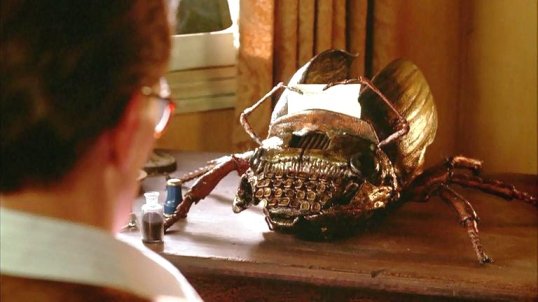
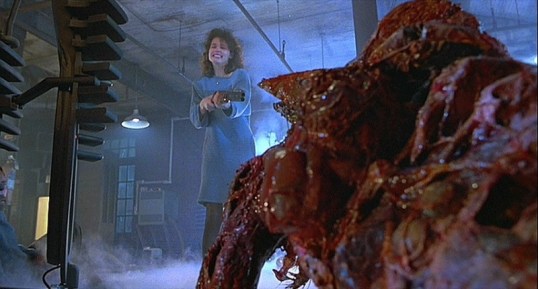
The Fly (1986, dir by David Cronenberg)

The Fly (1986, dir by David Cronenberg)

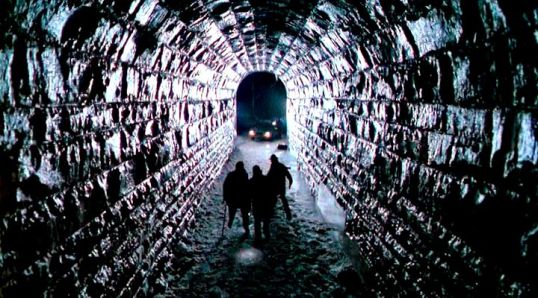
Near Dark (1987, dir by Kathryn Bigelow)

Near Dark (1987, dir by Kathryn Bigelow)

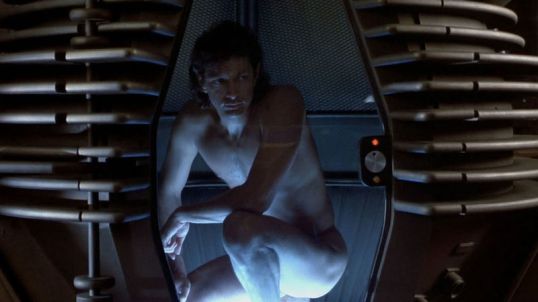
Evil Dead 2 (1987, dir by Sam Raimi)

Evil Dead 2 (1987, dir by Sam Raimi)

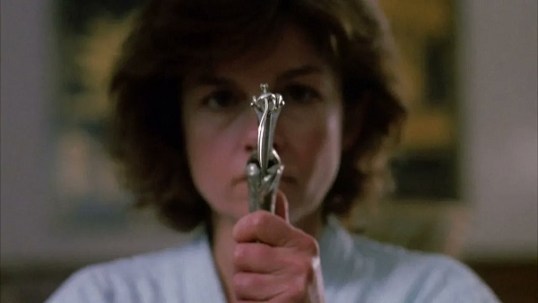
The Church (1989, dir by Michele Soavi)

The Church (1989, dir by Michele Soavi)

4 Shots From Horror Films: The 1980s Part 2


This October, I’m going to be doing something a little bit different with my contribution to 4 Shots From 4 Films.  I’m going to be taking a little chronological tour of the history of horror cinema, moving from decade to decade.

Today, we continue the 80s!

4 Shots From 4 Horror Films

The Living Dead Girl (1982, dir by Jean Rollin)

The Living Dead Girl (1982, dir by Jean Rollin)

Poltergeist (1982, dir by Tobe Hooper)

Poltergeist (1982, dir by Tobe Hooper)

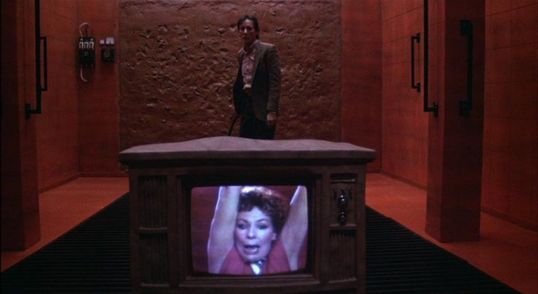
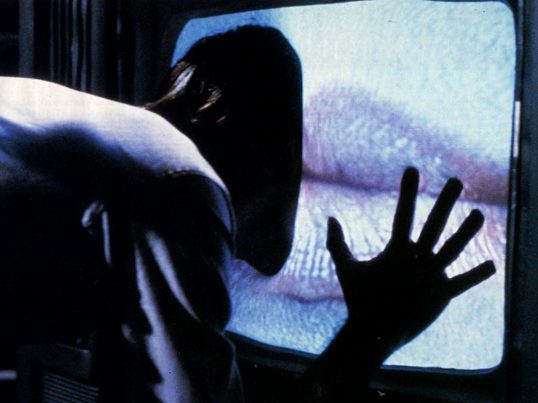
Videodrome (1983, dir by David Cronenberg)

Videodrome (1983, dir by David Cronenberg)

Nightmare on Elm Street (1984, dir by Wes Craven)

Nightmare on Elm Street (1984, dir by Wes Craven)

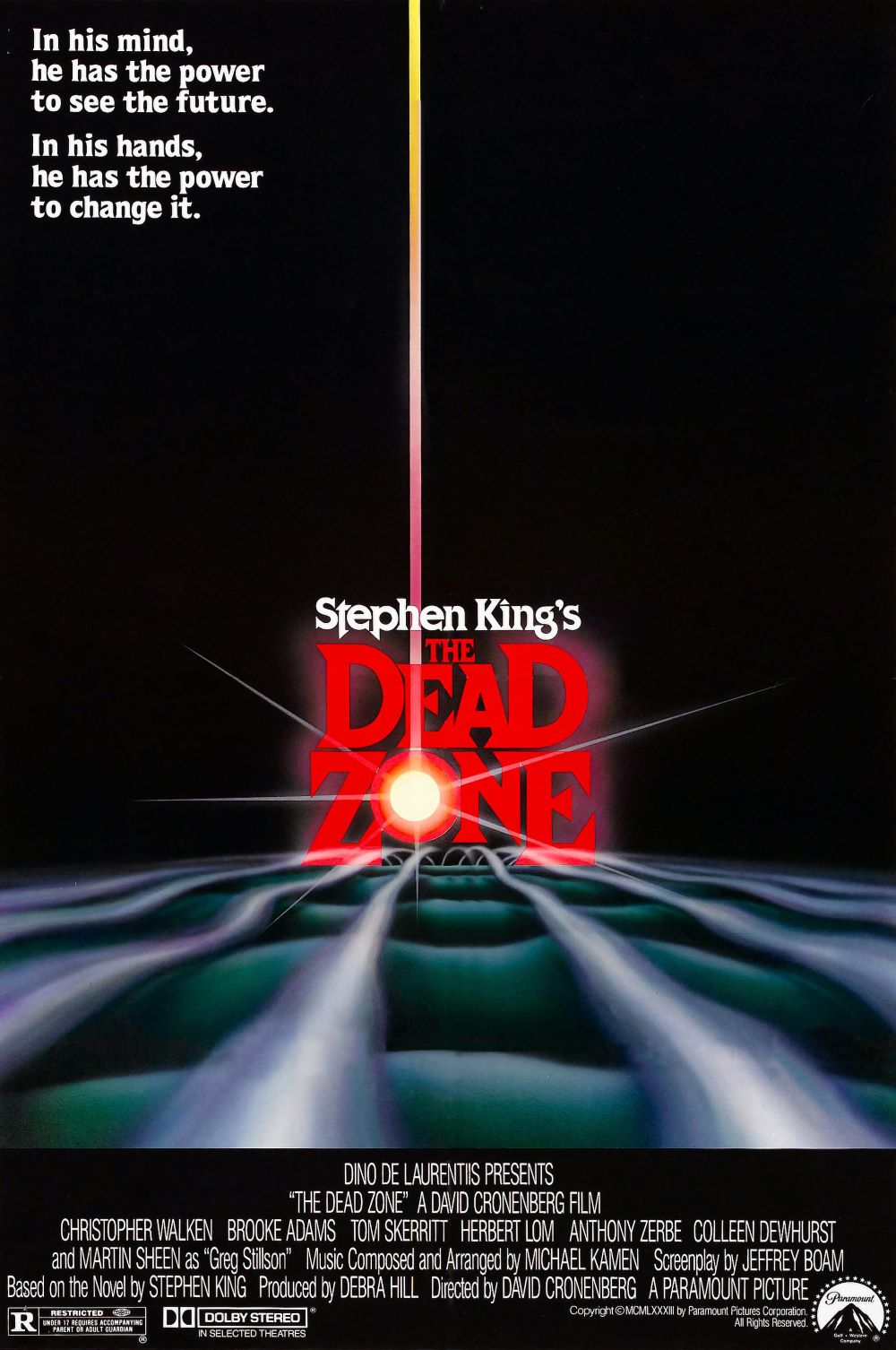
Horror Review: The Dead Zone (dir. by David Cronenberg)


“Bless me, Father, for I have sinned. I had the power… and I tried to prevent what I saw.”Johnny Smith

In 1983, David Cronenberg adapted Stephen King’s The Dead Zone with a distinctive emphasis on mood, morality, and psychological depth rather than traditional horror spectacle. The film follows Johnny Smith (Christopher Walken), a small-town schoolteacher whose life transforms irrevocably after a traumatic car accident leaves him in a five-year coma. Upon awakening, Johnny discovers he possesses psychic abilities that allow him to see the past and future by touch. Rather than a gift, this power becomes a heavy burden, isolating him and forcing him into wrenching moral choices.

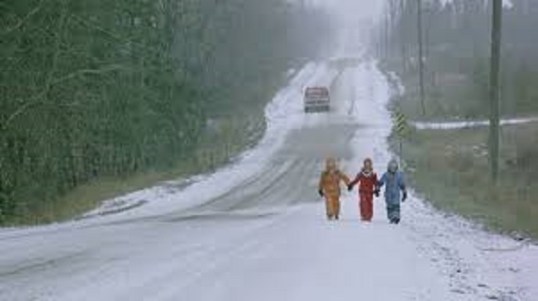
Cronenberg’s direction is meticulous and deliberately restrained. The film’s muted color palette and stark winter landscapes visually echo Johnny’s emotional isolation and the fragility of human existence. His careful, often gliding camera movements create a mounting sense of quiet dread, while minimalistic sound design underscores moments of revelation with haunting subtlety. This subdued style elevates the film’s psychological impact, transforming it into a thoughtful and melancholy meditation on the cost of harrowing knowledge.

Significantly, The Dead Zone marks a departure from Cronenberg’s signature body horror. Instead of the grotesque physical transformations and visceral mutations that characterize much of his other work, here Cronenberg turns inward. The real horror lies in the malleability of the mind and the elusive nature of perception—how reality, memory, and the future are unstable constructs that can shift and fracture under psychic strain. This thematic focus on the impermanence and distortion of mental reality touches on some of Cronenberg’s deepest artistic fascinations.

The restrained treatment of body horror in The Dead Zone previews the director’s later, more psychologically driven films such as A History of ViolenceEastern Promises, and A Dangerous Method, where character studies and narrative depth take precedence over startling visuals. In this early pivot, Cronenberg demonstrates that his mastery lies not only in visual spectacle but in probing the profound emotional and moral dilemmas faced by his characters. The vision-focused horror here is cerebral and grounded, rooting supernatural phenomena in human frailty and ethical complexity.

Christopher Walken’s nuanced portrayal is the emotional heart of the film. He captures Johnny’s vulnerability, weariness, and profound solitude, portraying a man burdened by a cursed knowledge that isolates him from the world. Martin Sheen plays Greg Stillson, the ambitious and morally bankrupt politician whose rise Johnny must foretell and who embodies the film’s central threat. The supporting cast, including Brooke Adams as Johnny’s lost love Sarah and Tom Skerritt as Sheriff Bannerman, delivers compelling and authentic performances that humanize the film’s intimate, small-town environment.

Several changes from King’s novel sharpen the film’s thematic focus. The novel’s sprawling plot, including a serial killer subplot and a brain tumor storyline symbolizing Johnny’s mortality, is pared down or omitted. Despite this trimming, the serial killer element retained in the film remains chilling and effective. It highlights the darker repercussions of Johnny’s psychic gift and injects a tangible sense of dread, reinforcing the psychological weight Johnny carries. This subplot grounds the supernatural within a disturbing reality, illustrating the violent and tragic circumstances Johnny must grapple with as part of his burden.

The concept of the “dead zone” itself shifts in meaning. Originally, the term referred to parts of Johnny’s brain damaged by the accident, blocking certain visions. Cronenberg reinterprets it as a metaphor for the unknown and unknowable parts of the future—the gaps in psychic clarity that allow for free will and change. This subtle shift reshapes the narrative toward a more ambiguous, hopeful meditation on destiny and human agency.

Compared to King’s novel, Cronenberg’s Johnny is more grounded and isolated. The novel frames Johnny’s struggle within a broader spiritual and fatalistic context, highlighted by the looming presence of a brain tumor and a nuanced exploration of hope versus resignation. The film, by contrast, focuses on the emotional and moral fatigue induced by Johnny’s psychic gift, emphasizing his loneliness and reluctant responsibility rather than supernatural destiny.

Walken’s restrained, haunting performance strips away mythic grandeur to reveal a deeply human character. The film’s narrowed narrative tightens focus on Johnny’s internal anguish and his difficult ethical choices, making his plight intimate and richly relatable.

On a thematic level, The Dead Zone contemplates fate, free will, and sacrifice. Johnny’s psychic abilities act as a draining, almost chthonic force, transforming him into a reluctant prophet who is tasked with intervening in grim futures at great personal cost. The film’s bleak winter setting visually reflects Johnny’s alienation, while its deliberate pacing highlights the exhaustion and heartbreak that comes with such knowledge.

Ultimately, Cronenberg’s The Dead Zone goes beyond supernatural thriller conventions. It is a profound meditation on empathy, sacrifice, and the human condition—where the greatest horrors are internal, and the cost of knowledge is both psychic and emotional. Johnny Smith emerges as a tragic, flawed figure wrestling with unbearable burdens.

Cronenberg’s direction and the impeccable performances make The Dead Zone a standout in King adaptations. The film’s enduring impact lies in its rich thematic texture, its moral ambiguity, and its unflinching exploration of human frailty, all conveyed through a director shifting skillfully from physical body horror to psychological and existential terror. The film remains as haunting and resonant now as it was upon release, a testament to the synergy of Cronenberg and King’s extraordinary talents.

4 Shots From 4 Films: Special Telekinesis Edition


4 Shots From 4 Films is just what it says it is, 4 shots from 4 of our favorite films. As opposed to the reviews and recaps that we usually post, 4 Shots From 4 Films lets the visuals do the talking.

For today’s edition of 4 Shots From 4 Films, we celebrate films that demonstrate what the human mind can do when it’s angry and there’s stuff around that can explode.  These are….

4 Shots From 4 Telekinetic Films

Carrie (1976, dir by Brian DePalma)

The Fury (1979, dir by Brian DePalma)

Patrick Lives Again (1980, dir by Mario Landi)

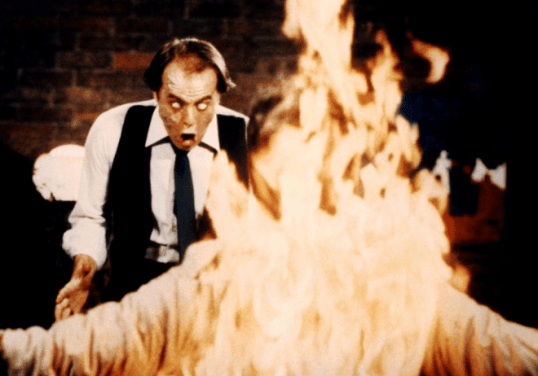
Scanners (1981, dir by David Cronenberg)

4 Shots From 4 Films: Special David Cronenberg Edition


4 Or More Shots From 4 Or More Films is just what it says it is, 4 shots from 4 of our favorite films. As opposed to the reviews and recaps that we usually post, 4 Shots From 4 Films lets the visuals do the talking!

Today, the Shattered Lens wishes a happy birthday to one of our favorite directors, David Cronenberg!  No one has done more to change the way that the world views Canada than David Cronenberg.  In honor of the man, his films, his country, and his legacy, here are….

4 Shots From 4 David Cronenberg Films

Crimes of the Future (1970, dir by David Cronenberg, DP: David Cronenberg)

Videodrome (1983, dir by David Cronenberg, DP: Mark Irwin)

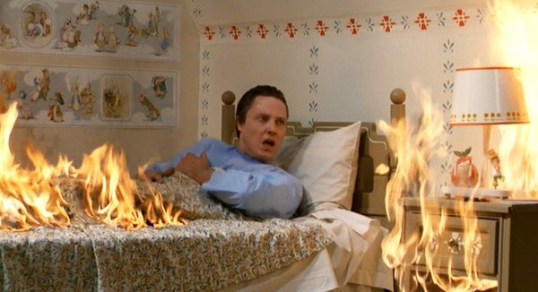
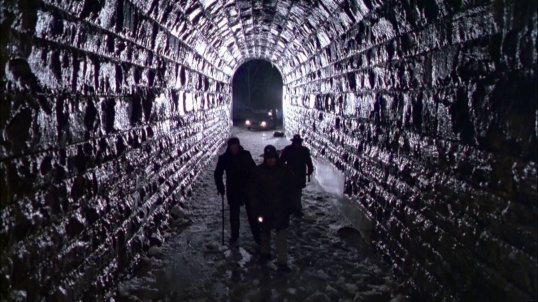
The Dead Zone (1983, dir by David Cronenberg, DP: Mark Irwin)

The Fly (1986, dir by David Cronenberg, DP: Mark Irwin)

4 Shots From 4 Horror Films: Special David Cronenberg Edition


4 Shots From 4 Films is just what it says it is, 4 shots from 4 of our favorite films. As opposed to the reviews and recaps that we usually post, 4 Shots From 4 Films is all about letting the visuals do the talking.

Today’s director is the master of Canadian horror, the one and only David Cronenberg!

4 Shots from 4 David Cronenberg Films

The Dead Zone (1983, dir. by David Cronenberg, DP: Mark Irwin)

Videodrome (1983, dir by David Cronenberg, DP: Mark Irwin)

The Fly (1986, dir. by David Cronenberg, DP: Mark Irwin)

Dead Ringers (1988, dir by David Cronenberg, DP: Peter Suschitzky)

Here Is The Official Cannes Lineup!


The lineup for the Cannes Film Festival has been announced.  After a rather subdued Sundance, film lovers like me are desperately looking to Cannes to add some excitement to 2024.  Considering that Cannes is going to see the premiere of new films from Francis Ford Coppola, Paul Schrader, Sean Baker, Kevin Costner, Andrea Arnold, George Miller, David Cronenberg, and Yorgos Lanthimos, it might do just that!

In the past, Cannes has always been hit-and-miss when it comes to the Oscars.  But lately, films like The Zone of Interest, Parasite, and The Tree of Life have followed success at Cannes with success with the Academy.

With that in mind, here’s the lineup.  If you’re going to Cannes in May, you’re going to have a good time!

Full lineup of the 2024 Cannes film festival.

The Second Act Quentin Dupieux (Opening Film) (Out of Competition)

Competition

L’Amour Ouf Gilles Lellouche

All We Imagine As Light Payal Kapadia

Anora Sean Baker

The Apprentice Ali Abbasi

Bird Andrea Arnold

Caught by the Tides Jia Zhangke

Emilia Perez Jacques Audiard

The Girl With the Needle Magnus von Horn

Grand Tour Miguel Gomes

Limonov: The Ballad Kirill Serebrennikov

Marcello Mio Christophe Honoré

Megalopolis Francis Ford Coppola

Motel Destino Karim Ainouz

Oh Canada Paul Schrader

Parthenope Paolo Sorrentino

The Shrouds David Cronenberg

The Substance Coralie Fargeat

Wild Diamond Agathe Riedinger

Kinds of Kindness Yorgos Lanthimos

Out of Competition

Furiosa: A Mad Max Saga George Miller

Horizon, an American Saga Kevin Costner

Rumours Evan Johnson, Galen Johnson, Guy Maddin

She’s Got No Name Chan Peter Ho-Sun

Un Certain Regard

Armand Halfdan Ullmann Tondel

Black Dog Guan Hu

The Damned Roberto Minervini

L’Histoire de Souleymane Boris Lojkine

My Sunshine Boku No Ohisama

Norah Tawik Alzaidi

On Becoming a Guinea Fowl Rungano Nyoni

Le Royaume Julien Colonna

Santosh Sandhya Suri

September Says Ariane Labed

The Shameless Konstantin Bojanov

Viet and Nam Truong Minh Quý

The Village Next to Paradise Mo Harawe

Vingt Deux! Louise Courvoisier

Who Let the Dogs Bite? Laetitia Dosch

Midnight Screenings

The Balconettes Noémie Merlant

I, The Executioner Seung Wan Ryoo

The Surfer Lorcan Finnegan

Twilight of the Warrior Walled In Soi Cheang

Cannes Premiere

C’est Pas Moi Leos Carax

Everybody Loves Touda Nabil Ayouch

The Matching Bang Emmanuel Courcol

Misericorde Alain Guiraudie

Rendez-Vous Avec Pol Pot Rithy Panh

Le Roman de Jim Arnaud Larrieu, Jean-Marie Larrieu

Special Screenings

Apprendre Claire Simon

La Belle de Gaza Yolande Zauberman

Ernest Cole, Lost and Found Raoul Peck

Le Fil Daniel Auteuil

The Invasion Sergei Loznitsa
4 Shots From 4 Films: Special David Cronenberg Edition


4 Or More Shots From 4 Or More Films is just what it says it is, 4 shots from 4 of our favorite films. As opposed to the reviews and recaps that we usually post, 4 Shots From 4 Films lets the visuals do the talking!

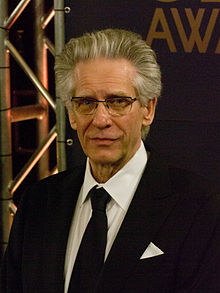
Today, the Shattered Lens wishes a happy birthday to one of our favorite directors, David Cronenberg!  No one has done more to change the way that the world views Canada than David Cronenberg.  In honor of the man, his films, his country, and his legacy, here are….

4 Shots From 4 David Cronenberg Films

The Brood (1979, dir by David Cronenberg, DP: Mark Irwin)

Scanners (1981, dir by David Cronenberg, DP: Mark Iwrin)

Videodrome (1983, dir by David Cronenberg, DP: Mark Irwin)

A History of Violence (2005, dir by David Cronenberg, DP: Peter Suschitzky)

Late Night Retro Television Review: Friday the 13th 1.12 “Faith Healer”


Welcome to Late Night Retro Television Reviews, a new feature where we review some of our favorite and least favorite shows of the past! On Fridays, I will be reviewing Friday the 13th, a show which ran in syndication from 1987 to 1990. The show can be found on YouTube!

This week, David Cronenberg directs a story about a cursed glove.

Episode 1.12 “Faith Healer”

(Dir by David Cronenberg, originally aired on February 8th, 1988)

After being absent for the last few episodes, Jack has returned to the antique shop and he’s back just in time to investigate a faith healer named Stewart Fishoff (Miguel Fernandes).

Fishoff started his career as a phony evangelist, one who was exposed by one of Jack’s friends, Jerry Scott (Robert A. Silverman).  However, Fishoff is back and now, it appears that he truly does have the power to heal the sick.  Jack can’t help but notice that Fishoff is now wearing a white glove, one that was purchased from the store.  The glove can take away someone’s illness but then it then passes on that illness to the next person that it touches.  With Micki busy researching the store’s history and Ryan suffering from a cold, Jack pays a visit to Jerry to plot how to get back the glove.

The problem is that Jerry wants the glove for himself and he’s willing to kill not only Fishoff but also Jack to get it.

Faith Healer was directed by David Cronenberg, one of the many prominent Canadian horror filmmakers who directed an episode or two of this show.  Not surprisingly, the episode is full of visually striking images, from Fishoff’s church and the member of his cult to the scenes of suddenly sickened skin erupting and then rotting away.  Indeed, if you watched this episode and somehow missed the directorial credit, you would still be able to guess that it came from the mind of David Cronenberg.  It’s full of moody Cronenbergian images and themes, as the rational skepticism of Jerry goes to war with the faith of Fishoff’s cult and both turn out to be equally destructive.  A good deal of this episode focused on showing how both Fishoff and Jerry were seduced by the cursed glove and its promise of power.  If you’ve ever wondered why everyone on this show is so quick to use the antiques for evil, this episode seems to suggest that the antiques are a bit like a powerful drug.  Once you give in to the temptation, the addiction quickly follows.

This episode was well-acted by both Cronenberg regular Robert A. Silverman and Chris Wiggins.  Silverman turns Jerry into a compelling villain, one who falls victim to the same dark magic that he previously made a career out of debunking.  This episode ends with Jack in a particularly dark place and Chris Wiggins does a great job of capturing Jack’s disillusionment.  As Jack points out, all of his friends are either evil or dead or both!  This episode explores the pain that comes from both owning the antiques and tracking them down.

Next week: Micki and Ryan travel in time to pursue a vampire!

4 Shots From 4 Horror Films: Special David Cronenberg Edition


4 Shots From 4 Films is just what it says it is, 4 shots from 4 of our favorite films. As opposed to the reviews and recaps that we usually post, 4 Shots From 4 Films is all about letting the visuals do the talking.

This October, I am going to be using our 4 Shots From 4 Films feature to pay tribute to some of my favorite horror directors, in alphabetical order!  That’s right, we’re going from Argento to Zombie in one month!

Today’s director is the master of Canadian horror, the one and only David Cronenberg!

4 Shots from 4 David Cronenberg Films

Scanners (1981, dir by David Cronenberg, DP: Mark Irwin)

The Dead Zone (1983, dir by David Cronenberg, DP: Mark Irwin)

The Fly (1986, dir by David Cronenberg, DP: Mark Irwin)

Dead Ringers (1988, dir by David Cronenberg, DP: Peter Suschitzky)