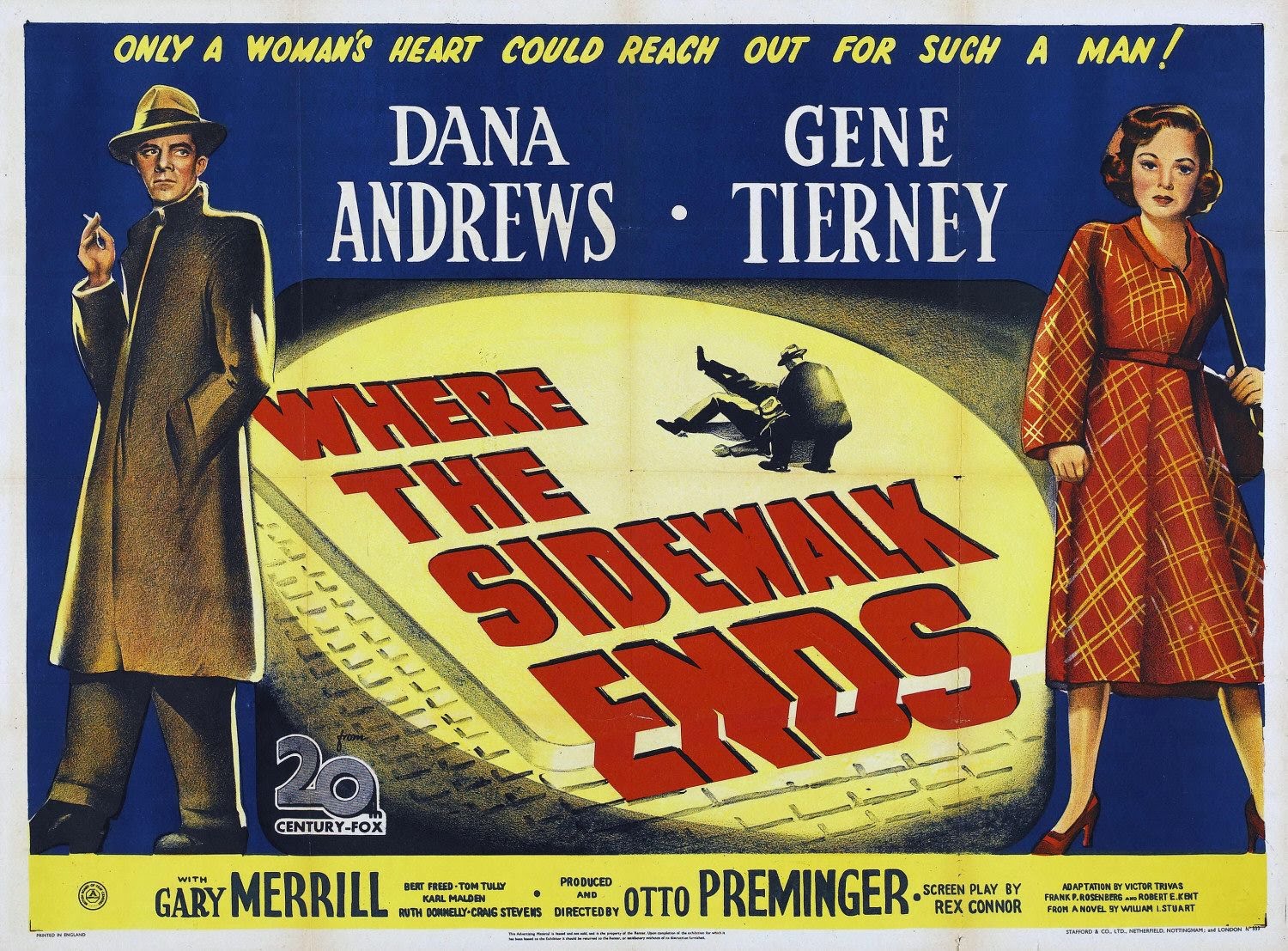
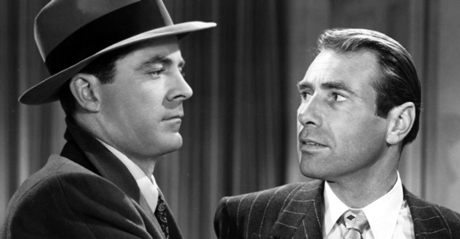
I recorded WHERE THE SIDEWALK ENDS way back in June, and haven’t watched it until just recently. It was well worth the wait, for this is one of the finest noirs I’ve seen yet. Director Otto Preminger reunited with the stars of his film LAURA, Dana Andrews and Gene Tierney, to give us a bleak crime drama that more than holds its own with the best films noir of the era.
Police Detective Mark Dixon (Andrews) is a proto-Dirty Harry cop, a tough SOB not above laying the smackdown on New York City’s criminal element. Another assault charge leads to Mark being demoted by his superiors. Mark’s got a reason for his brutality tactics, though: his father was a criminal, and he’s psychologically compelled to clean up the corruption in his city.
He’s particularly got a hair across his ass about gambling czar Tommy Scalise (Gary Merrill), who was set up in…
I’ve seen The Best Years Of Our Lives on TCM a few times. There’s a part of me that always wishes that this film was dull, in the way that many best picture winners can be when watched through modern eyes, or in any other way overrated. The Best Years Of Our Lives won the Academy Award for Best Picture of 1946 and in doing so, it defeated one of my favorite films of all time, It’s A Wonderful Life. A part of me would love to be able to say that this was one of the greatest injustices of cinematic history but, honestly, I can’t. The Best Years Of Our Lives is an excellent film, one that remains more than worthy of every award that it won.
The film deals with veterans returning home from World War II and struggling to adjust to life in peacetime. That’s a topic that’s as relevant today as it was back in 1946. If there’s anything that remains consistent about human history it’s that there is always a war being fought somewhere and the man and women who fight those wars are often forgotten and abandoned after the final shot has been fired. The returning veterans in The Best Years Of Our Lives deal with the same issues that our soldiers have to deal with today as they return from serving in Iraq and Afghanistan.
The Best Years Of Our Lives follows three veterans as they return home to Boone City, Ohio. As they try to adjust to civilian life, their loved ones struggle to adjust to them.
Teresa Wright and Dana Andrews
Fred Derry (played by Dana Andrews) is a self-described former soda jerk. (To be honest, I’m really not sure what a soda jerk was but it doesn’t sound like a very fun job.) During the war, he was a captain in the air force. He returns home with several decorations and few marketable skills. During the war, he was good at bombing cities but there’s not much that can be done with that skill during peacetime. Nearly penniless, Fred takes a job selling perfume at a department store. He spends his days trying to control her temper and not give into his frustration. At night, he’s haunted by nightmares of combat.
Teresa Wright and Virginia Mayo
Meanwhile, his wife, Marie (Virginia Mayo), finds herself resenting the fact that Fred has come home. She married him while he was in flight training and, as quickly becomes obvious, she’s less enamored of Fred now that he’s just another civilian with a low-paying job. (She continually begs him to wear the uniform that he can’t wait to take off.) The Best Years Of Our Lives is a film full of great performances but Virginia Mayo really stands out. I have to admit that, whenever I watch this film, I find myself envious of her ability to both snarl and smile at the same time.
Teresa Wright, Myrna Loy, Fredric March, and Michael Hall
Al Stephenson (Fredric March) was a bank loan officer who served as an infantry sergeant. (It’s interesting to note that the educated and successful Al was outranked by Fred during the war.) Al returns home to his loving wife, Milly (Myrna Loy), his daughter Peggy (the beautiful Teresa Wright), and his son, Rob (Michael Hall). At first, Al struggles to reconnect with his family and he deals with the tension by drinking too much. Rehired by the bank, he approves a risky loan to a fellow veteran. After the bank president (Ray Collins, a.k.a. Boss Jim Gettys from Citizen Kane) admonishes Al, Al gives a speech about what America owes to its returning veterans.
Meanwhile, Peggy has fallen in love with Fred. When Milly and Al remind her that Fred is (unhappily) married, Peggy announces, “I am going to break that marriage up!” It’s a wonderful line, brilliantly delivered by the great Teresa Wright.
Harold Russell
Marriage is also on the mind of Homer Parrish (Harold Russell). A former high school quarterback, Homer was planning on marrying Wilma (Cathy O’Donnell) as soon as he finished serving in the Navy. During the war, he lost both his hands and now he’s returned home with metal hooks. Homer locks himself away from the world. When he finally does talk to Wilma, it’s to show her how difficult life with him will be. Wilma doesn’t care but Homer does.
Harold Russell won an Academy Award for his performance here. Russell was not a professional actor. Instead he was a veteran and a real-life amputee. Watching his performance today, it’s obvious that Russell was not an experienced actor but the natural charm that enchanted the Academy still shines through.
Harold Russell, Dana Andrews, and Fredric March
It’s been nearly 70 years since The Best Years Of Our Lives was first released but it remains a powerfully honest and surprisingly dark film. All three of the veterans deal with very real issues and, somewhat surprisingly, the film refuses to provide any of them with the type of conventional happy ending that we tend to take for granted when it comes to movies made before 1967. As the film concludes, Fred is still struggling financially. Homer is still adjusting to life as an amputee. Al is still drinking. All three have a long road ahead of them but they’re all making progress. None of them will ever be the same as they were before the war but, at the same time, they’re all working on making new lives for themselves. They haven’t given up. They haven’t surrendered to despair and, the film suggests, that is triumph enough.
The Best Years Of Our Lives is a great film and a great best picture winner. It’s just a shame that it had to be released the same year as It’s A Wonderful Life.
Did you know that 75% of people are sick of hearing the results of polls about what people think about other polls? It’s true!
Me, I first got sick of polls back in 2012. That was when, every day, everyone on twitter would be talking about the result of another political poll. A poll would come out showing that Obama was ahead of Romney in the presidential election and all of my Republican friends would immediately start tweeting about why the poll could not be taken seriously. Then 2014 came along and polls started to show that the majority of American citizens did not approve of the job Obama was doing. And all of my Democrat friends would immediately start tweeting about why those polls could not be trusted.
As for me, I was always more concerned with what the polls said over on Rotten Tomatoes. Really?I would think. Only 35% of critics gave California Scheming a good review? 67% of moviegoers want to see the new Transformers film?
Oh my God, I thought, those numbers have to be so fake…
Because, let’s face it. The only time that we believe a poll is when we agree with it. Otherwise, we assume that they’re either the result of subtle manipulation, selective interpretation, or just completely and totally untrue.
Believe it or not, this suspicion is not a new phenomena. I’ve always felt that you can learn a lot about history by watching the movies. That doesn’t mean that movies are historically accurate. One need only read my review of Magnificent Doll to see that. However, movies do reflect the culture and concerns of the time in which they were made.
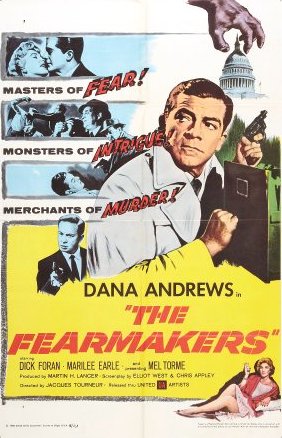
For instance, The Fearmakers was made in 1958 and it shows that not only has polling been around for a while but so has the fear of being manipulated by a fraudulent poll.
In The Fearmakers, Dana Andrews plays Alan Eaton. Before the start of the Korean War, Alan owned one of the best and most respected polling firms in Washington D.C. However, while serving in the army during the war, Alan was captured and held prisoner by the Chinese. After years of being tortured and perhaps brainwashed, Alan is finally released.
He returns to an America that is far different from the country that he left. For instance, while on a flight to Washington, D.C., he finds himself sitting next to a shifty scientist (Oliver Blake) who tries to convince Alan to support a group that believes in nuclear disarmament. Even worse, once the plane lands, Alan discovers that he’s been forced out of his polling firm and that his partner has died under mysterious circumstances.
The firm’s new owner, the outwardly friendly, inwardly cold-hearted Jim McGinnis (Dick Foran), offers to hire Alan as a special consultant. Alan is at first resistant but then he has a meeting with his old friend, Senator Walder (Roy Gordon). Walder explains that he suspects that Alan’s old polling firm has been infiltrated by outside forces and that it might be using its polling to try to push communist propaganda on the American people. Alan agrees to work for Jim and to help track down any and all subversives….
The Fearmakers is better than it sounds. Beyond the fact that the story remains relevant in our poll-driven times, it was directed by Jacques Tourneur, who directed several atmospheric and intelligent horror films in the 30s and 40s. He brings a similar atmosphere of doom to The Fearmakers. Perhaps the film’s best scenes are the ones where Tourneur just focuses his camera on Andrews’s face while Alan struggles to understand the country to which he has returned. As played by Andrews, Alan is troubled and hardly your typical hero. You’re never quite sure how much of the film’s danger is real and how much of it is just the result of Alan’s own paranoia.
I first saw The Fearmakers on Netflix. The next time you’ve got 84 minutes to kill, check it out.
Sometimes, you have to be careful which films you choose to watch over the course of the day.
Such as, last Friday night, I heard the news that Jill Clayburgh had died and I ended up watching An Unmarried Woman. This, along with the fact that I also watched the Black Swan trailer, led to me dancing around the house in my underwear, en pointe in bare feet, and doing a half-assed pirouette in the living room. And I felt pretty proud of myself until I woke up Saturday morning and my ankle (which I don’t think has ever properly healed from the day, seven years ago, that I fell down a flight of stairs and broke it in two places) literally felt like it was on fire. That was my body’s way of saying, “You ain’t living in a movie, bitch. Deal with it.”
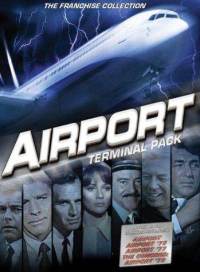
So, come Sunday, I decided to play it safe by watching something that I was sure wouldn’t lead to any imitative behavior on my part. Since I had previously reviewed Earthquake on this site, I decided that I would devote some time to the movies that started the entire 1970s disaster movie genre — Airport. Watching Airport led to me watching Airport’s three sequels.
I was able to do this largely because I own the Airport Terminal Pack, a two-disk DVD collection that contains all four of the Airport films and nothing else. There’s no special features or commentary tracks. That’s probably a good thing because these films are so extremely mainstream that I doubt the commentary tracks would be all that interesting except to people who love “Me and Jennings Lang had the same lawyer…” style stories.
The movies are a mixed bag of ’70s sexism, mainstream greed, and casts that were described as being “all-star” despite the fact that they featured very few stars. They’re all worth watching as time capsules of a past time. Some of them are just more worthy than others.
Below are my thoughts on each individual film in the collection…
Airport (directed by George Seaton)
First released in 1970, Airport was nominated for 10 Academy Awards (including best picture), broke box office records, and started the whole 70s disaster movie trend. It also has to be one of the most boring, borderline unwatchable movies ever made. The fact that I managed to sit through the whole thing should be taken as proof that I’m either truly dedicated to watching movies or I’m just insane. Take your pick.
Anyway, the film is painstakingly detailed account of the every day operations of an airport. Yeah, sounds like a lot of fun, doesn’t it? Burt Lancaster runs the airport. His brother-in-law Dean Martin flies airplanes. Both of them have mistresses but we’re told that’s okay because Lancaster’s wife expects him to talk to her and Martin’s wife is cool with him fucking around as long as he comes home at night. I would be tempted to say that this is a result of the film having been made in 1969 and released in 1970 but actually, it’s just an introduction to the sexual politics of the typical disaster film. Men save the day while women get in the way. And if you think things have changed, I’d suggest you watch a little film calledf 2012…
The only interesting thing about the film is that Lancaster’s mistress is played by Jean Seberg who, ten years earlier, had helped change film history by co-starring in Jean-Luc Godard’s classic film Breathless. Nine years later, after years of being hounded by the American press and the FBI for her radical politics, Seberg committed suicide.
Airport 1975 (directed by Jack Smight)
As opposed to its predecessor, Airport 1975 is actually a lot of fun in its campy, silly way. This is the one where a small private plane (flown by Dana Andrews, the star of the wonderful film noir Laura) collides with a commercial airliner. The entire flight crew is taken out and head stewardess Karen Black has to pilot the plane despite the fact that she’s obviously cross-eyed. Luckily, since Black is a stewardess, she has a pilot boyfriend who is played by Charlton Heston. Heston talks her through the entire flight despite the fact that she was earlier seen trying to pressure him into not treating her like an idiot. Anyway, Heston does his usual clench-jaw thing and if you need a drinking game to go with your bad movie, just take a shot every time Heston calls Black “honey.” You’ll be drunk before the plane lands.
There’s some other stuff going on in this movie (for instance, Gloria Swanson appears as “herself” and doesn’t mention Sunset Boulevard or Joseph Kennedy once!) but really, all you need to know is that this is the film where Karen Black acts up a storm and random characters keep saying, “The stewardess is flying the plane!?”
Odd trivia fact: Airport 1975 was released in 1974.
Airport ’77 (directed by Jerry Jameson)
In Airport ’77, a group of art thieves attempt to hijack an airplane which, of course, leads to the airplane crashing into the ocean and somehow sinking down to the ocean’s floor without splitting apart. The crash survivors have to try to figure out how to get to the surface of the water before they run out of oxygen.
In this case, our resident sexist pilot is Jack Lemmon who has a really ugly mustache. He wants to marry head stewardess Brenda Vaccarro. Vaccarro doesn’t understand why they have to get married to which Lemmon responds, “Because I want a wife and kids!” The film also gives us Lee Grant as a woman who is married to Christopher Lee but who is having an affair with another man. She also drinks a lot and dares to get angry when she realizes that the airplane is underwater. While this sort of behavior is acceptable from Dean Martin, Charlton Heston, and Jack Lemmon, the film punishes Lee Grant by drowning her in the final minutes.
Technically, Airport ’77 is probably the best of the Airport films. The cast does a pretty good job with all the melodrama, the film doesn’t drag, and a few of the scenes manage to generate something resembling human emotion. (For instance, when the blind piano player died, I had a tear in one of my freaky, mismatched eyes.) Unfortunately, the movie’s almost too good. It’s not a lot of fun. Everyone plays their roles straight so the silly plot never quite descends into camp and the key to a good disaster film is always camp. This film also has the largest body count of the series, with most of the cast dead by the end of the movie. (And, incidentally, this film did nothing to help me with my fear of water…)
The Concorde: Airport ’79 (directed by David Lowell Rich)
The last Airport movie is also the strangest. Some people have claimed that this film was meant to be a satire of the previous Airport films. I can understand the argument because you look at film like Concorde and you say, “This must be a joke!” However, the problem with this theory is that there are moments of obvious “intentional” humor in this film (i.e., J.J. from Good Times smokes weed in the plane’s bathroom, another passenger has to go to the bathroom whenever she gets nervous) and none of them show any evidence of the type of wit and outlook necessary to come up with anything this silly on purpose. Add to that, the film’s story is credited to Jennings Lang, a studio executive. Studio execs do not take chances. (Plus, the actual script was written by Eric Roth, who went on to write the amazingly humorless The Curious Case of Benjamin Button).
No, this film is meant to be taken seriously and oh my God, where do I start?
Our pilots are George Kennedy and Alain Delon. The head stewardess (and naturally, Delon’s girlfiend) is played by Sylvia “Emanuelle” Kristel who, at one point, says, “You pilots are such men!” “Hey, they don’t call it a cockpit for nothing, honey,” Kennedy replies.
Meanwhile, Robert Wagner is trying to destroy the Concorde because one of the passengers is his girlfriend who has proof that Wagner has been selling weapons to America’s enemies. So, he attempts to blow the plane up with a guided missile and when that fails, he sends a couple of fighter planes after them. Kennedy responds by opening up the cockpit window — while breaking the sound barrier mind you — and firing a flare gun at their pursuers.
After this, there’s stop over in Paris where Delon arranges for Kennedy to sleep with a prostitute who assures Kennedy that he made love “just like a happy fish.”
The next day, everyone returns to the exact same Concorde — despite the fact that just a day earlier they’d nearly been blown up by a squadron of fighter planes — and take off on the second leg of the flight. Let me repeat that just to make sure that we all understand what this film is asking us to believe. After nearly getting blown up by a mysterious squad of fighter planes, everybody shows up the next morning to get on the exact same plane.
Oh, and it never occurs to Wagner’s ex-girlfriend that Wagner might have something to do with all of this.
Now sad to say, Concorde is the one of those films that’s a lot more fun to talk about than to actually watch. It should be a lot more fun in its badness than it actually is. Still, the movie has just enough camp appeal to make it fun in a “what the fuck…” sorta way.
And that’s how the Airport series comes to an end.



 Through the Shattered Lens