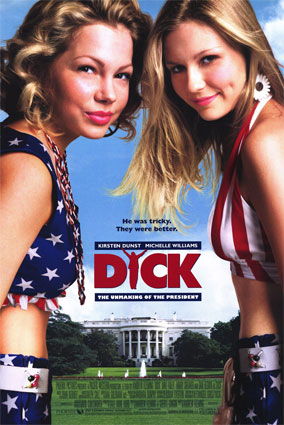
Shattered Politics #64: Dick (dir by Andrew Fleming)


Theatricalposterdick

I wouldn’t necessarily say that I love Dick but I still think it’s a pretty good film.  (Ha ha, see what I did there?)  Of course, to really appreciate this 1999 comedy, it helps to know a little something about political history.  For instance, it helps to know that the Dick of the title is President Richard Nixon (played here by a hilariously paranoid Dan Hedaya).  In 1973, as the result of his attempt to cover up White House involvement of a burglary at the Watergate Hotel, Nixon became the first President to resign from office.

A lot of the credit for Nixon’s downfall was given to two reporters for the Washington Post, Bob Woodward and Carl Bernstein (played, in this film, by Will Ferrell and Bruce McCulloch).  While Woodward and Bernstein investigated the Watergate break-in, they were reportedly fed information by a highly placed informant who was referred to as being Deep Throat.  For years, the identity of Deep Throat was a closely held secret.  Countless books were written that speculated as to who Deep Throat may have been.  (In the film All The President’s Men, he was played by Hal Holbrook.)  Finally, in 2005, it was revealed that Deep Throat was a FBI agent named Mark W. Felt, who was upset because he was passed over for a promotion.

And, quite frankly, that’s kind of a disappointing solution.  When you think about someone who brought down the government, you hope that he or she will turn out to be something more than just a disgruntled employee whose previous work consisted on running counter intelligence operations against domestic political activists.

In fact, it’s hard not to wish that, perhaps, Deep Throat could have been two 15 year-old girls who just happened to stumble across one of the biggest political scandals in American history.

Well, fortunately, this is the theory proposed in Dick.  Betsy (Kirsten Dunst) and Arlene (Michelle Williams) are two friends who, one night in 1972, sneak out of Arlene’s apartment so that they can mail a fan letter to singer Bobby Sherman.  While doing so, they happen to stumble across the Watergate burglars and get a good look at White House aide G. Gordon Liddy (Harry Shearer).

The next day, while on a field trip to the White House, the two girls are spotted by Liddy.  Liddy arranges for them to be pulled to the side and questioned by chief-of-staff H.R. Haldeman (Dave Foley), who determines that the girls barely know who Nixon is and that they don’t understand what they witnessed.  However, before Haldeman can send the girls on their way, Nixon himself enters the office and complains about how poorly planned the break-in was.

This leads to an unlikely relationship between Nixon and Betsy and Arlene.  Hoping to win their loyalty (and their silence), Nixon arranges for them to be his official dog walkers.  Betsy and Arlene, meanwhile, still don’t have the slightest idea of what’s going on.  They accidentally bring pot cookies to the White House (which Nixon particularly enjoys) and Arlene even develops a mad crush on Nixon.

But, of course, Nixon eventually shows his true colors and Betsy and Arlene take down the government….

In many ways Dick is a one-joke film, in which Betsy and Arlene regularly find themselves blissfully unaware while history literally unfolds around them.  But it’s actually a pretty clever joke and it’s also a very plausible one.  People are often unaware that anything important is happening when it’s actually happening.  Often times, it’s only in retrospect that historical moments are seen to be truly historical.  And, ultimately, Watergate itself is such a bizarre scandal that it’s the perfect moment in history to be reinterpreted as a comedy.

Dick is ridiculous enough to be funny but plausible enough to be memorable.

Back to School #50: Clueless (dir by Amy Heckerling)


clueless10

By their very nature, teen films tend to get dated very quickly.  Fashions, music, and cultural references — all of these serve to make a film popular when it’s first released and occasionally laughable just a few years later.  Take 1995’s Clueless for instance.  Watching it now, it’s impossible not to get a little snarky when Cher Horowitz (Alicia Silverstone) refers to a hot guy as being a “Baldwin.”  When heard today, it’s hard not to wonder if Cher is thinking of beefy rageaholic Alec or ultra-religious realty TV mainstay Stephen.  (Personally, I prefer to think that she was thinking of Adam Baldwin.)

Clueless is one of those films that I always remember watching on TV and loving when I was little but, whenever I watch it now, I always find myself feeling slightly disappointed in it.  It’s never quite as good as I remember and, with each viewing, I’m just a little bit more aware that, while both were very well-cast in their respect roles, Alicia Silverstone and Stacey Dash weren’t exactly the most versatile actresses of their generation.  There’s a reason why Dash is now a political commentator and Silverstone is best known for that video of her spitting food into her baby’s mouth.  As well, watching the film now, it’s hard not to think about how the talented Brittany Murphy would tragically pass away 14 years after its initial release.

And yet, I can’t help it.  I still enjoy Clueless.  I could spend hours nitpicking it apart and pointing out what parts of it don’t quite work as well as they should but ultimately, Clueless is a fun movie that features and celebrates three strong female characters, which is more than you can say for most teen films.

Directed and written by Amy Heckerling (who earlier directed the classic Fast Times At Ridgemont High), Clueless is based (quite directly) on Jane Austen’s Emma.  In this version, Emma is Cher, the spoiled 16 year-old daughter of a lawyer (played, very well, by Dan Hedaya), who lives in Beverly Hills and who is happy being superficial, vain, and popular.  In fact, the only person who ever criticizes Cher is her stepbrother, Josh (Paul Rudd), who is studying to be an environmental lawyer and is visiting during a break from college.

When Cher plays matchmaker and deftly manages to pair up two of her teachers (played by Wallace Shawn and Twink Caplan), she realizes that she enjoys helping people.  (Though, it must be said, the only reason she helped her two teachers wass because they were both taking out the misery of being single on her…)  So, Cher and her best friend Dionne (Stacey Dash) decide to help another student, new girl Tai (Brittany Murphy), become popular.  After giving Tai a makeover, forbidding her to date skater Travis (Breckin Meyer, who is adorable), and trying to set Tai up with rich snob Elton (Jeremy Sisto), Cher is shocked to discover that Tai has become so popular that she is now challenging Cher’s social status.  Even worse, Tai decides that she has a crush on Josh right around the same time that Cher realizes the same thing.

Plus, Cher still has to pass her driving test…

As I said before, Clueless is hardly a perfect film but it is a very likable movie.  Director Amy Heckerling creates such a vivid and colorful alternate teenage universe and the script is full of so many quotable lines that you can forgive the fact that the story sometimes runs the risk of getting almost as superficial of Cher.  It may never be quite as good as I remembered it being but Clueless is still an entertaining and fun movie.

clueless-pics-16-1

44 Days of Paranoia #30: Nixon (dir by Oliver Stone)


For our latest entry in the 44 Days of Paranoia, we take a look at Oliver Stone’s 1995 presidential biopic, Nixon.

Nixon tells the life story of our 37th President, Richard Nixon.  The only President to ever resign in order to avoid being impeached, Nixon remains a controversial figure to this day.  As portrayed in this film, Nixon (played by Anthony Hopkins) was an insecure, friendless child who was dominated by his ultra religious mother (Mary Steenburgen) and who lived in the shadow of his charismatic older brother (Tony Goldwyn).  After he graduated college, Nixon married Pat (Joan Allen), entered politics, made a name for himself as an anti-communist, and eventually ended up winning the U.S. presidency.  The film tells us that, regardless of his success, Nixon remained a paranoid and desperately lonely man who eventually allowed the sycophants on his staff (including James Woods) to break the law in an attempt to destroy enemies both real and imagined.  Along the way, Nixon deals with a shady businessman (Larry Hagman), who expects to be rewarded for supporting Nixon’s political career, and has an odd confrontation with a young anti-war protester who has figured out that Nixon doesn’t have half the power that everyone assumes he does.

Considering that his last few films have been W., Wall Street: Money Never Sleeps, and SavagesI think it’s understandable that I’m often stunned to discover that, at one point in the distant past, Oliver Stone actually was a worthwhile director.  JFK, for instance, is effective propaganda.  Nixon, which feels a lot like an unofficial sequel to JFK, is a much messier film than JFK but — as opposed to something like Savages — it’s still watchable and occasionally even thought-provoking.  Thanks to Hopkins’ performance and, it must be admitted, Stone’s surprisingly even-handed approach to the character, Nixon challenges our assumptions about one of the most infamous and villified figures in American history.  It forces us to decide for ourselves whether Nixon was a monster or a victim of circumstances that spiraled out of his control.  If you need proof of the effectiveness of the film’s approach, just compare Stone’s work on Nixon with his work on his next Presidential biography, the far less effective W.

(I should admit, however, that I’m a political history nerd and therefore, this film was specifically designed to appeal to me.  For me, half the fun of Nixon was being able to go, “Oh, that’s supposed to be Nelson Rockefeller!”)

If I had to compare the experience of watching Nixon to anything, I would compare it to taking 10 capsules of Dexedrine and then staying up for five days straight without eating.  The film zooms from scene-to-scene, switching film stocks almost at random while jumping in and out of time, and not worrying too much about establishing any sort of narrative consistency.  Surprisingly nuanced domestic scenes between Anthony Hopkins and Joan Allen are followed by over-the-top scenes where Bob Hoskins lustily stares at a White House guard or Sam Waterston’s eyes briefly turn completely black as he discusses the existence of evil.  When Nixon gives his acceptance speech to the Republican Convention, the Republican delegates are briefly replaced by images of a world on fire.  Familiar actors wander through the film, most of them only popping up for a scene or two and then vanishing.  The end result is a film that both engages and exhausts the viewer, a hallucinatory journey through Stone’s version of American history.

Nixon is a mess but it’s a fascinating mess.

Other Entries In The 44 Days of Paranoia 

  1. Clonus
  2. Executive Action
  3. Winter Kills
  4. Interview With The Assassin
  5. The Trial of Lee Harvey Oswald
  6. JFK
  7. Beyond The Doors
  8. Three Days of the Condor
  9. They Saved Hitler’s Brain
  10. The Intruder
  11. Police, Adjective
  12. Burn After Reading
  13. Quiz Show
  14. Flying Blind
  15. God Told Me To
  16. Wag the Dog
  17. Cheaters
  18. Scream and Scream Again
  19. Capricorn One
  20. Seven Days In May
  21. Broken City
  22. Suddenly
  23. Pickup on South Street
  24. The Informer
  25. Chinatown
  26. Compliance
  27. The Lives of Others
  28. The Departed
  29. A Face In The Crowd