The TSL’s Horror Grindhouse: Hell of the Living Dead (dir by Bruno Mattei)


Hell of the Living Dead, a 1980 Italian zombie film, is a movie known by many different names.  Some of these names are more memorable than others.

For instance, it’s known as Virus, which isn’t a very good name.  It’s kind of boring.  Plus, a virus could lead to anything.  Sure, a virus could turn someone into a zombie but it could also just mean a week in bed.  Plus, there’s already a thousand movies called Virus.

Night of the Zombies is a bit more specific, though still rather generic.  Just about every Italian horror film that came out in 1980 was about zombies and most of them took place at night.

Island of the Living Dead, at the very least, let’s you know where the majority of the movie takes place.  That said, it’s kind of a dishonest title.  The island isn’t just occupied by the living dead.  There’s also a primitive tribe, the members of which pop up occasionally to throw spears at a group of soldiers and a journalist.

I absolutely love the title Zombie Creeping Flesh.  Seriously, I don’t know why they bothered to come up with so many alternate titles when they already had Zombie Creeping Flesh.

However, this film is best known as Hell of the Living Dead and, actually, I guess that’s a pretty good title.  I mean, it’s totally and completely over the top.  Add to that the title almost feels like a challenge being specifically issued to the fans of George Romero’s zombie films.  It’s as if the film is saying, “If you can’t handle the Night or the Dawn, the Hell is absolutely going to kill you!”

Anyway, this is an extremely low-budget film from director Bruno Mettei and screenwriter Claudio Fragasso.  The team of Mattei/Fragasso were famous for producing some of the most ludicrously silly horror films to ever come out of Italy.  (Outside of his collaboration with Mattei, Fragasso is best known for directing Troll 2.)  A typical Mattei/Fragasso film is entertaining without being particularly good.  They were never ones to allow a thing like a lack of money to stand in the way of their narrative ambitions.

For instance, in Hell of the Living Dead, there’s one isolated scene that’s supposed to take place at the United Nations.  The scene appears to have been filmed in a lecture hall at a small university.  One delegate angrily declares that he is sick of everyone exploiting his zombie-occupied country.  Someone else suggests that maybe they should take a break until tomorrow.  It’s an incredibly inauthentic scene that adds nothing to the story but that didn’t keep the team of Mattei and Fragasso from including it in the film.  They were determined to have a UN scene and they weren’t going to let a lack of money or access stop them.

Anyway, the majority of the film deals with a zombie outbreak on a small tropical island.  The island is almost exclusively made up of stock footage.  A typical scene will feature a character like journalist Lia (played by Margit Evelyn Newtown) standing in the middle of the frame.  She looks to the right and we get some grainy stock footage of a bat or something similar.  She looks to her left and we get some faded stock footage of a tiger.

As I mentioned previously, the island also has primitive natives.  Whenever you hear the drums in the distance, it’s important to toss off your shirt, paint your face, and start jogging.  Otherwise, you might get killed.  You know how that goes.

And then there’s the zombies, of course.  The zombies get an origin story, something to do with an accident at top secret chemical plant.  At the start of the film, a rat attacks a scientist.  I’m assuming the rat was carrying the virus but it’s just as possible that Mattei just decided to throw in a random rat attack.  (His best film was literally just 90 minutes of rat attacks.)  Regardless, the zombie effects actually aren’t that bad but the problem is that whenever the zombies show up, they have to compete with all of the stock footage.  When the zombies aren’t dealing with animal footage that was originally shot for a mondo film, they keep busy by eating nearly everyone that they meet.  A group of soldiers have been sent to take care of the zombies but since none of them are particularly bright, they don’t have much luck.

Hell of the Living Dead has a reputation for being one of the worst zombie films ever made.  I don’t know if I would go that far.  It’s watchable in a “what the Hell did I just see?” sort of way.  And in the end, isn’t that kind of the point of a film like this?

6 Eurohorror Trailers For October 22nd


Hi there and welcome to this week’s special October edition of Lisa Marie’s Favorite Grindhouse and Exploitation film trailers!

My latest edition is dedicated to Eurohorror!  Some of these trailers are not going to be safe for work.  Of course, you probably shouldn’t be watching trailers at work in the first place.  But, in case you are, don’t let your boss catch you.  If you do get caught and lose your job, feel free to leave a comment under this post and let us know about your experience.  We love to hear that we’re changing lives.

  1. The Awful Dr. Orloff (1962)

The Awful Dr. Orloff was directed by Jess Franco and is considered to be the first Spanish horror film.  It was also an international success that helped to launch Franco’s amazingly prolific career.

2. The Girl Who Knew Too Much (a.k.a. Evil Eye) (1963)

This film, from director Mario Bava, is considered to be the first true giallo film.  When it was released in the United States, it was retitled Evil Eye.

3. The Shiver of the Vampires (1971)

From French director Jean Rollin comes this story of vampires hiding in grandfather clocks.  (Actually, there’s more to it than just that.  But that’s the scene that everyone seems to remember.)

4. Tombs of the Blind Dead (1971)

Arguably, this was the first Spanish zombie film.

5. The Grapes of Death (1978)

Again from director Jean Rollin, this is the first French zombie movie.

6. The Living Dead Girl (1981)

Finally, one last trailer from Jean Rollin.  You might not be able to guess it from the trailer but The Living Dead Girl is actually one of the most poignant films ever made.


The TSL’s Horror Grindhouse: Nightmare Beach, a.k.a. Welcome to Spring Break (dir by Harry Kirkpatrick and Umberto Lenzi)


Did Umberto Lenzi direct the 1989 film, Nightmare Beach?

That’s a question that Italian horror fans have been debating for a while now.  The film’s credited director is Harry Kirkpatrick.  Due to the fact that Kirkpatrick has no other known credits, it’s generally agreed that Kirkpatrick was a pseudonym.  But was it a pseudonym for Lenzi, screenwriter James Justice, or both of them?  In an interview for the book Spaghetti Nightmares, Lenzi said that he was originally hired to direct but, at the last minute, he changed his mind because he felt the film was too similar to his 1972 giallo, Seven Blood-Stained Orchids.  Lenzi says that he withdrew from directing but that he remained on set to provide technical assistance to the film’s actual director, “Harry Kirkpatrick,” who Lenzi also says co-wrote the script.  That may sound simple enough but skeptics point out that worrying about repeating himself didn’t dissuade Lenzi from following up Eaten Alive with Cannibal Ferox.  (Add to that, would Lenzi really have been concerned about duplicating a film that he made 17 years previously?)  As well, James Justice only has two credits listed on the imdb, one for writing this film and one for 2006’s Lesser Evil.

(For the record, I did a google search on James Justice and I didn’t find much.  However, I did comes across several Scientology sites that featured testimonials from “James Justice, screenwriter.”)

As for what the film’s about, it’s a strange combination of genres.  It starts out with a prisoner named Diablo (Tony Bolano) being sent to Florida’s electric chair.  Diablo was the leader of an infamous motorcycle gang.  He was convicted of murdering a teenage girl but, as he dies, Diablo yells that he’s been framed and that he was innocent.

However, no need to worry too much about Diablo!  No sooner has Diablo been sent to the chair then suddenly, Nightmare Beach turns into a spring break comedy!  Teenagers and college students are flooding the beaches of Florida and all they want to do is have a good time!  The local fire-and-brimstone preacher (Lance Le Gault) can’t stop the party, no matter how many times he says that everyone’s going to Hell.  The police chief (John Saxon) puts extra patrols on the beach.  The local doctor (Michael Parks) prepares to treat a hundred cases of alcohol poisoning.

The beach turns into a huge party!  Bands play.  T-shirts get wet.  For some reason, one dorky frat boy does the whole pretending to be dead while floating in the pool routine.  A young woman tries to stay in a hotel for free without getting caught.  Meanwhile, two college football players, Skip (Nicolas de Toth) and Ronny (Rawley Valverde) roll into town.  Skip is depressed because he lost the big game but Ronny is determined that his best friend is going to have a good time and get laid!  Whenever Skip gets depressed, Ronny pelts him with condoms.

It’s Spring Break!  Everyone’s going to have a good time…

Except, suddenly, a mysterious figure on a motorcycle rolls into town.  He never speaks.  He never takes off his helmet.  However, he does electrocute everyone that he meets.  Sometimes, he uses live wires and sometimes, he just has them sit on the back of his motorcycle, which has been designed to act as an electric chair.  Could it be the ghost of Diablo, seeking vengeance?  When Ronny disappears — NO!  NOT COMEDY RELIEF RONNY — Skip is determined to find out what’s going on.  Working with him is Gail (Sara Buxton), the sister of the girl that Diablo was convicted of murdering…

One reason why so many Italian horror aficionados are convinced that Umberto Lenzi must have directed Nightmare Beach is because, with its odd mix of genres and its weird combination of comedy and extreme gore, it just feels like an Umberto Lenzi film.  Add to that, around the same time that Nightmare Beach was filmed and released, Lenzi also filmed and released another film about teenagers being murdered during spring break, Hitcher In The Dark.

Because it’s such a strange mix of genres, Nightmare Beach is a much more interesting film than Hitcher In The Dark.  The motorcycle-driving killer is somehow both ludicrous and frightening at the same time. Plus, how can you resist a movie with both John Saxon and Michael Parks as ineffectual authority figures?  It just can’t be done.

The TSL’s Horror Grindhouse: Spasmo (dir by Umberto Lenzi)


Yesterday, Italian horror fans were saddened to hear of the passing of director Umberto Lenzi.

Over the course of his long career, Lenzi worked in almost every possible genre of Italian film.  He directed spy films.  He directed westerns.  He did a few comedies.  He directed two movies about Robin Hood.  In the wake of the international success of The French Connection, he was one of the leading directors of Italian crime films.  Among fans of Italian horror, he is best known for his cannibal films and his work in the giallo genre.  He even directed the first fast-zombie film, Nightmare City, a film that very well may have served as an inspiration for 28 Days Later.  According the imdb, Lenzi is credited with directing 65 films.  Some of them were good.  Many of them, if we’re to be honest, were rather forgettable.

But none were as strange as 1974’s Spasmo.

Attempting to detail the plot of Spasmo is a challenge.   Even by the twisty standards of the giallo genre, the mystery at the heart of Spasmo is a complicated one. According to Troy Howarth’s So Deadly, So Perverse Volume Two, even Lenzi admitted that Spasmo‘s storyline made no sense.  Add to that, Spasmo features so many twists and turns that it’s difficult to judge just how much of the movie’s plot you can safely describe before you start spoiling the film.

Spasmo tells the story of a man named Christian (Robert Hoffman).  While Christian is out walking on the beach with his girlfriend, they come across a woman lying face down in the surf.  The woman is named Barbara (Suzy Kendall) and, though she declines to explain why she was lying in the middle of the beach, Christian still becomes obsessed with her.  Barbara runs off but then he just happens to run into her at a party that’s being held on a boat.  Christian may be with his girlfriend and Barbara may be with her boyfriend but they end up leaving together.  Barbara says she will make love to Christian but only if he shaves his beard.

Meanwhile, lingerie-clad mannequins are being found on the beach.

Christian ends up getting attacked by a man named Tatum.  Christian shoots Tatum but then the body disappears.  Christian and Barbara hide out at a lighthouse.  There’s another couple at the lighthouse and where they came from is never quite clear.  They say that a dead body has recently been discovered but, when Christian demands to know what they mean, they say that they’re just joking.  Later, Christian thinks that he sees Tatum walking around but, just as suddenly, Tatum’s gone.

Christian is convinced that his brother, Fritz (Ivan Rassimov) can help him.  Barbara says that there is no hope.  We know better than to trust Fritz because he’s played by Ivan Rassimov.  Possessing the best hair in Italian horror, Ivan Rassimov almost always played the heel…

Meanwhile, mannequins continue to be found on the beach.

That may sound like I’ve described a lot of plot but I’ve actually only begun to scratch the surface.  Even by the standards of Italian thrillers, Spasmo is chaotic.  The film may not make any sense but it’s never boring.  Between the mannequins and the murders, it’s pretty much impossible to follow the plot but who cares?  As directed by Lenzi, Spasmo plays out like a dream, full of surreal images and memorably weird performances.  Robert Hoffman and Suzy Kendall are ideally cast while Ivan Rassimov is wonderfully slick and enigmatic as Fritz.  Spasmo is a film that keeps you guessing.  Whether it keeps you guessing because the plot is clever or because the plot itself is deliberately designed (and filmed) to make no sense is something that viewers will have to determine for themselves.  Personally, I think it’s a little of both.

Lenzi may not have cared much for Spasmo but it’s one of his most memorable films.

The TSL’s Horror Grindhouse: The Terminal Man (dir by Mike Hodges)


Check out the poster for 1974’s The Terminal Man.

Look at it carefully.  Examine it.  Try to ignore the fact that it’s weird that George Segal was once a film star.  Yes, on the poster, Segal has been drawn to have a somewhat strange look on his face.  Ignore that.  Instead, concentrate on the words in the top left corner of the poster.

“ADULT ENTERTAINMENT!” it reads.

That’s actually quite an accurate description.  The Terminal Man is definitely a film for adults.  No, it’s not pornographic or anything like that.  Instead, it’s a movie about “grown up” concerns.  It’s a mature film.  In some ways, that’s a good thing.  In some ways, that’s a bad thing.

Taking place in the near future (and based on a novel by Michael Crichton), The Terminal Man tells the story of Harry Benson (played, of course, by George Segal).  Harry is an extremely intelligent computer programmer and he’s losing his mind.  It might be because he was in a serious car accident.  It may have even started before that.  Harry has black outs and when he wakes up, he discovers that he’s done violent things.  Even when he’s not blacked out, Harry worries that computers are going to rise up against humans and take over the world.

However, a group of scientists think that they have a way to “fix” Harry.  It’ll require a lot of brain surgery, of course.  (And, this being a film from 1973, the film goes into excruciating details as it explains what’s going to be done to Harry.)  The plan is to implant an electrode in Harry’s brain.  Whenever Harry starts to have a seizure, the electrode will shock him out of it.  The theory is that, much like Alex in A Clockwork Orange 0r Gerard Malanga in Vinyl, Harry will be rendered incapable of violence.

Of course, some people are more enthusiastic about this plan than others.  Harry’s psychiatrist (Joan Hackett) fears that implanting an electrode in Harry’s brain will just make him even more paranoid about the rise of the computers.  Other scientists worry about the ethics of using technology to modify someone’s behavior.  Whatever happens, will it be worth the price of Harry’s free will?

But, regardless of the risks, Harry goes through with the operation.

Does it work?  Well, if it worked, it would be a pretty boring movie so, of course, it doesn’t work.  (Allowing Harry’s operation to work would have been like allowing King Kong to enjoy his trip to New York.)  Harry’s brain becomes addicted to the electrical shocks and, as he starts to have more and more seizures, Harry becomes even more dangerous than he was before…

The Terminal Man is a thought-provoking but rather somber film.  On the one hand, it’s a rather slow movie.  The movie does eventually get exciting after Harry comes out of surgery but it literally takes forever to get there.  The movie seems to be really determined to convince the audience that the story it’s telling is scientifically plausible.  On the other hand, The Terminal Man does deal with very real and very important issues.  Considering how threatened society is by people who cannot be controlled, issues of behavior modification and free thought will always be relevant.

Though the film may be slow, I actually really liked The Terminal Man.  Judging from some of the other reviews that I’ve read, I may be alone in that.  It appears to be a seriously underrated film.  As directed by Mike Hodges, the film is visually stunning, emphasizing the sterility of the white-walled hospital, the gray blandness of the doctors, and the colorful vibrancy of life outside of science.  Though he initially seems miscast, George Segal gives a good and menacing performance as Harry.

The Terminal Man requires some patience but it’s worth it.

The TSL’s Horror Grindhouse: Scream Blacula Scream (dir by Bob Kelljan)


Am I correct in assuming that everyone knows who Blacula was?

Blacula is often described as being the black Dracula but actually, it’s a little bit more complicated than that.  In life, he was an African prince named Mamuwalde who, in 1780, went to Dracula’s castle and asked for the count’s help in suppressing the slave trade.  Dracula turned him into a vampire instead and, after declaring that Mamuwalde would forever be known as Blacula, he proceeded to lock Mamuwalde in a coffin.  That’s where Mamuwalde remained for 290 years, until he managed to escape.  By that point, his coffin had been relocated from Transylvania to Los Angeles.

All of that was revealed in the 1972 film, BlaculaBlacula, which starred a distinguished Shakespearean actor named William Marshall in the lead role, was a surprise hit so, of course, Mamuwalde (played again by Marshall) returned the following year in a sequel.  It didn’t matter that the first Blacula ended with Mamuwalde deliberately ending his existence by walking out into the sunlight.  Blacula would return!

It also didn’t matter if anyone in the audience for Scream, Blacula, Scream had somehow missed seeing the first movie.  Scream, Blacula, Scream features lengthy flashbacks to the first film.  It makes sense, really.  Why waste money on all new footage when you can just pad the sequel with scenes from its predecessor?

I’m disappointed to say that Scream, Blacula, Scream did not feature any disco action.  When I saw that this movie would be airing on TCM Underground, I decided to watch it specifically because I figured there would be at least one scene of Blacula dancing underneath a spinning disco ball.  I mean, it was a movie from the 70s, right?  Honestly, I think that if Scream, Blacula, Scream had been made later in the decade, it would have featured at least one disco dance scene.

What the film did have was a lot of voodoo.  Judging from this movie, Live and Let Die, and the House on Skull Mountain, it would appear that people in the early 70s were really obsessed with voodoo.  When the movie opens, a voodoo priestess named Mama Loa is dying and she’s just named her apprentice, Lisa (Pam Grier), as the new head of the cult.  Mama Loa’s son, Willis (Richard Lawson), isn’t happy about this decision so, for some reason, he decides that it would be a good idea to bring Blacula back to life.

Willis apparently thought that the revived Blacula would be his servant but it doesn’t work out like that.  First off, Blacula was perfectly happy being dead.  Secondly, he is no one’s servant.  Blacula promptly bites Willis on the neck and then proceeds to vampirize nearly everyone that he comes across.  Soon, Blacula has an army of vampires but all he wants is to be human again.

And who can help him reach that goal?

How about the city’s newest voodoo priestess, Lisa?

Now, I will say this about Scream, Blacula, Blacula.  The main character is named Lisa and that automatically makes it an above average movie.  The entire movie features people saying, “Lisa” over and over again and you know I loved listening to that.

Other than that, though, the movie was kind of a mess.  It was obviously written and filmed in a hurry and, as a result, a lot of the action felt like padding.  For a subplot that wasn’t that interesting to begin with, the voodoo cult power struggle got way too much screen time.  On the plus side, William Marshall and Pam Grier were both a hundred times better than the material that they had to work with.  Regardless of how ludicrous the dialogue was, Marshall delivered it with dignity and just the right hint of ennui.

Scream, Blacula, Scream is not a particularly good film but it’s worth seeing for Marshall and Grier.


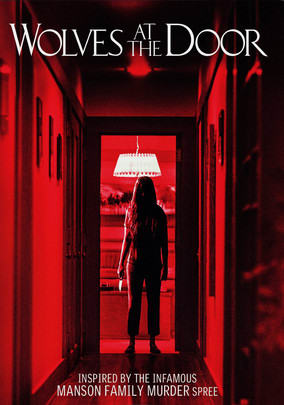
The TSL’s Horror Grindhouse: Wolves at the Door (dir by John Leonetti)


I’m really not sure what to make of Wolves at the Door.

I knew the film was inspired by the crimes of Charles Manson and his family before I watched the film.  Not only was Wolves at the Door specifically advertised as being “Inspired by The Infamous Manson Family Murder Spree” but just check out the plot description that was provided by Warner Bros:

Four friends gather at an elegant home during the Summer of Love, 1969. Unbeknownst to them, deadly visitors are waiting outside. What begins as a simple farewell party turns to a night of primal terror as the intruders stalk and torment the four, who struggle for their lives against what appears to be a senseless attack.

The Manson Family have inspired a countless number of films, so that’s not really an issue.  Almost all of those films either presented Manson and his followers as being the epitome of evil or they told stories that were heavily and obviously fictionalized.

Wolves at the Door, however, is different.  Other than in some news footage that is shown during the end credits, Manson is not seen in the film.  For that matter, the members of the Family don’t get much screen time either.  Mostly, they’re just seen as shadows, creeping down hallways and sometimes materializing in a doorway before vanishing.  There’s no mention of Helter Skelter or the Beatles.  I’d have to rewatch the film to say for sure but I think it’s possible that we only hear them say one or two words over the course of the entire movie.

Instead, Wolves at the Door spends most of its running time with the victims of the Manson Family, following them as they are unknowingly stalked inside of a Los Angeles mansion.  Usually, in a film like this, you would expect the names to be changed but, for some reason, that doesn’t happen in Wolves At The Door.

So, Katie Cassidy plays a pregnant actress who is named Sharon.

Elizabeth Henstridge plays a coffee heiress who is named Abigail.

Adam Campbell plays Abigail’s Polish boyfriend, who is named Wojciech.

Miles Fisher plays a hairdresser who is named Jay and who just happens to be Sharon’s ex-boyfriend.

And, finally, Lucas Adams plays a teenager stereo enthusiast named Steven, who just happens to be in the wrong place at the wrong time.

Speaking as someone who loves horror and who has defended some of the most critically derided films of all time, everything about Wolves at the Door just feels icky, tacky, and wrong.  Many grindhouse horror films have been inspired by actual crimes but most of them at least changed the names of the victims.   You really have to wonder just what exactly the filmmakers were thinking here.

(Then again, just two years ago, NBC greenlit a show called Aquarius, which could have just as easily been called “The Adventures of Young Charlie Manson.”)

It’s not just that Wolves at the Door is offensive.  In fact some of the best movies of all time were specifically designed to be offensive.  The problem with Wolves at the Door is that it’s also just a very shoddy film.  (In fact, if the film had been well-made, it wouldn’t be quite as offensive.)  Though the actors may be talented, they’re let down by a script that’s full of some of the clunkiest dialogue that I’ve ever heard.  Though the soundtrack may feature some good songs, they’re still the same damn songs that show up in every movie set in 1969.  (Judging from the movies, everyone in 1969 just listened to the same five songs over and over again.)  Though the movie itself is only 73 minutes long, it is so abysmally paced that it feels much, much longer.

Sadly, this film was directed by John Leonetti, who did a pretty good job with Annabelle.  Again, I’m not sure what exactly he or anyone else was thinking with Wolves at the Door, which I’m going to go ahead and declare to be the worst film of 2017.  I know that the year isn’t over yet but I just can’t imagine anything as bad as this.

6 Trailers For October 15th, Inspired by TCM Underground!


It’s time, once again, for another October edition of Lisa Marie’s Favorite Grindhouse and Exploitation Film trailers!

This week’s edition was inspired by watching TCM Underground last night.  In fact, the last two trailers features are for the two films that I watched.

  1. Abby (1974)

This film was also released under the title Black Exorcist.  Warner Bros. actually brought suit against Abby, claiming that it was such an obvious rip-off of The Exorcist that it should not be allowed to play in theaters.  Warner Bros. actually won their suit but not before Abby made a lot of money.

2. Sugar Hill (1974)

Sugar Hill is a popular film here at the Shattered Lens.  Check out the reviews from both Arleigh and Gary!  And be sure to watch the trailer.

3. Blackenstein (1973)

Blackenstein is one of those titles that sounds like it has to be a parody but no, it’s a real movie.  There’s even a trailer to prove it.

4. Dr. Black, Mr. Hyde (1976)

Again, the title might sound like a parody but this is a very real film and, from what I’ve read, apparently a rather highly-regarded one as well.  This is on my list of films to see, though I have a feeling that Gary will probably beat me to it.

5. Blacula (1972)

From William Crain, the director of Dr. Black and My Hyde

And starring William Marshall, the star of Abby

It’s Blacula!  This is the first film that I watched on TCM Underground and it’s a legitimate classic.  Check out Gary’s review here!  And watch the trailer below:

6. Scream, Blacula, Scream (1973)

Of course, any successful film is going to get an inferior sequel.  This was also the second movie that I watched on TCM Underground last night.


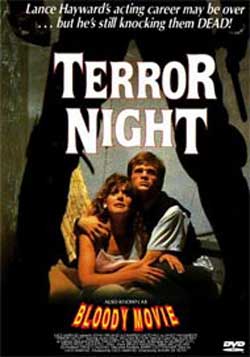
The TSL’s Horror Grindhouse: Terror Night, aka Bloody Movie (dir by Nick Marino)


Okay, so this is kind of a weird one.

The movie known as Bloody Movie was originally filmed in 1987, under the title Terror Night.  However, it was never released.  There are plenty of rumors about why it wasn’t released.  Some people say that it was because the film was produced with Mafia money.  Some people say it was because it used a lot of footage that was lifted from other movies and the producers apparently didn’t bother to clear the rights.  Of course, it’s also totally possible that the film wasn’t released because it wasn’t very good.  I mean, that does happen.

Regardless of why, the film apparently sat on the shelf for 20 years.  It was finally released by Fred Olen Ray’s Retromedia and retitled Bloody Movie.  That said, the DVD that I own (and watched for this review) was released by Legacy Entertainment and still had the Terror Night title.  The transfer on the Legacy DVD was notably bad.  From what I’ve been told, the Retromedia release looks a lot better.

Now, there’s a lot bad things that can be said about Terror Night.  It’s low-budget, which is one of those things that can be overcome by a clever director but, in this case, it just results in Terror Night looking cheap.  It’s poorly written, full of one-dimensional characters who were shallow even by the standards of a late 80s slasher.  This is also one of those movies where formerly respectable actors pop up for five minutes cameos.  Whenever one of those actors shows up, all the action stops so that they can earn their paycheck.  Aldo Ray is homeless and doomed.  Cameron Mitchell is a cynical cop and doomed.  Alan Hale, Jr. is an affable security guard and apparently not doomed.  There’s no real reason for any of them to be there but there they are!  There’s also a biker couple who show up for no particular reason, along with the typical collection of teenage victims.

But yet, there are moments when Terror Night goes from being bland to being almost transcendently odd..  There are moments of comedy mixed in with some surprisingly mean-spirited death scenes.  Necks are snapped.  Heads are chopped off.  Bodies are split in half.  It all gets rather messy and the presence of all those old time actors makes the sudden gore scenes feel all the more strange.

However, the main thing that distinguishes Terror Night from the other slashers of the era is the identity of the killer.  (And, before anyone yells at me, this is not a spoiler.  There is never any mystery about who the killer is.)  Lance Hayward is not a zombie like Jason Voorhees or a silent symbol of evil like Michael Myers.  He’s not seeking vengeance for some crime in the past.  Instead, he’s a former silent screen star.  (It seems like Hayward would have been close to 90 years old at the time of Terror Night.  He’s still surprisingly spry.)  Hayward commits his murders while wearing costumes from his old movies.  Adding to the strangeness of the whole scenario is that actual silent footage is spliced into the murder scenes.  Most of the footage comes from movies like The Thief of Baghdad, The Black Pirate, and the Gaucho.  You have to wonder if Douglas Fairbanks cheated the director’s father or something.

(Since Hayward spends most of the movie in costume, I’m assuming that he was mostly played by stuntmen.  When Hayward actually shows his face, he’s played by one-time Oscar nominee, John Ireland.  At the height of his career, Ireland co-starred in films like All The King’s Men.)

As to why a silent scream star would be murdering teenagers … well, your guess is as good as mine.  It’s a strange film, a mix of gore and nostalgia.  I wouldn’t necessarily recommend it but I still always appreciate anything this strange.

The TSL’s Horror Grindhouse: The Devil’s Nightmare (dir by Jean Brismée)


A 1971 Belgian-Italian co-production, The Devil’s Nightmare opens with a sepia-toned flashback to the closing days of World War II.  A child has been born to the Nazi general, Baron von Rohnberg (Jean Servais) but after the Baron learns that the baby is female, he orders that she be killed.  It’s a brutally effective little opening, all the more so because there is no greater evil than a Nazi with money and a title.  As with many European horror films, the crimes and sins of Hitler cast a shadow over every scene of The Devil’s Nightmare.

Years later, like many Nazi noblemen, the Baron remains free.  He lives in his isolated castle, occasionally letting tourists stay for the night while he practices his experiments in the basement.  A reporter comes by and pays a steep price for refusing the Baron’s orders not to take any pictures.  When her body is found, she has a hoof-shaped burn on her arm.  The sign of the devil, we are told.

Meanwhile, a bus takes a wrong turn and gets lost.  The tourists on the bus are a typical collection of Eurohorror types: the greedy woman, the bitter old businessman who loudly proclaims his atheism, the fighting husband and wife, and, of course, Alvin (Jacques Monseau), the seminarian.  The tourists meet a strange man (Daniel Emilfork) who directs them to the Baron’s castle, where they can stay until the ferry arrives the next day.

As the tourists explore the castle and get to know the Baron (who shares the story of how his family came to be cursed), a storm develops outside.  And, finally, one last guest arrives.  Her name is Lisa Muller (Erika Blanc) and, over the course of the night, everyone in the castle will be tempted.

The Devil’s Nightmare is a personal favorite of mine.  Now, I have to admit that, to a large extent, that’s because The Devil’s Nightmare is about a redhead named Lisa and I am a redhead named Lisa.  However, beyond that, The Devil’s Nightmare works surprisingly well.  What it may have lacked in a production budget, The Devil’s Nightmare makes up for atmosphere.  The castle is a wonderfully creepy location and, as played by Jean Servais, the Baron becomes a potent symbol of aristocratic decay.  Daniel Emilfork brings an eccentric flair to his role and, even if he is basically playing the movie’s most boring character, Jacques Monseau is sympathetic and believable as the upright seminarian.

That said, this film belongs to Erika Blanc, who basically grabs hold of the movie and then dares anyone to try to take it away from her.  Thoughout the film, Blanc shifts from elegant to evil and back again and she makes it all look not only easy but totally natural as well.

Finally, The Devil’s Nightmare ends with a twist that you’ll see coming from a mile away but that doesn’t make it any less satisfying.

The Devil’s Nightmare is one of those films that seems to have been included in almost every “Classics of Horror” box set that Mill Creek has ever released.  So, you probably have a copy even if you don’t realize it!  Track it down, turn off all the lights, and watch.