For today’s horror on television, we have a made-for-TV monster movie from 1972, Gargoyles!
What happens when a somewhat condescending anthropologist (Cornel Wilde) and his daughter (Jennifer Salt) head out to the desert? Well, they stop by a crazy old man’s shack so that they can look at his genuine monster skeleton. Before Wilde can thoroughly debunk the old man’s claims, the shack is attacked by real monsters!
That’s right! Gargoyles exist and they apparently live in Arizona! There’s nothing particularly surprising about the plot but the gargoyles are memorable creations and Bernie Casey gives a good performance as their leader. The gargoyle makeup was designed by none other than Stan Winston, who won an Emmy for his work here and who went on to win Oscars for his work on Aliens, Terminator 2, and Jurassic Park.
As well, a very young Scott Glenn shows up in the cast. I like to think that he’s playing the same character in both Gargoyles and Sucker Punch.
Welcome to Retro Television Reviews, a feature where we review some of our favorite and least favorite shows of the past! On Tuesdays, I will be reviewing the original Fantasy Island, which ran on ABC from 1977 to 1986. The entire show is currently streaming on Tubi!
This week, Fantasy Island is invaded by Nazis and Angels!
Episode 2.3 “Charlie’s Cherubs/Stalag 3”
(Dir by Cliff Bole, originally aired on December 9th, 1978)
Today’s episode begins with Mr. Roarke noticing that Tattoo is carrying a calculator with him.
“What is that, Tattoo?” he asks.
“A mini-computer,” Tattoo replies, “My cousin Igor sent it to me. Computers can take away a lot of guess work.”
Mr. Roarke, obviously thinking that these “computer” things are but a mere fad, replies, “So can bikinis. Let us meet our guests.”
This week, all of the guests have dangerous fantasies. For instance, Danny Ryan (Cornel Wilde) is a World War II veteran who has never really been able to make it in the post-War world. So, he invites three fellow vets to return with him to the French town in which they spent 1944. During the War, they were POWS at Stalag 3 but they were famous for continually outsmarting Commandant Horst Von Stern (Nehemiah Persoff). In fact, Von Stern’s career and reputation never really recovered from the time that Danny and his friends escaped. (I imagine that, after the war, Von Stern’s reputation was also damaged by the fact that he was a freaking Nazi commandant.) Not only has Mr. Roarke arranged for the old French village — complete with Fifi of the Resistance (played by Yvonne DeCarlo) — to be moved to Fantasy Island but he also brought over the old POW camp. Unfortunately, Von Stern decides to come over as well and get his revenge by tossing Danny and friends back in the camp.
“You see,” Von Stern announces, “generals have fantasies too.”
What the Hell is going on with this Island? Does Mr. Roarke just give anyone a fantasy, even a Nazi war criminal? Actually, it appears that Mr. Roarke doesn’t know that Von Stern has come to the Island nor does he know that there is a treasure of stolen diamonds hidden in the village. Apparently, Roarke decided to just let this fantasy run on autopilot without actually bothering to check in with what was going on.
Both Mr. Roarke and Tattoo are more concerned with the three secretaries (Melinda Naud, Brenda Benet, and Bond Gideon) who want to be Charlie’s Angels and solve a crime. The crime involves a theft on Fantasy Island and …. well, it’s really not much of a mystery. It’s basically a 20-minutes episode of Charlie’s Angels, with a bit less action but a lot more scenes of people saying stuff like, “He knows about electronics so he’s the thief!” It was really a weak fantasy, which is a shame because, if I ever went to Fantasy Island, I would probably want to be a detective as well!
The show ends with Von Stern being sent to Germany to be put on trial for war crimes and the Angels saying that they’re ready to be secretaries again. Roarke informs them that most angels fantasize about being secretaries. Uhmmm, Mr. Roarke …. the proper term is administrative professional. Everything appears to be wrapped up but, as the show ends, Tattoo announces that someone has stolen his mini-computer and Mr. Roarke laughs at his assistant’s misfortune. Perhaps Tattoo losing his most prized possession was Roarke’s fantasy.
This was a weird episode. Mr. Roarke might need to pay closer attention to what’s happening on his island!
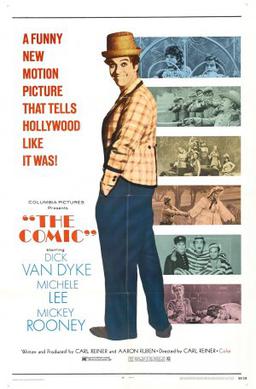
The 1969 film, The Comic, details the long and not particularly happy life of silent screen star Billy Bright (played by Dick Van Dyke). Billy Bright tells us his story from beyond the grave. The film opens with his funeral, which is sparsely attended and features the type of self-consciously mawkish eulogies that are usually trotted out whenever a generally unlikable person dies. The only sign of life at the funeral comes when Billy’s oldest friend, Cockeye (Mickey Rooney), throws a pie at one of the speakers. The speaker says that the pie was Billy’s final joke.
Billy Bright was a funny performer but a miserable man. That’s pretty much the entire plot of The Comic. We see the young Billy, performing in silent films and winning laughs through the seemingly impossible contortions through which he puts his body and his face. Off-screen, Billy marries one of his co-stars (Michele Lee) and starts a production company. When she discovers that he’s been cheating on her, their divorce is a major Hollywood scandal.
Even before the coming of the talkies, Billy struggles with alcohol. Once the talkies do come, his career is pretty much over. Billy became a star in silent films and he stubbornly wants to continue to make silent films, despite the fact that there’s no longer an audience for them. Billy quickly goes from being a star to being forgotten. He’s reduced to walking down Hollywood Boulevard with Cockeye and looking at the names under his feet. When he reaches his name, he discovers that someone has dropped their gum on it.
Billy finally does get his comeback in the late 60s but it’s not much of a comeback. He appears on a talk show and it’s hard not to cringe a little as the clearly infirm Billy duplicates some of his silent era pratfalls. He’s reduced to appearing in a rather awkward commercial for a laundry detergent called, I kid you not, White-ee. “That’s White-ee, baby!” his commercial co-star says after a freshly cleaned Billy emerges from a washing machine.
The idea that most funny performers are actually rather serious and depressing off-stage is certainly nothing new. Judd Apatow has basically built an entire career out of making films about how funny people are actually carrying around tons of emotional baggage. The thing distinguishes The Comic from so many other films about angsty comedians is that Billy Bright himself never seems to have a single moment of self-awareness. Usually, films about miserable celebrities will at least have one scene where the main character realizes that his misery is all his fault. Billy Bright is pretty much a jerk from the minute we meet him and he’s still a jerk when the film ends. He’s the type of guy who makes a big deal about picking up his son from school but who still manages to grab the wrong kid because it’s been so long since he’s spent any time with his family that he’s really not sure what his son looks like. Towards the end of the film, we see him watching one of his old films and what we notice is that he doesn’t seem amused at all. Is he thinking about how he lost it all or is it possible that this man who made millions laugh never really had much of sense of humor himself? The film leaves it to you to decide.
The Comic was written and directed by Carl Reiner, who undoubtedly knew quite a few Billy Brights in his life. As such, the film feels authentic in a way that a lot of other films about creative people do not. The Comic is a well-made film. It’s hard not to appreciate the film’s obviously affection for Old Hollywood. That said, Billy Bright is such an unpleasant character that I found the film difficult to enjoy. Van Dyke is genuinely funny whenever he’s doing Billy’s silent film shtick and he’s genuinely tiresome when Billy’s ego gets out of control. It’s a good performance as a generally unlikable character. How you react to The Comic will probably depend on how much sympathy you can summon up for a character who doesn’t really seem to deserve any.
For today’s horror on the lens, we have a made-for-TV monster movie from 1972, Gargoyles!
What happens when a somewhat condescending anthropologist (Cornel Wilde) and his daughter (Jennifer Salt) head out to the desert? Well, they stop by a crazy old man’s shack so that they can look at his genuine monster skeleton. Before Wilde can thoroughly debunk the old man’s claims, the shack is attacked by real monsters!
That’s right! Gargoyles exist and they apparently live in Arizona!
(And, hey, why wouldn’t gargoyles live in Arizona? I mean, they have to live somewhere, right? Real estate is not cheap.)
This film was introduced to me by TSL contributor and Late Night Movie Gang founder Patrick Smith and we had an absolute blast watching it. There’s nothing particularly surprising about the plot but the gargoyles are memorable creations and Bernie Casey gives a good performance as their leader. The gargoyle makeup was designed by none other than Stan Winston, who won an Emmy for his work here and who went on to win Oscars for his work on Aliens, Terminator 2, and Jurassic Park.
As well, a very young Scott Glenn shows up in the cast. I like to think that he’s playing the same character in both Gargoyles and Sucker Punch.
Listen, there’s a lot of things that can be said about the 1952 Best Picture winner, The Greatest Show on Earth. Not only was it one of three Cecil B, DeMille films to be nominated for best picture (along with 1934’s Cleopatra and 1956’s The Ten Commandments) but it was also the only one to win. It brought Cecil B. DeMille his first and only nomination for best director. (DeMille lost that directing Oscar to John Ford but he still took home an award, as the producer of The Greatest Show On Earth.) The Greatest Show on Earth not only featured Charlton Heston in his first starring role but, with a finale that featured everyone involved in the same spectacular train crash, it also set the standard for the countless disaster movies that would follow.
But, with all of that in mind, the main thing that you’ll remember about this movie is that Jimmy Stewart was Buttons the Clown.
Buttons is a beloved member of the Ringling Bros. and Barnum & Bailey’s Circus. He travels with the circus across the country, entertaining children and generally helping out wherever he can. Everyone loves Buttons, despite the fact that no one has ever seen him without his makeup. (That said, you only have to hear him speak to immediately recognize him as being played by Jimmy Stewart.) Not even the circus’s no-nonsense manager, Brad Braden (Charlton Heston, naturally), knows what Buttons actually looks like. Everyone assumes that Buttons is just a dedicated performer, a method clown.
However, it turns out that Buttons has a secret. Of course, nearly everyone at the circus has a secret but Buttons’s secret is a little bit more serious than just a love triangle or a case of professional jealousy. There’s a reason why Buttons is surprisingly good at providing first aid to the members of the circus. Before he was a clown, Buttons was a doctor. And, while he was a doctor, he killed his wife.
NO! NOT JIMMY STEWART!
In Buttons’s defense, it was a mercy killing and he feels really bad about it. That, of course, doesn’t matter to the FBI agent (Henry WIlcoxon) who suspects that the doctor may be hiding among the circus performers. At first, Buttons views that train crash as the perfect opportunity to escape but then he finds out that many of his fellow performers have been seriously injured. A doctor is needed. Perhaps even a doctor in clown makeup….
Even under all that makeup, Jimmy Stewart does a great job of bringing Buttons to life. Sometimes, we associate Stewart so much with his famous way of speaking that we overlook just what a good actor Jimmy Stewart actually was. Even before you discover why Buttons is running from the cops, Stewart does a good job of capturing the sadness and the regret that lies at the heart of Button. He’s truly a tragic clown.
Buttons’s status as a fugitive is just one of the many subplots to be found in The Greatest Show On Earth. There’s a lot of drama (not to mention parades and performances) to get through before that train crashes. Brad, for instance, is struggling to keep the circus from going bankrupt. Meanwhile, his girlfriend, Holly (Betty Hutton), is torn between him and the arrogant but charming Great Sebastian (Cornel Wilde). In fact, every woman in the circus — including Gloria Grahame and Dorothy Lamour — is in love with the Great Sebastian. Sebastian is a bit self-centered but he’s famous enough to ensure that the circus won’t have to be closed. Or, at least, he is until he’s injured in a trapeze accident. Will Sebastian ever perform again? Meanwhile, there’s a jealous elephant trainer named Klaus (Lyle Bettinger) and a crooked concessionaire named Harry (John Kellog). A local gangster, Mr. Henderson (Lawrence Tierney), is trying to muscle his way into the circus’s business. Is it any surprise that Brad always seems to be in something of a bad mood? He’s got a lot to deal with!
And yes, it’s all a bit overblown and a bit silly. And yes, the film really does feel like it was meant to be a commercial for Ringling Bros. And yet, in its way, the film definitely works. There’s a sincerity at the heart of the film, one that’s epitomized by Cecil B. DeMille’s opening narration. “”A fierce, primitive fighting force that smashes relentlessly forward against impossible odds: That is the circus — and this is the story of the biggest of the Big Tops — and of the men and women who fight to make it — The Greatest Show On Earth!” DeMille was 71 years old when he made The Greatest Show On Earth and he was coming to the end of a legendary filmmaking career. DeMille was one of the founders of the American film industry and you can argue that, if not for some of his silent spectacles, Hollywood would have always remained just a neglected suburb of Los Angeles. If anyone understood that importance of that old saying, “The show must go on!,” it was Cecil B. DeMille. And really, that’s what The Greatest Show On Earth is all about. It’s a tribute to the performers who refuse to give up. Love triangles? Fugitive clowns? Injured acrobats? Lawrence Tierney? No matter what, the show must go on!
The Greatest Show On Earth is often described as being one of the worst films to win the Academy Award for Best Picture. That has more to do with the quality of the films that it beat — High Noon, The Quiet Man, Moulin Rouge, and Ivanhoe — than the film itself. The Greatest Show On Earth is old-fashioned and a bit silly but it’s still entertaining. Should it have beaten High Noon? That would be a definite no. But it’s still better than Crash.
(ATTENTION: There’s a surprise waiting for you at the end of this post, so read on…)
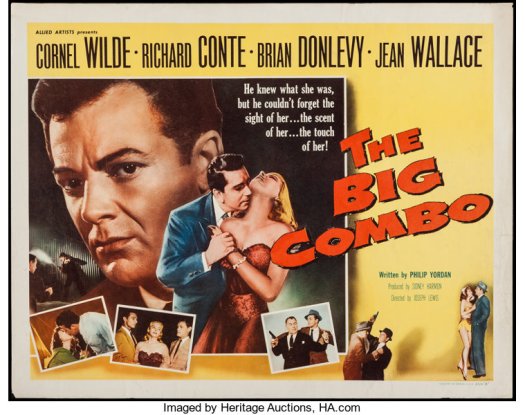
Joseph H. Lewis started his directing career with low-budget Westerns starring singing cowboy Bob Baker and East Side Kids programmers, and ended it back on the range doing epsiodes of THE RIFLEMAN, GUNSMOKE, and THE BIG VALLEY. In between, he created some of the finest films noir the genre has to offer: MY NAME IS JULIA ROSS , SO DARK THE NIGHT, THE UNDERCOVER MAN, and especially GUN CRAZY . His last big screen noir outing is the culmination of his work in the genre, 1955’s THE BIG COMBO.
The plot is fairly simple: Police Lt. Leonard Diamond is out to crack gangster Mr. Brown’s “combination”, which controls crime in the city. But Philip Yordan’s screenplay takes that plot and adds exciting twists and turns, indelible characters, and a level of violence audiences weren’t…
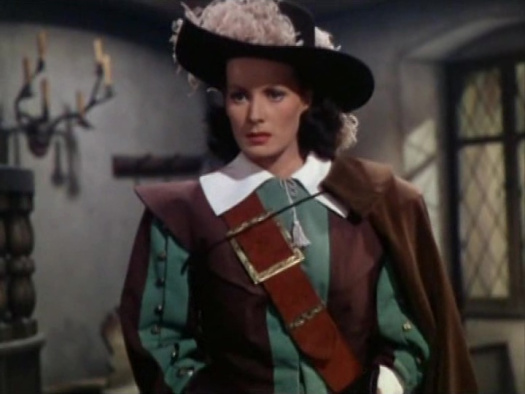
France in 1648 is in upheaval: Cardinal Richelieu has passed away, the Queen is ill, and evil Duc de Lavelle is plotting to usurp the crown by forcing a marriage to Princess Henriette and murder young Prince Louis. The Queen summons the only persons that can help: her trusted Musketeers! But the quartet have either grown old or died, and in their stead come their equal-to-the-task children, Cornel Wilde (D’Artagnon Jr.), Dan O’Herlihy (Aramis Jr.), Alan Hale Jr (Porthos Jr.), and – Maureen O’Hara , daughter of Athos!!
AT SWORD’S PONT isn’t a great movie, but it is a fairly entertaining one, with lots of flashing swordplay, leaping about, cliffhanging perils, and narrow escapes. It kind of plays like a Saturday matinee serial, and there’s a lot of fun to be had, with Cornel Wilde a dashing D’Artagnon Jr, O’Herlihy a competent second fiddle, and Hale doing his usual good-natured…
For today’s horror on the lens, we have a made-for-TV monster movie from 1972, Gargoyles!
What happens when a somewhat condescending anthropologist (Cornel Wilde) and his daughter (Jennifer Salt) head out to the desert? Well, they stop by a crazy old man’s shack so that they can look at his genuine monster skeleton. Before Wilde can thoroughly debunk the old man’s claims, the shack is attacked by real monsters!
That’s right! Gargoyles exist and they apparently live in Arizona!
This film was introduced to me by TSL contributor and Late Night Movie Gang founder Patrick Smith and we had an absolute blast watching it. There’s nothing particularly surprising about the plot but the gargoyles are memorable creations and Bernie Casey gives a good performance as their leader. The gargoyle makeup was designed by none other than Stan Winston, who won an Emmy for his work here and who went on to win Oscars for his work on Aliens, Terminator 2, and Jurassic Park.
As well, a very young Scott Glenn shows up in the cast. I like to think that he’s playing the same character in both Gargoyles and Sucker Punch.





 Through the Shattered Lens