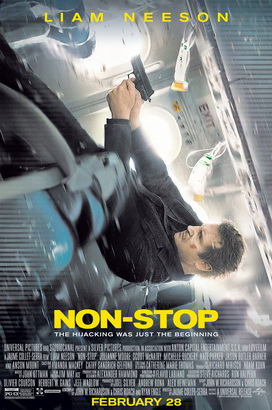
A Late Film Review: Non-Stop (dir by Jaume Collet-Serra)


NST_31_5_Promo_4C_4F.indd

With 2014 rapidly coming to a close, I am currently trying to get caught up on some of the movies that I either missed seeing or did not get a chance to review earlier this year.  After all, in just another month and a half, it’ll be time for me to make out my “Best Of the Year List” and I want to have as many options as possible.

With that in mind, I just finished watching Liam Neeson in Non-Stop, an action-suspense film that came out way back in February.

In Non-Stop, Liam Neeson plays Bill Marks.  It’s interesting to note that Bill Marks has the same initials as Bryan Mills, the very specifically trained CIA agent that Neeson plays in the Taken films.  And really, Bill Marks might as well Bryan Mills because Neeson pretty much gives the exact same performance in Non-Stop that he previously gave in Taken.  That’s not necessarily a criticism.  There’s a reason why Liam keeps getting cast in these type of roles.  He’s good at them.

In fact, I would say that Liam Neeson is one of the few action stars who I can imagine actually killing someone in real life (though only if he had to).  He has a rugged, world-weary cynicism about him.  You look into the eyes of a character played by Liam Neeson and you realize that he’s had to do things that you probably don’t want to know anything about.  At the same time, Neeson also projects a certain old-fashioned decency as well.  He’s the epitome of a decent man forced to use bad methods for the good of us all.

As for Non-Stop, I imagine it was probably pitched as being “Taken on a plane.”  Bill Marks is an air marshal who is on board a non-stop flight from New York to London.  Shortly after the plane takes off, he starts to receive mysterious text messages telling him that, unless he arranges for a 150 million dollar ransom to be paid into a specific bank account, someone on the plane will die every 20 minutes.  While Bill tries to discover who is sending him the text messages and various people on the plane die, the authorities on the ground are convinced that Bill is hijacking the plane.  Why?  Well, mostly because the bank account is in Bill’s name…

That’s right!  Somebody’s trying to frame Bill Marks!  Can Bill — with the help of a passenger played by Julianne Moore — figure out who is trying to frame him and why?  I have to admit that there was a part of me that was hoping that it would turn out that Bill really was the mastermind behind the whole scheme but instead, the movie offers up a solution that is even more ludicrous and illogical.  Naturally, there’s a twist.  The hijacking is not what it originally appears to be.  Perhaps if Non-Stop itself was more fun, the total implausibility of the twist wouldn’t bother me.

Director Juame Collet-Serra (who previously directed Neeson in Unknown) manages a few good action sequence but, ultimately, Non-Stop is really saved only be the presence of Liam Neeson.  Regardless of how implausible or silly the film may get, Neeson always brings a lot of authority to his role.  He’s never more convincing than when he’s walking up and down the aisles, glaring at the passengers and barking out orders.

It’s the type of performance that leaves us assured that the world will be safe as long as Liam Neeson is around to kill people.

Liam Neeson, about to kill someone

Liam Neeson, about to kill someone

Trailer: The Bourne Legacy


When Paul Greengrass completed The Bourne Ultimatum it looked like a perfect ending to the Bourne Series. Despite an ending that could be seen as a way to leave the door open to continue the series most people were content with the series ending as trilogy. That sort of thinking never enters the mind of studio executives who saw the success of this particular trilogy as still bankable even if it meant the filmmaker (Greengrass) and the series’ lead star (Matt Damon) weren’t going to participate.

What we ended up getting was a new lead in Jeremy Renner as another Treadstone-like agent, but one who didn’t have all the glitches that Jason Bourne had. Let’s just say that Renner’s character Aaron Cross would be Jason Bourne 2.0. I wasn’t convinced that a Bourne film minus Greengrass and Damon would work, but after seeing this latest official trailer from Universal Pictures I’m quite excited about this latest film.

With the success of The Avengers and Mission Impossible: Ghost Protocol where Renner had substantial roles in it looks like this latest film in the series could get a nice uptick in the amount of interest it gets from the public. The sort of action Renner’s character goes through in this film one could easily call this Hawkeye: The Early Years. All his character would need would be a nice hi-tech bow.

The Bourne Legacy is set for an August 17, 2012 release date.

Film Review: Midnight in Paris (dir. by Woody Allen)


Woody Allen’s latest film, Midnight in Paris, has an appealing premise behind it. 

Gil (Owen Wilson) is a Hollywood screenwriter who has come to Paris with his shallow fiancée Inez (Rachel McAdams) and her stuffy Republican parents (played by Kurt Fuller and Mimi Kennedy).  Disillusioned with American culture, Gil idealizes the Paris of the 1920s, the Paris that was home to Ernest Hemingway, F. Scott Fitzgerald, and James Joyce.  However, Inez and her parents are far less impressed with Paris and, as quickly become clear, with Gil himself.  While Inez spends her time with self-important “intellectual” Paul (a bearded Michael Sheen), Gil takes to wandering the streets of Paris at night.

One night, as Gil wanders around Paris, a vintage car approaches out of the shadows and the two well-dressed passengers in the back seat invite Gil to join them.  Gil does so and discovers that he’s been transported back to 1920s Paris.  He meets everyone from Hemingway (Corey Stoll) to Salvador Dali (Adrien Brody) to F. Scott and Zelda Fitzgerald (Tom Hiddleston and Alison Pill).  At the end of the night, Gil finds himself transported back to modern-day Paris.  Soon, Gil finds himself sneaking out at midnight every night so he can escape to the past, where he eventually meets and starts to romance an idealistic model named Adrianna (Marion Cotillard).  While Gil finds himself torn between his modern life and the past that he loves, he also begins to discover that the inhabitants of the 20s feel the same way about their present as he does about his.

The premise of the film itself is likable and one that I think anyone can relate to.  Who doesn’t wish that they could go back in the past and live with all the amazing people who they’ve only read about?  Myself, there are many eras that I often fantasize about finding myself in.  1920s Paris is definitely one of them but I’ve also occasionally dreamed of being in 1950s New York, having a threesome with Kerouac and Cassady or maybe being in Paris during the early days of the French new wave, appearing in movies directed by Rollin, Truffaut and Godard.  Ever since I read Peter Biskind’s Easy Riders and Raging Bulls, there’s been a part of me that wishes so much I could have been out in Hollywood or New York in the 1970s, hanging out on the beach with directors like Martin Scorsese, William Freidkin, Jon Milius, and even Peter Bogdonavich.  (But especially Freidkin, his terrible charisma just radiates from the page.) 

Still, Allen is smart enough as a screenwriter to know that everyone tends to idealizes the past, even those who we now idealize in the present.  Perhaps my favorite part of the film came when Wilson, while in the 1920s, sees a character getting into a horse-drawn carriage so that she can go back to the time that she idealizes as fiercely as he idealizes the 20s.

Midnight in Paris has a lot to recommend it.  Cotillard, despite the fact that she’s played the same idealized French mystery woman about a thousand times, gives a likeable performance and Rachel McAdams is hilariously shallow.  Michael Sheen, as well, makes a perfect stand-in for every pompous, self-important jerk who has ever talked down to you.  On the basis of his cameo appearance here as Dali, Adrien Brody really needs to consider doing more comedy.  He’s a lot more appealing when he’s being funny than when he’s trying to be a leading man.

At the same time, I have to admit that I wanted to like Midnight in Paris more than I actually did.  I like Owen Wilson as both an actor and a writer but he’s a little bit miscast here and the end result is that he occasionally seems like he’s trying too hard.  You just never buy him and McAdams as a couple and, as such, there’s really not much at stake as far as his romance with Cotillard is concerned. 

As well, I found it hard not to be a little bit disappointed with the way Allen presented 1920s Paris.  Though they were all well-cast and acted, Hemingway, the Fitzgeralds, Gertrude Stein (Kathy Bates), and all the rest just fell flat as actual characters.  Gil gets a chance to go into the past and essentially, he discovers that Hemingway was macho, the Fitzgeralds were neurotic and self-destructive, and that Dali didn’t make much sense.  Personally, I would be a bit let down if I got a chance to meet these icons and I discovered that essentially they just acted the exact same way that they acted in various PBS educational programs.

Despite this, Midnight in Paris is still a likable, frequently engaging comedy that works best as a tribute to a legendary and beautiful city that Allen (not to mention myself) obviously loves.  Flaws and all, this movie made me want to visit Paris once again (though Florence and Venice remains my favorite cities of all time) and, for that reason alone, it makes Midnight in Paris a film worth seeing.