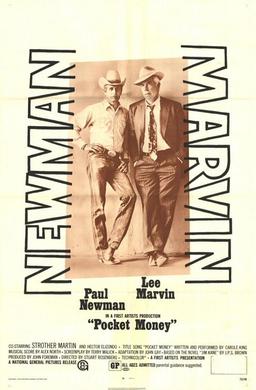
In this slow but amiable film, Paul Newman plays Jim Kane. Kane is a down-on-his luck cowboy who finds himself in Arizona with nearly a dollar to his name. Because Kane’s a likable sort, he has people who are willing to help him out but eventually, he finds himself with no choice but to accept a job offer from Stretch Russell (Wayne Rogers) and shady rancher Bill Garrett (Strother Martin). Kane agrees to Mexico to round up a heard of cattle. Helping Kane out on the job is an old friend by the name of Leonard (Lee Marvin).
Pocket Money was the last script to be written by Terrence Malick before Malick began his own directing career and the script’s dialogue shows off Malick’s skill at capturing the unique dialect and sound of the Southwest. It’s an episodic film, where the emphasis is more on the journey than the destination and it could be argued that the movie never really reaches its destination. The plot is far less important than the way Kane and Leonard talk to each other and view the world around them. Pocket Money is not for everyone. It’s the type of movie that will inspire some to complain that nothing really happens. For fans of Newman and Marvin, though, there’s a lot of enjoyment to be found. Newman and Marvin reportedly did not get along during shooting but that didn’t do a thing to harm their chemistry in their scenes together. This film reunites Paul Newman with Cool Hand Luke director Stuart Rosenberg and and also with two co-stars from that film, Strother Martin and Wayne Rogers. Newman gives a relaxed and likable performance. Lee Marvin gets to show his skill with comedy. If you’ve ever wanted to see Lee Marvin ride a horse while wearing a suit, this is the film for you.
Pocket Money was the first film to be produced by First Artists, a production company that was started by Paul Newman, Sidney Poitier, Barbra Streisand, Steve McQueen, and Dustin Hoffman. The company closed its doors in 1980 but not before giving the world not just this movie but also The Getaway, Straight Time, The Gauntlet, An Enemy of the People (starring Steve McQueen), The Life and Times of Judge Roy Bean, and The Gumball Rally, amongst others.
Welcome to Retro Television Reviews, a feature where we review some of our favorite and least favorite shows of the past! On Tuesdays, I will be reviewing the original Fantasy Island, which ran on ABC from 1977 to 1984. Unfortunately, the show has been removed from most streaming sites. Fortunately, I’ve got nearly every episode on my DVR.
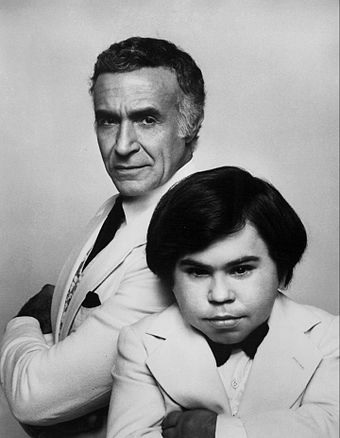
The Island just hasn’t been the same without Tattoo.
Episode 7.12 “The High Cost Of Loving/To Fly With Eagles”
(Dir by Jerome Courtland, originally aired on January 21st, 1984)
Craig Bradshaw (Doug McClure) is an aging pilot and daredevil who comes to the Island because he wants to compete in one final competition before he gets too old to keep going up in the air. His girlfriend (Christine Belford) doesn’t want him to keep risking his life. In the end, Craig finally comes to peace with the idea of getting older and he also gets engaged.
This fantasy felt pretty familiar. A lot of people have come to the Island over the years with the hope of winning one final competition. Actually, that’s probably one of the more realistic recurring fantasies that this show employs. Who wouldn’t want one last chance to win? If I went to Fantasy Island, I’d probably want to return to my high school years and compete in another speech and debate or drama competition. As for this specific fantasy, it’s always difficult for me to take Doug McClure seriously and this episode was no different.
As for the other fantasy …. yeesh! Lynn Redgrave plays Kristen Robbins, a former advertising exec who was fired when she refused her boss’s sexual advances. Instead of suing the guy, Kristen comes to Fantasy Island and tells Mr. Roarke that her fantasy is to fall in love and get married and start a family because that means she will never be sexually harassed again. (For a 40-something veteran of the advertising world, Kristen is incredibly naive.)
Kristen meets Paul Horner (Alex Cord) and it’s love at first sight. Paul is actually on the Island to interview Kristen for a job with his firm but instead, they have a night of passion. The next morning, Paul tells Kristen that, before they had sex, he recommended her for a job in which she would be working with him in Hawaii!
Kristen asks Roarke to change her fantasy. She now wants to get that job and work in Hawaii. Roarke reluctantly agrees. Kristen does get the job but the company decides that Kristen will be their sole representative in Hawaii and Paul will remain in New York. Kristen asks Mr. Roarke to change her fantasy once again. She doesn’t want the job, she just wants Paul. (Keep in mind that she’s known for Paul for one day.) Paul overhears and pretends to be a cad so that Kristen will take the job.
Now convinced that Paul is a compulsive womanizer, Kristen tells Roarke to change her fantasy back to taking the job. Roarke tells Kristen she needs to make up her own damn mind and then tells her that Paul was only pretending to be a womanizing jerk. In the end, Kristen decides to take the job and marry Paul. Paul decides to continue working in New York. As they leave the Island, they assure Mr. Roarke that they’ll make it work.
Yeah, good luck with that.
This fantasy irked me. Kristen lost her job because she refuses to sleep with her boss. I would rather have seen her get a revenge fantasy than a love fantasy. At the very least, Roarke could have introduced her to a good lawyer. Instead, we got a fantasy in which the main theme was that women are irresponsible and can’t make up their own mind.
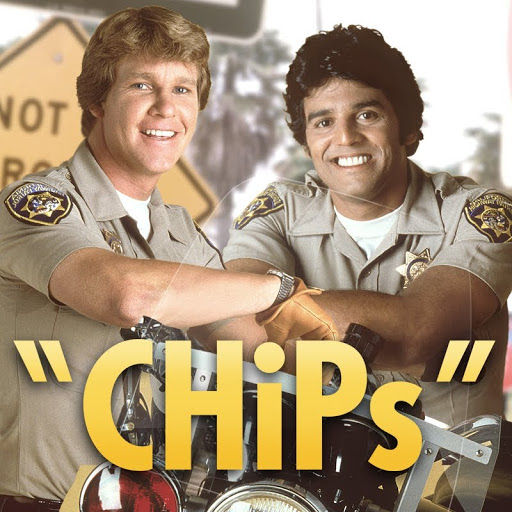
Welcome to Late Night Retro Television Reviews, a feature where we review some of our favorite and least favorite shows of the past! On Mondays, I will be reviewing CHiPs, which ran on NBC from 1977 to 1983. The entire show is currently streaming on Prime!
This week, not Ponch can smile his way out of the darkness.
Episode 4.8 “Wheels of Justice”
(Dir by Gordon Hessler, originally aired on December 21st, 1980)
The streets of Los Angeles are dangerous in this week’s episode.
Stan West (Basil Hoffman) is a reckless driver who is constantly causing accidents by driving too fast and making unsafe lane changes. He gets away with it because he keeps changing his name.
Arthur Holmes (Joshua Bryant) is a drunk who Jon and Ponch have pulled over several times. Arthur gets away with it by claiming, after every accident, that his wife was the one driving, Denise (Christine Belford) goes along with it, even though she hates the fact that she’s enabling her husband.
A group of cheerleaders drive around and do their cheers while driving!
Finally, a gas leak at the hospital leads to all the newborn babies being loaded into an ambulance for transport. When the ambulance is side-swiped by Stan, the babies end up at the station. Getraer gives everyone a lesson on how to properly soothe a crying baby. It’s cute but it’s also so manipulative that it leaves you feeling oddly used. But, hey, at least it’s cute!
This episode of CHiPs took a serious turn towards the end when the drunk driver swerved to avoid the cheerleaders and the end result is that his wife was thrown from the car and killed. When the car was shown crashing in slow motion, the wife’s mannequin actually fell out of the car. While I imagine that was probably not planned, it still created a memorably macabre image. In the end, Arthur ends up sobbing while Denise lies dead just a few feet away from him. That’s a pretty dark ending for an episode of CHiPs. Not even a quick scene of the officers holding the babies could change the fact that this was a really downbeat episode.
And you know what? There’s nothing wrong with that. Driving drunk is selfish, stupid, and dangerous and CHiPs deserves some credit for not holding back.
Welcome to Retro Television Reviews, a feature where we review some of our favorite and least favorite shows of the past! On Tuesdays, I will be reviewing the original Fantasy Island, which ran on ABC from 1977 to 1984. Unfortunately, the show has been removed from most streaming sites. Fortunately, I’ve got nearly every episode on my DVR.
This week epitomizes an era!
Episode 6.14 “Revenge of the Forgotten/Charo”
(Dir by Phillip Leacock, originally aired on February 19th, 1983)
Just the fact that one of this week’s fantasies is actually entitled “Charo” should tell you all you need to know about it. Charo plays Maria Diaz (her full name is much longer), who has come to Fantasy Island to meet her father. Charles Woodruff (Van Johnson) didn’t even know that he had a daughter but he takes the news surprisingly well.
The interesting thing about this fantasy is that Charles Woodruff is an American diplomat, who has a home in both New York City and Fantasy Island. As Fantasy Island has previously been established as being its own nation, you do have to wonder if perhaps Charles Woodruff is America’s ambassador to Fantasy Island. A large part of the fantasy involves him hosting a dinner for several other diplomats so I guess it’s possible that every country sends an ambassador to Fantasy Island. Perhaps Fantasy Island even sends a delegate to the United Nations. Maybe that would explain where Tattoo was during all of those season 5 episodes where Julie was suddenly Roarke’s sidekick. For that matter, maybe that’s where Julie is now. The show never has really explained what happened to her.
Anyway, how much you like this fantasy will depend on how much you like Charo. She is someone who definitely epitomizes an era and, of course, the same can be said of both The Love Boat and FantasyIsland. It’s interesting that, over the years, there have been multiple attempts to reboot both of those series and they’ve never really worked, largely because a good deal of the appeal of LoveBoat and FantasyIsland is how much they really are a product of the 70s and 80s. Attempting to update them for the modern era tends to negate everything that make both of the shows so entertaining to watch today.
(The latest Fox update of FantasyIsland had a lot of gorgeous scenery but it got bogged down in all of its attempts to world build. It’s fun to speculate about how the Island works. It’s less fun to actually have the show explain it to us.)
As for the other fantasy, it involves Marjoe Gortner! As usual, Marjoe’s playing a villain. He’s cast as Loren Robertson, who framed Alan Daly (Steve Kanaly) for a crime that he didn’t commit and then tricked Alan’s girlfriend, Marion (Christine Belford), into marrying him. Recently released from prison, Alan comes to Fantasy Island to track down a fabled treasure that Alan believes he can use to restart his life. With the help of Tattoo (who dresses up like Indiana Jones), Alan finds the treasure but, when he sees Loren and Marion on the Island, Alan gets distracted by his desire for revenge.
This story was a bit of an odd one. Alan’s fantasy was to find the treasure and, after he found it, Roarke was like, “So, I guess you’ll be leaving now.” Instead, Alan decides to spend a full weekend on the Island to try to get revenge. I’ve never seen Roarke try to get a guest to leave early before but it’s even more strange to be reminded that somehow all of these fantasies occur over the course of one weekend. Some episodes have seemed like a bit much for just two or three days.
Despite the fact that this episode originally aired in 1983, it doesn’t get more 70s than Charo and Marjoe! Charo was her usual self. Marjoe was a great villain as always. This was an enjoyable trip to the Island.
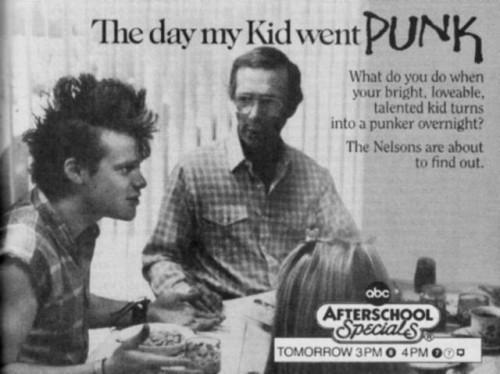
First produced in 1987, the short film The Day My Kid Went Punk tells the story of Terry Warner (Jay Underwood), a clean-cut teenager and aspiring violinist who lands a summer job working as a daycare counselor at a luxury hotel.
Feeling that he’s been neglected in favor of his high achieving older brother and his younger sister, Terry acts like a typical middle child and decides to change his image right after leaving home for his job. (It worked for Jan Brady!) He decides to become a punk. (Jan Brady never went that far.) Could this have something to do with his mother (Christine Belford) being the nation’s leading expert on the “Punk Syndrome,” that is terrifying parents everywhere? Or could it just be because Terry knows that he’ll never be as cool as his father (Bernie Kopell), who might claim to be named Tom Warner but who is obviously just Adam Bricker living in the suburbs? Every time Tom looks at his “punk” son, you can just see him dreading the thought of word of this getting back to Captain Stubing.
(Incidentally, the family in film is clearly named Warner but, in all of the advertisements that I’ve seen for this special, including the one at the top of the post, they’re identified as being the Nelson family.)
Needless to say, Terry Warner is, in no way, a convincing punk and judging from the film’s dialogue and plot, it would appear that the film doesn’t really know the difference between punk, goth, and heavy metal. Everyone at the hotel is a bit taken aback by Terry’s appearance but he proves himself to be a good worker and the kids absolutely love riding horses with him. I guess the message is that you shouldn’t judge someone based solely on how he looks. That’s a good message except that it’s ultimately undercut by Terry himself and his decision abandon his punk look as soon as it inconveniences him at school. So, I guess the message is that teens should dress the way they want unless it keeps them from winning first chair in the school band and parents shouldn’t worry because teenagers are so shallow that they’ll abandon anything after a month or two. The film suggests that Punk is less of a syndrome and more of a fad that whiny middle children go through during the summer.
(Myself, I’m not a middle child. I’m the youngest of four and I’ve never felt particularly ignored, even if there were times when it seemed like being left alone would be a nice change of pace. That said, I definitely went through some phases while I was growing up. During my junior and senior years of high school, I always made sure that I was wearing at least one black garment and I wrote emo poetry under the name Pandora DeSaad.)
Anyway, Halloween’s approaching and this very (and I do mean very) campy short film feels like a good way to welcome a month that encourages everyone, young and old, to think about putting on costumes. Here is The Day My Kid Went Punk!
During the late 1970s and early 1980s, one could hardly step into a theater during the fall or winter movie season without seeing a trailer for the newest Stephen King adaptation. His name had become synonymous with cinematic horror, and nearly every year brought a new film promising supernatural terror or psychological unease.
Among this wave of adaptations came a 1983 film that united two masters of the genre—Stephen King, the reigning literary giant of horror, and John Carpenter, the filmmaker who had already cemented his reputation with Halloween and The Thing. Their collaboration resulted in the sleek, deadly story of a boy and his car: Christine.
The film opens on the assembly line of a Plymouth factory in 1957, immediately signaling that something is off about this particular 1958 Plymouth Fury. From the first note of the retro rock soundtrack to the gleam of that deep crimson paint, Carpenter frames the car with both nostalgia and menace. The lighting in this opening feels almost clinical—bright, sterile, mechanical—yet Christine’s red sheen cuts violently through it, a visual omen that this machine is infused with something beyond metal and chrome. Carpenter wastes no time making it clear that this car is not an inanimate prop; it’s a living entity from the moment it’s born.
We’re soon introduced to the film’s human core—Arnie Cunningham (Keith Gordon), a shy, bookish teenager tormented by bullies and smothered by his controlling parents, and his best friend Dennis Guilder (John Stockwell), the confident star athlete who often looks out for him. One afternoon, during their drive home from school, Arnie spots a rusting, decrepit Plymouth Fury in the front yard of an old man named Roland D. LeBay. Where Dennis sees a heap of junk, Arnie sees perfection. Ignoring his friend’s concerns—and later, his parents’ outrage—Arnie buys the car and names it Christine.
As Arnie begins restoring Christine to her former glory, a transformation occurs—not just in the car, but in Arnie himself. The once timid, acne-scarred teenager grows into a confident, even arrogant young man, donning slicker clothes, sharper speech, and a darker aura. Christine becomes his obsession, his refuge, and ultimately, his identity.
Carpenter crafts this metamorphosis with eerie precision, pairing the car’s physical renewal with Arnie’s psychological decay. The cinematography shifts accordingly—the lighting grows darker, drenched in neon reds and shadowy blues, mirroring Christine’s two faces: seductive allure and demonic possession. Carpenter’s score, a pulsing blend of electronic rhythm and minimalistic dread, underscores these shifts. It functions almost like Christine’s heartbeat—steady, mechanical, and ominously sensual.
Between the vintage rock tracks that accompany Arnie’s moments of infatuation and the electronic motifs that follow Christine’s predatory stalks, Carpenter manipulates sound to blur the lines between teenage romance and supernatural horror. Every rev of the engine feels rhythmic, almost musical, as if the car itself communicates through vibration and tone rather than words.
Arnie’s newfound confidence even earns him Leigh Cabot (Alexandra Paul), the most desired girl in school—a relationship that initially feels like a symbol of his triumph. But Christine is no fairy tale. When Arnie’s bullies vandalize his beloved car, the story turns from eerie to vengeful.
In a now-iconic sequence, Christine repairs herself before Arnie’s stunned eyes—the crumpled metal expands, glass re-forms, headlights ignite like eyes opening from a nightmare. Carpenter lights the scene with a soft, golden underglow that turns mechanical resurrection into a hauntingly beautiful transformation. It’s both horrifying and hypnotic—a perfectly scored ballet of vengeance set to the hum of machinery and the director’s unmistakable electronic pulse.
What follows is a furious killing spree. Christine prowls the night streets for retribution, a creature of fire and gasoline more alive than metal should ever be.
While Carpenter’s adaptation diverges from King’s novel, it remains faithful to its emotional and thematic essence. King’s book delves deeply into the idea of objects absorbing the evil of their owners, suggesting that malevolence can linger in things as much as in people. Carpenter, however, turns the focus inward.
His version becomes a tragic character study—a battle for Arnie’s soul between the cold, seductive power of obsession and the fragile warmth of human connection. In one corner stands Christine, the car that offers Arnie unconditional love but demands total possession. In the other are Dennis and Leigh, desperate to save the friend they’re rapidly losing to something they can’t fully understand.
Carpenter’s signature touches—his electronic score, minimalist framing, and cynical tone—imbue the film with a dark romanticism. Christine is less a haunted object than a femme fatale: a mechanized embodiment of jealousy and desire. The film’s atmosphere bridges two eras, combining the nostalgic vibe of 1950s Americana with the grim realism of Reagan-era suburbia.
By the end, Christine becomes both a story of supernatural obsession and a commentary on teenage identity—the hunger to shed weakness, to command respect, and to control one’s fate, even at the cost of one’s soul.
Upon its release in December 1983, Christine performed modestly at the box office but was far from a failure. Over time, it has developed a strong cult following, cherished by both Carpenter devotees and Stephen King fans. Though often overshadowed by Carpenter’s heavier-hitting works like The Thing or Escape from New York, Christine remains one of his most technically polished films. It also stands as a fascinating bridge between studio horror and Carpenter’s independent sensibilities—where the shine of a Hollywood production mingles with the grit of a B-movie heart.
If Christine teaches any lesson, it’s that love and possession are two sides of the same coin. Arnie’s tragedy lies not in falling for the wrong woman, but in falling for one that burns with literal hellfire. In Carpenter’s vision, the road to damnation isn’t paved with good intentions—it’s lined with chrome, lit by headlights, and always hungry for one more ride.
 In this slow but amiable film, Paul Newman plays Jim Kane. Kane is a down-on-his luck cowboy who finds himself in Arizona with nearly a dollar to his name. Because Kane’s a likable sort, he has people who are willing to help him out but eventually, he finds himself with no choice but to accept a job offer from Stretch Russell (Wayne Rogers) and shady rancher Bill Garrett (Strother Martin). Kane agrees to Mexico to round up a heard of cattle. Helping Kane out on the job is an old friend by the name of Leonard (Lee Marvin).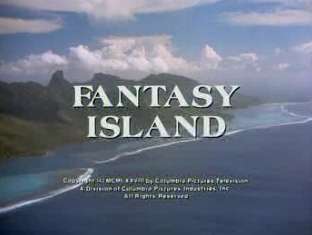

 Through the Shattered Lens