The best thing about The Valachi Papers is this:
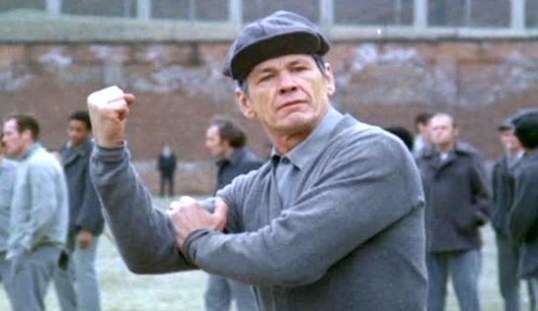
That is Charles Bronson, playing real-life mob informant Joe Valachi and making a gesture that expresses the way many people feel about the world right now. Valachi, in both the film and real life, was a bit player in the Cosa Nostra, a driver and an occasional hitman who was lucky enough to marry the daughter (played by Bronson’s real-life wife, Jill Ireland) of one of the bosses. In prison for smuggling heroin, Valachi runs into one of those bosses, Vito Genovese (Lino Ventura). Genovese, convinced that Valachi has broken the code of omerta, gives Valachi the kiss of death. Valachi kisses him right back and then becomes a rat.
Valachi’s 1963 testimony to the U.S. Senate was the public’s first glimpse into life in the Mafia. Many of the cliches that have since appeared in every mob movie or television show were the result of Valachi’s testimony and Peter Maas’s subsequent book, The Valachi Papers. (In the “Test Dream” episode of The Sopranos, Tony can be seen holding a copy of The Valachi Papers.)
Over the years, doubts have been raised about both the validity of Valachi’s testimony and his claim that he only turned rat because Genovese put a contract on his life. The film version of The Valachi Papers takes Valachi’s claims at face value, telling Valachi’s story in a series of flashbacks.
The Valachi Papers is often compared to another mob movie that came out in 1972, The Godfather, though there’s really not much of a comparison to be made. Whereas The Godfather was a family saga, The Valachi Papers is much more concerned with the day-to-day operations of the Mafia. It never comes close to matching The Godfather‘s epic feel and the cheap production values don’t help. (Keep an eye out for the twin towers of the World Trade Center, anachronistically towering over depression-era New York City.)
Storywise, The Valachi Papers actually has more in common with Goodfellas than with The Godfather. Like Henry Hill, Joe Valachi is not a major player. He’s just a working man whose employer happens to be the Mafia. Stylistically, of course, The Valachi Papers has nothing in common with Goodfellas. If not for the violence and some the language, it would be easy to mistake The Valachi Papers for an old made-for-TV movie.
The best thing about The Valachi Papers is Charles Bronson as Joe Valachi. When The Valachi Papers was made, Bronson was a huge draw in Europe but was still largely unknown in the United States. It was not until Death Wish came out, two years later, that Bronson became a star. He does a good job as Joe Valachi. In a way, it’s the perfect role for Bronson, who was a genuine tough guy who, like Valachi, spent decades working in the trenches before eventually becoming a household name.
I don’t think Charles Bronson ever would have turned informant, though.
Not our Chuck.
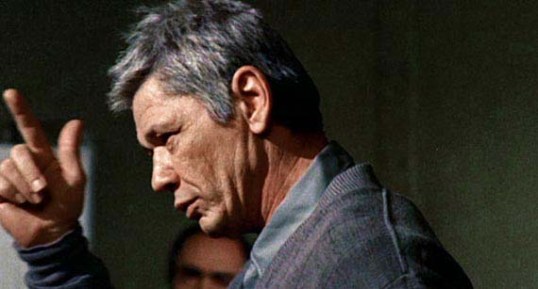
 In rural Colorado, the three wives and all the children of Orville Beecham (Charlie Dierkop) have been murdered. Veteran journalist Garret Smith (Charles Bronson) discovers that Orville is the son of an excommunicated Mormon fundamentalist named Willis Beecham (Jeff Corey). Willis, who lives on a heavily armed compound, practices polygamy and wants nothing to do with the outside world. However, Willis’s brother, Zenas (John Ireland), long ago split with Willis and set up a compound of his own. At first, Garret suspects that Orville’s family was killed by Zenas. As Zenas and Willis go to war, Garret discovers that there’s actually a bigger conspiracy at work, one dealing with corporate greed and water rights. (Forget it, Bronson, it’s Chinatown.)
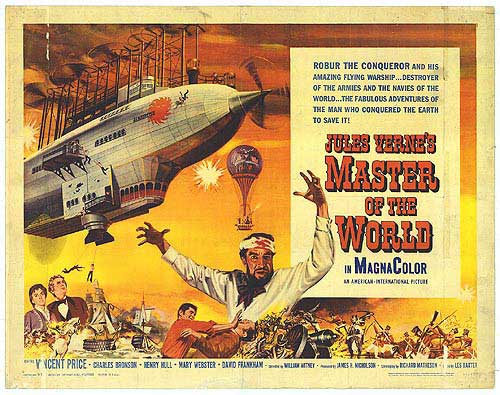
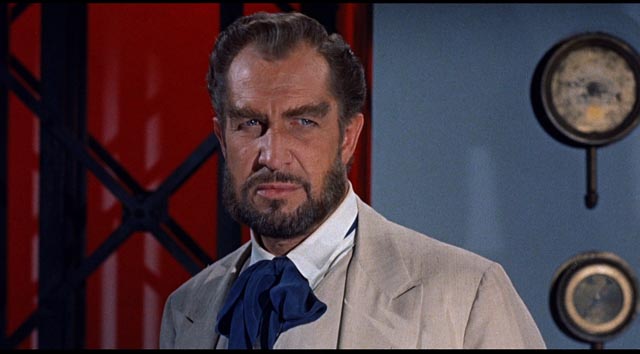
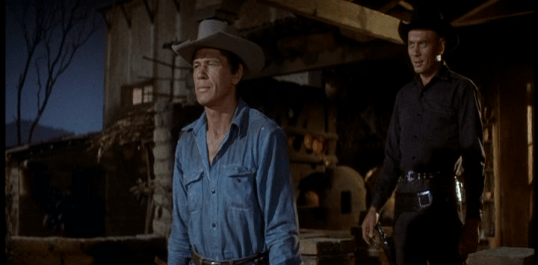


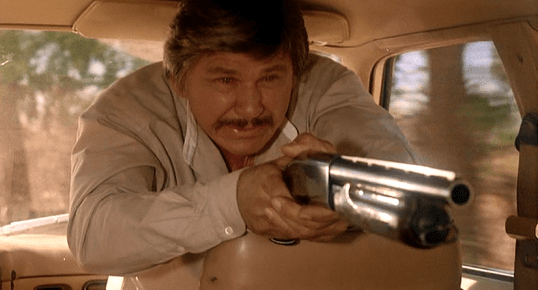
 Leon Alastray (Anthony Quinn) is an outlaw in 18th century Mexico who is given sanctuary and hidden from the Spanish authorities by a kindly priest, Father Joseph (Sam Jaffe). In return, Leon agrees to escort the priest to a peasant village that is under siege from the Yaqui Indians. During the journey, Joseph dies and when Leon arrives at the village, he is mistaken for the priest. Even though Leon’s an atheist and a womanizer, he pretends to be a man of God and tries to broker a peace with the Yaqui’s bloodthirsty leader, Golden Lance (Jaime Fernandez). Standing in the way is Teclo (Charles Bronson), a mestizo rebel who wants to keep the Spanish and the Yaqui at war.


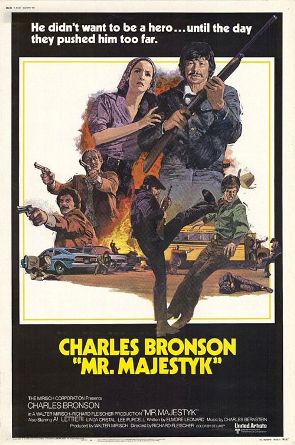 What happens when you combine the great tough guy writer Elmore Leonard with the great tough guy actor Charles Bronson?
 After tough New York detective Lou Torrey (Charles Bronson) lands in hot water for shooting and killing a teenage cop killer, he moves to Los Angeles and gets a job with the LAPD. Working under an unsympathetic supervisor (Norman Fell), saddled with an incompetent partner (Ralph Waite), and surrounded by paper pushing bureaucrats, Torrey still tries to uphold the law and dispense justice whenever he can. When a heroin dealer is murdered while in Torrey’s custody, Torrey suspects that it might be a part of a larger conspiracy, involving mobster Al Vescari (Martin Balsam).


 Through the Shattered Lens