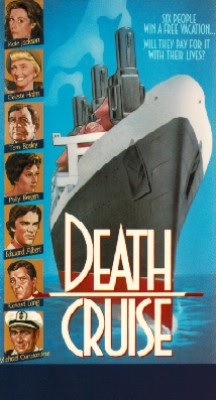
Welcome to Retro Television Reviews, a feature where we review some of our favorite and least favorite shows of the past! On Sundays, I will be reviewing the made-for-television movies that used to be a primetime mainstay. Today’s film is 1977’s Death Cruise! It can be viewed on Tubi and YouTube.
The thing with the Love Boat is that it promises something for everyone. It’s a place where you set a course for adventure and put your mind on a new romance.
The same cannot be said of the Death Cruise.
Death Cruise opens with three couples winning an all-expenses paid trip on a luxury liner. None of the couples are in a happy marriage. Sylvia Carter (Polly Bergen) is tired of her husband, Jerry (Richard Long), and his philandering ways. Elizabeth Mason (Celeste Holm) is frustrated with David Mason (Tom Bosley) and his loud dinner jackets. Mary Frances Radney (Kate Jackson) is fed up with James (Edward Albert) and his smug refusal to start a family. Of course, it’s not just martial problems that connects these passengers. It’s also the fact that someone on the boat is stalking and killing them, one-by-one. Can Dr. Burke (Michael Constantine) and Captain Vettori (Cesare Danova) track down the killer before it’s too late?
Death Cruise is an enjoyably twisty little murder mystery. It aired in 1974, a good two years before the first Love Boat pilot film appeared on television. However, both Death Cruise and The Love Boat were produced by Aaron Spelling so the two productions definitely have a shared DNA. The Love Boat is basically Death Cruise with the addition of a laugh track and considerably less murder. That said, I have my doubts as to whether Doc Bricker would have been as effective a detective as Dr. Burke.
One of the most interesting things about Death Cruise is how little anyone on the boat really seems to care about the fact that the passengers are turning up dead. In fact, one widower is asking a widow to be his date to dinner within a few hours of the deaths of their spouses. Of course, the murderer makes sure that dinner date is canceled but it’s still hard not to wonder whatever happened to an appropriate time of grieving. Then again, I guess if you’re on a boat for a weekend, you just do whatever feels right at the moment.
(And certainly, if they were on The Love Boat, the walking HR nightmares that was Doc Bricker wouldn’t have wasted any time asking the widows to come by his office for a examination.)
Of the victims and suspects, Richard Long and Edward Albert are memorably sleazy while Tom Bosley plays up just how annoyed he is with the whole situation. Michael Constantine is a good detective and the movie’s final twist is nicely executed. Personally, when it comes to cruises, I will always prefer the safety and romance of The Love Boat but Death Cruise was an entertaining nautical diversion.
Welcome to Retro Television Reviews, a feature where we review some of our favorite and least favorite shows of the past! On Tuesdays, I will be reviewing the original Fantasy Island, which ran on ABC from 1977 to 1986. Almost entire show is currently streaming is on Youtube!
This week, Tattoo goes rogue!
Episode 3.14 “Lookalikes/The Winemaker”
(Dir by Lawrence Dobkin, originally aired on December 22nd, 1979)
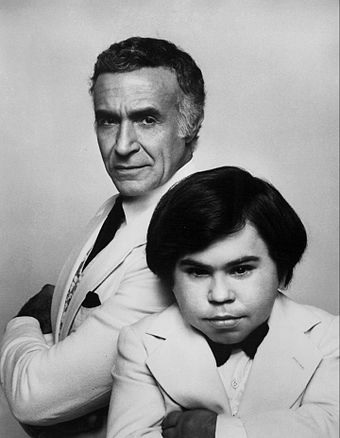
“Ah. So you thought you would handle her teeny, weeny fantasy your teeny weeny yourself,” Roarke says to Tattoo as they watch a nun depart from the plane and step onto Fantasy Island.
On the one hand, after the past few episodes, I guess we should be glad that Roarke is actually talking to Tattoo again. But, as the comment shows, it’s pretty obvious that Roarke still despises his assistant and Tattoo doesn’t have much respect for Roarke’s authority.
As for the fantasy, it involves Sister Veronica (Celeste Holm), a wine-making nun who wants to enter her wine in the Fantasy Island Wine Tasting Contest and hopefully win enough money to save her orphanage. At first, Roarke is a bit annoyed that Tattoo promised Sister Veronica a fantasy that Roarke is not sure that he can make come true. (Of course, after three seasons, we know that Roarke can do just about anything so, to be honest, Roarke’s objection mostly seems to be about having to do anything to help out Tattoo.) When Roarke tastes Veronica’s wine, he is pleasantly surprised. It’s quite good, he says. However, when he and Tattoo taste the wine a second time, they discover that it’s actually quite bad!
At first, Tattoo tries to substitute a different wine for Sister Veronica’s but Roarke catches him and tells him that the integrity of Fantasy Island cannot be compromised. However, greedy winemaker Armand Fernandel (Ross Martin) decides do to the same thing, switching the label of a bottle of his wine with the label of a bottle of Sister Veronica’s. As a result, Veronica wins the competition but has the win taken away when the judge (Jonathan Harris) discovers that the labels were switched. (Armand doesn’t get the win either, having been disqualifies for cheating.) So, it looks like Veronica’s fantasy is a bust….
….except, amazingly, oil has been discovered on the grounds of the orphanage. Yay! Everything works out and Tattoo is able to keep his promise to Sister Veronica.
As for the other fantasy, it features Ken Berry as Harry Simpson, an Idaho salesman who is convinced he has an exact double and who wants to live the double’s life for a weekend. It’s an oddly specific fantasy but somehow, Roarke pulls it off. (But if Roarke could find Harry’s double and allow Harry to live the double’s life, why couldn’t he fix a wine tasting competition?) It turns out that Harry’s double is a high-living gambler. Harry is excited to live his life until he discovers that his double is in trouble with a gangster (Michael V. Gazzo) and that he owes all of his gambling success to a 12 year-old card reader named Jimmy (Johnny Timko). In order to adopt Jimmy and give him a normal childhood, Harry has to win a game of blackjack on his own. Once again, it’s time to head down to the Fantasy Island casino! Mr. Roarke, of course, will not allow Jimmy to help Harry because the casino has a strict 18 and over age requirement. It’s strange how sometimes, Mr. Roarke is in charge of the casino and how other times, Roarke claims to have absolutely no power over the casino. Personally, I suspect the casino is a money laundering scheme.
This was an enjoyably silly episode, featuring guest stars who appeared to be having a good time. Celeste Holm is convincingly saintly as Sister Veronica while Ross Martin is enjoyably cartoonish as the greedy Armand. Ken Berry is so totally cast against type as a gambler that it actually kind of works. This episode managed to strike a balance between over-the-top silliness and melodrama and, as such, it was an entertaining weekend on the Island.
Welcome to Retro Television Reviews, a feature where we review some of our favorite and least favorite shows of the past! On Wednesdays, I will be reviewing the original Love Boat, which aired on ABC from 1977 to 1986! The series can be streamed on Paramount Plus!
This week, we have a special 90-minute episode of The Love Boat!
Episode 2.21 “A Good and Faithful Servant/The Secret Life of Burl Smith/Tug of War/Designated Lover”
(Dir by Roger Duchowny, originally aired on February 17th, 1979)
It’s a Mills family reunion as John, Juliet, and Haley all board The Love Boat. Despite being related, the three of them appears in three separate and unconnected stories. (There is one moment where Juliet walks past John and he gives her a slightly quizzical “Do I know you?” look.)
John Mills plays Bertram MacDonald, the long-time butler and chauffeur to Estelle Castlewood (Celeste Holm). Estelle has booked herself a vacation cruise on the Pacific Princess and she’s surprised to discover that Bertram has also booked a cruise. As Bertram explains it, the only time that he can take a vacation is when Celeste takes a vacation. At first, Bertram promises to stay away from Celeste during the cruise so that they can both enjoy their vacations without feeling like employer and employee. However, fate keeps bringing them together and soon, Bertram tells Celeste that he has to resign from his position because he’s now in love with her. Fortunately, Celeste is also in love with him so it all works out. Upon returning to America, Bertram again drives Celeste home but, this time, Celeste sits up front with him instead of in the back of her limo. This was a rather sweet story, largely because John Mills and Celeste Holm had a lot of chemistry and, being two veteran actors, they both knew exactly how to deliver their sentimental dialogue without making it sound overly calculated.
Juliet Mills plays Millicent, who is separated from Sherman (David Hedison). Millicent boards the cruise with her 8 year-old son, Lucas (Keith Coogan) and she is shocked to discover that Sherman has decided to take the cruise as well. Lucas blames himself for the separation but, fortunately, he gets a pep talk from a real-life baseball star, Reggie Jackson. (Yes, I did ask my sister who he was.) Even better, Sherman and Millicent realize that they still love each other and agree to call off the divorce. Yay! Again, this was another story that worked because of the chemistry between the two leads. Juliet Mills and David Hedison were convincing as a couple who, for all of their ups and downs, were still willing to give their marriage another chance.
Now, you may be wondering what Reggie Jackson was doing on the cruise. It turns out that Reggie is an old friend of Isaac Washington’s. Apparently, Isaac was known as “Freight Train Washington” in high school. Reggie went on to become a multi-millionaire athlete while Isaac went on to become a bartender on a cruise line. When Reggie boards the boat, he tells Isaac that he doesn’t want anyone to know that he’s famous. However, in an amusing twist, Reggie soon becomes frustrated when he gets what he asked for. He’s soon reduced to telling people that he’s Reggie Jackson, just to have them reply that he looks nothing like Reggie Jackson. Not even Captain Stubing believes that he’s Reggie Jackson! Fortunately, Reggie is finally able to convince Cleo (Telma Houston) that he is who he says he is and the two of them leave the boat together. As an actor, Reggie Jackson was a bit stiff but he still had decent comedic timing and it was hard not to be amused at his growing frustration over being anonymous.
Finally, Haley Mills plays model Cheryl Tyson. Gopher is excited that Cheryl is going to be on the cruise. She’s his favorite model! He even has a big poster on the wall next to his bed in his cabin. Unfortunately, every time that Gopher is near Cheryl, he loses the ability to speak in complete sentences. As such, Gopher spends the majority of the episode fantasizing outlandish, film-inspired scenarios that all lead to him sweeping Cheryl off her feet. Gopher imagines himself as an explorer, an admiral, a knight, a spy, and as Humphrey Bogart in Casablanca. He imagines himself as Elton John, performing Pinball Wizard as the Love Boat crew dances around. He even imagines being in a love triangle with Julie and Cheryl. Eventually, Cheryl gives him a pity date and it’s …. well, this whole storyline was pretty stupid. Fred Grandy was likable in the role and Gopher could be an amusingly goofy character but his fantasies were just so silly and poorly written that I couldn’t wait for them to be over. It’s nice that the show finally gave Grandy a showcase but neither he nor Haley Mills were particularly well-served by this episode.
This was an uneven episode. Even though the stories featuring John and Juliet Mills and Reggie Jackson were nicely done, the Hayley Mills/Fred Grandy stuff took up the majority of the episode and it dragged the whole thing down.
Next week …. Freight Train Washington falls in love!
Welcome to Retro Television Reviews, a feature where we review some of our favorite and least favorite shows of the past! On Tuesdays, I will be reviewing the original Fantasy Island, which ran on ABC from 1977 to 1986. The entire show is currently streaming on Tubi!
This week …. Tattoo gets a trumpet!
Episode 2.3 “The Beachcomber/The Last Whodunit”
(Dir by George McCowan, originally aired on September 30th, 1978)
Tattoo is learning how to play the trumpet and Mr. Roarke can barely hide his anger. That is this week’s Tattoo/Roarke storyline and it rasies a lot of questions about Roarke and Tattoo’s relationship. Is Roarke upset because Tattoo is a bad trumpet player or does he just dislike Tattoo in general? Does Tattoo really care about learning how to play the trumpet or is he just looking for an excuse to annoy Mr. Roarke? I think all of those possibilities may be true at the same time. If the previous two episodes hinted that Roarke and Tattoo no longer hated each other, this episode seems to confirm that they’re still the frenemies that they’ve always been. I sympathize with Roarke but it’s hard not to appreciate Tattoo’s determination to be an agent of chaos.
As for the fantasies, Charles Preston (John Astin) is a successful businessman who wants to throw it all ways so that he can spend the rest of his life as a beach bum. Roarke sets Preston up in a cabin on one of the shabbiest beaches on Fantasy Island. Seriously, the layout of Fantasy Island is just weird. A third of the island is a luxury resort. A third of the island is a magical jungle. And a third of the island is apparently just a collection of poverty-stricken fishing villages. Do the people who live on the island know that they could be having a fantasy if they only had the money? Let’s hope none of them ever pick up a copy of Marx or Piketty.
Anyway, Preston soon discovers that the life of a beach bum is not as easy as he thought it would be. For one thing, the chief of the island’s indigenous population demands that Preston marry his daughter. (The joke is that his daughter is overweight and …. well, it’s all pretty cringey by 2022 standards.) Meanwhile, a bounty hunter slaps some handcuffs on Preston and threatens to take him back to his family unless Preston pays him $70,000. “All of you beachcombers have a stash!” the bounty hunter hisses. Fortunately, Preston’s wife shows up and announces that she’s fine with him being a beach bum, as long as he’s a responsible beach bum who helps to pay the bills. And that’s the end of that. What an underwhelming fantasy.
Luckily, the episode’s other fantasy is a bit more entertaining. Mabel Jarvis (Celeste Holm) loves mystery stories and she wants to spend a weekend as her favorite fictional detective. Of course, Mabel soon finds herself investigating the real-life murder of Mabel’s favorite writer. Mr. Roarke explains that the writer was a friend of his and that he hoped Mabel could solve the case. That seems like a lot of responsibility to put on someone who is just looking for a vacation but, fortunately, Mabel proves to be up to the job. Anyway, this was a fun little fantasy and, as an avid reader of mysteries, it was one to which I could relate. Celeste Holm seemed to be having a lot of fun as Mabel and, even more importantly, her cat played a key role in solving the mystery.
This was not a bad episode. The beach stuff was forgettable but the episode was saved Celeste Holm and Tattoo’s trumpet.
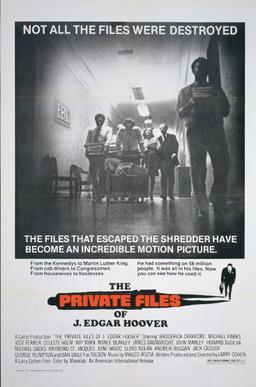
The 1977 film, The Private Files of J. Edgar Hoover, opens in 1972.
J. Edgar Hoover, the much-feared and long-serving director of the FBI, has just been found dead at his home and it seems like the entire city of Washington, D.C. is scrambling. Not only are people jockeying for Hoover’s job but they’re also wondering what might be found in his secret files. As quickly becomes apparent, Hoover had a file on everyone. While Presidents lauded him and the press portrayed him as hero, Hoover spent nearly 50 years building up a surveillance state. Hoover said it was to fight criminals and subversives but mostly, it was just to hold onto his own power. Even President Nixon is heard, in the Oval Office, ordering his men to get those files.
Hoover may have known everyone’s secrets but, the film suggests, very few people knew his. The film is narrated by a former FBI agent named Dwight Webb (Rip Torn). Dwight talks about how he was kicked out of the FBI because it was discovered that he not only smoked but that he was having an adulterous affair with a secretary. “You know how Hoover was about that sex stuff,” he says, his tone suggesting that there’s more to the story than just Hoover being a bit of a puritan.
We flash back to the 1920s. We see a young Hoover (James Wainwright) as a part of the infamous Palmer Raids, an early effort by the Justice Department to track down and deport communist subversives. Though Hoover disagrees with the legality of the Palmer Raids, he still plays his part and that loyalty is enough to eventually get him appointed, at the age of 29, to be the head of the agency that would eventually become the FBI. Hoover may start out as a relatively idealistic man but it doesn’t take long for the fame and the power to go to his head.
Hoover (now played by Broderick Crawford) serves a number of Presidents, each one worse the one who proceeded him. Franklin Delano Roosevelt (Howard Da Silva) is an avuncular despot while the Kennedy brothers (William Jordan as John and Michael Parks as Bobby) are two rich brats who think that they can control Hoover but who soon discover that Hoover is far more clever than they realize. Hoover finds himself a man out-of-place in the 60s and the 70s, Suddenly, he’s no longer everyone’s hero and people are starting to view the FBI as being not a force for law enforcement but instead an instrument of oppression.
Through it all, Hoover remains an enigma. He demands a lot of from his agents but he resents them if they’re too successful. Melvin Purvis (Michael Sacks) might find fame for leading the manhunt that took down Dillinger but he’s driven to suicide by Hoover’s cruel treatment. Unlike Clint Eastwood’s film about Hoover, The Private Files of J. Edgar Hoover suggests that Hoover was not gay but that instead, that he was so repressed that he was essentially asexual. When one woman throws herself at him, he accuses her of being a subversive and demands to know how anyone could find him attractive. He’s closest to his mother and when she dies, he shuts off his emotions. His own power, for better and worse, becomes the one thing that he loves. He’s married to the FBI and he often behaves like an abusive spouse.
The Private Files of J. Edgar Hoover is an interesting film. It’s an attempt to do a huge American epic on a less than epic budget. At the start of the film, the low budget is undeniably distracting. The 1920s are essentially represented by a back lot and two old cars. The scenes of the FBI dealing with gangsters like Dillinger and Creepy Karpis feel awkward and slapdash. But, as the film’s timeline gets closer to what was then the modern era, the film’s story tightens up and so does Larry Cohen’s direction. (One get the feeling that Cohen was, perhaps understandably, more interested in the Hoover of the 60s and the 70s than the Hoover of the 20s and 30s. There’s a sharpness to the second half of the movie that is just missing from the first half.) Broderick Crawford gives a chilling performance as a man who is determined to hold onto his power, just for the sake of having it. The scenes were Hoover and Bobby Kennedy snap at each other have a charge that’s missing from the first half of the film. Michael Parks does a great job portraying RFK as basically being a spoiled jerk while Crawford seems to relish the chance to play up the resentful, bitter old man aspects of Hoover’s personality. The film ultimately suggests that whether the audience previously admired RFK or whether they previously admired Hoover, they were all essentially duped.
Though the film never quite overcomes the limits of its low budget, it works well as a secret history of the United States. In 1977, it undoubtedly took guts to make a film that portrayed Roosevelt and Kennedy as being as bad as Nixon and Johnson. (It would probably even take guts today. One need only rewatch something like The Butleror Hyde Park on Hudson to see the ludicrous lengths Hollywood will go to idealize presidents like Kennedy and dictators like FDR.) While this film certainly doesn’t defend J. Edgar Hoover’s excesses, it often suggests that the president he served under were just as bad, if not even worse. In the end, it becomes a portrait of not only how power corrupts but also why things don’t change, regardless of who is nominally in charge. In the end the film’s villain is not J. Edgar Hoover. Instead, the film’s villain is the system that created and then enabled him. The man may be dead but the system remains.
Earlier today, as I was watching the 1947 film, Gentleman’s Agreement, I found myself thinking about a conversation that I had in 2006.
This was when I was in college. I was having lunch with some friends from one of my classes. As we were eating, the conversation turned to the war in Iraq. That, in itself, was not surprising because, in 2006, it seemed like every conversation somehow turned to what was happening in the Middle East.
One of the people with whom I was having lunch was Olivia, self-styled intellectual who fancied herself as the most knowledgeable person on campus. To be honest, I can’t think of anyone who liked her that much but she had a skill for subtly weaseling her way into almost every conversation. She was one of those incredibly pretentious types who started every sentence with “Actually….” and who had embraced Marxism with the shallow vapidness of someone who had grown up in Highland Park and who would never have to struggle to pay a bill.
On that day, Olivia announced to us all that the only reason we were in Iraq was because we were doing the bidding of Israeli lobbyists and then she went on to talk about how 9-11 was an inside job. She repeated the old lie about Jews calling in sick on 9-11 and claimed that five MOSSAD agents were arrested in New York for celebrating after the collapse of the Twin Towers.
After Olivia said this, there was the briefest silence as everyone else tried to figure out how to react. Finally, someone tried to change the subject by making a joke about our professor. Realizing the no one was going to openly disagree with Olivia and risk an argument, I said, “That’s not true.”
“What’s not true?” Olivia asked.
“About Jewish people calling in sick on 9-11 and celebrating after the Towers fell. That’s not true.”
Olivia looked a little bit surprised that she was being openly challenged. Finally, she said, in a surprisingly sincere tone of voice, “I’m sorry. I didn’t realize you were Jewish.”
I’m not Jewish. I’m Irish-Italian-Spanish and pretty much all of my immediate ancestors were Catholic. But, as far as Olivia was concerned, I had to be Jewish because why else would I object to her repeating an anti-Semitic conspiracy theory? When she apologized (and, make no mistake, there was not a hint of sarcasm in her tone when she said she was sorry), it wasn’t for being a bigot. Instead, it was for being a bigot in front of the “wrong” person. It didn’t occur to her that I was upset because what she said was bullshit.
Anyway, I wish I could say that I threw a drink in Olivia’s face or that I stood up on the table and delivered an impassioned speech but, once again, the other people at the table hastily changed the subject. Anything to avoid a conflict, I suppose. That was the last time I ever had a conversation with Olivia. For the rest of the semester, I ignored her and I felt pretty proud of myself for shunning her. It’s only been recently that I realized that Olivia also didn’t really make any effort to really talk to me after that conversation. I shunned her because of her bigotry and I can only assume that she shunned me because of her misconception about my ancestry.
Gentleman’s Agreement is about a Gentile reporter named Phillip Green (Gregory Peck) who, while researching a story about anti-Semitism, poses as a Jew and discovers that the world is full of people like Olivia. His own fiancee, a self-declared liberal named Kathy (Dorothy McGuire), reacts to Phil’s plan by asking him, “But you’re not really Jewish …. are you?” By the simple act of telling everyone that his last name is actually “Greenberg,” Phil discovers that he suddenly can’t get a hotel reservation. People stop returning his calls. When he and Kathy have an engagement party in a wealthy community in Connecticut, many of Kathy’s friends stay away. (Kathy, meanwhile, begs Phil to let her tell her family that she’s not actually engaged to a Jew.) When Phil’s son, Tommy (Dean Stockwell), is harassed at school, Phil is shocked to hear Kathy tell Tommy that he shouldn’t listen to the bullies not because they’re a bunch of bigots but because “you’re not actually Jewish.”
Meanwhile, Phil’s friend, Dave Goldman (John Garfield), has returned from serving in World War II, just to discover that he can’t even rent a home for his family because many landlords refuse to rent to Jews. When Phil learns that Katy owns a vacant cottage, he suggests that she rent it out to Dave. Despite her sympathy for Dave, Kathy is shocked at the suggestion. What will the neighbors think?
Gentleman’s Agreement was produced by Darryl F. Zanuck, who took on the project after he was refused membership in the Los Angeles Country Club because the membership committee assumed that Zanuck was Jewish. It was considered to be quite a controversial film in 1947, as it not only dealt with American prejudice but it also called out two prominent elected anti-Semites — Sen. Theodore Bilbo and Rep. John E. Rankin — by name. Zanuck often claimed that the other studio moguls asked him to abandon the project, saying that a film would only inspire more of what it was trying to condemn. Still, Zanuck stuck with the project and it was not only a box office hit but it also won the Oscar for Best Picture.
Seen today, Gentleman’s Agreement has its flaws. In the lead role, Gregory Peck is a bit of a stiff and Elia Kazan’s directs in an efficient but bland manner. Because this film was made in 1947 and a happy ending was a must, Kathy is given a rather convenient opportunity at redemption. The film’s most compelling performers — John Garfield, Celeste Holm, and June Havoc (playing Phil’s Jewish secretary, who had to change her last name before anyone would even consider hiring her) — are often underused.
And yet, with all that in mind, Gentleman’s Agreement is still a very effective film. Gentleman’s Agreement understand that there’s more to prejudice than just the morons who go to rallies or the degenerates who shout slurs across the street. Gentleman’s Agreement understands that, for prejudice to thrive, it also needs people like Kathy or Olivia, people who have that prejudice so ingrained in their system that they don’t even think twice about it and Dorothy McGuire does a very good job of playing a self-satisfied liberal who is blind to her own prejudice. Gentleman’s Agreement understands that bigotry isn’t just about the openly hateful. It’s also about the people who silently tolerate it and who refuse to stand up against it. It’s about the people who respond to prejudice not with outrage but who instead attempt to change the subject.
In the UK, one of the two major political parties has basically surrendered itself to anti-Semitism. Here in the US, Congress can’t even bring itself to condemn the frequently anti-Semitic comments of two of its members. Elected leaders and pundits only offer up the weakest of condemnation when Jewish people are viciously attacked in the streets. When a man attacked a group of Jews on Hanukkah, many excused the man’s attack by trying to say that he was just upset about gentrification. For many reasons, Gentleman’s Agreement is still relevant and important today.
The 1948 film, The Snake Pit, tells the story of a writer named Virginia Cunningham.
Virginia (Olivia de Havilland) is a patient at the Juniper Hill State Hospital, a psychiatric hospital that only treats female patients. Some days, Virginia knows where she is and some days, she doesn’t. Some days, she knows who she is and other days, she doesn’t. Sometimes, she hears voices and other times, the silence in her head is her only companion. Sometimes, she’s paranoid and other times, she’s quite lucid.
Virginia has been admitted against her will. Her husband, Robert (Mark Stevens), visits frequently and sometimes, she knows him and sometimes, she doesn’t. Through flashbacks, we see how Virginia and Robert first met. Robert worked at a publishing house. Virginia was a writer whose work kept getting rejected. Robert and Virginia fell almost immediately in love but Virginia always refused to consider marrying him. In fact, she even disappeared at one point, because things were getting too serious. However, one day, Virginia suddenly declared that she wanted to get married. Afterwards, her behavior became more and more erratic.
In the hospital, Virginia is treated by Dr. Kik (Leo Genn), who is depicted as being a compassionate and progressive psychiatrist, even as he puts Virginia through electroshock treatment. (Remember, this film was made in 1948.) With Dr. Kik’s guidance, Virginia starts to piece her life together and get to the cause of nervous breakdown. Unfortunately, it often seems like every step forward leads to two steps back and Virginia still reacts to every bit of pressure by acting out, even biting one unhelpful doctor.
The hospital is divided into levels. With each bit of progress that a patient makes, she’s allowed to move to a new level that allows her just a bit more freedom. Everyone’s goal is to make it to the final level, Level One. Unfortunately, Level One is run by Nurse Davis (Helen Craig), a tyrant who is in love with Dr. Kik and jealous of the amount of time he spends on Virginia. Davis starts to goad Helen, trying to get her to lose control. And what happens if you lose control? You end up in the Snake Pit, the dreaded Level 33. Being sent to Level 33 means being abandoned in a padded cell, surrounded by patients who have been deemed untreatable.
At the time that it was released, The Snake Pit was a groundbreaking film, the first major American studio production to deal seriously and sympathetically with mental illness. Seen today, it’s still effective but you can’t help but cringe at some of the techniques that are used in Virginia’s treatment. (Electroshock treatment, for instance, is portrayed as being frightening but ultimately necessary.) The film works best as a showcase for Olivia de Havilland, who gives an absolutely brilliant and empathetic performance as Virginia. Neither the film not de Havilland shies away from the reality of Virginia’s condition nor does it make the mistake of sentimentalizing her story. For me, de Havilland’s best moment comes when she learns that she bit another doctor. At first, she’s horrified but then she starts to laugh because the doctor in question was such a pompous ass that he undoubtedly deserved it. de Havilland handles the character’s frequent transitions from lucidity to confusion with great skill, without indulging in the temptation to go over-the-top. Arguably, The Snake Pit features de Havilland’s best lead performance.
(Olivia de Havilland is, at 103 years old, still with us and living, reportedly quite happily, in France.)
Olivia de Havilland was nominated for Best Actress but she lost to Jane Wyman in Johnny Belinda. (A year later, De Havilland’s won an Oscar for The Heiress.) The Snake Pit was also nominated for Best Picture but ultimately lost to Laurence Olivier’s adaptation of Hamlet.
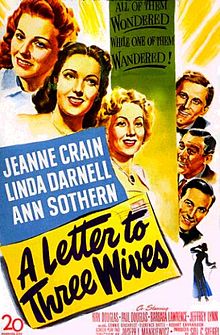
Last week, I started a little series that I call Embracing The Melodrama, Part II. Over the next three weeks, I will be reviewing, in chronological order, 128 cinematic melodramas. I started this series with the 1927 silent film Sunriseand now, we have reached our 18th film, the 1949 best picture nominee, A Letter To Three Wives!
Now, I’m going to start this review by pointing out something that will probably scare off some of our readers. So, before you read the next paragraph, understand that A Letter To Three Wives is a great film that’s full of great performances and witty dialogue and you really should watch it the next time that it’s on TCM. Got all that? Okay. Good. Moving on…
A Letter To Three Wives feels a lot like a 1949 version of Desperate Housewives. Now, before you freak out, I’m talking about early Desperate Housewives as opposed to later Desperate Housewives. The similarities are actually pretty striking. Both A Letter To Three Wives and Desperate Housewives take place in an upper class suburb. Both of them deal with women who appear to have happy marriages but who are all actually dissatisfied with how their lives have turned out. Both of them are satires disguised as mystery stories. (The mystery in Desperate Housewives involved murder. The one in A Letter To Three Wives involves adultery.) Perhaps most significantly, both Desperate Housewives and A Letter To Three Wives are narrated by a snarky woman who exists largely off screen.
The narrator in A Letter To Three Wives is named Addie Ross and voiced by Celeste Holm. We never actually see Addie but we hear a lot from her and a lot about her. Apparently, every man in town has, at some point, been in love with Addie. Every woman is jealous of her. And Addie, amazingly enough, seems to have the power to know exactly what’s happening in everyone else’s marriage. At the start of A Letter To Three Wives, Addie has sent … well, a letter to three wives. In the letter, Addie explains that she’s run off with one of their husbands but she declines to reveal which husband. Each one of the wives thinks back on her marriage and wonders if her husband is the one.
Deborah (Jeanne Crain), for instance, is a country girl who met and married Bradford “Brad” Bishop (Jeffrey Lynn) during World War II. Deborah is insecure about the fact that Brad comes from an upper class background and that he was apparently engaged to marry Addie before he met Deborah.
(Here’s an interesting piece of trivia for those of you who, like me, are into true crime stories. Along with the movie character, there’s also a real-life murderer named Bradford “Brad” Bishop. Like the character in the movie, he came from an upper class background. Unlike the film character, the real Brad Bishop ended up murdering his wife, his children, and his mother and then fled to Europe. He’s been a fugitive for close to 40 years and is believed to still be alive. He’s currently on the FBI’s most wanted list.)
And then there’s Rita (Ann Sothern), who is an old friend of Brad’s. Rita is married to George. George is a quiet and intellectual English professor who is insecure over the fact that Rita, working as a soap opera writer, makes more money than he does. George is played by Kirk Douglas and, admittedly, it does take a while to get used to the idea of Kirk Douglas playing an introverted intellectual. But, once you get over the initial shock, Kirk Douglas gives a pretty good performance. Kirk may be miscast but that actually works to the film’s advantage. In a world where surface appearances hide the unexpected truth, it only makes sense that a mild college professor would look like Kirk Douglas.
My favorite wife was Lorna Mae (Linda Darnell), who grew up next to the train tracks and who pursues and eventually married a wealthy, older man (Paul Douglas). It was impossible for me not to relate to and even admire Lorna Mae. Much like me, Lorna Mae was determined to get what she wanted. Perhaps my favorite scene with Lorna Mae was when she blatantly did everything possible to get stuffy old Paul Douglas to look at her legs, largely because I’ve done the exact same thing on occasion.
A Letter To Three Wives is an entertaining and witty film that still holds up today. Director Joseph L. Mankiewicz deservedly won the Best Director Oscar for his work here. The film itself was nominated for best picture but lost to All The King’s Men. I actually happen to like All The King’s Men but, if I had been an Academy voter in 1949, my vote would have totally gone to A Letter To Three Wives.
“Fasten your seat belts, it’s gonna be a bumpy night!” — Margo Channing (Bette Davis) in All About Eve (1950)
If you’re a lover of classic films or even if you’re just someone who occasionally watches TCM, chances are that you already know All About Eve. It’s one of those films that is endlessly quoted and it features at least two performances — Bette Davis’s turn as aging Broadway diva Margo Channing and George Sanders’ acidic theater critic Addison DeWitt — that serve as frequent inspiration for professional impersonators. It’s the film that was named best picture of 1950 and it continues to hold the record for both the most Oscar nominations overall and it’s the only film in Oscar history to receive four female acting nominations.
Even more importantly, it’s a film that everyone already knows it great.
So, that brings up the question that every film blogger dreads: how do you review a classic film that everyone already knows about? I’ve often said that it’s easier to review a bad film than a great one. It’s easy to pinpoint why a film fails but when it comes time to explain why a film is great, it’s often difficult to put to words the intangible qualities that elevate it.
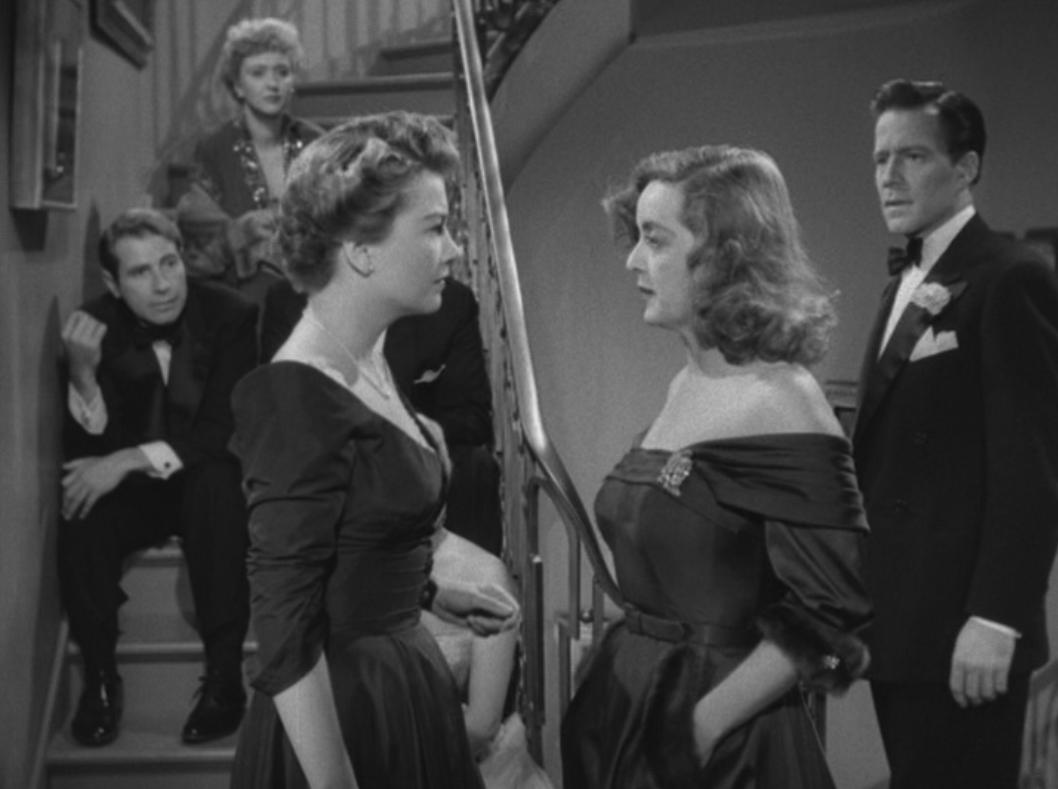
For instance, I could tell you that the film has a fascinating plot but that barely only begins to scratch the surface of everything that’s going on underneath the glossy and melodramatic surface of All About Eve. The movie tells the story of how scheming young actress Eve Harrington (Anne Baxter) becomes a star with the help of Addison DeWitt and at the expense of the talented but aging Margo Channing. In telling Eve and Margo’s stories, All About Eve explores issues of female friendship and competition, sexuality, and why older men are celebrated while older women are constantly at risk of being pushed to the side for a newer model. The complexity and power of All About Eve’s storyline can be summed up by the fact that right now, when I watch the film, I relate to Eve but I imagine that twenty years from now, I’ll rewatch and I’ll relate to Margo.
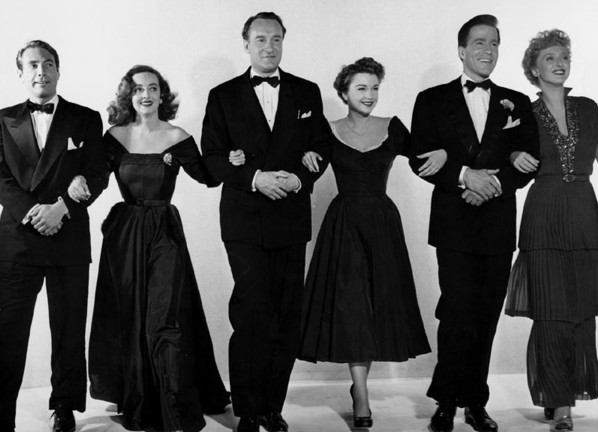
I could tell you that this is a film that is full of bigger-than-life characters and iconic performances but that doesn’t even begin to scratch at the surface of how well-acted and perfectly cast this film is. Even boring old Hugh Marlowe is a perfect choice for playing boring old playwright Lloyd Richards. (His wife is played by Celeste Holm. Reportedly Bette Davis hated working with Celeste Holm but onscreen, their friendship feels very real and poignant and leads to some of the best scenes in the entire film.) Gary Merrill, who later married Bette Davis, is likable as Margo’s boyfriend and Thelma Ritter is great as Margo’s outspoken assistant, largely because she’s Thelma Ritter and she was always great. Marilyn Monroe famously makes the most of her minor role in All About Eve, playing an aspiring actress who has a very good reason for calling the butler a waiter. And then there’s Bette Davis and George Sanders, both of whom are simply brilliant.
My favorite scene from All About Eve
But to me, the best performance in All About Eve comes from Anne Baxter. Baxter plays Eve as a perpetually smiling schemer and one of the great pleasures of the film is watching as Eve wrecks passive-aggressive havoc through Margo’s circle of friends. Just watch the scenes where she deftly manipulates Celeste Holm. All About Eve is usually referred to as being a vehicle for Bette Davis but if you actually watch the film, you see that the title is absolutely appropriate. The film really is all about Eve.
And I could always tell you about how wonderfully sardonic the dialogue is but you already know that. There’s a reason why even people who have never seen the film still quote Margo’s suggestion that everyone fasten their seat belts!
So, in the end, what can I tell you about All About Eve? Well, all I can really tell you is that it’s a great film and, if you haven’t seen it, you need to make time to learn all about Eve.







 Through the Shattered Lens