October Positivity: Prayer Never Fails (dir by Wes Miller)


The 2016 film, Prayer Never Fails, tells the story of Aiden Paul (Nick Lashaway).  Having survived a traumatic childhood that was full of abuse, Aiden is now the beloved basketball coach at the local high school.  (The fact that he never shaves or gets his hair out of his face does not seem to be a problem as far as this school district is concenred.)  When one of his players approaches Aiden and tell him that he’s being abused by his father (Lorenzo Lamas), Aiden suggests that the player pray on it.  When the player says that he doesn’t know how to pray (because his father is not just abusive but also a hardcore atheist, of course), Aiden takes him into a classroom and teaches him how.

Unfortunately, another teacher sees Aiden and the player praying and reports Aiden to the principal.  Aiden is fired from his position.  Though Aiden says that he’s just going to give up and find another job, his players demand that Aiden fight to be reinstated.  Aiden decides to take the school to court!

Unfortunately, there aren’t any lawyers that Aiden can afford.  (And most lawyers would hopefully be ethical enough tell Aiden that, regardless of his good intentions, he doesn’t have a case.)  Finally, a chance meeting at a diner leads to Aiden hiring Michael Brown (Clifton Davis), an agnostic lawyer with a gambling problem.  Michael takes the case but he soon finds himself going up against master litigator Joseph T. Harrington (Corbin Bernsen).  Can Michael somehow win the case?

This is another one of those Christian courtroom films where no one does anything that makes sense.  For instance, it seems like, instead of ducking into an open classroom for a quick prayer, Aiden could have reported that one of his students was being abused by a parent, which is something that, as a teacher, he would have been required to do in the first place.  (Instead, that subplot is abandoned after Aiden is fired.)  As well, to win the case, all Joseph T. Herrington had to do was 1) point out that Aiden had admitted to leading a prayer in school and 2) call to the stand a Constitutional law expert to explain the establishment clause.  Instead, Herrington puts the entire concept of prayer on trial and tries to argue that praying doesn’t work.  It’s an argument based purely on emotion and bias, which allows Michael to make a counter-argument that’s based purely on emotion and bias.  At one point, Michael interrogates the school’s principal as to why he was willing to defend a transgender teacher but not Aiden’s right to pray.  The correct answer, of course, is that whether or not another teacher is transgender has nothing to do with Aiden’s case and that the Supreme Court has ruled that prayer is not allowed in public schools.  That’s really all anyone needed to say to any of Michael’s arguments but no one does because, if they did, it would be a very short film.

(Along with the dubious legal arguments, this film annoyed me because Aiden didn’t ever bother to shave or comb his hair before the trail began.  I mean, seriously, did someone tell him that it was a good strategy to go to court looking like you spend the previous week sleeping in the back of a pickup truck?  I would not want him coaching my school’s basketball team.)

On the plus side, Eric Roberts is in this movie.  He plays the judge and goes through the film with a bemused smile on his face, as if even he can’t believe the legal arguments that he’s hearing.  It’s always nice to see Eric Roberts picking up a paycheck.

Previous Eric Roberts Films That We Have Reviewed:

  1. Star 80 (1983)
  2. Blood Red (1989)
  3. The Ambulance (1990)
  4. The Lost Capone (1990)
  5. Love, Cheat, & Steal (1993)
  6. Love Is A Gun (1994)
  7. Sensation (1994)
  8. Dark Angel (1996)
  9. Doctor Who (1996)
  10. Most Wanted (1997)
  11. Mr. Brightside (2004)
  12. Six: The Mark Unleased (2004)
  13. Hey You (2006)
  14. In The Blink of an Eye (2009)
  15. Enemies Among Us (2010)
  16. The Expendables (2010) 
  17. Sharktopus (2010)
  18. Deadline (2012)
  19. Miss Atomic Bomb (2012)
  20. Lovelace (2013)
  21. Self-Storage (2013)
  22. This Is Our Time (2013)
  23. Inherent Vice (2014)
  24. Road to the Open (2014)
  25. Rumors of War (2014)
  26. Amityville Death House (2015)
  27. A Fatal Obsession (2015)
  28. Stalked By My Doctor (2015)
  29. Joker’s Poltergeist (2016)
  30. Stalked By My Doctor: The Return (2016)
  31. The Wrong Roommate (2016)
  32. Dark Image (2017)
  33. Stalked By My Doctor: Patient’s Revenge (2018)
  34. Monster Island (2019)
  35. Seven Deadly Sins (2019)
  36. Stalked By My Doctor: A Sleepwalker’s Nightmare (2019)
  37. The Wrong Mommy (2019)
  38. Exodus of a Prodigal Son (2020)
  39. Free Lunch Express (2020)
  40. Her Deadly Groom (2020)
  41. Top Gunner (2020)
  42. Deadly Nightshade (2021)
  43. Just What The Doctor Ordered (2021)
  44. Killer Advice (2021)
  45. The Poltergeist Diaries (2021)
  46. A Town Called Parable (2021)
  47. My Dinner With Eric (2022)

Retro Television Reviews: The Love Boat 2.17 “Second Chance / Don’t Push Me / Like Father, Like Son”


Welcome to Retro Television Reviews, a feature where we review some of our favorite and least favorite shows of the past!  On Wednesdays, I will be reviewing the original Love Boat, which aired on ABC from 1977 to 1986!  The series can be streamed on Paramount Plus!

This week’s episode of The Love Boat is all about second chances!

Episode 2.17 “Second Chance / Don’t Push Me / Like Father, Like Son”

(Dir by Allen Baron, originally aired on January 27th, 1979)

As usual, this week’s episode presents us with three different stories involving people on the cruise.  Two of them aren’t that interesting and I’m going to deal with them first.

Fred Beery (Roddy McDowall) is a nerdy guy who is sailing on The Love Boat to get away from his clingy, marriage-obsessed girlfriend, Christine (Tammy Grimes).  However, Christine shows up at the last minute and boards the boat with Fred.  Fred suddenly starts sneezing.  When Christine asks Fred to marry her, he sneezes and, for some reason, she assumes that was his way of saying yes.  Fred goes to Doc Bricker and wonders if he could be allergic to Christine.  Doc says that people can be allergic to one another.  Fred is excited because this gives him an excuse not to marry Christine.  But then Fred changes his mind and discovers that he’s no longer allergic to Christine.  However, Christine now finds Fred to be too clingy and doesn’t want to marry him and …. well, that’s pretty much the storyline.

This was a bit of an annoying storyline.  Even with Roddy McDowall in the role, Fred was not particularly likable.  Fred’s refusal to get married and his sudden “allergy” was played for laughs but, when seen today, it’s hard not to feel that Fred is basically deep in denial.  If this episode were made today, it would end with Fred finding the courage to come out and Christine realizing the real reason why he didn’t want to marry her.  But, since it was made in the 70s, it ends with Fred begging Christine to give him a second chance.

The second storyline featured Robert Mandan and Randolph Mantooth as a father and a son who were both in love with the same woman (Cathy Lee Crosby).  Crosby, however, was far more attracted to the older Mandan than the younger (and, it seemed, alcoholic) Mantooth.  In the end, Mantooth made peace with the idea of the woman he loved becoming his stepmother.  It sounds like the premise of a Lifetime movie.

But enough about those stories.  The story that actually worked featured Debbi Morgan as Stephanie Jackson, a recent parolee who Isaac convinced the Captain to hire to work in the gift shop.   When some pearl earrings go missing, Stephanie is the number one suspect because she was previously arrested for shoplifting.  Isaac has to figure out if Stephanie stole the jewelry or if she still deserves her second chance.  Eventually, it is revealed that Stephanie did steal the earrings but she also returned them hours later, locking them up in the gift shop’s safe.  Stephanie nearly returned to her criminal ways but had a change of heart.  After hearing her confession, the Captain tells Stephanie that she did the right thing and that she will continue to work at the gift shop.

I actually liked this storyline.  Some of that was because Debbi Morgan gave a good performance as Stephanie.  But also I liked the fact that The Love Boat was highlighting the importance of helping out the formerly incarcerated.  Too often, when people get out of prison, they find themselves without any opportunities.  Most businesses and stores will always find an excuse not to hire someone with a criminal record and, as a result, those recently released are not left with many options beyond returning to a life of crime.  If we’re going to insist that prison is about rehabilitation than we have to be willing to give the formerly incarcerated a chance to prove that they’ve been rehabilitated.  The Love Boat may have been a rather silly show but, with this episode, it sailed with an important message.

Next week: The Love Boat hosts a high school reunion!

Horror on TV: Kolchak: The Night Stalker 1.19 “The Youth Killer” (dir by Don McDougall)


Tonight on Kolchak….

There’s a new dating service in Chicago!  It’s only for the hot, single, and young!  So, why are some of the members turning up dead and suddenly old?  Could it be that the owner of the dating service has a less-than-ethical way of remaining young!?

Carl Kolchak is going to find out!

This episode aired on March 14th, 1975.  It’s not one of the better episodes but, as always, Darren McGavin is a lot of fun in the role of Kolchak.

Enjoy!

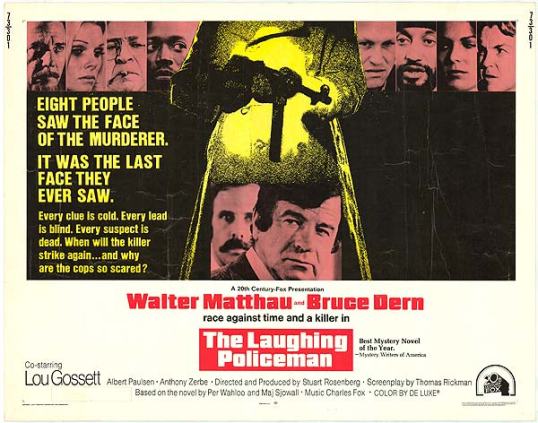
A Movie A Day #17: The Laughing Policeman (1973, directed by Stuart Rosenberg)


8232729_orig

San Francisco in the 1970s.  Revolution is in the air.  Hippies are on every street corner.  A man named Gus Niles knows that he’s being tailed by an off-duty cop, Dave Evans.  Gus boards a city bus, knowing that Evans will follow him.  On the bus, an unseen gunman suddenly opens fire with an M3 submachine gun, not only killing both Evans and Gus but six other people as well.  After the bus crashes, the gunman calmly departs.  At first, it is assumed that the massacre was another random mass shooting, like Charles Whitman in Austin or Mark Essex in New Orleans.  But one San Francisco detective is convinced that it wasn’t random at all.

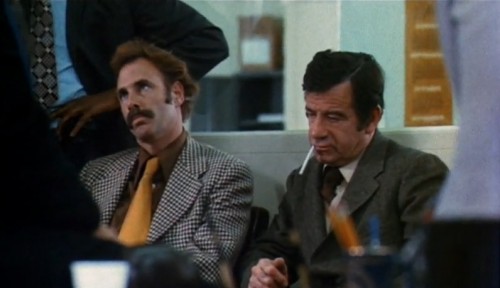
The Laughing Policeman was one of the many police procedurals to be released after the box office success of Dirty Harry and The French Connection and, despite the name, it’s also one of the grimmest.  While the complex mystery behind why Evans was following Gus and who killed everyone on the bus is intriguing, The Laughing Policeman‘s main focus is on the often frustrating nitty gritty of the investigation, complete with false leads, uncooperative witnesses, unanswerable questions, and detectives who frequently make stupid mistakes.  The movie’s first fifteen minutes are devoted to the police processing the bus, with Stuart Rosenberg (best known for directing Paul Newman in Cool Hand Luke) using overlapping dialogue to give the entire scene a documentary feel.  As Detective Jake Martin, Walter Matthau is even more cynical and downbeat than usual while Bruce Dern provides good support as a younger, more volatile detective.  The supporting cast is full of 70s character actors, like Lou Gossett, Anthony Zerbe, Gregory Sierra,and playing perhaps the sleaziest drug dealer ever seen in an American movie, Paul Koslo.

The Laughing Policeman was based on a Swedish novel that took place in Stockholm but, for the movie, Swedish Detective Martin Beck became world-weary Sgt. Jake Martin and Stockholm became San Francisco.  Rosenberg directed the entire film on location, giving The Laughing Policeman the type of realistic feeling that would later be duplicated by TV shows like Hill Street Blues, NYPD Blue, and Law & Order.  Though it may not be as well-known as either Dirty Harry or The French Connection, The Laughing Policeman is a dark and tough police procedural, an underrated classic of the genre.

Incidentally, The Laughing Policeman was one of the first films for which character actor Bruce Dern shared top billing.  According to Dern’s autobiography, Matthau generously insisted that Dern be credited, with him, above the title.

bruce_dern_walter_matthau_the_laughing_policeman_1973-500x288

The TSL’s Daily Horror Grindhouse: The Dark (dir by John “Bud” Cardos)


Some of y’all may have noticed that, whenever I don’t have much to say about a movie, I’ll usually start things about be praising either the film’s title or its poster art.

With that in mind, the 1979 film The Dark has got a great title.  I mean, what self-respecting horror film could actually resist a movie called The Dark?  It’s a title that promises horror and blood and no holds barred morbidity!  And really, the title is so brilliant that it almost doesn’t matter that the film itself come no where close to delivering.

And finally, just check out the poster art!

the-dark

Seriously, that’s a great poster!  If I had been alive in 1979, I totally would have wanted to see this movie just because of the poster.  Not only is the film called The Dark but the poster literally promises that this movie is going to be — and I quote — “A chilling tale of alien terror!”

Woo hoo!

Of course, The Dark didn’t start out as a chilling tale of alien terror.  The Dark is one of those films where what happened behind the camera is far more interesting than what was actually filmed.  The story behind The Dark is a classic tale of low-budget, exploitation filmmaking:

Originally, The Dark was going to be a story about a zombie decapitating people in Los Angeles.  The zombie had once been a Confederate soldier who ended up resorting to cannibalism.  As originally envisioned, the Dark would feature numerous scenes of that dead Confederate wandering around with a big axe that it would use to chop off heads.

Tobe Hooper, who was hot as a result of having directed The Texas Chainsaw Massacre, was brought in to direct.  However, after just a few days of shooting, he was replaced.  Depending on which version you read, Hooper was either fired or he walked off the set.  Either way, all accounts seem to agree that Hooper didn’t see eye-to-eye with the film’s producers.  (One of those producers was Dick Clark, the same guy who always used to host ABC’s New Year’s special.)

With Hooper gone, a new director was brought in.  That director was John “Bud” Cardos, who had previously had a drive-in hit with Kingdom of the Spiders.  Cardos finished the film but he had no emotional investment in it and that’s obvious when you watch The Dark today.  Visually, The Dark looks and feels like an old cop show, the type that you might expect to turn up on a cable station that is specifically programmed to appeal to the elderly.

The film that Cardos completed featured a Confederate zombie with an axe.  However, the producers showed that film to a preview audience and quickly discovered that nobody cared about a Confederate with an axe.

So, they made some changes.

At the time, Alien was the most popular film at the box office so the producers thought, “Why not add some special effects, redub some dialogue, and make our Confederate zombie into an alien?”  Sure, why not?

Hastily, The Dark was reedited.  All shots featuring the zombie with an axe were removed from the film.  Instead, whenever the monster attacked, the film now featured a freeze frame of the monster’s face with some hastily added laser beams shooting out of his eyes.  This would be followed by a freeze frame of the victim and stock footage of an explosion….

(That said, there’s still plenty of references to the alien removing people’s heads…)

Interestingly, there’s still a scene in the film in which a police detective suggests that the creature might be a zombie.  “Zom-bies!?” his superior yells, “I don’t want to hear those two words again!”  Well, don’t worry.  It’s not a zombie!  It’s an alien!

(You do have to wonder why an alien would be wearing jeans and flannel shirt but, then again, why would a Confederate zombie be wearing jeans and a flannel shirt?  It’s a strange world.)

As you’ve probably already guessed, The Dark is a bit of a mess.  The alien is going around Los Angeles and blowing people up.  (Though a few times, he also rips off their heads because … well, we already went into that.)  The father of one of the victims is a burned out writer and he’s played by William Devane.  (This is the same William Devane who has played the President in nearly every movie and TV show ever made.  Words cannot begin to express how bored Devane appears to be in this movie.  Oddly, with his hair long and graying, Devane bears an uncanny resemblance to Law & Order SVU‘s Richard Belzer.)  The father is investigating, even though the lead detective (played by Richard Jaeckel) tells him not to.  A reporter (Cathy Lee Crosby) is also investigating.  And then there’s a psychic (Jacquelyne Hyde) and the psychic somehow knows what the monster is and who is going to die next.

The characters do eventually cross paths.  When the detective meets the reporter, the detective announces that he’s going to kill the killer.  “38 caliber justice?” the reporter replies.  “If he’s dead, he can’t kill again!” the detective explains and he kind of has a point.

(Making it even stranger is that, while the detective and the reporter talk, there’s a political protest gong on behind them.  The protest consists of people jumping up and down.)

It’s all really messy because, while watching the movie, you get the feeling that none of the actors knew what anyone else was filming.  It’s like six different films with six different tones and they’ve all been smashed together.  It’s also not particularly scary because ultimately, the zombie alien is just a freeze frame with some hastily added laser beams.  (It doesn’t help that the lasers occasionally go “pew pew” when they’re fired.)

But still, The Dark is a great title for a movie.

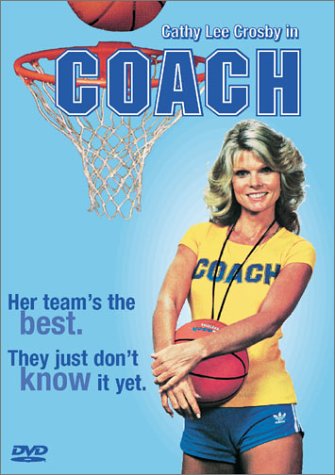
Back to School #20: Coach (dir by Bud Townsend)


Just from watching the trailer above, you probably think that the 1978 film Coach is just your standard high school sports film.  And, in many ways, it is.  But, since it was made in the 70s, things still get a little bit weird.  Before proceeding, I should probably point out that Coach (like the similar The Teacher) was produced by Crown International Pictures.  But you probably already guessed that.

CIP_Logo

An exclusive California high school has a problem.  The boy’s basketball team is having a terrible season.  The most powerful man in town, F.R. Granger (Keenan Wynn), demands a change!  (You can tell that Granger is powerful because he goes by his initials.)  After ordering the hapless basketball coach to resign, Granger and the school board hire Randy Rawlings to replace him.  Oddly enough, they don’t actually interview Randy for the job or attempt to meet Randy ahead of time.  They just know that Randy is a former Olympian and are overjoyed when Randy accepts the job.

On Randy’s first day on the job, everyone is shocked to discover that Randy Rawlings is — GASP — a woman!  Now, I’ll admit that this film is a little bit before my time and the world was probably a lot different back in the 70s but, as an Olympic medalist, wouldn’t Randy be a bit of a celebrity?  And would anyone as obsessed with winning as F.R. Granger actually hire a coach sight unseen?  Anyway, F.R. is none too happy to discover that Randy (Cathy Lee Crosby) is a woman and tries to fire her on the spot.  Sorry, F.R. — can’t be done.  As Randy points out, F.R. needs cause to fire her.

After forcing them to all take a cold shower and then coaching them to a few victories, Randy wins over the team.  She also starts sleeping with one of her players (played by a very young and handsome Michael Biehn) and this is where the movie gets weird.  I kept expecting this affair to be discovered and used by F.R. as an excuse to fire Randy.  Because, after all, why would any film feature a rather creepy subplot about a teacher sleeping with a student unless it was somehow going to pay off in the end?  But instead, the affair just sort of happens and never really ties back into the main plot of whether or not Randy will be able to coach the team to having a winning season.

coach

Now, I know you’re probably thinking to yourself, “What would the great Russian writer Anton Chekhov think about this?”  Well, here’s an exact quote from Mr. Chekhov:

“Remove everything that has no relevance to the story. If you say in the first chapter that there is a rifle hanging on the wall, in the second or third chapter it absolutely must go off. If it’s not going to be fired, it shouldn’t be hanging there.”

In other words, Coach was definitely not written by Anton Chekhov.

Anton Chekhov ponders the narrative failings of Coach

Anton Chekhov ponders the narrative failings of Coach