VGM Entry 37: DuckTales


VGM Entry 37: DuckTales
(Thanks to Tish at FFShrine for the banner)

Part of going over these older game scores involves a lot of legwork in tracking down their composers. Sometimes authorship is ascribed in a straight forward manner that raises no alarms, but more often developers were especially cryptic about their musical staff. Composers tended to go by aliases rather than proper names, and sometimes confusion between composition and sound programming lead to false assumptions. That is the topic I’d like to focus on again for this next 1989 NES title.

http://www.youtube.com/watch?v=CdlwhzXs24k

If you are not already familiar with NES music to some extent, this selection might seem like a joke at first glance. And after all, the first track in the video is nothing but a standard rendition of the original television theme. But as the standard expectation passes on and the soundtrack comes into its own, you’ll soon be forced to admit that DuckTales (Capcom, 1989) is indeed among the very best on the NES. If “The Amazon” (1:13) fails to instantly convince you, “The Moon” (2:16) most certainly should. It’s sad and beautiful to an extent approaching Yasunori Mitsuda’s “To Far Away Times”.

The funny thing is it’s not entirely clear who wrote it. You will almost always see it credited to Yoshihiro Sakaguchi (Yukichan no Papa)–the same Sakaguchi credited alongside Tamayo Kawamoto on Forgotten Worlds. This came into question in 2010. Yoshihiro Sakaguchi is actually a name I first encountered when I was listening to Mega Man and Mega Man 2, but I ran into an interview with Manami Matsumae, Takashi Tateishi, and Yoshihiro Sakaguchi on Square Enix Music Online (SEMO) which sorted all of that out.

I’ve mentioned a number of times the vaguaries surrounding the conversion of composition into actual game sound, especially in ports. When we’re talking Commodore 64 music this isn’t really an issue, as the composers were almost always responsible for the full project from start to finish as best I can tell. But when you get into platform systems like the NES and Genesis, and full sound teams like Taito’s Zuntata and Capcom’s Alph Lyla, the business gets excruciatingly vague. The interview expressly reveals that Manami Matsumae “did the background music and sound effects on the original Mega Man“, and Takashi Tateishi “did the background music and sound effects on Mega Man 2,” while Yoshihiro Sakaguchi “was in charge of programming the sound driver.” Where is the dividing line? Was Sakaguchi’s job to program the specific tones chosen by the composers, or did he choose the tones based on their compositions? Takashi Tateishi’s comments lead me to believe that there was some collaboration involed, and the divide in work load was by no means black and white. But we’re not talking the difference between say, composing a score and conducting an orchestra. The vast differences in quality between different ports, such as those I exemplified through “Dark Fact”/”Final Battle” from Ys I, should give you an idea of how absolutely critical the programmer/arranger/whatever you want to call its role must have been on these early systems.

My relevant point here is that any revelation that Yoshihiro Sakaguchi did not compose the vast majority of the music he is credited with should not necessarily downplay his significance. As for DuckTales in particular, it is quite safe to assume that it was composed by Hiroshige Tonomura, not Yoshihiro Sakaguchi. While the published content of the SEMO interviews never specifically addresses DuckTales, Chris on vgmdb, who had some insider knowledge, stated in responce to the DuckTales question that “there are a lot of other credits with his name in, sometimes only his name in, but Sakaguchi denied his involvement composing them.” User dissident93 followed this up by claiming to have contacted Manami Matsumae on Facebook and confirmed that Hiroshige Tonomura was the composer. Hiroshige Tonomura’s stint with Capcom was brief, joining Alph Lyla in 1988 and leaving alongside Tamayo Kawamoto for Zuntata only two years later, probably adding to the obscurity of his credits there. I am convinced he wrote it, and you probably should be too, but it does make for a fun little detective story.
VGM Entry 35: Forgotten Worlds


VGM Entry 35: Forgotten Worlds
(Thanks to Tish at FFShrine for the banner)

I mentioned that musicians had yet to properly exploit the capabilities of the Sega Genesis/Mega Drive in 1989. There were nevertheless some fairly decent efforts. I wouldn’t place most of them on par with Altered Beast, but they are still worth noting.

http://www.youtube.com/watch?v=e2TUDR3RcVA

I have seen Herzog Zwei (TechnoSoft, 1989) mentioned from time to time on ‘best of the Genesis’ type lists. It was composed by Naosuke Arai and Tomomi Ootani, and it was one of the earlier games to be released exclusively for the Genesis/Mega Drive. As a pretty standard action soundtrack, it was a definite improvement over Space Harrier II and Super Thunder Blade, and it’s got a few memorable moments, especially towards the beginning of this mix. But it sort of feels, to me at least, as though it could have functioned on just about any system. It seems backwards-compatible I guess, as if it could be transposed to the NES or SMS without any real alterations beyond the difference in tone quality. There weren’t too many Genesis titles against which to compete in the 80s, and I suppose it comes out near the top of its small field, but the quintessential sound of the system still remained to be defined.

http://www.youtube.com/watch?v=mXZOkCGo2qA

Phantasy Star II (Sega, 1989) I am a bit more fond of. The Genesis was never well known for its RPGs and adventure games, but it did have them. Phantasy Star was Sega’s own attempt at an RPG series, and its second installment was the first to appear on the Genesis/Mega Drive. Like Herzog Zwei, it was released exclusively for one system. It was composed by Tokuhiko Uwabo, or “Bo” as he’s credited–that same Bo who contributed to the rather poor Ys I SMS port I mentioned earlier. But whatever went wrong there, Phantasy Star II turned out alright.

I’d hardly call it typical RPG music. It ranges from relaxed jazz to pretty hoaky pop. It’s got some awful tracks, and there’s no getting around that. Parts of it are better off in outdated infomercials (0:44). But when it’s not bad it’s pretty enjoyable and wholly appropriate. You don’t need to see any video to know that this is not your typical wizards and knights in shining armor game, but rather something futuristic or space-oriented. It wasn’t the first game to musically break with RPG tradition. Ys II certainly did the previous year. But Phantasy Star II exhibits a great degree of stylistic consistency, despite its frequent shortcomings. All of the music is closely related through a fairly unique sound. And since that sound was definitely impossible to attain on the SMS or NES, as you can easily tell, it can be regarded as one of the first games to really put the Genesis’s capabilities to proper use. It is mainly Tokuhiko Uwabo’s hesitancy to can the cheesier tracks, not featured in this sample, which prevent it from leaving a very noteworthy mark on the development of video game music. I would also argue that the style is just a little too restricting to reflect the inherent diversity of an RPG, but it’s a solid effort in creatively applying new technology. My personal favorite is “Over” (4:13).

Capcom’s Forgotten Worlds, credited to Tamayo Kawamoto and Yukichan no Papa (Yoshihiro Sakaguchi), is a pretty interesting case. You may remember Tamayo Kawamoto from the original arcade versions of both Commando and Ghouls’n Ghosts. I have reason to believe that Tamayo Kawamoto actually wrote the music, while Yoshihiro Sakaguchi may have been responsible for the finished product and port. But I am not certain of this. At any rate, it is one of the most eclectic and bizarre game soundtracks I have ever heard, and while it’s just a little too weird to be brilliant, it cannot be wholly ignored. As with the vast majority of early Genesis/Mega Drive titles, it was released on a wide variety of platforms. The version you are hearing right now is from the 1988 arcade original. Make what you will of it. What I would like to emphasize is the differences in the Genesis port.

http://www.youtube.com/watch?v=WXYkz1kpBDc

This version, released in 1989, is an exact replica of the original in structure. Only the tones have changed. The first thing you’re bound to notice is that the opening organ on the Genesis sounds downright sinister. The arcade version has no such effect. As the song progresses, the Genesis version remains decisively sharper and more pronounced until around the break at 47 seconds. Here the composition demands a degree of clarity that the Genesis just fails to pull off. The flute is too raspy, and both the pulse tone and the sporadic deep note lack the depth of the original. It’s only as the main melody starts to run wild ten or so seconds later that the merits of the Genesis return, giving it a much more disturbing sort of feel.

I trust that both versions of the song were prepared with care. Such a peculiar song could be easily butchered, and that the Genesis version sounds, to me at least, slightly better, says something about the mindfulness with which they prepared it. It also makes the these two versions of the score a fruitful means to assess the differences between the sounds of the Genesis and the ‘arcade standard’ of the time. The Genesis seems to have lacked a little bit of the depth of arcade sound systems, but it compensated with a greater distinction of tones. Everything is a lot more pronounced in the Genesis take, and it’s only when the original calls for subtlety that the Genesis comes up a little short. I think you can hear much more vividly Tamayo Kawamoto and Yoshihiro Sakaguchi’s juxtaposition of peaceful and deranged tones in the port version, because it forcefully distinguishes the latter.

If you want a really interesting experience, try and sync up the two songs and play them simultaneously. The effect is pretty cool–better than either version individually–and you may observe that the arcade version is capable of much deeper bass tones. As I’ve always regarded Genesis music as being heavily bass-driven, at least in comparison to the Super Nintendo, this came as a bit of a surprise.

VGM Entry 32: Arcade and C64 in ’88


VGM Entry 32: Arcade and C64 in ’88
(Thanks to Tish at FFShrine for the banner)

Beyond the NES, a lot of great things were going on in 1988 that I am largely still unaware of. Late 80s arcade and computer gaming gets a lot less publicity today than the Nintendo counterpart, and even some of the best require a bit of digging to uncover, but here are a few I found worthy of mention.

http://www.youtube.com/watch?v=skXQAXpN0As

Jeroen Tel is a Dutch composer born in 1972. I am not sure when he first got into the business, but his works really start to stand out for the first time in 1988. Cybernoid and Cybernoid II, both developed by Raffaele Cecco and published by Hewson Consultants, were also both released in 1988. The latter’s main theme is particularly catchy. The game was a sort of weird combination space shooter and action side scroller, hedging more towards the latter. It appeared on a number of platforms, but its C64 version is by far the most memorable, specifically because of Tel’s musical contributions. He would go on to be remembered alongside Rob Hubbard as one of the greatest Commodore 64 composers. His Cybernoid II music has even been performed by live orchestras, though the success of converting such an essentially chippy tune is dubious. Suffice to say this track is catchy in its original form, and clocking in at 6 minutes, it provides a pleasant motivation for extended gameplay.

The arcade had long established itself as the primary venue for optimal sound quality. The general lack of great arcade soundtracks in my experience makes me wonder if I’m not missing an enormous and important range of video game music. The works of Tamayo Kawamoto in Ghouls’n Ghosts (Capcom, 1988) certainly upholds the higher standard. The majority of the soundtrack is rather dark and ambient, and quite successful as such, but it’s the unique “Stage Two” theme which really stands out. For a relatively unknown video game composer, Tamayo Kawamoto has quite a history. She began her career on Capcom’s Alph Lyla house band, composing arcade music as early as 1984 to include the classic Commando. A few years after Ghouls’n Ghosts she would move on to join Zuntata, the Taito house band responsible for Darius and quite a number of other arcade classics.

The Ghouls’n Ghosts soundtrack, and “Stage Two” in particular, would ultimately be remembered in the form of Tim Follin’s Commodore 64 arrangement, not Tamayo Kawamoto’s original, and for good reason, but let’s give credit where credit’s due.

http://www.youtube.com/watch?v=GVGBQuYvWsk

Even so, the world of the arcade was fading fast, and Zuntata were one of the few acts still putting their all into it. Some bad research on the part of youtube posters lead me to believe for a time that the music of the 1993 Sega-CD/Mega-CD port of The Ninja Warriors (Taito, 1988) was in fact the original, and it’s this latter version for which the game is probably most famous. But unlike with Ghouls’n Ghosts, the music to The Ninja Warriors didn’t conceptually change over time. It just improved in the light of better technology.

The soundtrack of The Ninja Warriors was headed by Hisayoshi Ogura, who also lead the composition of Darius. The track featured here, “Daddy Mulk”, is the most famous in the game. (I have no idea what the origin of this peculiar name is, and I wonder if it’s not an afterthought in consideration of the apparent sound of the electronic voice in the music.) Now that I am aware of the difference between the 1988 arcade soundtrack and its 1993 Sega-CD counterpart I’m a bit surprised that the arcade quality is quite this low. I mean, it’s outstanding compared to anything on competing platforms, but it doesn’t sound like any technological upgrades had been made since Darius two years prior. Another sign of the arcade’s fading significance? Perhaps. Zuntata certainly weren’t cutting corners, as their live renditions and later adaptations of the soundtrack would show. They were still kings of the arcade in 1988, even if this was a dying kingdom, and their legacy is well earned.

VGM Entry 30: Mega Man 2


VGM Entry 30: Mega Man 2
(Thanks to Tish at FFShrine for the banner)

I’ve never actually played a main series Mega Man game in my life. I know, it’s embarrassing. We just somehow never crossed paths. I played Mega Man X and Mega Man X2 when they came out, but not the classics. Ah well. I suppose Mega Man 2 (Capcom, 1988) was most people’s first encounter with the series, but it picks up exactly where the first installment left off, both in plot and in music.

http://www.youtube.com/watch?v=N8Ao63nmzuE

The introduction is pretty epic really, for all its simplicity. You start out hearing the end credits music to the original Mega Man while gazing out over a futuristic 8-bit cityscape. As you learn that Dr. Willy has returned with new robots, the pace quickens, the camera begins to zoom up, and bam, there’s Mega Man standing in the breeze with a hero’s anthem pounding out behind him. It’s the ultimate super hero introduction, better than any of that glossy Hollywood stuff you see today. And from this point forward, the music never really stops kicking ass.

http://www.youtube.com/watch?v=AREhaZ6O2Yo

If I had to fight a guy with a giant blade saw on his head I’d be sweating it. The music to Metalman is packed with a real sense of danger that I don’t think any previous game–and few since–have so effectively captured. The effect is huge, and that might be the best way to describe the rest of the music in this game too. With nothing but two main tracks and drums and bass, Takashi Tateishi manages to craft music that cements you to your chair and locks you into the action like never before.

http://www.youtube.com/watch?v=s1nhkCByv-E

And he does it so consistently. He also does so without ever letting on that he did not actually composed the first Mega Man game. The style is completely in keeping with Manami Matsumae’s work in the original, acknowledging every good thing she had going and improving upon it rather than making an independent statement. The two did work together somewhat, I would imagine. Manami Matsumae is not completely absent in this game. She composed the introduction, which quite effectively set the stage for everything to follow, as well as the music for Airman. (She wrote the stage start tune too, though this is the same as in the first game.)

http://www.youtube.com/watch?v=9uKXoZ5oyo0

The clock isn’t always ticking, but when Tateishi isn’t chugging out Iron Maiden bass lines he’s still presenting a heroic vibe. The music to Crashman makes you feel like you’re winning, but that’s just another part of the action. Its bluesy rock grooves keep on moving and carry the player along.

It would be impossible to showcase every good song in this game short of literally posting every song in the game, so though it may seem a crime to leave out Flashman or Heatman, I must be moving on.

http://www.youtube.com/watch?v=8fFRCUQLqKk

Because like any good rock star, Tateishi saved his best works for the end of the album. Or close enough. The first Dr. Wily level’s music is so epic it makes all of the previous bosses look like wimps. Total Iron Maiden worship? Perhaps, and so what if it is?

Takashi Tateishi stated in an interview conducted by Chris Greening that he “aimed to create melodies that people could hum along with, or play in their bands”. I wonder if he had any idea just how successful he was. The Mega Man series in general, but most especially Mega Man 2, has been the subject of countless covers and live renditions over the ages. With a real explosion of interest in vgm over the past couple years, some exceptionally successful efforts are coming to the surface.

I’ll leave you with a live speed run of Mega Man 2 performed by Bit Brigade at MAGFest X in January 2012. It is, to the best of my knowledge, the most awesome thing in the history of mankind. Sorry vikings and skydiving. You lose.

VGM Entry 24: Metal Gear and More


VGM Entry 24: Metal Gear and More
(Thanks to Tish at FFShrine for the banner)

Notice: Square Enix have apparently deemed one of my soundtrack reviews a copyright infringement and demanded I remove it. I have complied, and I kindly encourage you to boycott all Square Enix products in the future. Since their games are terrible these days anyway I am probably doing you a favor. (Their complaint involved brief audio samples from only one video game–amusingly out of print today–so I have left my other reviews intact.)

At the same time that RPG/adventure game music was coming into its own on the Nintendo, a lot of solid action soundtracks followed in the wake of Castlevania. Metal Gear (Konami, 1987) kicked off a series that would not really rise to major prominence until 1998, but its history of good scores dates back to the originals.

http://www.youtube.com/watch?v=pyKaAiuwsqM

Metal Gear called for a lot of spy work and sneaking around, and its original soundtrack captured precisely that. Not the music you were expecting to hear? Well, two versions of Metal Gear were released in 1987. The first, released in July, was for the MSX2, and it contained a completely different soundtrack from the NES version that followed it in December. It’s not entirely clear who composed it; Wikipedia lists Iku Mizutani, Shigehiro Takenouchi, and Motoaki Furukawa as the composers for Metal Gear without distinguishing between ports. That’s pretty shady business, as Kazuki Muraoka’s NES score contained a number of original compositions and was much more popular, at least in the western world. Most sites only list Iku Mizutani for the MSX2 and Kazuki Muraoka for the NES, while the only official release of the MSX2 soundtrack simply credits Konami Kukeiha Club.

Well, I watched the actual ending credits of the MSX2 version, and Konami lists it as:

Main Sound Effect:
Iku Mizutani

Sub Sound Effect:
Shigehiro Takenouchi
Motoaki Furukawa

The same bad translation persists on the NES version, where Kazuki Muraoka is responsible for all “Sound Effect”. So that’s enough to sort it out, right? All evidence suggests that Mizutani composed the MSX2 version (with a little help from Takenouchi and Furukawa) and Muraoka composed the NES version.

Of course these indecisive credits always leave room for speculation. Here’s one for you: The PC88 visual novel Snatcher (Konami, 1988) contains an arrangement of the song “Theme of Tara” (1:49). The game offers very thorough credits, and it expressly states that the song was composed by Masanori Adachi and arranged by Masahiro Ikariko and Kazuhiko Uehara. If it’s just an arrangement of the MSX2 original, then… wait a minute…

But Adachi isn’t even credited in Metal Gear. Did Konami perhaps forget who wrote the MSX2 music and credit Adachi by mistake? Here’s the real kicker. Snatcher was ported to the MSX2 shortly after its release, and for the port Iku Mizutani is credited with arranging Masanori Adachi’s composition, which was, if our credits all add up, a copy of Iku Mizutani’s original Metal Gear composition.

http://www.youtube.com/watch?v=-r0lEkwtqQU

Oh well. We are at least pretty sure Kazuki Muraoka wrote the NES one. In the very least he’s the only name appearing in the credits in association with sound. His score was a mix of arrangements from the MSX2 and new songs, and as far as I’m concerned the new material was almost always an improvement. Generally this consisted of replacing the weaker tracks, but Muraoka did take the risk of replacing “Red Alert!” (0:16 in the previous video), perhaps the best song in the MSX2 mix, with a completely new track under the same name (2:03). The decision paid off.

If you would like to hear some comparisons between the original MSX2 compositions and Muraoka’s ports, look for “Mercenary” (4:21 on the MSX2 video, 2:55 on the NES) and “Return of Fox Hounder” (6:52 on the MSX2 and 4:25 on the NES). Unless I overlooked something, the rest of this NES compilation consists of original compositions. The whole Metal Gear sound as established on the MSX2 turned out to be excellently suited for the NES–a system on which speed and catchiness served well to compensate for a lack of much bass or distortion. Even so, my favorite Muraoka addition is a slow one. I have no idea why “Password Entry” (3:37) was put to such petty use. It would have made a fine ending credits theme.

http://www.youtube.com/watch?v=SwiKP7etEnc

Castlevania II: Simon’s Quest (Konami) also made its first appearance in the summer of ’87. By this time Kinuyo Yamashita had moved on to other projects, and Kenichi Matsubara picked up the job. Like Kinuyo Yamashita in the original, it would be his only contribution to the series.

And what a contribution it was. His efforts to maintain stylistic consistency with the first game are commendable, and he did so while writing equally catchy and memorable songs. Obviously his most famous work (and probably the most famous song in the series) is “Bloody Tears”, appearing second in the video. But I was really quite surprised to encounter tracks like “Dwelling of Doom” (2:10), which could just as easily have become series staples had future writers chosen to retain them. Kenichi Matsubara arguably surpassed the original Castlevania with this soundtrack, and it wouldn’t be the last time that the series stood at the forefront of video game music.

In the meantime, Kinuyo Yamashita had by no means fallen by the wayside. Her work on Arumana no Kiseki (Konami, 1987) is really outstanding, taking advantage of the Family Computer Disk System’s enhanced capabilities to produce a very clean, crisp sound. (The FDS was an extension of the Famicom released only in Japan. Its early titles included The Legend of Zelda and Metroid.) I have to imagine the only reason Arumana no Kiseki never got much praise is because fewer people heard it. Konami seem to have gotten around the copywrite challenges of making an Indiana Jones ripoff by simply never releasing the game outside of Japan, although they may have been better off paying up and releasing it. The first licensed series game for the NES, Indiana Jones and the Temple of Doom (Mindscape), released some time in 1987 or 1988, was a gameplay disaster on par with E.T. the Extra-Terrestrial, and its soundtrack is a lame attempt to preserve the original John Williams score.

explod2A03 on youtube provides a nice collection of music from Arumana no Kiseki, available here, along with a number of other forgotten soundtracks from the era.

http://www.youtube.com/watch?v=Ei_YMyN_69Y

Of course we all know what the most important video game music series on the NES was, and Capcom, not Konami, get the credit this time. Known as Rockman in Japan, the original Mega Man was unleashed upon the world in December 1987. Manami Matsumae did not compose for the Mega Man series for long. After scoring Mega Man and contributing to Takashi Tateishi’s work in Mega Man 2, she sort of dropped off the face of the earth, not to resurface in the series again until Mega Man 10‘s massive collaborative effort in 2010. But the legacy she began is one of the finest in gaming history.

Here’s a track list for the compilation, in case you’re interested:
(0:00) Epilogue
(1:40) Stage Select
(1:57) Robot Intro
(2:04) Cutman
(2:52) Fireman
(3:28) Elecman
(4:22) Gutsman
(4:57) Iceman
(6:00) Dr. Wily’s Castle 1
(6:44) Dr. Wily’s Castle 2
(7:20) Robot Battle
(7:49) Dr. Wily Battle
(8:17) Bombman
(9:02) Victory!

Of course the series did not find massive commercial success until Mega Man 2 the following year, but from the beginning it was as intimately tied to its score as the Final Fantasy series. It isn’t nostalgia that leads modern-day rock bands and chiptune artists to cover “Cutman”, “Fireman”, and “Bombman”, just to name a few. It’s because the music is outstanding. I mean, I think the samples speak for themselves. Manami Matsumae established a standard of quality which Capcom would strive to maintain for many years to come. Takashi Tateishi would soon raise the bar higher, but it may well be argued that, without Manami Matsumae’s original concept of what Mega Man music ought to sound like, none of the future improvements would have ever been possible.

VGM Entry 17: A question of authorship (part 3)


VGM Entry 17: A question of authorship (part 3)
(Thanks to Tish at FFShrine for the banner)

Kinuyo Yamashita and Kazunaka Yamane: two respected video game composers whose main melodies have appeared in both refined, noteworthy form (on the NES) and in rather half-hearted, trashy form (on the MSX and in the arcade respectively.) The lack of well-documented attribution leaves us clueless as to how much of a role either played in this disparity. But at least we can be fairly confident that they wrote the basic melodies of the songs.

In the case of some pretty famous works, even that much information can be difficult to come by.

Take Bionic Commando. Its main theme (calling it the “main theme” might be something of an afterthought; it first appears as the background music for level 2) is an iconic NES classic. But in the span of about a year between 1987 and 1988, Capcom released this game for the arcade, the Amiga, the Atari ST, the Commodore 64, the Amstrad CPC, the ZX Spectrum, DOS, and oh yes, the Nintendo. The Nintendo version did have its fair share of differences, both in gameplay and in song selection (perhaps as an undermining of Nintendo’s licensing laws akin to Vampire Killer), but the “Main Theme” faithfully appears in every version.

Here is a collection of some of the song’s variations over the years. You’ll notice that even the early takes were each quite different:

http://www.youtube.com/watch?v=fTl5jSgJk-Q

The first track in this mix is the arcade version. You’ll notice the central roll of the drums and the flutey trills, giving the song a distinctly martial feel quite appropriate for the game. It was clearly composed with an orchestra in mind, and could I imagine be preformed live with hardly any alterations.

The second track in the mix is from the Commodore 64 version. Tim Follin is credited with the arrangement, and if you’re at all familiar with his unique and lively approach to video game music, there can be hardly any doubt. The then about 17 year old Follin was determined to make a musical impact, and he certainly did, taking such spirited risks as mixing in the Star Wars theme song and converting an upbeat march into a grimy space groove. Completely inappropriate for the game, it’s certainly sub par to the arcade version, but Follin was fairly new to C64 sound programming at the time, having made his initial mark in the world of the ZX Spectrum. (Follin did use this same version of the song for the ZX Spectrum release, not featured in the compilation video, but considering its drastic departure from his previous Spectrum compositions I have to assume his arrangement was originally intended for the C64.)

The next track, confoundingly labeled “Nintendo Sequel”, “WRONG AMIGA VERSION”, and a bit later “Bionic Commando Rearmed” is in fact the Amiga 500 version. You might think of it as a toned down, slightly safer take on Follin’s C64 version.

The fourth take is the Nintendo version. Whether it should be regarded as a “sequel” or simply a heavily altered port is debatable. Its music in this instance is faithful to the arcade version, ignoring Follin’s spin, but it fails to incorporate a lot of the original’s frills or deliver with nearly the same impact. It is, I would say, by far the weakest of the five, while the original arcade take is the best. (The “Bionic Commando Rearmed” version which follows in this video is obviously a travesty, but it was released in 2008.)

Now tell me: who wrote this song? Do a quick google search, pull your best resources, see what you can come up with. Pretty much every result is going to direct you to either the 2008 remake Bionic Commando Rearmed or the 2009 sequel Bionic Commando (both by Capcom, same publisher as the originals), because their soundtracks were actually released and the latter uses the exact same name. You’ll find a lot of sites that simply list a composer for the 80s versions with no further information, but they can’t all seem to come to an agreement. Something official from the publishers would be nice. The original game manuals contain no credits (I checked), nor do the original games appear to have ending credits, save the NES version, which lists the composer under a pseudonym. So I pulled up the official liner notes of the 2008 and 2009 game soundtracks. Both acknowledge “Main Theme” to be based on the original by Junko Tamiya. A-ha. We have an answer.

But Wikipedia lists Harumi Fujita as the composer of Bionic Commando (arcade, 1987)–providing no source–and Junko Tamiya as the composer of Bionic Commando (NES, 1988)–providing precisely the 2009 liner notes I used as a source. And we know that “Main Theme” appears in the arcade version. You just heard it. The NES version wiki’s subsection on Music states that “The music for the game was created by female videogame music composer Junko Tamiya, who was credited under the pseudonym “Gondamin”. It is very highly praised for its militaristic compositional element. Two songs from the Arcade versions are used in some areas.” This last comment again has no source.

That makes a bit more sense. I picked up copies of both soundtracks, and sure enough, aside from “Main Theme” and “Power Plant”, all of the NES music is original. Junko Tamiya did likely compose sixteen out of its eighteen tracks. The problem is that one of the two she did not compose happens to be her most famous composition!

What to do when a few unsourced claims on Wikipedia get the credits right and Capcom, the people who actually made the game, don’t?

Bionic Commando‘s “Main Theme” is one of the most revered video game songs of the 1980s. If it wasn’t, I wouldn’t have been so concerned about figuring out who originally wrote it. It would certainly appear as though Harumi Fujita wrote it, Junko Tamiya rearranged it for the Nintendo shortly thereafter, and an oversite more then twenty years later lead the company who released it to get the two mixed up. But this is only a best guess. It just goes to reaffirm the dismal state of preservation of even some of the best early video game music.

VGM Entry 08: Ports complicate the picture


VGM Entry 08: Ports complicate the picture
(Thanks to Tish at FFShrine for the banner)

While I have noted that composers remained within regional spheres, games certainly did not. Ports reigned supreme, and it was not uncommon for a game to appear around the world in a half dozen different formats. Each of these required a group of programmers familiar with the given system, and it was certainly not always the case that the original arcade version remained the best at the end of the day.

Take Commando (Capcom, 1985) for instance. The original main theme was composed by Tamayo Kawamoto, an obscure name which will persistently resurface throughout this series of articles. It’s certainly a commanding little march (utilizing the YM2203, if my previous article has peaked anyone’s interest in this regard), and I’d have fed in my quarter in the hopes of hearing more. But quite a number of Kawamoto’s soundtracks are better known for what other artists made of them in the port process than in their original form, and Commando is no exception.

Put it in the hands of Rob Hubbard and, well, did you expect anything less? This wild ride might be his most famous 1985 work after Monty on the Run, and it’s all the more enhanced when you realize how distinct it was from the original. Again Hubbard shines best when he is expanding and improvising upon the music of others. The potentially performable original work is completely lost here, transformed into a uniquely SID sound and style, and with all due respect to Tamayo Kawamoto, its certainly not worse off in consequence. The problem, which would go on to haunt countless composers down the line, is that most fans of Commando have no idea Kawamoto had any part in writing it.

The composition was actually a single day project, and the entire port was pushed through by Elite Systems in a mere two months. Hubbard briefly discussed it in an interview by Jason ‘Kenz’ Mackenzie’s Commodore Zone magazine. (Issue 10 as best I can tell, probably released in 1997): “There is an interesting story behind Commando. I went down to their office and started working on it late at night, and worked on it through the night. I took one listen to the original arcade version and started working on the c64 version. I think they wanted some resemblance to the arcade version, but I just did what I wanted to do. By the time everyone arrived at 8.00am in the morning, I had loaded the main tune on every C64 in the building! I got my cheque and was on a train home by 10.00 am…

Yie Ar Kung-Fu (Konami, 1985) is an especially odd game to consider, because its ports varied so drastically. I couldn’t find a stand-alone sound sample of the original arcade version, but you can hear it well enough beneath the sound effects of this gameplay video. The upbeat, distinctly Asian sound is a refreshing change of pace from the usual video game song styles, and in consideration of what Rob Hubbard did with Commando, you can imagine the potential for new arrangements this presents. Arguably the most famous version of the game’s music, however, is a completely bizarre departure.

The only rational explanation I can think of for Martin Galway having replaced the traditional Asian music theme with a completely irrelevant cover of “Magnetic Fields” by Jean Michel Jarre is that the title screen music is, in fact, completely irrelevant. I think perhaps Galway, either by request or on his own initiative, submitted the song as an all-purpose Commodore 64 option for Imagine Software, who produced the European computer ports of the game, and that it found its way into Yie Ar Kung-Fu simply because it happened to be available at the time. It is not one of Galway’s finer works, but I suppose you can do what you want to the loader screen. It was the combat music that really defined the game.

http://www.youtube.com/watch?v=rC2SBO_-NX4

Even so, the actual gameplay music to the Commodore 64 port of Yie Ar Kung-Fu is as unexpectedly similar to the arcade as the title screen is unexpectedly divergent. The arrangement makes no effort whatsoever to expand upon or even properly convert the original arcade gameplay music to suit the SID sound. Instead we’re met by an unimaginative attempt to emulate the original as closely as possible, marred by SID distortion which could have so easily emphasized the music’s finest features but instead just drowned them out. I mean, this is far more appropriate than Galway’s load screen, but so much for a middle ground between total disregard for the original and a carbon copy.

http://www.youtube.com/watch?v=5OOm4CyFutQ

And then you have the Famicom/NES version, released in April 1985. (That’s five months before Super Mario Bros., to put things in context.) Without altering the style of the arcade version in the slightest, it offers an almost entirely original song. It’s really the best version of Yie Ar Kung-Fu out there–you’d be hard-pressed to argue otherwise–and its existence is a bit puzzling. Who composed it?

The notes I’ve found on Yie Ar Kung-Fu credit Miki Higashino, but they fail to distinguish between the arcade and NES versions, as if these weren’t completely different songs. Now, I am inclined to think Higashino wrote both, which is quite remarkable considering she was only 17 years old at the time. (The only other really famous game musician I can think of to get this early of a career start is Tim Follin.) The other titles credited to Higashino in the mid-80s don’t exhibit this kind of quality, but in consideration of the fact that ten years later she would compose one of the greatest game soundtracks of all time (Suikoden), I know she had it in her. The Suikoden soundtrack is predominantly folk and traditional music (like Yie Ar), and the consistency of style between the arcade and Famicom songs favors a single composer.

The other thing Higashino-authorship has going for it is that she worked for Konami, who made both the arcade and Famicom versions. She would have been involved in the sound team of both, so it’s reasonable to believe she would have had the liberty to create an entirely new song when it came time to program the port. Her hands would have been tied for the European versions, which were produced by Imagine Software. On a final interesting note, the MSX version ports the Famicom soundtrack, not the original arcade music.

It’s all just speculation though. Anyone at Konami could have potentially been responsible for the changes. I’ll leave you with one final version that was most certainly not arranged by Miki Higashino. … Ok, I’m really going to try to avoid video game covers where they aren’t historically relevant, but you have to admit this Markdoom Shehand cover is one of the most awesome things ever.

E3 Trailer: Resident Evil 6 (Official)


Another game which seem to have gotten a huge positive reaction from the pre-E3 pressers on Monday was Capcom’s latest entry in its very popular and lucrative survival-horror series, Resident Evil (Biohazard in Japan). This is a series that goes back over a decade and through several console lifetimes and still remains as popular now as when it first began.

The game looks to bring back several well-known faces from the previous games in the series like Leon S. Kennedy, Chris Redfield, Ada Wong and Sherry Birkin. One thing the latest game brings back that’s been missing in the last two games was the main antagonist that started it all and that’s the Umbrella Corporation. The game also looks to expand the locales where the game takes place in. In previous titles in the series the location tend to be very localized with some international jet-setting here and there, but from the looks of the trailer it seems that Resident Evil 6 will be going global.

I haven’t played a Resident Evil game in years, but it looks like this cold streak may just end with Resident Evil 6.

Resident Evil 6 is set for an October 2, 2012 release date.

E3 2011: Asura’s Wrath (E3 Trailer)


Asura’s Wrath is a title by Capcom and developer CyberConnect2 and first made it’s appearance at E3 2010. It’s actually a title that has flown way below my radar when it comes to interesting games coming up in the forseeable future. It’s a good thing that Capcom brought it to this year’s E3 once more and showed more details about what the g ame is really about and some of it’s core gameplay.

Let’s just say that from the trailer this game looks to be one over-the-top of an action game that reminds me of the SEGA/Platinum Games title Bayonetta. More people seem to compare this game both aesthetically and spiritually to the Sony God of War franchise and they wouldn’t be wrong. Asura’s Wrath really ends up being a mash-up of both those series with a sci-fi helping from Too Human.

The art design for the game looks beautiful. Looks like developer CyberConnect2 decided to go for the 3D cel-shading that looks quite similar to Capcom’s own look for the recent Street Fighter IV. The game is not flat and actually has depth to all the scenes, but the flat-look of the cel-shading really gives this game a unique look that’s quite uncommon in gaming of this latest generation.

Asura’s Wrath doesn’t have a set release date, but all points to sometime around 2012 (hopefully)

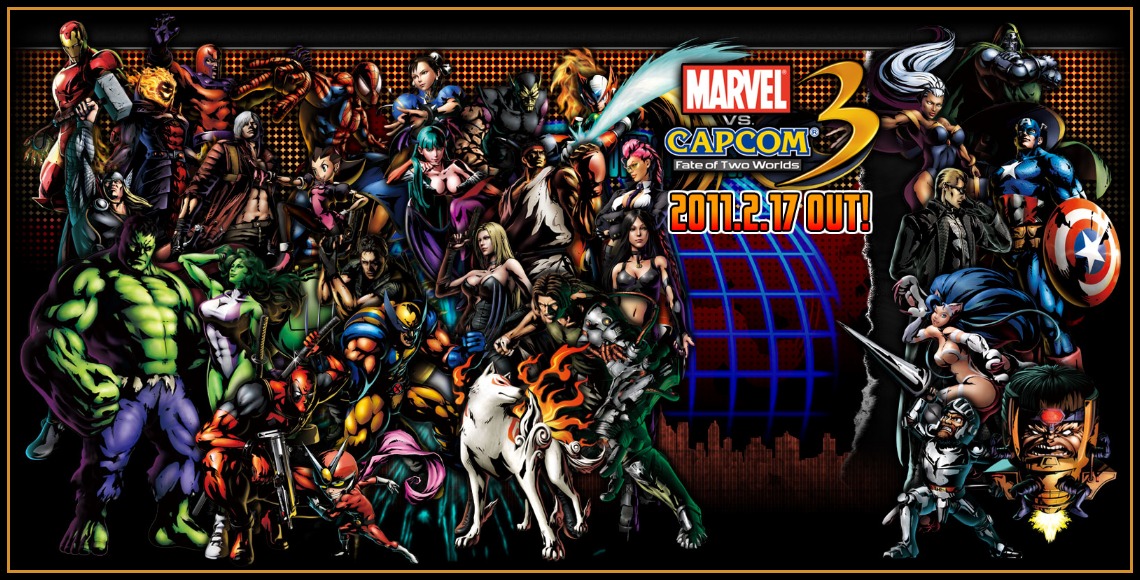
Game Review: Marvel vs. Capcom 3: The Fate of Two Worlds


The Bottom Line

It’s been over a decade (no, seriously! Marvel vs. Capcom 2 came out in 2000! It was on the Dreamcast!) since we last dropped into this remarkable franchise of fighting games. A lot of our favourite characters are missing, but the feel hasn’t changed.

Unfocused Ramblings

As usual, I like to begin these reviews with a boring story about my personal life. About ten years ago, a friend of mine owned the Sega Dreamcast. He never had a ton of games for it, and we all agreed that the controller was preposterously big, but it was probably the console that my group of friends and I played the most during that stretch. Because whatever we thought about the Dreamcast, and however few games there were on it, or however few my friend owned… he did own Marvel vs. Capcom 2. At this point, years later, I don’t even remember much about the fine details of the game. But I do remember its feel… and that feel has returned, to my hazy memory more or less intact, this year with the release of Marvel vs. Capcom 3: The Fate of Two Worlds. So now that I’ve played it, and the excitement is all flooding back to me, the unfortunate truth comes out: for all of its selling points (and it has them to spare) this game is not as much fun as its predecessor.

It’s not. You may think it is, and you may even be having more fun with it now… but it’s a matter of circumstance. And this game is not as much fun as the last one.

Does that mean that Marvel vs. Capcom 3 isn’t a great game? No. Actually, I’ve been impressed by basically everything that I have seen from the new title so far. It has the same feel of the old game. That hyper-frenetic superhero/comic book/action game and so on action is quite intact. You still have the hyper combo bars. You still have three different characters who are flying in and out of the action supporting one another and generally causing some havoc. You can still fill the screen with blasts of energy and crazy attack schemes that seem like no one could ever possibly survive them (and be just as disappointed to see that your opponent blocked in time). In other words, they’ve done a magnificent job of recreating what made Marvel vs. Capcom great. So we can say that this sequel is a faithful one. So what’s the problem?

I’m not sure this game translates as well to playing against faceless strangers on the internet as some of the other fighting games that have come out over time. Of course, it’s not a different experience on XBox Live (or the equivalent service of your choice) but this game, unlike other games, is a more intense frenetic experience and should be less about a cold, tactical approach. To me, this makes it more fun to play with friends than in multi-player match-making. Ultimately, that’s subjective, and if you like fighting games you should enjoy the multi-player experience here as well. Of course, whatever I may say about frenetic superhero/video game combat, the more skillful players of fighting games will still maintain a big advantage in this game due to the huge variety of combos available, even if the move-sets of each character are relatively simple. A lot of universal concepts translate across all characters (such as chaining together flashy aerial or team combos, and the counters to those moves).

The game does offer some options to help teach people about the game-play mechanics. If your fingers aren’t made of steel you may get frustrated attempting to execute long multi-team-mate-extravaganza type combos, but the mission mode (sort of a training mode with specific objectives as far as moves) encourages you to explore chaining moves together (from the basics of knocking a foe in the air and coming down on top of them with a crushing blow all the way to the aforementioned 500000 hit combos). I suspect that if you explore some of these modes, and trouble to learn the moves of a few favourite fighters, you’ll quickly get the hang of winning in this game.

Oh, and don’t be overly troubled by the absence of some Marvel vs. Capcom favourites. I’m sure they will all be available through DLC sooner or later. What’s that, you say? They announced that Jill Valentine and Shuma Gorath will appear as DLC characters even before launch? Let the games begin!

The Big Question

What were they thinking, not including characters like Megaman X? Presumably they were already looking at the prospect of selling DLC packages… but there is an infinite pool of characters to draw on between Marvel and Capcom. It still feels a little cheap to have excised some of the staples that we’ve been playing with since the first installment in the series.

Overall Game-Play

It’s a seamless game-play experience that has more than its fair share of flashy effects and super-cool sets of moves. My one gripe with the game on the whole is the inconsistency in move-sets between the characters, where some of the characters have a huge variety of diverse moves that can work in every situation… while other characters… are basically stuck with a signature move or two and a series of button combos. I can see how the innate attributes of the different fighters necessitate some of this for the purposes of balance, but it’s a little disappointing to find out that a personal favourite character has a lackluster move set. I suspect that this will be the exception rather than the rule for most players, but I do think it’s worth mentioning.

Graphics

It’s not visually breathtaking, but it has a certain (and to my mind, incredibly appropriate) style, and you won’t be disappointed by the attack animations. A ton of unlockable artwork accompanies the game in addition to the rendered character models, and there’s a lot to like with the visuals in this game. More important than the overall graphical presentation is probably the tightness of the experience, which doesn’t seem to have any glitches or bugs to it.

Sound

An upbeat main soundtrack accompanies unique themes for every fighter in the game as well as for the mighty Galactus. You’ll likely recognize a lot of the music as remixes on songs associated with the character in question (for example, Chun-Li’s appearance in a bout is accompanied by an overclocked remix of her battle theme from Street Fighter II) and you’ll probably come to appreciate a few favourites. I didn’t find the score forgettable which is a point in its favour. Obviously there’s not a ton of room for mood music in a fighting game, so the character themes and menu themes are essentially it. As for the voice acting, I haven’t encountered any voices that send me to my knees screaming at the heavens, and I take that to be a good sign. For a handful of bonus points, if you have some good surround sound and bass, you may be blown out of your seat by comments from Galactus, who addresses Thor with a hearty “If you are a god… then what shall we call Galactus!?” and other fun-loving quips.