A Movie A Day #196: Mercenary Fighters (1988, directed by Riki Shelach Nissimoff)


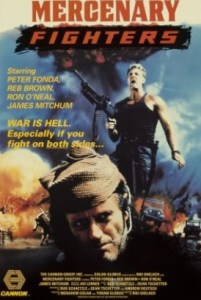
Everyone’s favorite hippie action hero, Peter Fonda, plays Virelli, a long-haired Vietnam vet turned mercenary who is hired by a corrupt African general (Robert Doqui) to protect the construction of a dam that will result in the flooding of a native village.  Got all that?  Though Fonda is top-billed, he is not the star of the film.  The star is Reb Brown, who plays T.J. Christian.  T.J. starts out as a member of Fonda’s team but then he falls in love with a nurse (Joanna Weinberg) and he switches sides.  The villagers need someone to lead their revolution and all it takes is hearing Reb Brown do one of his trademarks power yells to know that he’s the man for the job.  Reb Brown was famous for yelling whenever he did anything and he yells a lot in Mercenary Fighters, even more than he yelled in Space Mutiny.

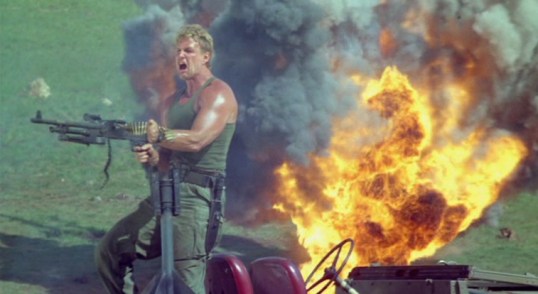
Mercenary Fighters is a typical Cannon film from the late 80s.  Like many of Cannon’s mercenary movies, it was covertly filmed in South Africa, at a time when apartheid was still being enforced and Nelson Mandela was still sitting in a prison cell.  (Cannon was not the only film company to secretly make movies in South Africa during the Apartheid Era.  They were just the most blatant about it.)  Richard Kiel apparently turned down Peter Fonda’s role.  It’s hard to imagine Kiel in the role but perhaps that’s because Virelli is a quintessential Peter Fonda-in-the-80s role.   Fonda glides through the film, delivering his lines like a California surfer who just smoked the kine bud.  The presence of Ron “Superfly” O’Neal and James “son of Robert” Mitchum serves to elevate the film’s cool factor while Robert Doqui brings some “I’ve worked with both Robert Altman and Paul Verhoeven” credibility to his one-note role.  Mercenary Fighters is good for anyone who is into either mindless Cannon action movies or Reb Brown yelling while shit blows up behind him.
Movie A Day #178: Kinjite: Forbidden Subjects (1989, directed by J. Lee Thompson)


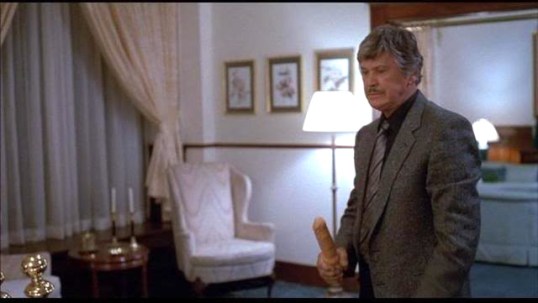
This is the one where Charles Bronson sodomizes a guy with a dildo.

Don’t worry, though.  Bronson does it off-screen and the guy was abusing Nicole Eggert so he had it coming.

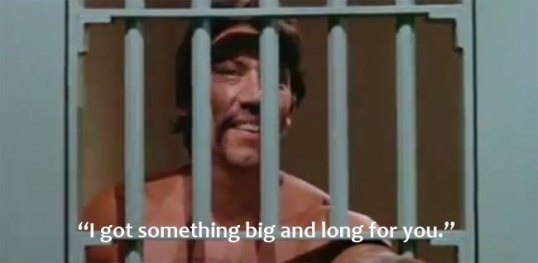
In Kinjite, Bronson plays Lt. Crowe, a tough LAPD vice cop who hates two groups of people: pedophiles (which is cool, who doesn’t hate them?) and the Japanese (which is not cool).  Not only does Crowe sodomize a pervert but he also forces a pimp to eat a gold watch and later, with the help of his partner, he holds another man over the edge of a balcony, just to have that man accidentally slip out of his shoes and plunge to his death.  Finally, Crowe tosses a convict into a prison cell, where another prisoner (played by Danny Trejo, in what may have been his film debut) announces that he’s “got something big and long for you.”  Crowe chuckles, “That’s justice” and then walks away.

Danny Trejo in Kinjite

Of the many strange films that Bronson made for Cannon Films, Kinjite may be the strangest.  The main plot involves Crowe searching for and rescuing the kidnapped daughter of a Japanese businessman (James Pax).  Before his daughter was kidnapped, the businessman groped Crowe’s fifteen year-old daughter on a city bus.  The entire movie seems to be building up to the moment that Crowe, who is portrayed as being overprotective of his daughter, discovers what the businessman did but that moment never comes.  There are numerous scenes of the businessman in Japan but they do not have anything to do with the rest of the plot.  Strangely, neither Crowe’s daughter nor his wife (played by Peggy Lipton) are ever menaced by the bad guys.  What type of Charles Bronson movie is this?

In Bronson’s defense, he was 71 year-old when he made this movie and, off screen, his wife Jill Ireland was battling the cancer that would eventually take her life.  Bronson can be excused for not appearing to be overly invested in Kinjite: Forbidden Subjects.  (Since Kinjite means Forbidden Subjects in Japanese, the actual title of this movie is Forbidden Subjects: Forbidden Subjects.)  No one appears to have made much of an effort on Kinjite, though Bronson’s stunt double gets a good work out.  Kinjite is full of scenes where Bronson throws a punch in close-up but his first in never actually shown connecting with anyone.  Most of the action scenes are clumsily filmed so that Crowe keeps his back to the camera.   All Kinjite needs is a supporting turn from Troy McClure and a cameo from McGarnagle and it would be perfect viewing for The Simpsons.

Kinjite would be the final film that Bronson made for Cannon Films.  It would also be the last Bronson film to be directed by J. Lee Thompson.  After Kinjite, Bronson appeared in two more feature films: Sean Penn’s The Indian Runner (which, if not for Penn’s pretentious direction, could have launched Bronson on a second career as a first-rate character actor) and a final Death Wish film.  Bronson returned to television, appearing in three made-for-TV movies before retiring in 1999.  Bronson died in 2003 but, as long as there are people who enjoy a good action movie, he will never be forgotten.

This scene is not from Kinjite but it’s still pretty fucking cool.

A Movie A Day #177: Murphy’s Law (1986, directed by J. Lee Thompson)


What is Murphy’s Law?

Let’s ask LAPD Detective Jack Murphy.

“Don’t fuck with Jack Murphy.”

Normally, having a law named after you would be pretty cool but it appears that this is just a law that Jack came up with himself.  Having to come up with your own law is kind of like having to come up with your own nickname.  Dude, it’s just lame.  Since Jack Murphy is played Charles Bronson, we can cut him some slack.

Murphy’s Law was one of the many film that, towards the end of his career, Bronson made for Cannon Films.  He played a detective in almost all of them.  Jack Murphy is Dirty Harry without the fashion sense.  He is also an alcoholic who cannot get over his ex-wife (Angel Tompkins) and her decision to become a stripper.  Not only has Murphy managed to piss off his superiors with his bad attitude but the mob is out to get him.  Everyone has forgotten Murphy’s Law.  Everyone is fucking with Jack Murphy.

Jack’s main problem, though, is Joan Freeman (Carrie Snodgress).  Years ago, Murphy sent Joan to prison for murder but, because it’s California and Jerry Brown appointed all of the judges, Joan gets out after just a few years.  Joan starts to systematically murder everyone that Murphy knows, framing Murphy for the murders.  Murphy’s arrested by his fellow cops, all of whom need a refresher on Murphy’s Law.  Though handcuffed to a young thief (Kathleen Wilhoite), Murphy escapes from jail and set off to remind everyone why you don’t fuck with Jack Murphy.

Murphy’s Law is a typical Cannon Bronson film: low-budget, ludicrously violent, borderline incoherent, so reactionary than it makes the Dirty Harry films look liberal, and, if you’re a fan of Charles Bronson, wildly entertaining.  Bronson was 65 years old when he played Jack Murphy so he cannot be blamed for letting his stunt double do most of the work in this movie.  What’s interesting is that, for once, Bronson is not the one doing most of the killing.  Instead, it is Carrie Snodgress, in the role of Joan Freeman, who gets to murder nearly the entire cast.  There is nothing subtle about Snodgress’s demonic performance, which makes it perfect for a Cannon-era Bronson film.  In fact, Carrie Snodgress gives one of the best villainous performances in the entire Bronson filmography.  There is never any doubt that Snodgress is capable of killing even the mighty Charles Bronson, which makes Murphy’s Law a little more suspenseful than most of the movies that Bronson made in the 80s.

Whatever else can be said about Murphy’s Law, it does feature one of Bronson’s best one liners.  When Joan threatens to send him to Hell, Murphy replies, without missing a beat, “Ladies first.”  Only Bronson could make a line like that sound cool.  That’s Bronson’s Law.

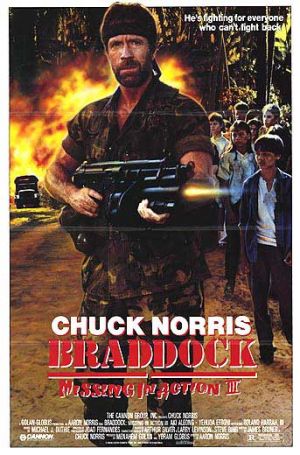
A Movie A Day #137: Braddock: Missing in Action III (1988, directed by Aaron Norris)


Chuck Fucking Norris, dude.  Chuck Norris is so cool that continuity bends to his will and thanks him for the opportunity.
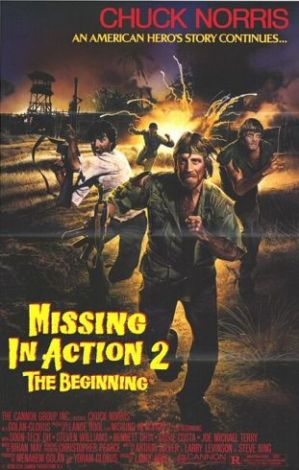
Need proof?

Just watch Braddock: Missing in Action III.

The third Missing in Action film starts in 1975, with the fall of Saigon.  The communists are taking over.  The Americans are fleeing Vietnam.  Colonel James Braddock (Chuck FUCKING Norris) is determined to bring his Vietnamese wife to America with him but, when she loses her papers and is not allowed to make her way to the American embassy, Braddock believes that she had been killed. (Keep an eye out for Keith David as the Embassy guard.  Only Chuck Norris could overshadow Keith David in a movie.)  Heartbroken, Braddock returns to the United States.

Every fan of the Missing in Action franchise knows better.  We all know that Chuck was in a POW camp when Saigon fell.  In Missing in Action 2, he and his fellow prisoners did not even know if the war had ended.  Also, Chuck mentioned having a wife waiting for him back in the United States.  What gives?

I can think of only two possible explanations.

Either Chuck Norris and Cannon Films did not care about continuity

or

Chuck Norris is so cool that, in order to prevent his collected coolness from knocking the Earth off of its axis, the U.S. Army split Chuck’s coolness in half by creating a clone.  One clone spent ten years in a POW camp.  The other clone escaped during the Fall of Saigon but had to leave behind his wife.

Thirteen years later and back in the U.S., Chuck is contacted by Reverend Polanski (Yehuda Efroni), who tells him that his wife is still alive in Vietnam and that he has a 12 year-old son.  Chuck’s boss at the CIA tells him that, under no circumstances, is Chuck to go to Vietnam.

Anyone who thinks they can tell Chuck Norris what do is a fool.

Chuck goes to Vietnam and is reunited with his wife and son.  Unfortunately, when Chuck tries to get his new family out of the country, they are captured by sadistic General Quoc (Aki Aleong).  Again, Braddock must escape from a Vietnamese prison camp.

Braddock: Missing in Action III was co-written by Chuck Norris and it was directed by his brother, Aaron.  It’s a Norris production all the way, which means a lot of heroic shots of Chuck and a lot of bad guys wondering why Chuck is so much better than them.

Braddock was released four years after the first Missing in Action but, more importantly, it was released two years after Oliver Stone’s Platoon changed the way that movies dealt with the war in Vietnam.  By the time that Braddock came out, films in which lone American refought and single-handedly won the war were no longer in fashion.  Braddock was a flop at the box office and it ended the franchise.  However, continuity errors aside, Braddock is actually the best of the Missing in Action films.  It features Chuck’s best performance in the series and Chuck searching for his wife and child gives Braddock more emotional weight than the first two Missing in Action films. Maybe Chuck should have co-written and selected the director for all of the films he made for Cannon.

Chuck Norris, dude.

Chuck Fucking Norris.

A Movie A Day #136: Missing in Action 2: The Beginning (1985, directed by Lance Hool)


Goddamn, dude.  Chuck Fucking Norris.  Even when the movie is terrible, Chuck is cool.
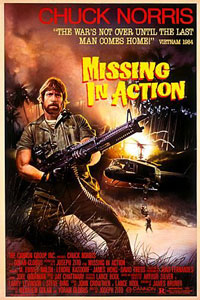
That is especially relevant when it comes to a movie like Missing In Action 2: The Beginning.  Produced by Cannon Films and shot back-to-back with the first Missing in Action, The Beginning was supposed to come out first.  However, Menahem Golan and Yoram Globus took a look at the two movies and realized that The Beginning would work better as the 2nd film in the series.  They were right though some post-production tinkering did lead to some serious errors in continuity.

(Not that anyone watching a Golan/Globus production would be worrying about continuity.)

Did you ever wonder how James Braddock (Chuck Norris) became a POW in the first place?  No?  Missing In Action 2 is going to show you how it happened anyway.  It turns out that he and his men were captured, in 1972, by the Viet Cong when their helicopter crashed into a lake.  At the start of the movie, Chuck only has a mustache.  If Chuck had been fully bearded, there is no way the VC could have captured him.  After Chuck and his men have spent ten years in a jungle prison, where they are forced to pick poppies for a French heroin drug lord, Chuck has grown a full beard and is finally strong enough to escape from the prison, rescue his men, and defeat the sadistic camp commandant (Soon-Tek Oh) in hand-to-hand combat.  None of it is surprising but there’s enough weird stuff, like the prostitutes that the French drug dealer flies into the camp and the Australian journalist who shows up out of nowhere and is executed ten minutes later, to keep it interesting.  Chuck is as stiff as always but he’s good in the action scenes and gets to show off some sweet karate moves towards the end of the movie.  Supposedly, Chuck viewed the Missing in Action films as a tribute to his brother, Wieland, who was killed in Vietnam.

The continuity error has to do with the amount of time that Braddock and his men spend in the camp.  After Chuck is captured in 1972, the film inserts some footage of Ronald Reagan giving a speech about the men who never returned from Vietnam.  A narrator says that the Americans are still wondering what happened to the thousands of soldiers who were reported as being MIA in Vietnam.  The implication is that Chuck and company spent ten years in the POW Camp, which means that they escaped in 1982.  Since it is said, in Missing in Action, that it has been ten years since Chuck escaped, that means that Missing in Action actually took place in 1992.  But if Chuck and the boys escaped and returned to America in 1982 then why, in 1992, was everyone so convinced that all the POWs were released immediately after the Vietnam War?

Fortunately, Chuck Norris is so cool that it doesn’t matter what year it is.

Chuck Norris, man.

Chuck Fucking Norris.

A Movie A Day #135: Missing in Action (1984, directed by Joseph Zito)


Chuck Fucking Norris, man.  Is there anything this man can not do?

In Missing in Action, he plays Colonel James Braddock, an army intelligence officer.  For a career military man, his long hair and his beard are definitely against regulations but who is going to tell Chuck Norris to get a haircut?  Ten years ago, Braddock escaped from a POW camp in North Vietnam.  Haunted by nightmares and still convinced that there are American POWs in Vietnam, Braddock is inspired by an episode of Spider-Man and his Amazing Friends (I am not joking!) to accompany a U.S. Senator on a fact-finding trip to Ho Chi Minh City.  It’s there that Braddock uncovers evidence that American soldiers are being held prisoner by the evil General Trau (James Hong).  With the government refusing to help him, Braddock is forced to go to Thailand, where he hooks up with an old friend, a former soldier turned black marketeer named Tuck (M.  Emmett Walsh).  Braddock and Tuck head into the jungle, to both rescue the POWs and to remind the world that, no matter what a bunch of pointy-headed lefties might say, Americans never lose a war!

A blatant rip-off of the Rambo films, Missing in Action was one of Cannon Films’ most financially successful movies.  Seen today, Missing in Action is borderline xenophobic and it takes forever for the action to really get started.  I was surprised by the number of scenes that were devoted to Braddock looking for evidence that the POWs were still in Vietnam, as if there was ever any real suspense about what Braddock would find.  (No POWs = no movie.)

On the positive side, once it finally starts, the action is exciting.  Joseph Zito was a veteran genre director and he know how to handle a battle scene.  Unfortunately, in this one, Chuck does most of his fighting with a machine gun instead of his hands.  This is also one of the first movies where Chuck Norris has the full beard going.  The beard serves to distract from what a stiff actor Chuck Norris usually was and it does its job in Missing in Action.  When it comes to picking a Chuck Norris film to watch, it’s a good idea to see how much facial hair will be featured.  If Chuck has a beard, definitely watch.  If Chuck only has a mustache, proceed with caution but, if there’s nothing else to watch, give the movie a chance.  If Chuck is clean-shaven and Bruce Lee is nowhere to be seen, throw the movie back and never speak of it again.

Missing in Action was shot back-to-back with what eventually became known as Missing in Action 2: The Beginning.  Originally, The Beginning was meant to be released first and Missing in Action was intended to be a sequel.  However, once the execs at Cannon saw the footage, they deemed The Beginning to be unreleasable and instead sent Missing in Action out to theaters.  (A movie so bad that even Cannon was hesitant to release it?  It boggles the mind.)  Missing in Action was such a box office success and The Beginning was subsequently released as a prequel.  However, when it comes to Norris/Cannon films, Invasion USA is the one to watch.  That one has a bearded Chuck and Richard Lynch!

A Movie A Day #134: America Ninja 3: Blood Hunt (1989, directed by Cedric Sundstrom)


Is an American Ninja film still an American Ninja film if it doesn’t feature the American Ninja?

That is the question posed by American Ninja 3: Blood Hunt.  Michael Dudikoff, who played Joe Armstrong in the first two films, is nowhere to be found.  Instead, he has been replaced by Doug Bradley.  Fortunately, the movie does not try to pass Bradley off as being Joe Armstrong.  Instead, he is a new character, CIA agent Sean Davidson.  Sean’s father was a martial arts champion who was killed by gangster while Sean watched.  Sean later went to Japan where he was trained in the ways of the ninja.  Sean is an American ninja, even if he’s not the American Ninja.

He also happens to be best friends with Jackson (Steve James), who previously appeared in the first two films and who never comments on the coincidence of having two best friends who both happen to be American ninjas.  Jackson, along with sidekick Dexter (Evan J. Klisser) and lady ninja Chan Lee (Michele B. Chan), team up with Sean after Sean’s sensei is kidnapped by a terrorist known as The Cobra (Marjoe Gortner).  The Cobra, who has a team of his own ninjas, has developed a poison that he wants to test on Sean.

The plot makes as much sense as the previous two American Ninja films and, somehow, everyone forgets about finding the sensei before the movie ends.  As an actor, Doug Bradley is no Michael Dudikoff (which is saying something) but he’s good in the fight scenes and that is the only thing that really matters.  The whole film is nearly worth it just to see former child evangelist Marjoe Gortner in the role of The Cobra.  Dudikoff is missed but at least his absence meant that Steve James got to do more in American Ninja 3 than he did in the first two films.  Sadly, just three years after this film’s release, James died as the result of pancreatic cancer.  He was 41 years old.

A Movie A Day #133: American Ninja 2: The Confrontation (1987, directed by Sam Firstenberg)


Duuuuuuuuude!  The American Ninja is back!
In this sequel to the first American Ninja, ninja Joe (Michael Dudikoff) and sidekick Jackson (Steve James) are now Army Rangers.  They have been assigned to provide security at an embassy on a small Caribbean island.  At first, it seems like an easy gig but then Joe discovers that a large number of Marines have recently vanished.  According to the only witness, they were abducted by men dressed in black.  Joe and Jackson know what that means!

The Marines are being set up by a traitor in their own ranks, Tommy Taylor (played by Miguel Ferrer look-alike Jonathan Pienaar).  Taylor is being blackmailed by a master criminal known as, I kid you not, Leo the Lion (Gary Conway, who also co-wrote the script).  Leo is brainwashing the Marines, shooting them up with all sorts of drugs and transforming them into zombie-style ninjas.

Doing away with any pretense towards reality, American Ninja 2 is pure comic book action.  A bad guy even says, “It’s the American Ninja!” when he sees Joe.  It’s a strange film.  On the one hand, it is full of goofy humor and it even has a streetwise kid sidekick, all things that would indicate that it was made to appeal to kids.  On the other hand, the first cut was reportedly so violent that it got a dreaded X-rating.  The final version still has enough impalings, decapitations, and throwing stars to the head to earn its R.

With its combination of nonstop action and Steve James one-liners, American Ninja 2 is both a worthy sequel and a worthy addition to the Cannon library.  Still, it bothers me that at least a few of the ninjans that Joe and Jackson killed were probably just brainwashed Marines.  That amounts to a lot of innocent victims being killed by our heroes.

The life of an American ninja is never an easy one.

A Movie A Day #132: American Ninja (1985, directed by Sam Firstenberg)


Hell yeah!

From Yoram Globus and Menahem Golan, the duo who were responsible for producing the coolest films of the 1980s, comes American Ninja!

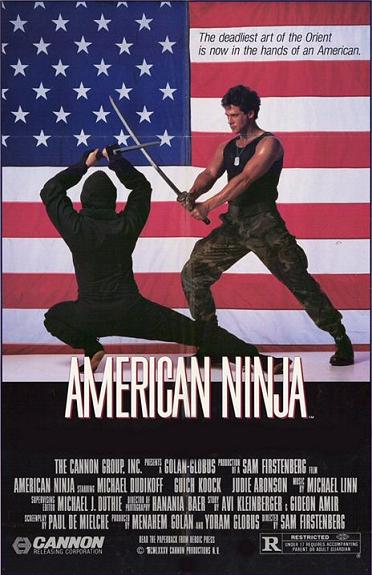
Private Joe Armstrong (Michael Dudikoff) is the newest arrival on an American army base in the Philippines.  A former member of a street gang, he has been forced to enlist in the army in order to keep himself out of jail.  Because he keeps to himself, the other soldiers do not like him.  Colonel Hickock (Guich Kook) is angry that his daughter, Patricia (Judie Aronson), likes Joe and conspires to have Joe court martialed.  Joe’s only friend is Corporal Jackson (Steve James), who starts out as an enemy but changes his ways after Joe shows off some sweet martial arts moves.  Because Joe is an amnesiac, he does not know where or why he learned how to fight.  He just knows that he can.

It’s good that he can because the local black marketer, Ortega (Don Stewart) has hired the legendary Black Star ninjas to help him steal supplies from the base.  Ortega has even allowed the ninjas to set up a training camp in his back yard.  When Joe prevents the ninjas from kidnapping Patricia, the ninjas swear revenge.

As if there could possibly be any doubt, American Ninja was made and distributed by Cannon Films.  It is about as pure an example of the Cannon aesthetic as anyone could hope to find.  Find a star — in this case, Michael Dudikoff — who was credible without being expensive.  Give him a love interest who was easy on the eyes and who could get held hostage during the film’s climax.  Toss in slow motion stunt work, big explosions, and Steve James.  Come up with a title that would appeal to both NASCAR-loving patriots and drive-in movie fans.  End result: American Ninja!

As a film, American Ninja get the job done and then some.  The fights are well-choreographed and the movie does not allow things like character development or subtext to get in the way of showcasing plenty of ninja action.  There are enough weird details, especially after Joe dons the black pajamas of the American Ninja, to keep the move interesting.  At one point, a ninja literally vanishes and what’s cool is that no one acts surprised when it happens.  Long before Crouching Tiger, Hidden Dragon, American Ninja showed that there’s nothing a ninja can’t do!

One final note: Keep an eye out for my favorite scene, in which a slow-moving jeep bumps into a tree and explodes with all the force of a planet that’s just been zapped by the Death Star.

A Movie A Day #42: Hero and The Terror (1988, directed by Steve Tannen)


hero_and_the_terror_posterDanny O’Brien (Chuck Fucking Norris!) is a tough Los Angeles cop who has been nicknamed Hero.  Danny hates it when people call him “Hero.”  Maybe if Danny knew what people usually call cops, he would not complain so much about his nickname.  Three years ago, Danny captured Simon Moon (Jack O’Halloran), a neck-breaking serial killer nicknamed “The Terror.”  After he was captured, The Terror faked his own death and disappeared.  He ended up living in a deserted theater and not bothering anyone until the Mayor of Los Angeles (Ron O’Neal, Superfly himself!) decides to tear down his new home.  The Terror does not take kindly to urban renewal and goes on another killing spree.  Can Hero track down and beat the The Terror while also making it to the hospital in time to see his girlfriend give birth to their baby?

Not surprisingly, Hero and the Terror is one of the films that Chuck made for Cannon Films in the late 80s and, along with Chuck and Ron O’Neal, it features Cannon regulars Steve James and Billy Drago.  (Billy Drago actually plays a good guy, for a change.)  It’s obvious that Chuck was trying to broaden his horizons with Hero and the Terror: with the exception of the final confrontation between Hero and the Terror, there’s less kung fu action than in his previous films and a lot of the movie is dedicated to his relationship with his girlfriend and his struggle to handle her pregnancy.  That’s all good and well and the Chuck Norris of Hero and The Terror is a much better actor than the Chuck Norris who could barely deliver his lines in Breaker, Breaker but, ultimately, a Chuck Norris movie with more human interest and less roundhouse kicks just feels wrong.

(On Netflix, there’s a whole documentary about how Chuck Norris’s roundhouse kicks led to the collapse of Nicolae Ceaușescu’s communist dictatorship in Romania.  It’s called Chuck Norris vs. Communism.  Communism didn’t have a chance.  Hopefully, Chuck will never turn against capitalism because, if he does, it’ll probably lead to another stock market crash.)

I once read an interview with Gene Hackman, in which he was asked to name his least favorite of the movies that he had made.  Hackman selected March or Die.  “I can’t believe I was in something called March or Die,” Hackman said.  If he thought March or Die was a bad title, he should be happy that he didn’t end up in Hero and The Terror.  Give Chuck Norris credit.  Even if he’s not Gene Hackman and even if the movie does not really work, he is the only actor who could credibly star in something called Hero and the Terror.