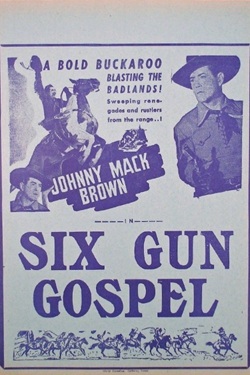
Six Gun Gospel (1943, directed by Lambert Hillyer)


Marshals Nevada Jack McKenzie (Johnny Mack Brown) and Sandy Hopkins (Raymond Hatton) are sent to the frontier mining community of Goldville to determine who is responsible for hijacking all of the gold that should be coming out of the town.  Not surprisingly, it’s all the work of another dastardly saloon owner (Kenneth MacDonald) who is planning on stealing all the gold, chasing off all the settlers, and then selling their land to the railroad company.  While Sandy goes undercover as the town’s new preacher, Jack agrees to ride shotgun on a gold shipment, along with with Dan Baxter (Eddie Drew).  Dan is in love with Jane Simms (Inna Gest), the daughter of honest miner Bill Simms (Kernan Cripps).

Johnny Mack Brown made a countless number of westerns for several different production companies but it seems like they always featured a crooked saloon owner and a plan to sell the land to a railroad company.  Luckily, nobody watches these movies for the plots and that was probably true even when they were first released.  People watch these movies for the nostalgia value of watching a movie where it’s good vs evil and good always triumphs without leaving any sort of lingering doubt about whether or not the heroes did the right thing.  Johnny Mack Brown is as authentic on a horse and carrying a gun as he ever was and there’s a scene where he manages to get a gun despite being tied up that’s pretty cool.  The appeal of Johnny Mack Brown was that he always seemed like he could do the things that he did in the movies in real life as well.  Raymond Hatton provides comic relief, pretending to know the hymns being sung by his congregation and providing some songs of his own.  There’s enough gun fights and horse chases to provide nostalgic happiness for fans of the genre and that’s the important thing.

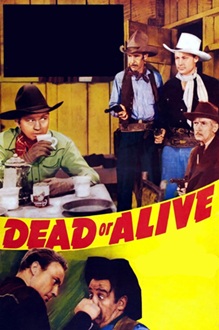
Dead Or Alive (1944, directed by Elmer Cifton)


In this Poverty Row western, the Texas Rangers, a trio of western do-gooders who appeared in a handful of films, are sent to a small town to stop the Yackey Gang, led by the town’s saloon keeper (Ray Bennett).

The Texas Rangers are led by Tex Haines (Tex Ritter), who is known as the Idaho Kid despite apparently being from Texas.  Tex goes undercover as a lawyer and tries to rally the community to stand up the Yackey Gang.  Tex also sings some songs because he’s a singing cowboy along with being a cowboy who can hold his own in bar brawl.  Maybe if he didn’t sing so much, there wouldn’t be as many brawls.  Dave Wyatt (Dave O’Brien) is the younger Ranger who goes undercover and joins that Yackey Gang.  Panhandle Perkins (Guy Wilkinson) is the comic relief, who loses a lot of money at Yackey’s casino but only to help Dave maintain his cover.  The film was an obvious rush job and the plot is far more difficult to follow than any 54-minute film should be.  The kids at the matinee probably enjoyed it, though.  It delivers exactly what fans of the old B-westerns expect, including Charles King as yet another villain.

Tex Ritter, who appeared in a lot of these films, was also the father of actor John Ritter.  In 1970, long after the days of the poverty row westerns, Tex Ritter ran for the Senate in Tennessee but he lost the primary.  If he had won, he would have been the Republican candidate against Al Gore’s father.  That would have been a battle for the ages.

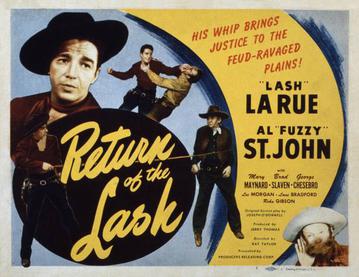
Return of the Lash (1947, directed by Ray Taylor)


There’s another range war brewing on the frontier.  Big Jim Kirby (George Chesebro) knows there’s plans for a new railroad so he wants to steal the land from the ranchers so he can make a fortune off a selling it.  Kirby calls in everyone’s mortgage, knowing they’ll never be able to pay.  Rancher Tom Grant (Buster Slaven) reaches out to Cheyenne Davis (Lash LaRue, a look alike for Humphrey Bogart)) and Fuzzy Q. Jones (Al St. John) for help.  Cheyenne raises the money but then he makes the mistake of trusting Fuzzy to deliver it.  Fuzzy takes a knock to the noggin and now, he’s got amnesia.  Where’s the money?

This is a standard B-western and you know the drill.  Big Jim’s henchmen don’t want that money to get paid.  Cheyenne is on the side of the angels.  Fuzzy provides comic relief.  Lash LaRue appeared in several B-westerns.  He never became as big a star as some of his contemporaries but he did have a gimmick that made him memorable.  Most westerns stars used guns.  LaRue had a bullwhip.  When LaRue was first offered the role of Cheyenne, he lied and said he could crack a whip.  After he struggled to teach himself, tiny production company PRC hired a professional trainer.  That was a huge expense for a poverty row studio but it paid off because LaRue became proficient with the whip and he had a surprisingly long career.  He was born Alfred LaRue.  The studio came up with the Lash nickname.  Many western stars, like Johnny Mack Brown, played characters who shared their name.  Lash almost always played Cheyenne Davis.

Lash LaRue’s movies were cheap and never that memorable.  In this one, Lash barely appears and most of the action is carried out by Al St. John as Fuzzy.  But Lash LaRue did play an important part in Hollywood history when he briefly came out of retirement to teach Harrison Ford how to crack a whip for a little film called Raiders of the Lost Ark.

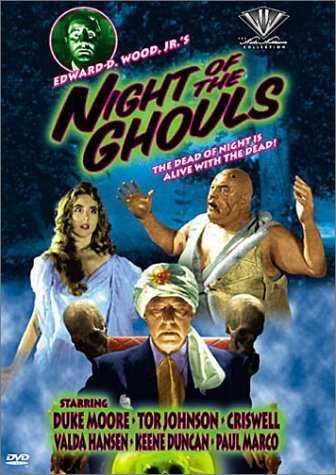
Horror on the Lens: Night of the Ghouls (dir by Edward D. Wood, Jr.)


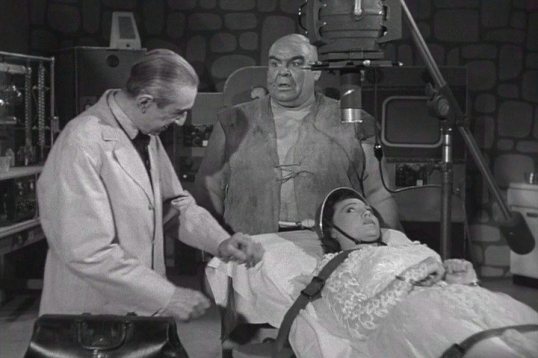
GhoulsdvdToday we celebrate Ed Wood’s 100th birthday with his sequel to Bride of the Monsters.  In Night of the Ghouls, con man Dr. Alcula (Kenne Duncan) moves into Bela Lugosi’s old mansion and pretends to talk to the dead.  What Alcula doesn’t realize is that the house is actually haunted (by Tor Johnson’s Lobo, among others) and real ghosts don’t appreciate pretend ghosts.

What can you say about a film like of Night of the Ghouls?  It’s an Ed Wood film, with all that suggests.  However, how can you resist a film that starts with Criswell sitting up in his coffin and providing commentary?

The role of Dr. Alcula was originally written for Bela Lugosi.  After Lugosi’s death, veteran actor and longtime Wood friend Kenne Duncan got the role instead.  Also of note, Wood appears twice in this film.  Not only does his picture appear on a wanted poster in the police station but Wood also plays one of the ghouls.

Horror on the Lens: Bride of the Monster (dir by Edward D. Wood, Jr.)


Bride of The Monster (1955, dir by Ed Wood)

Since tomorrow will be the great man’s birthday, it seems appropriate that today’s horror film on the lens is Edward D. Wood’s 1955 epic, Bride of the Monster.

(Much like Plan 9 From Outer Space, around here, it is a tradition to watch Bride of the Monster in October.)

The film itself doesn’t feature a bride but it does feature a monster, a giant octopus who guards the mansion of the mysterious Dr. Vornoff (Bela Lugosi).  Vornoff and his hulking henchman Lobo (Tor Johnson) have been kidnapping men and using nuclear power to try to create a race of super soldiers.  Or something like that.  The plot has a make-it-up-as-you-go-along feel to it.  That’s actually a huge part of the film’s appeal.

Bride of the Monster is regularly described as being one of the worst films ever made but I think that’s rather unfair.   Appearing in his last speaking role, Lugosi actually gives a pretty good performance, bringing a wounded dignity to the role of Vornoff.  If judged solely against other movies directed by Ed Wood, this is actually one of the best films ever made.

(For a longer review, click here!)

Landrush (1946, directed by Vernon Keays)


Steve Harmon (Charles Starrett) rides again!  This time, he’s investigating the murder of a Pony Express rider.  The murderer is outlaw leader Claw Hawkins (Bud Geary), who is working with rancher Kirby Garvey (Steve Barclay) to cheat the local homesteaders out of their land.

When local newspaper editor Jake Parker (Emmett Lynn) is attacked for trying to expose Claw Hawkins, Steve puts on a mask and dark clothing and, as the Durango Kid, he moves Jake to the carpentry shop owned by Durango’s old friend, Smiley Burnette.  While Jake continues to spread the word to the homesteaders, Durango works to prevent Claw and Kirby from taking all of the land for themselves.

This is a typical Durango Kid film.  This is not the first time that I’ve seen the Durango Kid protect the rights of homesteaders and, as usual, the main villain is not the outlaw that everyone fears but the respectable citizen who is controlling him.  Along with the usual gunfights and horse chases, Landrush has an exciting sequence where Durango and the homesteaders have to deal with a series of fires that have been set by Claw to keep the homesteaders from reaching their land.  Charles Starrett is as authentic a cowboy as ever.  Unfortunately, Bud Geary and Steve Barclay aren’t very interesting as the villains.  People who have watched several Durango Kid films will regret that series regulars Frank Fenton and Jock Mahoney weren’t cast in the roles.

As usual, Smiley Burnette provides comedy relief and sings two songs.  This time, he’s accompanied by Ozie Waters and His Colorado Rangers.

Six-Gun Law (1948, directed by Ray Nazarro)


Steve Norris (Charles Starrett) has moved to a new frontier town and is making a good living as a cattle rancher.  The sheriff (Ethan Laidlaw) takes a dislike to Steve and even accuses him of being a cattle rustler.  Steve is so angered that he plays right into the hands of Decker (Hugh Prosser), a corrupt businessman who secretly puts blanks into Steve’s gun and then tricks Steve into thinking that he has shot and killed the sheriff.

Decker appoints Steve as the new sheriff but demands that Steve do exactly what Decker orders him to do.  If Steve actually enforced the law, Decker will turn him in as the first sheriff’s murderer.  Steve may not be able to do anything about Decker’s crimes but his alter ego, The Durango Kid, can!  As always, working with Steve is his loyal sidekick, Smiley Burnette.

The stand-out set piece of this Durango Kid film is an exciting stagecoach chase, which features the Durango Kid (in the form of legendary stuntman Jock Mahoney) making some thrilling moves.  The scene was so exciting and popular that it was used in a dozen other Durango Kid films.  These movies were never shy about reusing good scenes, effective stunts, and plot twists.  (It’s easy to lose track of how many times Steve has been appointed as sheriff of a town.)  This was also neither the first nor the last time that Hugh Prosser and Robert Wilke would play bad guys in a Durango Kid movie.  However, this is the only Durango Kid film to feature the Rodeo Rangers providing musical accompaniment  to Smiley Burnette’s songs.

Six-Gun Law will be best appreciated by fans of the western genre.  Charles Starrett is as tough and authentic a cowboy as always and the storyline has some nice twists and turns.  For once, with Steve being blackmailed by Decker, it makes sense that Steve would put on his disguise and solve his problems as the Durango Kid.

The Desert Horseman (1946, directed by Ray Nazarro)


Steve Godfrey (Charles Starrett) is in trouble again.  He has been accused of stealing another payroll and the only man who can clear his name has just been murdered.  Steve thinks that he is being set up by outlaws who want to take control of the dead man’s ranch, which is now owned by Mary Ann Jarvis (Adele Roberts).

Luckily, Steve’s old friend, Smiley Burnette, is working as a cook at the Jarvis Ranch.  When Smiley isn’t singing songs with the Colorado Hillbillies, he tries to help Steve clear his name.  He explains that Mary Ann Jarvis won’t listen to Steve but maybe she’ll listen to Steve’s alter ego, The Durango Kid!

Durango rides again in this movie, though, the majority of the hour runtime is made up of Smiley Burnette singing songs and making jokes.  Smiley Burnette is not for everyone.  I enjoy the broad humor he brought to these films but I can understand why others might not.  Whenever Smiley sings a song, it does bring the action to a halt but that’s true of every Durango Kid film.  If you’re a fan of the series, you either like Smiley or you can at least tolerate him.  Smiley does do more than just sing in this movie.  He also throws black pepper in the eyes of one of the bad guys.

Even with all of the attention paid to Smiley, The Desert Horseman delivers all of the expected horse chases and gunfights.  The story is a little more interesting than usual.  Steve has been framed for not one but two crimes that he didn’t commit and that adds some urgency to the proceedings.  Charles Starrett, as always, is a believable western hero and he takes the role seriously.


The Stranger From Ponca City (1947, directed by Derwin Abrahams)


After spending the past few years cleaning up the west, Steve Leary (Charles Starrett) rides into the town of Red Mound and says that he is ready to buy a ranch and settle down.  What Steve finds is an unfriendly town that is divided between law-abiding citizens on one side and cattle rustlers on the other.  The cattle rustlers want to prevent Steve from purchasing the old Atkins ranch and they’ll do anything to keep the deed from being signed over.  It’s a good thing that Steve also happens to be the legendary Durango Kid.

This is a standard entry in the Durango Kid series.  To me, it’s interesting to see that, even though Steve seems like he wants to settle down and live a peaceful, ranching life, he still can’t bring himself to give up his secret identity.  It is also interesting that Steve cannot escape Smiley Burnette.  This time, Smiley is the owner of Red Mound’s restaurant and he’s accompanied by Texas Jim Lewis and the Lone Star Cowboys.  It seems like Smiley sings even more than usual in this entry.

I liked the opening of The Stranger From Ponca City, in which Steve rides into town and all of the townspeople demand to know which side of Red Mound he supports.  Smiley even explains that food made on one side of the town cannot be taken to the other without it leading to violence.  After the opening sequence, The Stranger From Ponca City focuses on all of the usual horse chases and gunfights that showed up in all of the Durango Kid films.  Most of the Durango Kid stock company shows up as well.  Keep an eye out for Jock Mahoney, playing a bad guy with Kermit Maynard.

Director Derwin Abrahams keeps things moving, even if his direction is not up the level of the work of Durango’s usual directors, Ray Navarro and Fred F. Sears.  This isn’t the best of the Durango Kid films but fans of the genre should enjoy it.

Bonanza Town (1951, directed by Fred F. Sears)


The frontier community of Bonanza Town has been taken over by the corrupt businessman, Krag Boseman (Myron Healey).  No one can stand up to Krag because the local judge (Luther Crockett) is under Boseman’s control.  The judge’s son (Ted Jordan) writes to the Durango Kid and asks him to come to Bonanza Town and lead a group of vigilantes to overthrow Boseman.

The Durango Kid, whose real name is Steve Ramsay (Charles Starrett) somehow receives the letter and heads into town.  As Steve, he gets a job working for Boseman and looks for evidence that Boseman is actually being bankrolled by a notorious outlaw named Henry Hardison (played by the film’s director, Fred Sears).  As the masked Durango Kid, he defuses the vigilante’s violent plan and, with the help of Smiley Burnette, he investigates what Boseman has on the judge.

Charles Starrett played the Durango Kid in 131 films.  In fact, he appeared in so many movies that the majority of Bonanza Town is made up of flashbacks from 1947’s West of Dodge City.  Despite all of the flashbacks, Bonanza Town is one of Starrett’s better films, featuring an interesting story and good performances from both Fred Sears and Luther Crockett.  Sears shows some imagination with his staging of the many gunfights and, as always, Starrett is convincing riding a horse and carrying a gun.

Bonanza Town is a fairly serious film and Smiley Burnette’s trademark comedic relief feels out of place but the kids in 1951 probably enjoyed it.  While everyone else is shooting guns and committing murder, Smiley is running his barber shop and turning a potato into a musical instrument.  While the Durango Kid dispenses frontier justice, Smiley sings a song and leaves his customers bald.  They were a good team.