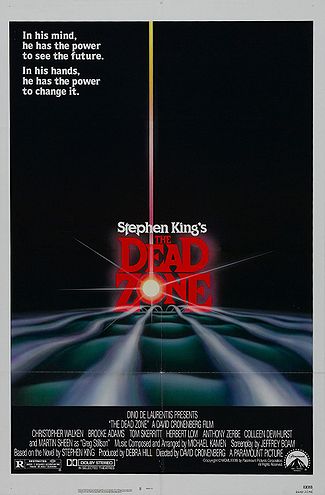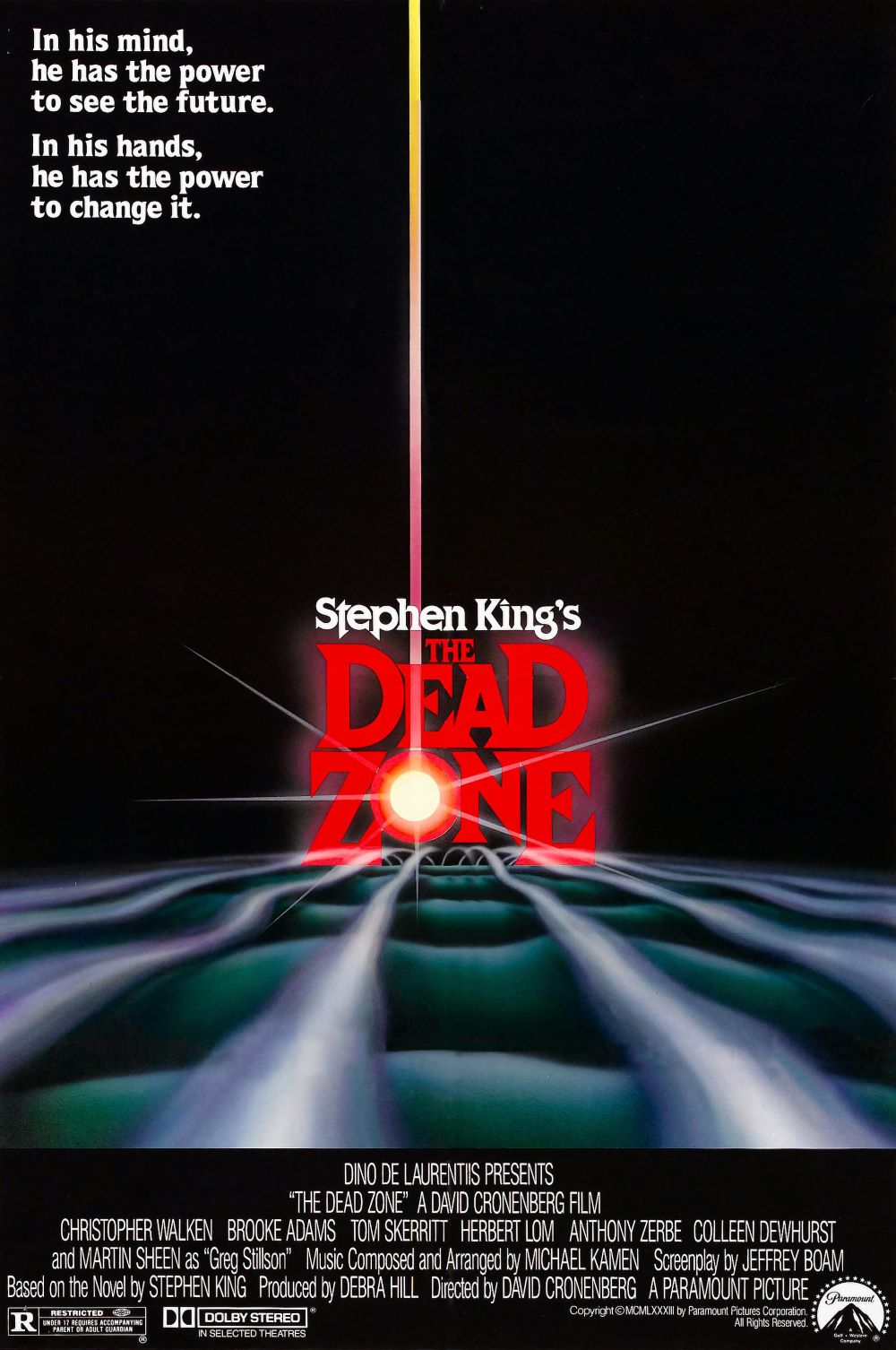
Horror Review: The Dead Zone (dir. by David Cronenberg)


“Bless me, Father, for I have sinned. I had the power… and I tried to prevent what I saw.”Johnny Smith

In 1983, David Cronenberg adapted Stephen King’s The Dead Zone with a distinctive emphasis on mood, morality, and psychological depth rather than traditional horror spectacle. The film follows Johnny Smith (Christopher Walken), a small-town schoolteacher whose life transforms irrevocably after a traumatic car accident leaves him in a five-year coma. Upon awakening, Johnny discovers he possesses psychic abilities that allow him to see the past and future by touch. Rather than a gift, this power becomes a heavy burden, isolating him and forcing him into wrenching moral choices.

Cronenberg’s direction is meticulous and deliberately restrained. The film’s muted color palette and stark winter landscapes visually echo Johnny’s emotional isolation and the fragility of human existence. His careful, often gliding camera movements create a mounting sense of quiet dread, while minimalistic sound design underscores moments of revelation with haunting subtlety. This subdued style elevates the film’s psychological impact, transforming it into a thoughtful and melancholy meditation on the cost of harrowing knowledge.

Significantly, The Dead Zone marks a departure from Cronenberg’s signature body horror. Instead of the grotesque physical transformations and visceral mutations that characterize much of his other work, here Cronenberg turns inward. The real horror lies in the malleability of the mind and the elusive nature of perception—how reality, memory, and the future are unstable constructs that can shift and fracture under psychic strain. This thematic focus on the impermanence and distortion of mental reality touches on some of Cronenberg’s deepest artistic fascinations.

The restrained treatment of body horror in The Dead Zone previews the director’s later, more psychologically driven films such as A History of ViolenceEastern Promises, and A Dangerous Method, where character studies and narrative depth take precedence over startling visuals. In this early pivot, Cronenberg demonstrates that his mastery lies not only in visual spectacle but in probing the profound emotional and moral dilemmas faced by his characters. The vision-focused horror here is cerebral and grounded, rooting supernatural phenomena in human frailty and ethical complexity.

Christopher Walken’s nuanced portrayal is the emotional heart of the film. He captures Johnny’s vulnerability, weariness, and profound solitude, portraying a man burdened by a cursed knowledge that isolates him from the world. Martin Sheen plays Greg Stillson, the ambitious and morally bankrupt politician whose rise Johnny must foretell and who embodies the film’s central threat. The supporting cast, including Brooke Adams as Johnny’s lost love Sarah and Tom Skerritt as Sheriff Bannerman, delivers compelling and authentic performances that humanize the film’s intimate, small-town environment.

Several changes from King’s novel sharpen the film’s thematic focus. The novel’s sprawling plot, including a serial killer subplot and a brain tumor storyline symbolizing Johnny’s mortality, is pared down or omitted. Despite this trimming, the serial killer element retained in the film remains chilling and effective. It highlights the darker repercussions of Johnny’s psychic gift and injects a tangible sense of dread, reinforcing the psychological weight Johnny carries. This subplot grounds the supernatural within a disturbing reality, illustrating the violent and tragic circumstances Johnny must grapple with as part of his burden.

The concept of the “dead zone” itself shifts in meaning. Originally, the term referred to parts of Johnny’s brain damaged by the accident, blocking certain visions. Cronenberg reinterprets it as a metaphor for the unknown and unknowable parts of the future—the gaps in psychic clarity that allow for free will and change. This subtle shift reshapes the narrative toward a more ambiguous, hopeful meditation on destiny and human agency.

Compared to King’s novel, Cronenberg’s Johnny is more grounded and isolated. The novel frames Johnny’s struggle within a broader spiritual and fatalistic context, highlighted by the looming presence of a brain tumor and a nuanced exploration of hope versus resignation. The film, by contrast, focuses on the emotional and moral fatigue induced by Johnny’s psychic gift, emphasizing his loneliness and reluctant responsibility rather than supernatural destiny.

Walken’s restrained, haunting performance strips away mythic grandeur to reveal a deeply human character. The film’s narrowed narrative tightens focus on Johnny’s internal anguish and his difficult ethical choices, making his plight intimate and richly relatable.

On a thematic level, The Dead Zone contemplates fate, free will, and sacrifice. Johnny’s psychic abilities act as a draining, almost chthonic force, transforming him into a reluctant prophet who is tasked with intervening in grim futures at great personal cost. The film’s bleak winter setting visually reflects Johnny’s alienation, while its deliberate pacing highlights the exhaustion and heartbreak that comes with such knowledge.

Ultimately, Cronenberg’s The Dead Zone goes beyond supernatural thriller conventions. It is a profound meditation on empathy, sacrifice, and the human condition—where the greatest horrors are internal, and the cost of knowledge is both psychic and emotional. Johnny Smith emerges as a tragic, flawed figure wrestling with unbearable burdens.

Cronenberg’s direction and the impeccable performances make The Dead Zone a standout in King adaptations. The film’s enduring impact lies in its rich thematic texture, its moral ambiguity, and its unflinching exploration of human frailty, all conveyed through a director shifting skillfully from physical body horror to psychological and existential terror. The film remains as haunting and resonant now as it was upon release, a testament to the synergy of Cronenberg and King’s extraordinary talents.

Late Night Retro Television Reviews: Gun 1.6 “Father John”


Welcome to Late Night Retro Television Reviews, a feature where we review some of our favorite and least favorite shows of the past!  On Tuesdays, I will be reviewing Gun, an anthology series that ran on ABC for six week in 1997.  The entire show is currently streaming on Tubi!

Tonight, we finish up Gun!

Episode 1.6 “Father John”

(Dir by Jeremiah S. Chechik, originally aired on May 31st, 1997)

Father John, the final episode of Gun, is also one of its worse.  The only thing keeping it from being the absolute worst is that Robert Altman directed that episode that dealt with the country club presidency and then there was that episode with Daniel Stern as the guy having an elaborate Hollywood fantasy and, of course, there was last week’s episode with Kirsten Dunst…. actually, now that I think about it, of the six episodes of Gun that were produced, Father John is in the top 3 but only by default.

The episode stars Fred Ward as John Farragut, a newspaper columnist who is also a recovering alcoholic and who is always struggling to keep up with his alimony payments to his ex-wife, Joyce (Brooke Adams).  John doesn’t have much faith in the world but he has always worshiped his Uncle John, a priest for whom he was named.  When Uncle John dies, nephew John is shocked to discover that his uncle not only died with a lot of money hidden away in his room but that he also owned the pearl-handled gun that appears in every episode of this series.  What secrets were being hidden by Uncle John!?

Nephew John sets out to find out.  At first, he assumes that his Uncle must have been having an affair with a woman named Gloria (Angela Alvarado) but he then comes to learn that Gloria (whose real name is Gabriella) is a refugee who was rescued from a sex trafficking ring by his uncle.  Uncle John had the gun to protect Gabriella and now, it’s time for his nephew to continue to protect her.

It sounds pretty straight-forward and, to be honest, there really aren’t any unexpected twists in this episode.  That said, the episode itself is incredibly overwritten.  We not only get to watch as living John tries to solve a very simple mystery but, even worse, we have to listen to his narration as he tells us the details of what he’s doing.  Of course, we can already see what he’s doing so it all feels a bit redundant.  The narration itself is so hard-boiled that it feels almost like a parody of the detective genre and I found myself wondering why anyone would want to read anything written by a man whose narration is essentially a collection of clichés.  John Farragut is the type of guy who says, “If you sleep with dogs, you wake up with fleas,” as if he think he’s the first person to ever come up with it.  Surprisingly, Fred Ward is very much miscast as John Farragut.  With his weathered face and his weary tone, it’s hard to buy Ward as someone who 1) still hero-worships anyone and 2) would still be crying about having never met his father.  Farragut appears to be nearly 50 and he’s still whining about stuff that most people get over or have figured out by the time they graduate college.  Farragut’s actions often only make sense if you accept that idea that he is impossibly naïve about the world and that’s not the feeling one would ever get from a character played by Fred Ward.

With this episode, Gun ends on a boring note but, then again, it was never a particularly exciting series to begin with.  For all the notable actors who appeared in Gun, it’s hard to think of any stand-out episodes or performances.  If I had to rank the episodes, it would go something like this:

  1. Ricochet 
  2. Columbus Day
  3. Father John
  4. The Hole
  5. The Shot
  6. All The President’s Women

That’s not a very impressive list, to be honest.  Gun perhaps would have worked better if there had been some sort of continuity as far as the gun itself was concerned.  Perhaps the show would have worked if there had been a feeling of the gun following a natural journey from owner to owner.  Instead, it just randomly showed up in each story and sometimes, it was important and, far more often, it was just a prop.  The show certainly had nothing to say about American gun culture.  It was an uneven show.  The opening credits featured U2 covering Happiness Is Warm Gun and Bono’s overbaked interpretation of the lyrics felt appropriate for this show’s flashy but shallow style.

Next week, there will be a new show in this time slot.  What will it be?  Uhmmmm …. ask me next week.

Live Tweet Alert: Watch Shock Waves with #ScarySocial


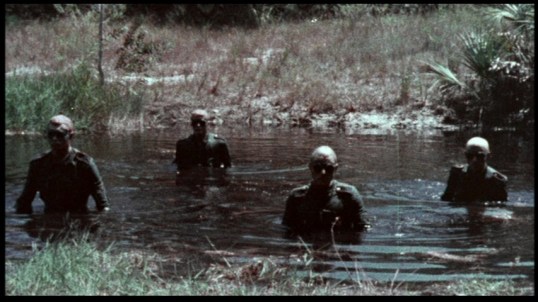
Shock Waves (1977, dir by Ken Wiederhorn)


As some of our regular readers undoubtedly know, I am involved in a few weekly live tweets on twitter.  I host #FridayNightFlix every Friday, I co-host #ScarySocial on Saturday, and I am one of the five hosts of #MondayActionMovie!  Every week, we get together.  We watch a movie.  We tweet our way through it.

Tonight, for #ScarySocial, I will be hosting 1977’s Shock Waves!

That’s right!  It’s John Carradine, Peter Cushing, and Brooke Adams in the best underwater zombie film ever made!

If you want to join us on Saturday night, just hop onto twitter, start the film at 9 pm et, and use the #ScarySocial hashtag!  The film is available on Prime, YouTube, and a few other streaming sites.  I’ll be there co-hosting and I imagine some other members of the TSL Crew will be there as well.  It’s a friendly group and welcoming of newcomers so don’t be shy.

Who Is The Black Dahlia? (1975, directed by Joseph Pevney)


In 1947 Los Angeles, the body of 22 year-old Elizabeth Short is discovered in an empty lot.  Short, who was nicknamed The Black Dahlia because she always wore black, was an aspiring actress who was violently tortured before being chopped in half.  Her murder remains one of Hollywood’s most infamous unsolved crimes.

In this made-for-television movie, Ronny Cox and Efrem Zimbalist, Jr. play the two detectives who are assigned to investigate Short’s murder.  Though they struggle to find any clues identifying who could have killed Short, they do learn about her life and how she went from being a naïve innocent who came to Hollywood with stars in her eyes to being a hardened and cynical woman who may have been supporting herself through sex work when she was murdered.  The film makes use of frequent flashbacks, in which Elizabeth Short is played by Lucie Arnaz.  Her friends and acquaintances are played by familiar television faces like Henry Jones, Mercedes McCambridge, June Lockhart, Brooke Adams, Donna Mills, and Tom Bosley.  Also be sure to keep an eye out for Sid Haig, playing a tattoo artist.

What Elizabeth Short went through over the course of her short time in Hollywood was probably too graphic to be put on television in the 70s but this movie still does a good job of recounting the basic facts of her life and murder.  Because the film is based on fact, no one is ever arrested for Short’s murder.  The only suspect is a doctor who turns out to have an alibi.  The movie instead focuses on Short trying make it in Hollywood and discovering that it’s a cruel town.  Lucie Arnaz was far better than I was expecting in the role of Elizabeth and brought a lot of vulnerability to the role.  The film ended with a title card, asking anyone who had information about the murder of Elizabeth Short to call the LAPD.  The case remains open to this day.

Horror on the Lens: Sometimes They Come Back (dir by Tom McLoughlin)


For today’s horror on the lens, we have 1991’s Sometimes They Come Back.

Adapted from a Stephen King short story, this made-for-television film tells the story of a teacher (played by Tim Matheson) who returns to the New England town where he grew up.  If he seems reluctant to do so, it’s because he has some bad childhood memories to deal with.  In the 60s, his brother was murdered by a group of leather-clad greasers, all of whom subsequently died in a fiery car crash.

But, if all of them died in the 60s, why are they now showing up in his classroom?  And why have none of them aged?

Could it be that … sometimes they come back?

And could it also be that the reason that they’re coming back is so they can finish the job that they started in the 60s and murder the last remaining brother?

This campy but enjoyable adaptation features good performances from both Tim Matheson and, in the role of the main dead guy, Robert Rusler.  Why have they come back and what can be done to make them leave once again? Watch, find out, and enjoy!

Shattered Politics #49: The Dead Zone (dir by David Cronenberg)


The_Dead_Zone

So, it seems like every time that I write a review of any film based on a novel by Stephen King, I always have to start out by explaining that I think, while King’s success is undeniable, the fact that he’s overrated is also undeniable.  It’s a comment that I always make and then I have to deal with people going, “But, Lisa, everyone loves Stephen King!  He’s the most commercially successful author ever!  He’s a modern-day Charles Dickens!”

Bleh.

Make no mistake, I think that Stephen King is a talented writer.  However, I don’t think that he’s the greatest writer that has ever lived and that’s where I often come into conflict with King’s fans.  (Stephen King fans tend to be like religious fanatics when it comes to defending their belief.)  Having read both King’s earlier work and his more recent books, it’s hard for me not to feel that Stephen King has been growing steadily complacent.  There’s a certain self-importance to his prose and his plotting that, for me, is the literary equivalent of nails on chalk board.  If anyone is guilty of believing the most fawning praise of his biggest fans, it would appears to be Stephen King who, to judge from his twitter feed, appears to also believe that he’s our most important cultural critic as well.

(To be honest, I’d probably have more tolerance for King’s attempts at cultural and political criticism if he wasn’t so  predictable about it all.  Stephen King may write best sellers but that doesn’t mean he has anything interesting or unique to say about current events.)

Anyway, since I don’t feel like having to deal with all of that shit all over again, I’m not going to start this review by saying that I think Stephen King is overrated.  In fact … whoops.

Okay, so much for that plan.

Even I have to admit that The Dead Zone is one of Stephen King’s better books.  First off, it’s less than a 1,000 pages long.  Secondly, the hero isn’t a writer who spends all of his time whining about the political preferences of his neighbors.  Third, it deals with all of the “big” issues of faith, destiny, and morality but it does so in a far less heavy-handed manner than most of King’s books.

The Dead Zone is also the basis for one of the better films to be adapted from a Stephen King novel.  Directed by David Cronenberg and starring Christopher Walken, the film’s plot closely follows the novel.  Johnny Smith (Christopher Walken) is a high school teacher who, after a horrific car crash, spends five years in a coma.  When he finally wakes up, he discovers that his girlfriend, Sarah (Brooke Adams), has married another man.  His mother has become a religious fanatic.  And, perhaps most importantly, whenever Johnny touches anyone, there’s a good chance that he’ll see either the person’s past or a possible future.

Needless to say, Johnny struggles with how to deal with his new powers.  After he helps to catch a local serial killer, Johnny goes into seclusion.  However, when he discovers that Sarah is now volunteering for ambitious politician Greg Stillson (Martin Sheen), Johnny goes to a Stillson rally, shakes the man’s hand, and has a vision.  Johnny discovers that, if Stillson is elected to the senate, he’ll eventually become President and then he’ll destroy the world.

Much like The Shining, The Dead Zone benefits from being directed by a filmmaker who was both confident and strong enough to bring his own individual style to the material.  (Usually, when a King adaptation fails, it’s because it followed the source material too closely, as if the film’s producers were scared of upsetting any of King’s constant readers.)  Though the film’s plot may closely follow the novel, the movie itself is still definitely more of a product of David Cronenberg than Stephen King.  Whereas King’s novel devoted a good deal of time to Johnny and Sarah’s relationship, it’s treated as almost an afterthought in Cronenberg’s film.  Whereas King’s novel presented Johnny Smith as being an everyman sort of character, Cronenberg’s film gives us a Johnny who, from the start of the film, is a bit of an outsider even before he starts to see the future.  Whereas King put the reader straight into Johnny’s head, Cronenberg approach is a bit more detached and clinical.  Cronenberg’s Johnny is a bit more of an enigma than King’s version.

Fortunately, Cronenberg was fortunate enough to be able to cast Christopher Walken in the role of Johnny Smith.  King’s preference for the role was Bill Murray.  As odd as it may sound, you can actually imagine Bill Murray in the role when you read King’s book.  But, for Cronenberg’s more detached vision, Walken was the perfect choice.  People tend to spend so much time focusing on Christopher Walken’s quirky screen presence that there’s a tendency to forget that he’s actually a very talented actor as well.  He’s very likable and sympathetic as Johnny and brings a humanity and a sense of humor to the role, which provides a good balance to Cronenberg’s sense of detachment.

The Dead Zone is a good book and it was later turned into an occasionally good (and, just as often, not-so-good) television series.  However, the film is still the best.

http://www.youtube.com/watch?v=lmC5oPc7L3M