Charles Bronson is an Arizona cop who goes to Switzerland to bring back a gangster’s girlfriend (Jill Ireland). The gangster (Rod Steiger) sends a hitman (Henry Silva) to kill her so she can’t tell his crime secrets to the authorities.
This isn’t one of Bronson’s best films, but it’s still a fun movie to watch on a chilly, rainy day. There are some good action scenes set in various cold & snowy European locations. This is Bronson in “Bond” mode which is kind of fun and different. And what can you say about a stuttering Rod Steiger screaming at his advisors about the meaning of “love.” It’s fun stuff when you like Steiger as much as I do. I do deduct half a star because Steiger gets so mad at one point that he turns over a table with some of the biggest, most scrumptious looking shrimp I’ve ever seen. That was completely uncalled for and wasteful, but not quite as wasteful as Bronson and Henry Silva in the same movie without an epic battle of some sort. The fact that they didn’t fight it out on the Matterhorn itself can only be described as a missed opportunity.
Episode 16 opens with Shane (David Carradine) back in Cheyenne, WY. He has joined up with Major Hackett’s (Bradford Dillman) outfit to try to find out the Major’s plans for attacking the homesteaders. The first thing he has to do is have it out with Jed (Charles Grodin) who is still smarting from the ass-whoopin’ he took in the last episode. The two men get into another brawl that ends when Major Hackett shoots Jed in the knee and discharges him from his service for good. The next day, Major Hackett, Shane, the men, and the Gatling Gun head towards the valley after rustlers and homesteaders. Major Hackett assigns Shane to advance scout their next target, Bull O’Reilly. Shane heads out and forces O’Reilly to leave his home before the other men arrive. Shane tells them O’Reilly was gone before he got there, but Major Hackett doesn’t appear to be buying what Shane is selling and tells his men to keep an eye on him. When Shane finds out they are headed for the valley the next day, he beats up the guy he’s on night watch duty with and rides all night back to the Starett ranch. With Tom (Tom Tully) and Marian’s (Jill Ireland) help, he is finally able to convince the homesteaders and the cattlemen, led by Rufe Ryker (Bert Freed), to stand together and take on Major Hackett and his men. But do they have any chance against that gun?
Part 1 of the Great Invasion spent most of its running time setting up the backstory for Major Hackett’s invasion of the valley in order to get rid of all the rustlers and homesteaders. With all of that out of the way, Part 2 mainly focuses on the actions Shane takes in trying to stop Major Hackett from within. He engages in two fistfights. He convinces an old man to leave his home as soon as possible, giving him time to put on his boots but not time to put on his pants, which gave me a chuckle. And he stands with the homesteaders and the cattlemen as they trick Major Hackett into thinking the Ryker ranch is abandoned so they can attack with an element of surprise. David Carradine, of course, handles all of the action and drama very well. Part 2 is a pretty solid episode, but after the setup from Part 1, I was hoping for a little more. I can’t help but question Major Hackett’s judgement when it comes to Shane. There were plenty of red flags that would indicate Shane wasn’t very trustworthy when it came to executing the plan, but Hackett seemed willing to give him the benefit of the doubt anyway. His cockiness and over confidence in his ability to control the Gatling Gun also knocked him down a notch or two. Major Hackett turned out not to be as smart as we originally thought him to be, which was a little disappointing, especially with Bradford Dillman’s interesting performance. On a positive note, I was glad that Little Joey (Christopher Shea) gets a sweet moment in this episode. He’s mostly a background piece in the series but his childlike wisdom comes in handy at one point. He overhears the adults questioning whether or not Shane has really joined the invaders. Joey tells them matter of factly that he knows that Shane has a plan that will help everyone and finishes his statement with, “Y’all just don’t know him as well as I do.” Tom and Marian can’t help but smile with that innocent truth-bomb, and from that point never doubt Shane again. Tom Tully gets another opportunity to shine as well, as his Tom Starett gives an impassioned speech to his fellow homesteaders asking them join together and fight the invaders. It was a good moment for him.
Overall, “The Great Invasion” is an episode that builds a solid foundation in the first part that it doesn’t completely capitalize on in the second. It has its moments, though, especially with some good character moments from both the main cast and its guest stars. I also found the very final shootout to be exciting. The relationship between Shane and Marian does seem to be reaching a breaking point as her patience is wearing thin with his inability to share his true feelings with her. We only have one episode to go, so I’m expecting some sort of action in that department as the series reaches its conclusion.
Episode 15 opens with Shane (David Carradine) at a hotel in Cheyenne, WY. He hears a ruckus in the next room where a guy named Jed (Charles Grodin) is holding court with a group of men and women. Jed, who has clearly been drinking way too much, is going on about the honor of serving with Captain William Quantrill. He asks Shane to have a drink with him and Shane declines. Offended by this, Jed challenges Shane only to get his ass thoroughly kicked in about 10 seconds flat. One of the men in the group recognizes Shane as the great gunfighter. Soon the men force Shane at gunpoint to go see their boss, Major George Hackett (Bradford Dillman). It seems Hackett is putting together a group of men for a project and offers Shane the large sum of $75 per week to join up. Sensing something bad, Shane turns down his offer and leaves. Shane is right to leave as we soon learn that Hackett’s “project” is to eliminate any homesteaders who are not a part of the Cattlemen’s Benevolent Association, a large outfit out of Chicago.
While in Cheyenne, Shane also runs into his old friend Longhorn Jenny (Constance Ford) who is in town selling a herd of cattle. She’s accompanied by her assistant Dan (Archie Moore). The two swap some old stories, with Shane even asking how she came across that herd of cattle. They seem to hint that she didn’t necessarily come across them legally. Shane says goodbye and starts the journey back to the ranch. Before leaving Cheyenne, he reads a story in the paper that specifically mentions Longhorn Jenny, implying that she’s a rustler. The story in the paper, which seems to back the Cattlemen’s Association, plus Major Hackett’s offer convinces Shane that something truly bad is on the way. When he gets back to the ranch, he tells Tom (Tom Tully), Marian (Jill Ireland) and a few other local homesteaders that he’s concerned that they may all be in danger. Unfortunately, everyone he speaks to in the valley about this situation, including cattleman Rufe Ryker (Bert Freed), think he’s overreacting and don’t seem concerned at all. Then Major Hackett and his men ride out to Jenny’s ranch, unveil their Gatling Gun and proceed to kill Jenny and Dan, ultimately hanging her at the gate with a sign that says “Rustler.” Even after Jenny is killed, no one in the valley will listen to Shane and prepare to defend themselves. Marian tells Shane that she’ll prepare to defend their ranch, but she is not leaving. Not knowing what to do to keep those he loves safe, Shane heads back to Cheyenne and accepts Hackett’s offer to work for him. Credits roll for the end of Part 1.
A lot happens in the “The Great Invasion: Part 1.” All the main people are introduced, with Hackett and his plan coming into light. We also spend an inordinate amount of time with Longhorn Jenny as we meet her, learn about her and ultimately see her die. This being the first part of a two part episode, I’ll withhold my larger analysis for the next review, but I am looking forward to seeing where the story goes. I find the characters quite interesting. Bradford Dillman comes off as very odd and extremely dangerous as Major Hackett, a man who seems to relish the opportunity to use his Gatling Gun. Charles Grodin’s Jed appears to be your typical loudmouth killer at this point, but it will be interesting to see what happens to him. And I’m looking forward to seeing what Shane does to stop the madness before it takes out the people in their valley. There’s no way they can compete with Hackett’s Gatling Gun, so Shane will have to figure out a way to stop things from within.
There were a few other interesting things I noted while watching this episode. First, when Shane is heading back to the ranch from Cheyenne, we see the Grand Teton Mountain range behind him for the first time in the series. If you remember, the Tetons are prominently featured in the classic 1953 film SHANE, and it was cool seeing them here. Second, Shane goes on a rant to Marian at one point about how newspapers spin the facts in a way that distorts the truth. Just in case anyone thought that a dishonest media was only a current issue, this should lay that theory to rest. And finally, Marian Starett flat out asks Shane why he continues to stay at the ranch. She’s clearly wanting to know if it’s for her. Once again he won’t give her the satisfaction of confirming her thoughts, and it appears that his reluctance to be honest with her is starting to wear thin. Couple that with a crying Joey who doesn’t understand why Shane left and the interpersonal emotions are running high as the episode fades out. I’m all in for seeing how it plays out.
When it comes to conspiracy theories involving presidential assassinations, the theories surrounding JFK may get all the attention but it’s the theories surrounding the death of Abraham Lincoln are usually far more plausible.
Unless, of course, it’s the theories that are pushed in the 1977 docudrama, The Lincoln Conspiracy.
A mix of documentary-style narration and really cheap-looking historical reenactments, The Lincoln Conspiracy essentially indicts almost everyone who was alive in 1865 as being a part of either the conspiracy or the subsequent cover-up. Really, it’s remarkable how many historical figures are implicated in this film.
With the Civil War coming to a close, President Lincoln (John Anderson) hopes to pursue a generous reconstruction policy for the former Confederate States. Secretary of War Edwin Stanton (Robert Middleton), Senator Ben Wade (Dick Callinan), and a host of other are all opposed to this plan, both because they want vengeance and they also want to make as much money as possible off of the Southern cotton fields. They come up with a plan to impeach Lincoln but, in order to draw up the articles, they have to make sure that Lincoln is not seen for a few days. When Col. Lafayette Baker (John Dehner) discovers that an actor named John Wilkes Booth (Bradford Dillman) is planning on kidnapping Lincoln, Stanton and his conspirators decide to give Booth their unofficial support. However, when the plan changes at the last minute and Stanton decides that it would actually be a bad idea to kidnap Lincoln, an angry Booth decides to just kill Lincoln, Andrew Johnson, and William Seward.
Booth succeeds in shooting Lincoln and making his escape. The other members of Booth’s group all fail in their assignments. Andrew Johnson becomes president. Though grievously wounded, William Seward survives. Booth flees to Canada and …. oh, you thought Booth died? No, that was just a look alike who was shot by a bizarre soldier named Boston Corbett. By allowing everyone to believe that Booth was killed, Stanton is able to cover up any role he and his allies played in inspiring the assassination. Unfortunately, Col. Baker keeps a diary and it seems like he might be planning on revealing the truth but he dies mysteriously before he can.
(And, to give the film some credit, Col. Baker’s sudden death at 41 was an odd one. And, though it’s not really explored in the film, Boston Corbett, the man who shoot Booth, really was a weirdo who was described by contemporaries as being a religious fanatic who castrated himself and claimed to hear the voice of God.)
It’s a big conspiracy theory that is presented in The Lincoln Conspiracy. In fact, it’s a bit too big to really be taken seriously. The film pretty much accuses everyone in Washington of having a part in the assassination. The film itself has the cheap look of a community theater production and the use of Dr. Samuel Mudd as a narrator only adds to the film’s silliness. If you’re a fan of gigantic and thoroughly implausible conspiracy theories, as I am, the film is entertaining in its way. If nothing else, Bradford Dillman certainly looks like how most people probably imagine John Wilkes Booth to have looked. Otherwise, The Lincoln Conspiracy is far-fetched and not at all realistic, which is why I assume that a lot of people in 1977 probably believed every word of it.
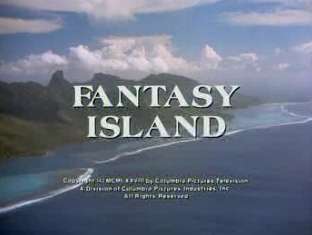
Welcome to Retro Television Reviews, a feature where we review some of our favorite and least favorite shows of the past! On Tuesdays, I will be reviewing the original Fantasy Island, which ran on ABC from 1977 to 1986. Almost the entire show is currently streaming is on Youtube, Daily Motion, and a few other sites.
This week, FantasyIsland loses a fantasy. Read on to find out the details and remember, “Smiles, everyone! Smiles!”
Episode 4.3 “The Skater’s Edge/Concerto of Death/The Last Great Race”
(Dir by Cliff Bole and Vince Edwards, originally aired on November 8th, 1980)
When this episode originally aired, it was a special two-hour episode of Fantasy Island, one that featured three fantasies as opposed to the usual two.
In Skater’sEdge, Charlie Johnson (Charlene Tilton) is a farm girl from Missouri who dreams of being a world class figure skater. She comes to the Island to compete in the Fantasy Island Skating Competition. Mr. Roarke gives Charlie a pair of magic skates that he claims belonged to figure skater Sonja Henie. As long as Charlie is wearing the skates, she is the greatest skater in the world. She takes the competition by storm and she also wins the heart of coach Mike O’Brien (Dack Rambo). Unfortunately, in doing so, Charlie upsets Mike’s protégé, Laura Henderson (Peggy Fleming). Laura steals Charlie’s skates but, after Mr. Roarke talks to her about the importance of friendship and fair play, Laura returns the skates to Charlie. Charlie gets a perfect score from the judges but, even more importantly, she learns a lesson in humility and she’s happy when Laura is named the winner of the competition. Laura has the Fantasy Island championship but Charlie has got Mike.
In ConcertoofDeath, Dennis Cole plays Jeremy Hale, who comes to the island with his wife (Mary Ann Mobley). Jeremy’s brother was a talented concert pianist who was murdered. Jeremy wants to play as well as his brother but he also wants to solve his murder. Roarke gives Jeremy an emerald ring that glows a deep green when Jeremy plays his piano. Roarke warns Jeremy that his brother’s ghost might try to possess him and seek violent revenge against those who he blames for his death. The scenes involving Jeremy being possessed feature Jeremy being suffused by a green glow and yes, it’s kind of silly but it’s still fun in the way that cheap special effects often are. Eventually, Jeremy realizes that his brother was killed by Carla Marco (Erin Gray) and it ends with the police taking away Carla and Jeremy’s guest cabin burning to the ground. That cabin burned down to the ground at least once per season.
Finally, in TheLastGreatRace, Dick Shawn and Juliet Mills play a couple who are divorcing. They go on a race with the winner getting the majority of their possessions.
You may notice that I don’t have much to say about The Last Great Race. This is because the Race fantasy was edited out of this episode when it went into syndication. Unfortunately, all of the versions that I’ve found of this episode online are of the syndicated version. So, I guess TheLastGreatRace is just going to be the lost fantasy of Fantasy Island.
It’s hard to judge this episode because, in the syndicated version, it’s very obvious that a lot has been removed. It makes things feel a bit disjointed with the scene transitions often coming abruptly. Charlie and Mike seem to fall in love in record time and Laura declaring herself to be Charlie’s friend seems odd because we haven’t really seen them interact before Laura steals her skates. Meanwhile, the story with Jeremy also feels rushed with the final confrontation between Jeremy and the murderer seeming to come out of nowhere.
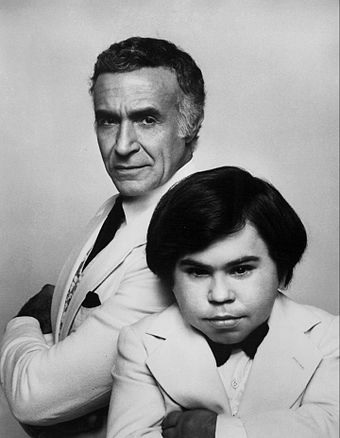
That said, it’s kind of a fun episode. The skating scenes feature an obvious stunt double for Charlene Tilton and it’s hard not to be kind of charmed by how obvious it all is. (You can get dizzy as the scene cuts from close-ups of Tilton’s face and close-ups of the stunt double’s legs.) The supernatural story makes no sense but the silly special effects made me smile. The episode ends with Mr. Roarke causing snow to fall on FantasyIsland but, in typical Roarke fashion, he makes sure that it only falls on Tattoo. Roarke has a good laugh while Tattoo screams in terror. Seriously, those two hate each other so much.
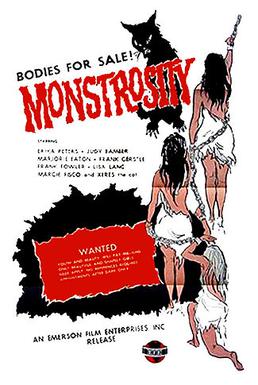
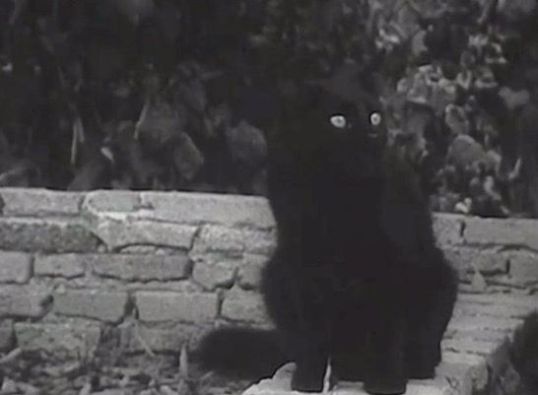
Seriously, the best thing about the 1964 film, Monstrosity, is that it features a black cat named Xerxes. Xerxes is not only a cute little kitty (and, seriously, who doesn’t love a black cat?) but Xerxes is also the best actor to be found in the entire film. While everyone else is struggling to deliver their lines and not wander out of the shot, the cat delivers its meows with the skill of a pro and always hits the right mark. If there was an Oscar category for best animal actor, Xerxes definitely would have been the one accepting the Oscar from the Breakfast at Tiffany’s cat. Seriously, I hope Xerxes was paid well for this role. I hope it opened up a lot of doors for Xerxes. When animal actors get together, I hope that they take a few minutes to raise a toast and to praise a true trailblazer and a wonder performer, Xerxes the Cat!
Unfortunately, the rest of the film doesn’t really live up to Xerxes’s work. Xerxes was obviously doing the best that a cat could do to save this film but there is only so much that a cat can do. At some point, the humans have to step up and make a little bit of effort as well.
Monstrosity, which is also known as The Atomic Bomb, tells the story of Mrs. Hettie March (Marjorie Eaton), a thoroughly unpleasant but very wealthy woman who lives in an isolated mansion. Working in her basement is Dr. Otto Frank (Frank Gerstle), a mad scientist whose work in the field of brain transplantation has led to a lot of strange things happening at the house. For instance, there’s a guy who has the brain of a bulldog. There’s also a woman who wanders around the laboratory with a blank look on her face. Still, Mrs. March is convinced that Dr. Frank will eventually be able to take her brain and transplant it into a younger and more attractive woman.
An ad is put in the classifieds, asking for a young woman to come work as a housekeeper at Mrs. March’s mansion. Three women show up for the job, not realizing that they are actually being set up as candidates to become Mrs. March’s new body. Nina Rhodes (Erika Peters) is from Austria and is the most level-headed. Bea Mullins (Judy Bamber) is from the United Kingdom and speaks with such a thick accent that the viewer will automatically know that she’s not actually British. Anita Gonzalez (Lisa Lang) is from Mexico and rarely speaks. The women arrive at the mansion and soon find themselves at the mercy of the rich old woman, the mad doctor, and all of the failed experiments.
Monstrosity is pretty dumb and remarkably poorly acted, with Lisa Lang’s performance as Anita being the main offender. (Bradford Dillman, who would go on to become a very busy character actor, provided the film’s narration.) That said, Xerxes was a true star. All hail Xerxes!
Welcome to Retro Television Reviews, a feature where we review some of our favorite and least favorite shows of the past! On Sundays, I will be reviewing the made-for-television movies that used to be a primetime mainstay. Today’s film is 1971’s Five Desperate Women! It can be viewed on YouTube!
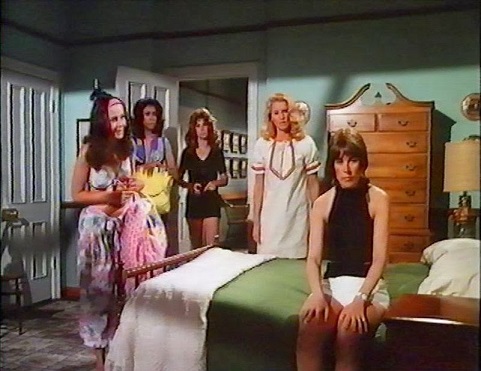
Five women, who all went to college together, reunite for the first time in five years. They’re planning on spending a weekend at a cabin on a private island. Lucy (Anjanette Comer) is the alcoholic who talks too much. Dorian (Joan Hackett) is the pill popper who lies about having a handsome husband and two beautiful children. Joy (Denise Nicholas) is the former activist turned trashy model. Gloria (Stefanie Powers) is bitchy and self-centered. And Mary Grace (Julie Sommars) is the one with the mentally ill mother who refuses to speak to her. Upon reuniting on the dock, the five women all immediately gather in a circle sing an old sorority song. It’s going to be one of those weekends!
The private island is lovely and the women believe that they have it to themselves, with the exception of the two men who are also on the island. Wylie (Robert Conrad) is the caretaker and he seems to be a trustworthy gentleman and exactly the type of guy who you would want to be stranded on an island with. And then there’s Meeker (Bradford Dillman), who drove the boat to the island and who is the type of overbearing jerk who has to be specifically told not to bother the women. While the women stay in the main house, the men stay in the nearby caretaker’s cottage.
From the start, it proves to be a stressful weekend. All of the women have secrets and long-buried resentments that come out at the slightest provocation. Not helping the fact is that there’s a murderer on the island, one that goes from killing a dog to strangling Dorian while the rest of the women are at the beach. The woman, figuring that the murderer has to be either Meeker or Wylie, lock themselves into their house for the night but it turns out that it’s going to take more than a locked door to defeat a killer.
Five Desperate Women has an intriguing premise but it also has an extremely short running time. With only 70 minutes to tell its story and 7 major characters to deal with, the film doesn’t leave much room for character development and, as a result, each woman is only given one personality trait and each actress ends up portraying that trait as broadly as possible. As a result, it doesn’t take long for the movie to go from being Five Desperate Women to Five Annoying Women. As for Robert Conrad and Bradford Dillman, the two of them give effective performances but anyone with a hint of genre savvy will be able to guess who the killer is going to turn out to be. There is one unintentionally funny moment where the desperate women attempt to fight off the killer by throwing rocks at him and none of the rocks come close to reaching their target but otherwise, Five Desperate Women is not particularly memorable.
In the late 1970s, the Rev. Jim Jones was a very powerful man.
The leader of the California-based People’s Temple, Rev. Jones had made a name for himself as a civil right activist. As a minister, he made it a point to reach out to the poor and to communities of color. (It was said, largely by Jones, that he had been forced to leave his home state of Indiana by the Ku Klux Klan.) Local politicians eagerly sought not only Jones’s endorsement but also the donations that he could easily raise from the members of the People’s Temple. Though there were rumors that he was more of a cult leader than a traditional preacher, Jones was appointed chairman of the San Francisco Housing Authority. Everyone from Governor Jerry Brown to San Francisco Mayor George Moscone appeared with Jim Jones at campaign events. Among the national figures who regularly corresponded with Jim Jones were First Lady Rosalyn Carter and Vice President Walter Mondale.
Of course, what actually went on behind the closed doors of the People’s Temple was a bit of secret. Jones was a self-proclaimed communist who claimed to have had visions of an upcoming nuclear war between the U.S. and Russia. In his sermons, he often claimed that it would be necessary for both him and the rest of the People’s Temple to eventually leave the United States. Jones spoke of enemies that were trying to destroy him, like the reporters who investigated Jones’s claim of being a faith healer and who followed up on reports that Jones was sexually exploiting both the women and the men who followed him. Jones secretly started to make plans to leave the United States in 1973 but it would be another four years before he and a thousand of his followers arrived in Guyana. The People’s Temple Agricultural Project sat in the jungle, isolated from oversight. It was informally known as Jonestown.
Over the next year, Jonestown did not exactly thrive. Rev. Jones demanded that his people work hard and he also demanded that they spend several hours a day studying socialism and listening to him preach. Jones ran his commune like a dictator, refusing to allow anyone to leave (for their own safety, of course). Anyone who questioned him was accused of being an agent of the CIA. In the U.S, the families of Jonestown’s citizens became concerned and started to petition the government to do something about what was happening in Guyana. A few people who did manage to escape from Jonestown told stories of forced labor, suicide drills, rape, and torture. The People’s Temple claimed that those people were all lying and, because Jones still had his government connections, he was largely left alone.
Finally, in 1978, Congressman Leo Ryan, a Democrat who had a history of opposing the political establishment, flew down to Guyana so that he could see Jonestown for himself and also bring back anyone who wanted to leave. Despite the efforts of Jones to disguise the truth about life in Jonestown, several people did ask to leave the colony with Rep. Ryan. Jones sent his most loyal men to meet and open fire on Rep. Ryan’s entourage at a nearby airstrip. Rep. Ryan and four others were shot and killed, making Ryan the first Congressman to be assassinated since 1868. Nine others, including future Rep. Jackie Speier, were wounded in the attack.
Back at Jonestown, Jim Jones announced that his prophecy was coming true and that the imperialists would soon descend on Jonestown. Though 85 of Jones’s followers managed to escape into the jungle, the other 909 residents of Jonestown subsequently died. Though some showed signs of having been murdered by Jones’s followers, the majority committed suicide by drinking poisoned Flavor-Aid. Jim Jones shot himself in the head.
The world was horrified and the term “drinking the Kool-Aid” entered the discourse. And, of course, many filmmakers were inspired by the horrific events that happened in Jonestown. Ivan Rassimov, for instance, played a Jim Jones-style cult leader in Umberto Lenzi’s Eaten Alive. Meanwhile, Powers Boothe would win an Emmy for playing Jim Jones in a 1980 television miniseries called Guyana Tragedy.
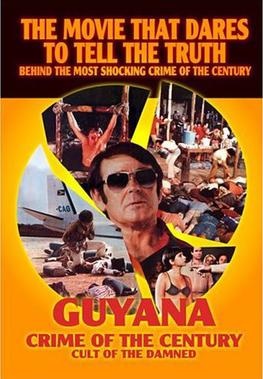
Guyana Tragedy is often described as being the definitive film about Jim Jones. However, a full year before Guyana Tragedy aired, the Mexican director, Rene Cardona Jr., was in theaters with his own version of the Jim Jones story. To anyone who is familiar with Cardona’s style of filmmaking, it’s perhaps not surprising that 1979’s Guyana: Crime of the Century did not win any awards.
Cardona’s film opens with a rather odd title card, explaining that, though the film is based on Jonestown, the names of certain characters “have been changed to protect the innocent.” But if you’re going to start the film by announcing that it’s about the biggest news story of the past year, what’s the point of changing anyone’s name? And for that matter, why is Jim Jones renamed James Johnson and his colony rechristened Johnsontown? Jones was hardly one of the innocents, not to mention that he was dead and in no position to sue when the film came was released. Why is Leo Ryan renamed Lee O’Brien, especially when the film portrays Ryan as being the type of hard-working and honest congressman that anyone would be happy to vote for?
The film opens with Rev. James “Johnson” (played by Stuart Whitman) giving a lengthy sermon about how it’s time for the congregation to move to Guyana, which he describes as being a Socialist paradise. Oddly, in the film, the People’s Temple is portrayed being largely white and upper middle class whereas, in reality, the opposite was true. Indeed, Jones specialized in exploiting communities that were largely marginalized by American society. One reason why Jones’s claim of government persecution was accepted by the members of his church is because the People’s Temple was made up of people who had very legitimate reasons for distrusting the American government.
A few scenes later, Johnson is ruling over “Johnsonville.” Since this is a Cardona film, the viewers are shown several scenes of people being tortured for displeasing Johnson. A child is covered in snakes. Another is shocked with electricity. A teenage boy and girl are forced to kneel naked in front of Johnson as he announce that their punishment for trying to run away is that they will be forced to have sex with someone of Johnson’s choosing. Once the torture and the nudity is out of the way, the film gets around to Congressman O’Brien (Gene Barry) traveling to the Johnsontown. Since the audience already knows what’s going to happen, the film becomes a rather icky game of waiting for O’Brien to announce that he’s ready to go back to the landing strip.
Because the film has been released under several different titles and with several different running times, Guyana: Crime of theCentury has gotten a reputation for being one of those films that was supposedly cut up by the censors. I’ve seen the original, uncut 108-minute version of Guyana and I can tell you that there’s nothing particularly shocking about it. Instead, it’s a painfully slow film that doesn’t really offer much insight into how Jim Jones led over 900 people to their deaths. While Gene Barry make for a convincing congressman, Stuart Whitman gives a stiff performance as the Reverend Johnson. There’s very little of the charisma that one would expect from a successful cult leader. One gets the feeling that Whitman largely made the film for the paycheck.
Of course, Whitman was hardly alone in that regard The film features a host of otherwise respectable actors, including Yvonne DeCarlo, Joseph Cotten, John Ireland, Robert DoQui, and Bradford Dillman. As well, Cardona regular Hugo Stiglitz appears as a photographer. (Stiglitz is perhaps best known for starring in Nightmare Cityand for lending his name to a character in Tarantino’s Inglourious Basterds.) Of the large cast, I appreciated the performances of Cotten and Ireland, who play Johnson’s amoral but well-connected attorneys. (The characters are based on the Temple’s real-life attornes, Charles Garry and Mark Lane. Lane also wrote the first JFK conspiracy book, Rush to Judgment.) I also liked Yvonne DeCarlo’s performance as the most devoted of Johnson’s followers. Even Bradford Dillman’s natural blandness was used to good effect as his character comes to represent the banality of evil when it comes time for him to start administering the Flavor-Aid. But those good performances still can not overcome the film’s slow pace and the fact that the film didn’t bring any new insight to the tragedy.
The film sticks fairly close to what is believed to have actually happened at Jonestown but, in the end, it barely even works as an example of shameless grindhouse filmmaking. It’s not even offensive enough to be enjoyable on a subversive level. Instead, it was just a quick attempt to make some money off of the crime of the century.
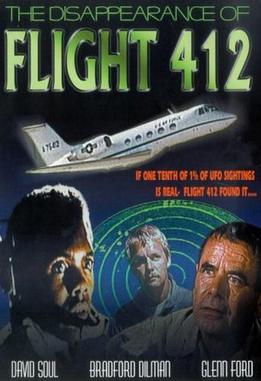
Because of recent electrical surges aboard its aircrafts, the commander of the Whitney Air Force Base 458th Radar Test Group sends a four-man crew up in Flight 412 to try to figure out what’s happening. Colonel Pete Moore (Glenn Ford) and Major Mike Dunning (Bradford DIllman) assume that it will just be a routine flight. Instead, they find themselves at the center of a government cover-up when Captain Bishop (David Soul) and the other members of the crew spot what appears to be a UFO. When two jets are sent out to intercept the object, the jets vanish.
Suddenly, Flight 412 is ordered to land at a seemingly deserted military base in the desert. When they do, the airplane is impounded and the crew is forced to undergo an 18-hour debriefing led by government agents. The agents demand that the crew members sign a statement saying that they didn’t see anything strange in the air before the jets vanished. Until all four of the men sign the release, the crew of Flight 412 are officially considered to be missing and will not be released until they agree to deny what they saw.
Meanwhile, Col. Moore tries to learn what happened to his men but the government, led by Col. Trottman (Guy Stockwell), is not eager to tell him.
This movie was made-for-television, at a time when people claiming to have been abducted by aliens was still a relatively new phenomenon. It was also made during the Watergate hearing and in the wake of the release of the Pentagon Papers, so the film’s sinister government conspiracy probably felt relevant to viewers in a way that it wouldn’t have just a few years earlier. I appreciated that the movie took a semi-documentary approach to the story but that it tried to be serious and even-handed. The film shows how witnesses can be fooled or coerced into saying that they saw the opposite of what they actually did see. Unfortunately, The Disappearance of Fight 412 is ultimately done in by its own cheapness. The overreliance on familiar stock footage doesn’t help the film’s credibility and there’s too many familiar faces in the cast for the audience to forget that they’re just watching a TV movie. The Disappearance of Flight 412 doesn’t really succeed but it is still interesting as an early attempt to make a serious film about the possibility of alien abduction and the government covering up the existence of UFOs.. Three years after this film first aired, Steven Spielberg would introduce these ideas to an even bigger audience with Close Encounters of The Third Kind.
At the height of the Vietnam War, the U.S. Government came up with a plan that could have changed the course of the war.
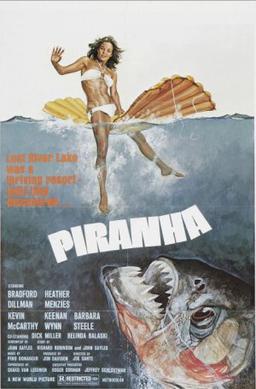
What if the government developed gigantic, super-fast, occasionally jumpy piranha? And what if they set those killer fish loose in the rivers of Vietnam? Would those fish swim through North Vietnam and take out the VC? Sadly, the war ended before the government got a chance to test out Operation Razorteeth. With the war over, the government was stuck with a bunch of killer fish. Scientist Robert Hoak (Kevin McCarthy) ignored all orders to destroy his mutant fish because they were his life’s work. (Awwwwwwwww!) He kept an eye on them and did everything he could to prevent them from getting into the nearby river.
Unfortunately, Dr. Hoak’s best wasn’t good enough. Because the piranha have gotten loose and now they’re making their way down to the river! They start out eating skinny dipping teenagers, fisherman, and Keenan Wynn. (They’re good enough not to eat Wynn’s adorable dog, which I appreciated.) Further down the river, there’s a summer camp and a water park! It’s definitely not safe to get back in the water but sadly, that’s what several people insist on doing throughout this film. Even when the water is full of blood, people will jump in. (It’s easy to be judgmental but it is a pretty river. I don’t swim but I honestly wouldn’t mind living near a river that looked that nice. Instead, I have to make due with a creek.)
Floating down the river on a raft and trying to warn everyone is the unlikely team of Maggie (Heather Menzies) and Paul (Bradford Dillman). Maggie is a detective who has come to town to track down the two teenage skinny dippers who were eaten at the start of the film. Paul is a drunk. Well, technically, Paul is a wilderness guide and he does spend the entire movie wearing the type of plaid shirt that would only be worn by someone who goes camping every weekend but really, Paul’s main personality trait seems to be that he enjoys his booze. Paul’s daughter is away at the summer camp. Yes, that’s the same summer camp that’s about to be visited by a school of piranha. AGCK!
Produced by Roger Corman and obviously designed to capitalize on the monster success of Jaws, Piranha was an early directorial credit for Joe Dante. Dante would later go on to direct films like The Howling and Gremlins. Piranha was also an early screenwriting credit for the novelist John Sayles, who would use his paycheck to launch his own directing career. As a director, Sayles specializes in politically-themed ensemble pieces, which is something you might not guess while watching Piranha. (Piranha does have an anti-military subplot but then again, it’s a film from the 70s so of course it does.) Like the best of Corman’s film, Piranha works because it sticks to the basics and it delivers exactly what it promises. Piranha promises killer fish biting away at anyone dumb enough to get in the water and that’s what it gives us. As an added bonus, we also get some occasionally witty dialogue and Joe Dante’s energetic, self-aware direction.
As is typical with the films of both Corman and Dante, the cast is full of familiar faces. Along with Kevin McCarthy as the mad scientist and Keenan Wynn as the eccentric fisherman, Dick Miller shows up as the waterpark owner. Richard Deacon, who made a career of playing bosses and neighbors on various sitcoms in the 50s and 60s, plays the father of a missing teenager. Director Paul Bartel plays the head of the summer camp, who may be a jerk but who still heroically jumps in the water to save several campers. (Bartel’s moment of heroism is one of Piranha’s best scenes and, significantly, it’s played without irony. You’ll want to cheer for the guy.) Finally, the great Barbara Steele plays the government scientist who shows up to clean up Operation Razorteeth.
Piranha is simple but entertaining. Dante’s direction is energetic and, despite the film’s self-referential tone, the killer fish are just savage enough to be scary. It’s a film that tell us not to get back in the water but which understands that the temptation might just be too strong.



 Through the Shattered Lens