October True Crime: Cries Unheard: The Donna Yaklich Story (dir by Armand Mastroianni)


In 1994’s Cries Unheard: The Donna Yaklich Story, Jaclyn Smith is miscast as Donna, a naive young woman who is charmed by a cop named Dennis Yaklich (Brad Johnson).  The film is told in flashback and, for some reason, it was decided to have Jaclyn Smith (who was 49 when this film aired) not only play the middle-aged Donna but also to play her where she was just supposed to be in her 30s and looking for a husband.

Anyway, Dennis starts out charming but he soon turns out to have some problems.  He is easily angered.  He spends all of his time lifting weights.  He’s possessive.  He pops pills and shoots up steroids and, by the end of the movie, he’s grown out one of those madman beards that crazy men in movies always end up with.  When Dennis discovers that Patty (Hillary Swank), his daughter from his first marriage, is pregnant, he flies into a rage.  Donna does some research and comes to the conclusion that Dennis murdered his first wife.  When she confronts Dennis with this, he just laughs.

Donna is too frightened to grab her toddler son and run away from home, despite the fact that Dennis is hardly ever at home.  (In fairness, Dennis is a cop so he would definitely have the resources to track her down if she did leave.)  Instead, Donna hires two no-good trailer park boys to shoot Dennis when he comes home from work.  Dennis dies in his driveway, still holding the toy truck that he hoped to give his son.  It’s also raining when he dies because that’s the type of movie this is.

Donna made the mistake of hiring the dumbest people possible to carry out the crime and soon, she is getting arrested and being put on trial for murder.  Later, she tells her story to her now-teenage son, Denny (David Lascher).  Denny is angry because he had to grow up without a dad but he still assures his mother that she’s a wonderful person and the he can’t wait to pick her up from prison in 40 years.

Watching Cries Unheard was an odd experience for me.  By all logic, I should have been on Donna’s side but I found myself getting pretty annoyed with her.  Some of it was because Jaclyn Smith was totally miscast in the role.  Donna is supposed to be naive and meek and easily gaslit by her husband but Jaclyn Smith seemed as if she had just returned from a Paris shopping trip.  The other problem is that the film, which was heavy-handed even by the standards of a made-for-TV movie from the 90s, tried too hard to pretend as if hiring a hitman is something that anyone would have done in Donna’s situation.  The film ends with a Jaclyn Smith voice-over in which she points out that husbands who hire hitmen to kill their wives usually get a shorter sentence than women who do it and I really wanted to throw a shoe at the TV.  Regardless of the circumstances, hiring a hitman is an extreme step to take.  Most people will go through their entire life without ever hiring a hitman.  Most people don’t even know anyone who they could hire to be a hitman.  So, don’t sit there and act like this is the equivalent of women not getting paid as much men for the same amount of work.  I did a little research and discovered that this film was based on interviews that Donna gave in prison.  Dennis’s other daughter– who was not portrayed in the film — called the film a complete fabrication.

I should note that this film was directed by Armand Mastroianni, who also directed some of the best episodes of Friday the 13th: The Series and the classic slasher film He Knows You’re Alone.  (That film was also Tom Hanks’s feature debut.)  His direction embraces the melodrama but it can’t overcome a weak script and a miscast lead.
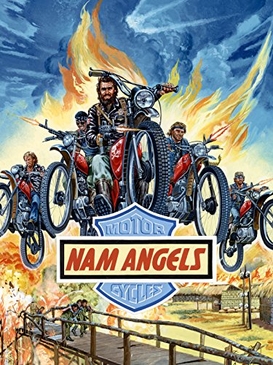
Nam Angels (1989, directed by Cirio H. Santiago)


During the Vietnam War, an American patrol is captured by a German (Vernon Welles) who plans to sell them to the VC.  Only their commanding officer, Lt. Vance Calhoun (Brad Johnson), manages to get away.  When he’s told the the Army can’t spare any men for a POW rescue mission, he instead recruits a group of Hell’s Angels who just happen to be hanging out in Vietnam.  When the Hell’s Angels learn that there’s gold hidden in the caves near the POW camp, they hop on their motorcycles and heard on out.

You might wonder why the Hell’s Angels were in South Vietnam to begin with.  The easy answer is that they were there to raise Hell and spread the legend of their motorcycle club.  The truth is that they were there to win the war for America.  Like many Vietnam films released in the 80s, the main message of Nam Angels is that America could have won if not for the cowardly officers who weren’t willing to rescue our POWs.  America should have listened to Vance Calhoun and the Hell’s Angels.  Meanwhile, the real-life Hell’s Angels sued the filmmakers for trademark infringement.  It doesn’t get more American that!

As for Nam Angels, it has all of the explosions and motorcycles that are promised by the title and, as always, Vernon Wells is a good villain.  Considering the premise, it’s disappointing that Nam Angels proves itself to be a typical straight-to-video war movie but it still features all of the action, torture, and tough talk the fans usually want from these movies.  It ends with a quote from John Milton that doesn’t really have anything to do with the film that we just watched.

This was one of the 104 films that Cirio Santiago directed over his career.  Reportedly, Steven Spielberg was a fan of this one, casting Brad Johnson in Always on the basis of his performance in Nam Angels.  Make good movies because you never know who might be watching.

Film Review: Left Behind: World At War (dir by Craig R. Baxley)


With the 2005 film, Left Behind: World At War, the Left Behind series enter special guest star territory.  Kirk Cameron and Brad Johnson, while still present in the film, were largely pushed to the background and Louis Gossett, Jr. and Charles Martin Smith popped up as Nicolae Carpathia’s two main adversaries.

Gossett plays President Gerald Fitzhugh.  Smith plays Vice President John Mallory.  (Speaking as someone of Irish descent, it fills me with pride to think that America will someday be led by the presidential ticket of Fitzhugh and Mallory.)  Despite the fact that Carpathia (again played by Gordon Currie) spent the previous film talking about how, under his leadership, there would be no more borders, it appears that there still are borders.  However, Carpathia has a plan to take care of that.  Mallory has discovered the plan but, right after he tells Fitzhugh about it, they’re attacked by Carpathia’s goons.  The presidential limo is blown up and with it, John Mallory.  (Poor Charles Martin Smith.)  Fitzhugh manages to escape, thanks to the help of the Tribulation Force.

It turns out that Carpathia’s latest scheme is to steal the few remaining bibles in the world, lace them with anthrax, and then distribute them back to the believers.  Gossett gets to go full action hero as he tries to stop Carpathia and good for him.  As for the other members of the Tribulation Force, Buck (Kirk Cameron) marries Chloe Steele (Janaya Stephens) and Chloe’s father, Rayford (Brad Johnson), meets his former lover, Hatti Dunham (Chelsea Noble).  Hattie is now Carpathia’s lover and is pregnant with his child.  Some members of the Tribulation Force die over the course of the film.  Buck has a moment of anger at God, which is the best scene in the film because it at least acknowledges that one can believe and still be angry.  The majority of the film, however, is Lou Gossett, Jr. wandering around with a “How did I go from winning an Oscar to appearing in this?” look on his face.

Anyway, credit where credit is due.  World at War is the most action-packed of the Left Behind films and, while it’s still definitely an evangelical film, it’s considerably less preachy than either the first Left Behind film or Tribulation Force.  World at War is pure melodrama, with a lot of plotting and evil cackling and overdone action scenes.  If you don’t want to listen to the dialogue, you can focus on just how small the film’s version of the Oval Office is.  That’s what happens when you try to a globe-spanning epic on a low budget.  Sometimes, you have to settle for a small replica of the Oval Office instead of trying for the real thing.

That’s not to say that World At War is a particularly good film.  Brad Johnson gets even less to do than in the second film and Kirk Cameron is still Kirk Cameron.  Since he lost his job at the end of Tribulation Force, we’re no longer asked to believe that Kirk Cameron’s playing a respected journalist.  Instead, Buck is now just a self-righteous evangelist and, for obvious reasons, it’s easy to believe Kirk Cameron in that role but Kirk Cameron is one of those actors who is far more likable when he’s miscast than when he’s playing himself.  Much as with Tribulation Force, World At War can’t seem to decide just how powerful Carpathia actually is.  He’s got supernatural powers and is apparently actually immortal and yet, he is often easily deceived by the simplest of ruses and is incapable of killing anyone until their usefulness to the film’s narrative has expired.

Louis Gossett, Jr. was smart enough to play a character who dies at the end of World At War, therefore freeing him from having to appear in any more Left Behind movies.  It turned out to be a moot point, however.  This was the last Left Behind film until the recent unsuccessful attempt to reboot the franchise with Nicolas Cage as Rayford Steele.

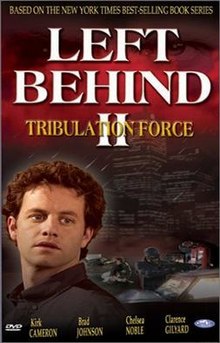
Film Review: Left Behind 2: Tribulation Force (dir by Bill Corcoran)


The 2002 film, Left Behind II: Tribulation Force, begins a week after the Rapture.  I have to admit that it took me by surprise when they mentioned that only a week had passed since the events that kicked off the first Left Behind film because the action in the original film seemed to go on for a lot longer than week.  I guess, if nothing else, that’s a lesson in the importance of keeping your film moving at a steady pace.

Speaking of pacing, Tribulation Force has a bit of quicker pace than the first film.  Now that everyone knows what happened, Rayford Steele (Brad Johnson) and Buck Williams (Kirk Cameron) can jump into action and start working to try to thwart the evil plans of Nicolae Carpathia (Gordon Currie).  Of course, at the start of the film, they’re told that it’s impossible to thwart the evil plans of Carpathia because the Bible has already predicted that he can’t be thwarted.  However, the Bible has also predicated that people will still try so I guess Rayford and Buck really don’t have that much of a choice.

Both Buck and Rayford get minor subplots that are designed to bring some humanity to all of the apocalyptic melodrama.  Rayford is still coming to terms with being left behind and struggling to forgive himself for not going to church with his wife and son.  To give some credit where credit is due, Brad Johnson is this film’s secret weapon.  He doesn’t really get to do much but Johnson brings just enough emotional reality to the role that his scenes have some depth that the rest of the film is missing.

As for Buck, he’s pursuing a tentative relationship with Rayford’s daughter, Chloe (Janaya Stephens).  Unfortunately, he’s also letting his assistant Ivy crash at his apartment and when Chloe stops by and discovers Ivy wearing a towel and an engagement ring, she assumes the worst.  Luckily, Buck’s able to say, “She’s my assistant” and that takes care of that.

Kirk Cameron is pretty much at the center of Tribulation Force, which is a problem because he’s totally miscast as a tough and respect journalist.  Carpathia, who really should have known better seeing as how he’s the son of Satan and everything, decides to turn Buck into the public face of his global news channel.  Unfortunately, there’s nothing about Kirk Cameron that suggests that any character he would play would ever have the gravitas or the charisma necessary to be the public face of any government.  As in the first film, Cameron comes across as being extremely earnest and a little bit dull.  He’s like the intern who accidentally screws up everyone’s lunch order.

Anyway, in Tribulation Force, everyone in the world loves Carpathia, even though he’s the most obviously evil dictator ever.  (The Rapture left behind not just the nonbelievers but also the extremely stupid.)  Carpathia announces the birth of a new world without borders and without religion.  Buck and Rayford plan to televise an interview with the Two Witnesses, who are waiting at the Wailing Wall.  But, to do that, they’re going to have to figure out a way to work around the fact that Carpathia controls all of the news channels….

Despite the fact that Tribulation Force is not as slow as the first film, the bulk of the film is still made up of people having long conversations about Biblical prophecy.  Like a lot of early faith-based films, Tribulation Force gets bogged down in explaining its message as opposed to showing the audience what that message means.  When Buck does finally reach the Wailing Wall, we do get to see some people get set on fire but, other than that, this is a very talky film.  As well, Tribulation Force can’t ever seem to decide just how powerful and all-knowing Carpathia is supposed to be.  At times, he has nearly supernatural powers and yet, at the same time, he’s totally incapable of seeing that Buck and Rayford are both plotting against him.  Is Carpathia a victim of his own hubris or is it just bad plotting on the part of the film?  I’ll leave it up to you decide.

Tribulation Force was followed by one more Left Behind film, World At War.  I’ll review that one in about 15 minutes!  Hope to see you then.


Film Review: Left Behind: The Movie (dir by Vic Sarin)


As I watched the 2000 film Left Behind: The Movie (not to be confused with the remake starring Nicolas Cage), I found myself thinking about names.

For instance, if your name is Rayford Steele, you really probably don’t have any choice but to become a pilot and maybe star in a low-budget action movie.  I mean, let’s just be honest.  People with names like Rayford Steele don’t end up working the night shift at 7-11.  In Left Behind, Rayford Steele is played by Bad Johnson and Johnson has just the right look to play a character named Rayford Steele.  He’s handsome in a somewhat old-fashioned, Gary Cooperish sort of way.

And yes, Rayford is a pilot.  He had a wife who resents the fact that Rayford is always flying off and abandoning his family.  She goes to church and she worries that he’s not a believer.  Rayford, meanwhile, is having an affair with flight attendant Hattie Dunham (Chelsea Noble).  That affair, however, may have to soon come to an end because Hattie has a new job with the UN.  Poor Hattie.  Nothing good ever comes from working at the UN!

Just as anyone named Rayford Steele would have to become a pilot, I imagine that anyone named Buck Williams would have to become a globe-trotting journalist.  We’re told that Buck is one of the most famous and successful journalists in the world.  Someone even mentions that Buck is so brave that he would have reported from Hiroshima while the first atomic bomb was being dropped.  (I assume that would have been a fairly short broadcast.)  Unfortunately, it’s a bit of a struggle to buy Buck Williams as a crusading journalist because he’s played by Kirk Cameron.  Buck is described as being tough and cynical.  There’s absolutely nothing tough about Kirk Cameron.  At his best, he projects an earnest blandness.  At his worst, he reminds you that he’s the guy who, years after starring in this film, would claim that a conspiracy of atheists was responsible for Saving Christmas receiving bad reviews.

Finally, if your name is Nicolae Carpathia, you’re pretty much destined to grow up to be very wealthy and also very evil.  You’re not going to end up living in the suburbs, mowing your own lawn and complaining about property taxes.  No, with a name like Nicolae Carpathia, you’re destined to end up using your position at the UN to take over the world.  When you declare that your goal is to lead the world into “seven years of peace,” everyone knows that you’re planning on doing the exact opposite.

Or, at the very least, everyone should know.  As played by Gordon Currie, Nicolae Carpathia is obviously evil from the minute he first appears.  (Even if you didn’t know his name, you would think he was evil just from the way he smirks.)  However, in the world of Left Behind, almost everyone loves Nicolae Carpathia.  When thousands of people mysteriously vanish, all at the same time, Carpathia is the person to whom humanity turns their tear-brimmed eyes.  The viewers know that it’s the Rapture and Rayford Steele and Buck Williams come to realize that it was the Rapture but Carpathia sees it as an opportunity to lead humanity into a …. dare I say it? …. new world order.

Left Behind is an odd film.  For the most part, it’s a fairly ludicrous film, a low-budget and excessively preachy attempt to create a religious epic on a Wal-Mart budget.  Kirk Cameron is miscast as a journalist and the film’s special effects are so obviously cheap that one can’t help but feel the filmmakers got a bit too ambitious for their own good.  (Just check out the scene at the start of the film when Buck Williams reports while “bombs” explode all around him.)  With a running time of one hour and 40 minutes, the film drags a bit and the characters are often frustratingly dense.  (Even non-evangelicals have, at the very least, heard that there’s a thing called the Rapture.)  And yet, occasionally, there will be moments when the film actually comes close to working.  Brad Johnson, for instance, gives about as good a performance as anyone could as Rayford Steele.  The scene where Carpathia manipulates a subordinate into committing suicide may not be terrible original but it’s still surprisingly effective.

Despite the fact that the film itself barely made a profit, Left Behind would go on to spawn two sequels.  We’ll look at the first, Tribulation Force, in 15 minutes.  Hope to see you then!

Lisa Reviews An Oscar Winner: The Greatest Show on Earth (dir by Cecil B. DeMille)


Jimmy Stewart is Buttons the Clown!

Listen, there’s a lot of things that can be said about the 1952 Best Picture winner, The Greatest Show on Earth.  Not only was it one of three Cecil B, DeMille films to be nominated for best picture (along with 1934’s Cleopatra and 1956’s The Ten Commandments) but it was also the only one to win.  It brought Cecil B. DeMille his first and only nomination for best director.  (DeMille lost that directing Oscar to John Ford but he still took home an award, as the producer of The Greatest Show On Earth.)  The Greatest Show on Earth not only featured Charlton Heston in his first starring role but, with a finale that featured everyone involved in the same spectacular train crash, it also set the standard for the countless disaster movies that would follow.

But, with all of that in mind, the main thing that you’ll remember about this movie is that Jimmy Stewart was Buttons the Clown.

Buttons is a beloved member of the Ringling Bros. and Barnum & Bailey’s Circus.  He travels with the circus across the country, entertaining children and generally helping out wherever he can.  Everyone loves Buttons, despite the fact that no one has ever seen him without his makeup.  (That said, you only have to hear him speak to immediately recognize him as being played by Jimmy Stewart.)  Not even the circus’s no-nonsense manager, Brad Braden (Charlton Heston, naturally), knows what Buttons actually looks like.  Everyone assumes that Buttons is just a dedicated performer, a method clown.

However, it turns out that Buttons has a secret.  Of course, nearly everyone at the circus has a secret but Buttons’s secret is a little bit more serious than just a love triangle or a case of professional jealousy.  There’s a reason why Buttons is surprisingly good at providing first aid to the members of the circus.  Before he was a clown, Buttons was a doctor.  And, while he was a doctor, he killed his wife.

NO!  NOT JIMMY STEWART!

In Buttons’s defense, it was a mercy killing and he feels really bad about it.  That, of course, doesn’t matter to the FBI agent (Henry WIlcoxon) who suspects that the doctor may be hiding among the circus performers.  At first, Buttons views that train crash as the perfect opportunity to escape but then he finds out that many of his fellow performers have been seriously injured.  A doctor is needed.  Perhaps even a doctor in clown makeup….

Even under all that makeup, Jimmy Stewart does a great job of bringing Buttons to life.  Sometimes, we associate Stewart so much with his famous way of speaking that we overlook just what a good actor Jimmy Stewart actually was.  Even before you discover why Buttons is running from the cops, Stewart does a good job of capturing the sadness and the regret that lies at the heart of Button.  He’s truly a tragic clown.

Buttons’s status as a fugitive is just one of the many subplots to be found in The Greatest Show On Earth.  There’s a lot of drama (not to mention parades and performances) to get through before that train crashes.  Brad, for instance, is struggling to keep the circus from going bankrupt.  Meanwhile, his girlfriend, Holly (Betty Hutton), is torn between him and the arrogant but charming Great Sebastian (Cornel Wilde).  In fact, every woman in the circus — including Gloria Grahame and Dorothy Lamour — is in love with the Great Sebastian.  Sebastian is a bit self-centered but he’s famous enough to ensure that the circus won’t have to be closed.  Or, at least, he is until he’s injured in a trapeze accident.  Will Sebastian ever perform again?  Meanwhile, there’s a jealous elephant trainer named Klaus (Lyle Bettinger) and a crooked concessionaire named Harry (John Kellog).  A local gangster, Mr. Henderson (Lawrence Tierney), is trying to muscle his way into the circus’s business.  Is it any surprise that Brad always seems to be in something of a bad mood?  He’s got a lot to deal with!

And yes, it’s all a bit overblown and a bit silly.  And yes, the film really does feel like it was meant to be a commercial for Ringling Bros.  And yet, in its way, the film definitely works.  There’s a sincerity at the heart of the film, one that’s epitomized by Cecil B. DeMille’s opening narration.  “”A fierce, primitive fighting force that smashes relentlessly forward against impossible odds: That is the circus — and this is the story of the biggest of the Big Tops — and of the men and women who fight to make it — The Greatest Show On Earth!”  DeMille was 71 years old when he made The Greatest Show On Earth and he was coming to the end of a legendary filmmaking career.  DeMille was one of the founders of the American film industry and you can argue that, if not for some of his silent spectacles, Hollywood would have always remained just a neglected suburb of Los Angeles.  If anyone understood that importance of that old saying, “The show must go on!,” it was Cecil B. DeMille.  And really, that’s what The Greatest Show On Earth is all about.  It’s a tribute to the performers who refuse to give up.  Love triangles?  Fugitive clowns?  Injured acrobats?  Lawrence Tierney?  No matter what, the show must go on!

The Greatest Show On Earth is often described as being one of the worst films to win the Academy Award for Best Picture.  That has more to do with the quality of the films that it beat — High Noon, The Quiet Man, Moulin Rouge, and Ivanhoe — than the film itself.  The Greatest Show On Earth is old-fashioned and a bit silly but it’s still entertaining.  Should it have beaten High Noon?  That would be a definite no.  But it’s still better than Crash.

Lifetime Christmas Movie Review: Jingle Belle (dir by Peter Sullivan)


As our longtime readers know, I’ve never been one for false modesty.  I know that there are things that I do well and I don’t see any reason not to brag about my natural talents.  On occasion, I’ve been told that it can be a little off-putting but so what?  As long as its justified, what’s wrong with a little arrogance?

That said, part of knowing what I can do means being honest about what I can’t do.  And if there’s any job that I would absolutely suck at, it would be writing advertising jingles.  I mean, there’s a reason why none of my poems ever rhyme.  Coming up with pithy one-liners that will make you want to “buy!  buy!  buy!,” just isn’t my specialty.  Fortunately, jingles themselves are no longer as important as they were back in the Mad Men era.  In fact, off the top of my head, I can only think of one current jingle and that’s the “Liberty Liberty Liberty Lib-er-ty!” song.

(And everyone hates that!)

Fortunately, Belle Williams (Tatyana Ali), the main protagonist of Jingle Belle, doesn’t have that problem.  Long ago, she abandoned New York for Ohio and she’s established herself as one of the best jingle writers around.  Unfortunately, it appears that she might be losing that magic touch.  As this film begins, she’s suffering from a terrible case of writer’s block.  In fact, when the mayor of her hometown calls and asks her to return home and help write the annual Christmas pageant, her initial reaction is to say no.  However, her boss (Loretta Devine) insists that Belle take the assignment.  Perhaps a trip back home is just what Belle needs to break through her writer’s block.

Belle returns home, planning on helping the town out.  What she doesn’t know is that the Christmas pageant is being directed by her ex-boyfriend and former performing partner, Michael Hill (Cornelius Smith, Jr).  Can Belle and Michael set aside their differences and their complicated personal history long enough to put on a successful Christmas pageant?  And how will Michael the purist react when Belle’s boss tries to turn one of their songs into an advertising jingle?

Of course, you already know the answer to all those questions.  Jingle Belle is predictable even by the standards of a Lifetime Christmas movie.  As I’ve said quite a bit this month, how much you enjoy this film will depend on how much tolerance you have for Lifetime and Hallmark Christmas films in general.  (That’s kind of become my mantra this month.)  Anyway, there’s no surprises to be found in this one but Cornelius Smith, Jr. is appropriately charismatic as Michael and the great Loretta Devine mines a lot of humor out of the role of the demanding boss.

The film’s final message is that small towns are better than big cities and you can write jingles anywhere.  It’s a nice little message but, then again, it does seem like, if you work in advertising, it would be a good idea to live near the hub of the advertising industry.  That said, I’ve never written a jingle in my life so I could be wrong.  All I know is that, wherever Belle lives, she’ll come up with something better than the Liberty Mutual jingle and really, that’s the most important thing of all.