Book Review: Chiefs by Stuart Woods


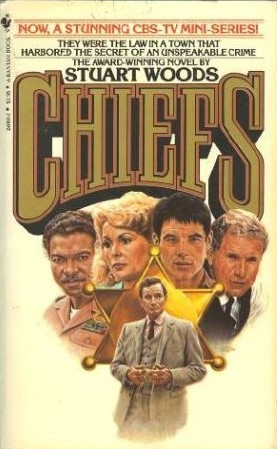
First published in 1981, Chiefs follows the town of Delano, Georgia over the course of five decades.

Delano starts out as a small, rural town, one that sit uneasily on the dividing line between the old and the new South.  Under the leadership of forward-thinking civic leaders like Hugh Holmes, the town starts to grow.  And, like any growing town, it needs a chief of police to maintain the peace.  In 1919, a simple but honest farmer named Will Henry Lee is selected as the town’s first chief of police.  Not selected is the wealthy Foxy Funderburke.  That’s probably for the best because Will Lee is determined to do a good job and fairly treat all of the town’s citizens, regardless of their race or their economic class.  Foxy, meanwhile, is a serial killer who has been killing young men and dumping their bodies all over the county.

Chiefs tells the story of three men who serve as Chief of Police while Delano grows and Foxy continues to murder anyone that he can get his hands on.  Will Henry Lee is followed by Sonny Butts, a war hero who soon turns out to be a corrupt and racist psychopath.  Sonny is eventually followed by Tucker Watts.  As the town’s first black police chief, Tucker has to deal with both racism and Foxy Funderburke’s murders.  However, Tucker himself has a secret of his own, one that links him back to the very first chief of police.

Chiefs is kind of all over the place.  Not only does the novel follow the growth of Delano and the decades-long investigation into all of Foxy Funderburke’s murders but it also finds time for appearances from Franklin D. Roosevelt and a subplot about Billy Lee, Will Henry Lee’s son, running for governor of Georgia and potentially replacing LBJ as Kennedy’s running mate in 1964.  (The President, of course, explains that he’ll make his decision after returning from Dallas.)  At times, it gets to be a bit too much.  The mystery of the Delano murders too often gets pushed aside for the far less interesting political stuff.  Chiefs was Stuart Woods’s first novel and he makes the common first-timers mistake of trying to cram too much into his story.

The book is at its best when it just sticks to Delano.  Foxy Funderburke is not just a murderer but also a symbol of the times when there law was only arbitrarily enforced in the former Confederacy and wealthy, white landowners could pretty much do whatever they wanted without having to worry about the consequences.  Foxy represents the old ways and each chief, even the evil Sonny Butts, represents just a little bit of progress towards the new way.  Though his prose is rarely memorable, Stuart Woods was a good storyteller and Foxy Funderburke is a memorable villain.  (And, to be honest, Foxy Funderburke is a brilliant name.)  Even if their characterizations aren’t particularly deep (Will Lee is honest, Sonny is narcissistic, Tucker is determined to prove himself), the three men who oppose him are all worthy adversaries and it’s interesting see how, over several decades, the three of them each finds a different piece of the puzzle until Foxy’s true nature is finally exposed.  Will Henry Lee may not have known Sonny Butts and Sonny certainly would never have even spoken to Tucker Watts but, in a way, the three of them work together to solve the town’s greatest mystery.

In the end, the book appealed to the side of me that loves a mystery and it also appealed to my dedicated history nerd side.  Chiefs is flawed but compelling.
Horror Review: “One for the Road” (by Stephen King)


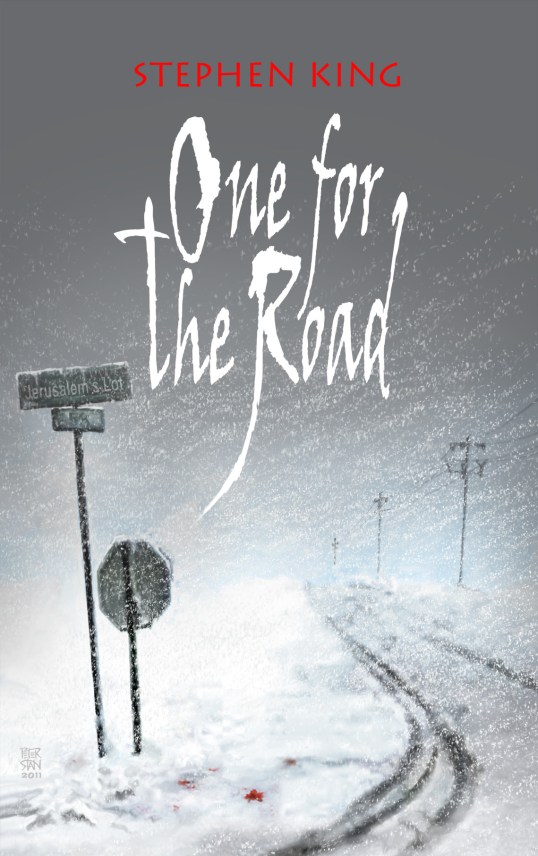
Stephen King’s writing style in “One for the Road” exemplifies his mastery of atmosphere, character voice, and narrative restraint. While much of his later work often invests heavily in world-building over long stretches, this short story demonstrates his ability to deliver a rich, immersive experience in a concise format. His choices here, both stylistic and structural, serve the story’s central purpose: to convey unspoken dread and the inevitability of evil.

The story serves as a chilling epilogue to ’Salem’s Lot, set during a brutal New England winter many years after a fire destroyed the infamous town. Told by Booth, an elderly local from nearby Falmouth, it begins in the warm familiarity of Herb Tookey’s bar, where Booth and Herb are longstanding fixtures. Their evening is interrupted when Gerald Lumley, cold and near collapse, stumbles in. Lumley explains that his car broke down in the snow miles away, and that he left his wife and daughter in the vehicle while seeking help. Tension deepens when he reveals the breakdown happened near Jerusalem’s Lot—a place everyone in the area fears but rarely discusses. Despite knowing the dangers, Booth and Herb reluctantly agree to help him return.

Their journey into the storm is both physically taxing and emotionally tense, as the two locals understand all too well what they might find. As they approach the outskirts of The Lot, King uses sparse detail and implication to build dread. By the time they reach Lumley’s car, the supernatural horror makes itself known, hammering home the message that evil never truly dies—it lingers, waiting for an opportunity to strike.

King’s decision to frame “One for the Road” within a harsh New England winter is critical to its success. The cold itself becomes an antagonist—slowing movement, reducing visibility, and draining the characters’ strength—adding a physical urgency to the supernatural threat. Snowstorms are a recurring motif in his work (The ShiningStorm of the Century) because they isolate the characters, making escape impossible and forcing confrontation with whatever is lurking nearby. The blizzard in this story intensifies feelings of claustrophobia, despite the vastness of the open, rural landscape.

King also makes the setting deeply familiar for his readers. Falmouth feels like a lived-in place, with its bar, locals who know one another’s routines, and whispered legends about The Lot. The story doesn’t waste time describing Jerusalem’s Lot in detail; instead, its horrors exist in the margins, in what the locals refuse to say.

The choice of Booth as the first-person narrator adds authenticity and intimacy. Booth speaks with the cadence of an elder New Englander—practical, reserved, and hardened by experience. Readers never doubt that this is the account of someone who understands the local history and its dangers. The conversational delivery, sprinkled with regional colloquialisms, draws the reader into the moment rather than presenting a polished, detached recounting.

Rather than sensationalizing The Lot’s horrors, Booth lets them linger unsaid. King understands that withholding explicit details can fuel imagination more effectively than extravagant description. This restraint makes the story’s climax more impactful because the dread has been steadily fed through implication.

The story’s pacing is deliberate but tight. King introduces the danger early—Lumley’s car is stranded near Jerusalem’s Lot—then uses the journey back to extend suspense. The structure mirrors a descent into darkness: starting in the relative safety of Herb Tookey’s bar, venturing into the blizzard, and finally confronting the true horror at the edge of The Lot. King avoids unnecessary subplots, instead focusing on a single mission: rescuing Lumley’s family. This gives the narrative relentless forward motion while allowing tension to rise in small increments.

One of King’s most notable thematic choices is the portrayal of evil as a constant, indestructible force. In ’Salem’s Lot, that evil once emanated from the Marsten House, a decaying mansion that served as both the symbolic and literal heart of darkness. By the time of “One for the Road,” however, the Marsten House has been burned down and stripped of its power. Yet, rather than eradicating the evil, its essence has expanded outward—the town itself has inherited its malign influence. The Lot has effectively become the new Marsten House, and its ruined streets and frozen remains now radiate the same dark gravity that once resided solely within those walls. King transforms the geography of evil: what was once contained in a single haunted house has transposed itself over the entire landscape, infecting the air, the snow, and the silence with something sentient and waiting.

King also plays with the tension between duty and self-preservation. Booth and Herb could have ignored Lumley’s plea. Their choice to help—despite knowing what might await them—aligns with King’s recurring motif that true courage lies in facing evil with no guarantee of victory.

Even when weaving atmosphere, King exercises a tight control over detail. The bar scene is economical: we know just enough about Herb, Booth, and their friendship to trust their dynamic. The blizzard is described vividly but without purple prose. This brevity forces the reader to focus on what matters—the growing realization that Lumley’s family is in mortal danger. The vampires themselves receive minimal “screen time,” a deliberate choice that allows the prior suspense to make their eventual appearance all the more devastating.

As a companion piece, “One for the Road” functions as both a continuation and a tonal reinforcement of ’Salem’s Lot. Rather than tying up loose ends, King emphasizes that nothing was truly resolved. Evil is only temporarily held back, and the destruction of the town did not remove its blight. By telling the story through outsiders who skirt the edge of The Lot without entering deeply into it, King preserves the town’s mystique, forcing readers to imagine the horrors that remain—an imaginative space where dread thrives long after the last page.

Book Review: THE LAST STAND by Mickey Spillane (Hard Case Crime 2018)


gary loggins's avatarcracked rear viewer

2018 is the centennial anniversary of Mickey Spillane’s birth! Spillane got his start in comic books, then caused a sensation with his 1947 novel I, THE JURY, introducing the world to that hardest of hardboiled PI’s, Mike Hammer. Hard Case Crime, an imprint every pulp fiction fan should know about, celebrates Spillane’s birth by releasing THE LAST STAND, The Mick’s last completed novel, with a bonus unpublished novella from the early 1950’s.

Spillane with friend/literary executor Max Allan Collins

Mickey’s literary executor and friend Max Allan Collins writes the introduction. Collins is no stranger to the hardboiled genre himself, having been Chester Gould’s replacement on the long-running comic strip Dick Tracy from 1977-92, author of the graphic novel ROAD TO PERDITION, and the Quarry series of books (made into a Showtime series in 2016). Since Spillane’s death in 2006, Collins has been editing and completing the writer’s (“I’m not an…

View original post 553 more words

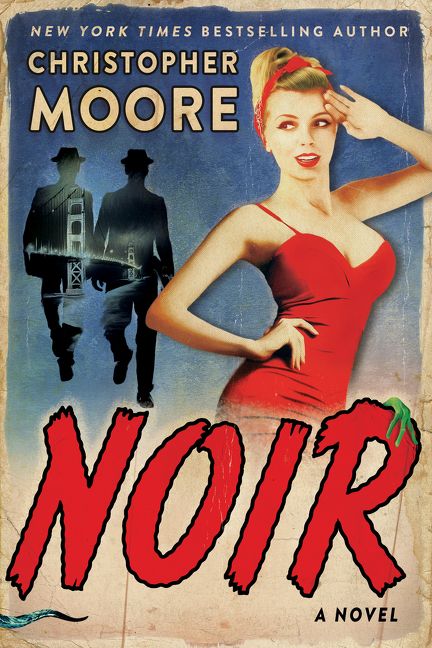
Book Review: NOIR by Christopher Moore (William Morrow 2018)


gary loggins's avatarcracked rear viewer

In between everything else I do, I read about a book a week, mainly mystery fiction. Current favorites include James Lee Burke, Lee Child, Michael Connelly, Janet Evanovich, and John Sandford, all with their own unique styles, and all masters of the genre. But when I need a good laugh, I pick up Christopher Moore. I first became aware of Moore’s work with his brilliant 2002 novel LAMB, OR THE GOSPEL ACCORDING TO BIFF, CHRIST’S CHILDHOOD PAL, an irreverent satire narrated by Jesus’s good buddy Biff that’s as outrageous as it sounds, and sinfully funny to boot.

Robert Mitchum and Jane Greer in “Out of the Past” (RKO 1947) have nothing on Sammy and The Cheese!

This time around, Moore goes from taking on the Scriptures to the hard-boiled world of Raymond Chandler and Dashiell Hammett. The novel is set in 1947 San Francisco, a very good year for noir

View original post 303 more words

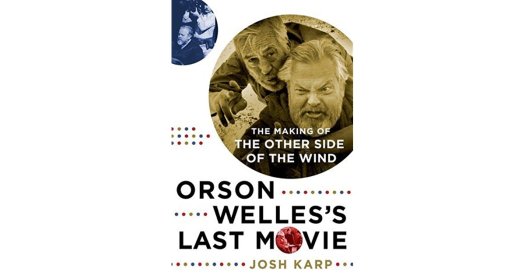
Book Review: ORSON WELLES’S LAST MOVIE by Josh Karp (St. Martin’s Press 2015)


gary loggins's avatarcracked rear viewer

There’s a lot of buzz around the film community about THE OTHER SIDE OF THE WIND, Orson Welles’s unfinished film begun in 1970 that he worked on for almost a decade. Welles used different film stocks (8, 16, & 35 MM) and varied his styles to create a film-within-a-film focusing on the early 70’s clash between the Old Hollywood of the studio system and the New Hollywood auteurs (Welles, the ultimate auteur himself, disdained the term).  Netflix has announced the film has finally been restored and completed with the help of an Indiegogo campaign, and will be available for viewing sometime in 2018 (When, Netflix, when???). In the meantime, you can read author Josh Karp’s fascinating 2015 book ORSON WELLES’S LAST MOVIE: THE MAKING OF THE OTHER SIDE OF THE WIND.

Karp gives us a fast-paced look behind the scenes of a genius at work, creating art on…

View original post 283 more words

Book Review: Need To Know by Karen Cleveland


How well do you know the people you love?

That’s the question that’s at the heart of Need to Know, the debut novel of Karen Cleveland.

When we first Vivian Miller, the main character and narrator of Need to Know, she has a life that, on the surface, many would envy.  She has four children, a nice house in the suburbs of D.C., and a handsome and charming husband named Matt.  Of course, there are problems.  Money’s tight.  One of her children has a heart defect, one that will undoubtedly require surgery in the future.  Honestly, Vivian would be happy to stay home and spend all of her time taking care of the children but, as Matt always reminds her, they need the money that her job brings in.

Vivian works for the CIA.  She’s an analyst and, as glamorous as working in intelligence might sound, her job basically involves spending a lot of time in the office, searching through the computers of suspected Russian agents.  For instance, there’s the mysterious Yury.  When Vivian searches through Yury’s files, she comes across a folder that is labeled “Friends.”  Inside the folder are five pictures of five people who might or might not be working for the Russians.

Four of the pictures are of total strangers.

The fifth picture is of Matt.

If nothing else, Need to Know is a book that will keep you guessing.  Is Matt a Russian agent or was his picture placed in the folder just to compromise Vivian’s position with the CIA?  Has Matt spent ten years being a perfect and supportive husband or was he actually a passive aggressive manipulator?  What do the Russians want and how far are they willing to go to get it?  And, even more importantly, how far is Vivian willing to go to protect her children?

Need to Know is a strong debut novel, a perfectly paced thriller that will take consistently take you by surprise.  Karen Cleveland is a former CIA analyst herself and she puts that background to good use in Need to Know, supplying a lot of interesting details that you wouldn’t get from a book written by … well, by someone like me, whose national security expertise is pretty much limited to what I’ve seen in the movies.

(Speaking of movies, apparently Charlize Theron will be producing and starring in the film version of Need to Know.  Personally, the entire time I was reading the novel, I pictured Naomi Watts as Vivian, Jeremy Renner as Matt, and Richard Jenkins as Vivian’s boss, Peter.)

I did have a few issues with the final few chapters of the book.  Though it didn’t effect my overall enjoyment of the novel, I would have liked a stronger ending.  That said, the ending does potentially leave room for a sequel and I will definitely be reading the next book that Karen Cleveland writes!

If you’re in the mood for a good and intelligent spy thriller, Need to Know is definitely one to check out.

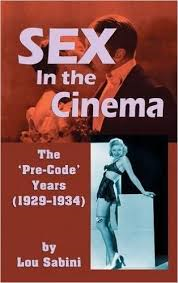
Book Review: SEX IN THE CINEMA The ‘Pre-Code’ Years (1929-1934) by Lou Sabini (Bear Manor Media 2017)


gary loggins's avatarcracked rear viewer

Those of you who faithfully follow this blog know what a huge fan of Pre-Code films I am, even devoting an entire series to them, “Pre Code Confidential”. Well, film scholar and all-around good guy Lou Sabini has gone a step further and written a new book, SEX IN THE CINEMA: THE PRE-CODE YEARS, published by the fine folks over at Bear Manor Media, a handy reference guide to 107 Pre-Code films covering topics like illicit sex, gangland violence, drug addiction, alcoholism, prostitution, abortion, and Busby Berkeley… what more could a Pre-Code fan ask for!!

Helen Twelvetrees & Charles Bickford in 1932’s PANAMA FLO

Out of the 107 movies covered here, I’ve seen a mere 36, and covered seven on CRV. That will certainly change, as a few of them are sitting in my DVR ready to be enjoyed (thanks, TCM!). Lou was a student of noted film historian/collector William…

View original post 209 more words

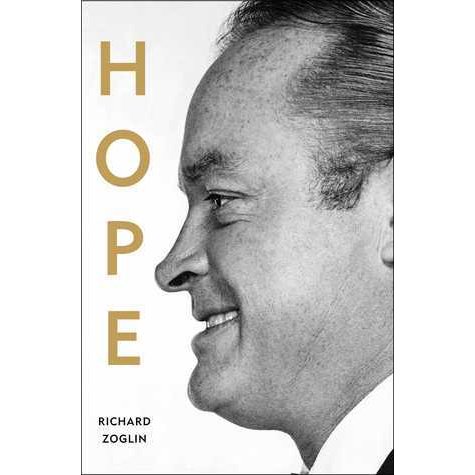
Book Review: HOPE: Entertainer of The Century by Richard Zoglin (Simon & Schuster, 2014)


gary loggins's avatarcracked rear viewer

He was unquestionably one of the most famous, most recognized persons of the 20th Century, the father of what we now know as stand-up comedy, the first true multi-media star. A patriot and a philanderer, a giver and a taker, a smart-mouthed comic and a friend to presidents and generals. But who was Bob Hope, really? This ambitious 2014 biography by Richard Zoglin attempts to answer that question, a meticulously researched tome that tries to uncover the private man behind the public mask.

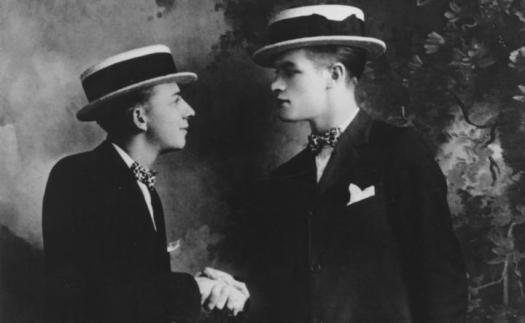
with vaudeville partner George Byrne

Zoglin digs deep into the available archives and uses interviews with those that knew him to paint his portrait of the notoriously reticent Bob Hope, reaching all the way back to his hardscrabble beginnings as an immigrant in Cleveland with six brothers, an alcoholic father who was an itinerant stone cutter, and a stern but loving mother who served as the de facto head…

View original post 422 more words

Book Review: STICK IT! MY LIFE OF SEX, DRUMS, AND ROCK’N’ROLL by Carmine Appice with Ian Gitting (Chicago Review Press 2016)


gary loggins's avatarcracked rear viewer

About three weeks ago, I attended the Vanilla Fudge 50th Anniversary show at the Narrows Center for the Arts in Fall River, MA. It’s a great venue to see a concert, with an intimate 280 seat capacity. Three of the four original members performed (bassist Tim Bogert is retired from active touring), and their psychedelic, proto-metal stylings had the joint rocking hard. Keyboard wizard Mark Stein, guitarist Vinnie Martell, new bass player Pete Bremy, and legendary drummer Carmine Appice tore the house down with their renditions of hits like “You Keep Me Hangin’ On”, “Take Me for a Little While”, and “People Get Ready”.

Much as I enjoyed all their musicianship, the main reason I went was to catch Carmine Appice,  one of rock’s all-time greatest drummers. The band did a meet-and-greet after the show, and I snatched by a copy of Appice’s recent book, STICK IT! MY LIFE OF SEX…

View original post 318 more words

Book Review: JOHN WAYNE: THE LIFE AND LEGEND by Scott Eyman (Simon & Schuster)


gary loggins's avatarcracked rear viewer

wayne1

He’s a walking contradiction, partly truth, partly fiction” –

Kris Kristofferson, The Pilgrim

He was a football star at USC who also starred on the debate team. A primitive that could quote Shakespeare, Keats, and Churchill with ease. A two-fisted, hard drinker who was adept at chess and bridge. A man some called racist whose three wives were all Hispanic. To his friends, he was Duke Morrison, but to the world he was known as John Wayne. This definitive, well researched biography by Scott Eyman was released in hardcover in 2014, and is now available in trade paperback form. Eyman, who also wrote the definitive book on John Ford (1999’s PRINT THE LEGEND: THE LIFE AND TIMES OF JOHN FORD), spent years to make this the last word on John Wayne, separating the man from the myth, in this in-depth study of how the boy from Winterset, Iowa became…

View original post 541 more words