Horror Film Review: It Conquered The World (dir by Roger Corman)


“Man is a feeling creature, and because of it, the greatest in the universe….”

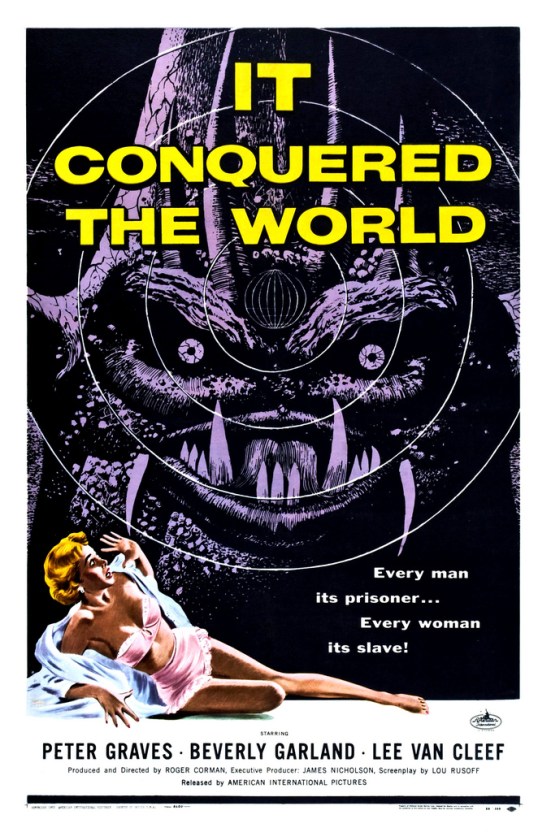
So says scientist Paul Nelson (Peter Graves) towards the end of 1956’s It Conquered The Universe.  Paul may be a scientist but he understands the importance of emotion and imagination and individuality.  He knows that it’ll take more than just cold logic to save humanity from destruction.

Unfortunately, Paul’s best friend, Tom Anderson (Lee Van Cleef), disagrees.  Tom worked at Los Alamos.  Tom helped to develop the atomic bomb.  Tom is convinced that humanity will destroy itself unless a greater power takes over.  Tom feels that he has discovered that greater power.  Tom has recently contacted a Venusian and invited it to come to Earth.  Upon arriving, the Venusian promptly disrupts all electrical power on Earth.  It sends out bat-like creatures that inject humans with a drug that takes control of their minds and turns them into a compliant slaves.  Paul tells Tom that robbing people of their free will is not going to save the Earth but Tom remains committed to the Venusian, even as it becomes obvious that the Venusian’s main concern is with its own survival.

It Conquered The World is very much a film of the 1950s.  Along with tapping into the era’s paranoia about nuclear war and UFOs, it also features Peter Graves delivering monologues about freedom and the inherent superiority of the human race.  When Paul confronts Tom, he not only accuses Tom of selling out the Earth but he also attacks Tom’s patriotism.  When Tom’s wife, Claire (Beverly Garland), confronts the alien and orders it to leave her plant along, she does it while wearing high heels and a tight sweater and holding a rifle.  The one female scientist (played by Karen Kadler) spends most of her screentime being menaced while wearing a white slip and there’s a platoon of bumbling but unbrainwashed soldiers hanging out in the woods.  If one looked up 1956 in the dictionary, there’s a very good chance this film would be the definition.

At the same time, the film’s story feels like a metaphor for modern times.  When the Venusian-controlled police turn authoritarian and start threatening to punish anyone who questions their orders, we’re reminded of the excesses of the COVID lockdowns.  When the editor of the town’s newspaper is shot by a policeman who says that words are no longer necessary in the new world, it’s hard not to think of all the writers, commentators, artists, and ordinary citizens who have run afoul the online cancellation brigade.  When Paul is reduced to riding a bicycle from place to place, it’s hard not to think of the environmental Luddites, with their hatred of anything that makes life more convenient.  When Tom rationalizes his activities by saying that humanity must be saved from itself, he’s expressing an opinion that is very popular among several people today.  Tom’s embrace of cold logic feels very familiar.  Of course, today, people don’t need a Venusian to order them to accept authoritarianism.  Instead, they’re more than happy to do on their own.

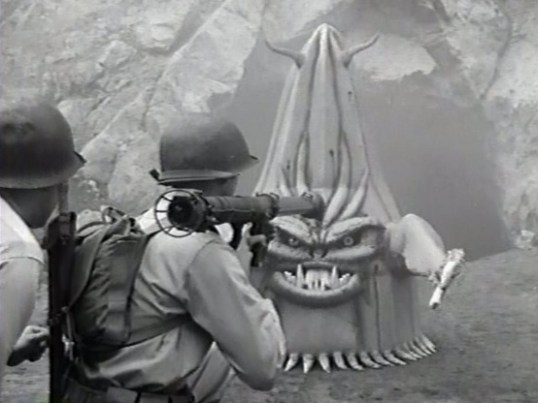
It Conquered The World was directed by Roger Corman.  It was his eighth film as a director and it remains one of his most entertaining.  As one might expect from a low-budget sci-fi film, It Conquered The World produces it’s share of laughs.  It’s hard not to smile at the sight of the extremely serious Peter Graves peddling his bicycle from location to location.  (It doesn’t help that Graves never takes off his suit or loosens his tie.)  And the Venusian simply has to be seen to be believed:

At the same time, It Conquered The World holds up well.  Lee Van Cleef and Beverly Garland both give performances that transcend the material, with Van Cleef especially doing a good job of paying a man struggling to rationalize his bad decisions.  It Conquered The World holds up today, as both a portrait of the 50s and 2024.

Horror Film Review: The Alligator People (dir by Roy Del Ruth)


You know what the worst bayou is?

Bayouself.

Thank you!  I’ll be here all night and don’t forget to tip your server!

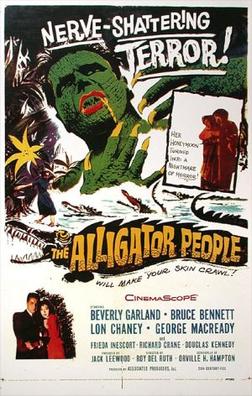
Anyway, the 1959 film, The Alligator People, largely takes place in the bayous of Louisiana.  Nurse Jane Marvin (Beverly Garland) is suffering from amnesia so she allows two psychiatrist to give her a dose of truth serum and then, when she’s in a hypnotized state, she proceeds to remember her former life as Joyce Webster.

Joyce married a handsome and seemingly perfect man named Paul Webster (Richard Crane) but, right when they were about to go on their honeymoon, he received a telegram that disturbed him.  After he made a phone call, he vanished from Joyce’s life.  Joyce did some research of her own and discovered that Paul’s former home was the Cypresses Plantation in the small town of Bayou Landing, Louisiana.

When Joyce travels down to Bayou Landing, she discovers that there’s really not much there, other than a bunch of hungry alligators.  She meets the owner of the plantation, Lavinia Hawthorne (Frieda Inescort).  She also meets the handyman, Manon (Lon Chaney, Jr.), a one-handed brute who spends most of his day shooting at alligators.  And, eventually, Joyce comes across her husband but Paul is no longer the man that she remembers.

Paul’s skin is scaly and he only comes out at night.  It turns out that Paul was, long ago, injected with a serum that would allow him to grow back a missing limb.  The serum worked as far as the limb was concerned but an unfortunate side effect is that Paul is now turning into an alligator!  Dr. Mark Sinclair (George Macready), the man who came up with the serum in the first place, is hopeful that he can reverse the process but, to do so, he’s going to need a lot of radioactive material.

Complicating things is that Manon has decided that he wants Joyce for himself and he’s certainly not going to compete with some alligator man for her attention.  Of course, Joyce despises Manon from the first moment she sees him but Manon’s not that smart.  Can Paul be cured before Manon destroys everything?

The Alligator People is one of those 1950s B-movies that is probably better-known for its name than anything else.  That said, when taken on its own terms, it’s an entertaining watch.  It was one of the final films to be directed by Roy Del Ruth, who had previously been one of Hollywood’s top directors of musicals and comedies.  There’s not much music or deliberate comedy to be found in The Alligator People but Del Ruth does manage to capture the humid stillness of the bayous.  As always, Beverly Garland gives a strong performance as a determined woman who isn’t going to be told what to do and Richard Crane is about as convincing as one can be while turning into an alligator.

As for Lon Chaney, Jr, he plays Manon as being a total monster and he gives a convincing performance, even if it is hard not to mourn the loss of the shadings that he brought to his monster roles while he was with Universal.  Manon is a rough and determinedly unintelligent character, one who exists only to destroy.  Significantly, he’s not one of the Alligator People.  Instead, he’s just a man who doesn’t care about anyone but himself.

The Alligator People is an effective B-movie, full of a bayou atmosphere.

Retro Television Reviews: The Weekend Nun (dir by Jeannot Szwarc)


Welcome to Retro Television Reviews, a feature where we review some of our favorite and least favorite shows of the past!  On Sundays, I will be reviewing the made-for-television movies that used to be a primetime mainstay.  Today’s film is 1972’s The Weekend Nun!  It  can be viewed on YouTube!

By day, Marjorie Walker (Joanna Pettet) is a probation officer who, some might say, cares just a little too much.

By night and on the weekends, she’s Sister Mary Damian, a nun who has taken the three vows of poverty, chastity, and obedience.

Mother Bonaventure (Ann Sothern) isn’t sure that she’s happy about Sister Damian working as a probation officer.  And the tough and cynical Detective Chuck Jardine (Vic Morrow) certainly isn’t happy when he discovers that the reason why Marjorie has never invited him into her home for a drink is because she lives at a convent.  But Marjorie is determined to make a difference, especially in the life of a troubled teen runaway named Audree (Kay Lenz).

Now, this may sound like the premise of a socially relevant sitcom and, indeed, The Weekend Nun is one of those titles that might lead some to expect wacky hijinks and an intrusive laugh track.  However, The Weekend Nun is not only loosely based on a true story but the film also takes itself very seriously.  From the minute that Sister Damian agrees to take part in a program that would allow her to work a real job during the day while returning to the convent at night, she’s exposed to the harsh realities of the world.  She goes from being sheltered to dealing with distraught parents, drug addicts, teen prostitutes, and violent criminals.  Because Captain Richardson (James Gregory) doesn’t want anyone to feel uncomfortable, he hides the fact that she’s a nun.  Of course, this leads to be people like Chuck Jardine wondering why Marjorie is so shocked when she witnesses the thing that he has to deal with a day-to-day basis.

And, indeed, the film’s biggest flaw is that Marjorie is often portrayed as being ridiculously naïve.  The film acts as if spending time in a convent is somehow the equivalent of spending a decade hiding out in a bomb shelter or something.  (Speaking as a Catholic school survivor, nuns are usually some of the least naïve people around.)  Marjorie is portrayed as being such a wide-eyed innocent that it’s hard not to wonder why she was hired to work as a probation officer in the first place.  Of course, Marjorie quickly gets an education on just how dangerous and unforgiving life on the streets can be and she soon has to make a choice between being a nun or being a probation officer.  Will she give her life to God or will she potentially give it to Vic Morrow?

Joanna Pettet overplays Marjorie’s innocence but that’s more the fault of the script than anything else.  James Gregory, Vic Morrow, and Ann Sothern are all believable as the authority figures in Marjorie’s life and Kay Lenz has a few good scenes as the teenage runaway who Marjorie tries to save.  Beverly Garland has a small but brief role as Lenz’s horrifically unconcerned mother.  It’s a well-acted film, regardless of any other flaws.

The Weekend Nun is not perfect but it’s still preferable to The Flying Nun.  It’s a sincerely heartfelt film, one that’s earnest in a way that can seem a bit quaint but which is still likable when watched today.  For better or worse, there’s not a hint of snark to be found.

Retro Television Reviews: The Day The Earth Moved (dir by Robert Michael Lewis)


Welcome to Retro Television Reviews, a feature where we review some of our favorite and least favorite shows of the past!  On Sundays, I will be reviewing the made-for-television movies that used to be a primetime mainstay.  Today’s film is 1974’s The Day The Earth Moved!  It  can be viewed on YouTube!

Sitting in the middle of the Nevada desert, there’s a town called Bates.

Bates was once a thriving community but the years and the hot Nevada winds have not been kind to it.  Now, it consists of only a  few buildings and a speed trap.  Judge Tom Backsler (William Windom) is the most powerful man in this tiny community and he’s determined to return Bates to its former glory.  His plan is to open up a Christmas park and to remake Bates as “Santa Claus’s home away from the North Pole.”  In order to raise the money for that project, he and the police run an aggressive speed trap.  When pilot and photographer Steve Barker (Jackie Cooper) is caught in the speed trap, it turns out that he doesn’t have enough money to pay his fine.  So, his car is impounded and he’s put to work, sweeping up the dust and helping to get the Christmas park ready to open.

With the help of friendly little townsgirl, Steve is finally able to escape from Bates and return to his job.  He works with his wife, Kate (Stella Stevens), and his best friend, Harley (Cleavon Little), as surveyors.  When someone wants to buy a stretch of the Nevada desert, Steve and Harley fly over the land and take pictures.  Looking over the latest batch of pictures, Steve deduces that not only is there going to be an earthquake but it’s going to destroy the town of Bates!  Can Steve return to the town that once held him prisoner and convince the townspeople to leave with him before disaster hits!?

In many ways, The Day The Earth Moved is a standard made-for-TV disaster flick.  Only Steve and Kate realize what’s about to happen and they struggle to get anyone else to believe them.  Indeed, it seems like the world is almost conspiring to keep them from warning everyone about the incoming earthquake.  The film’s story checks off all of the expected disaster movie plot points.  That said, the town of Bates itself — with its gigantic Santa Claus standing in the middle of the desert — is a nicely surreal location and the repeated shots of a deserted farm being gradually destroyed by minor tremors achieve a certain ominous grandeur.  Jackie Cooper and Stella Stevens are believable as a husband and wife who love each other despite the fact that they’re often very annoyed with each other.  To the film’s credit, William Windom’s character is not portrayed as being a cardboard villain but instead as someone who simply wants to give his neighbors some place decent to live.  The Day The Earth Moved is predictable but well-done.

Of course, the main reason anyone will have to watch this film will be for the earthquake.  Unfortunately, this is where viewers will run into a common problem that has afflicted many made-for-TV movies.  The low-budget earthquake is just not that impressive.  For all the scenes of people yelling, it’s always pretty obvious that the camera is doing most of the shaking.  But you know what?  It’s a made-for-TV movie from 1974.  Cut it some slack and just go with it.

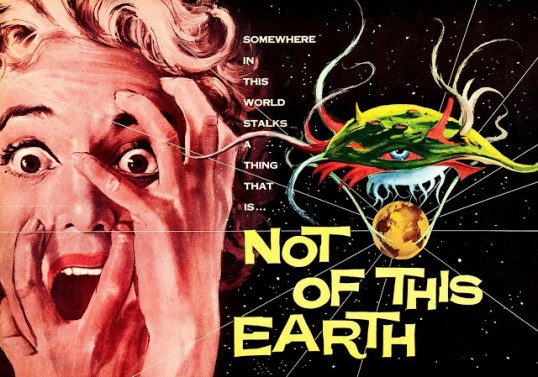
Horror on the Lens: Not of this Earth (dir by Roger Corman)


Today’s horror on the lens is the 1957 Roger Corman-directed, sci-fi “epic,” Not of this Earth.

Paul Johnson (Paul Birch) may seems like a strange character, with his stilted way of speaking and his sunglasses and his overdramatic reaction to any and all loud noises.  Paul could us be an eccentric.  Or, he could be …. NOT OF THIS EARTH!  Actually, his habit of draining people of their blood and sending weird, umbrella-like creatures out to attack his enemies would seem to suggest that the latter is probably true.

Listen, it’s not easy being a blood-sucking alien.  I mean, sure, there’s always seems to be people stupid enough to show up at your mansion so that you can drain their bodies.  Paul is lucky that he doesn’t exactly seem to be surrounded by brain surgeons.  But sometimes, things happen.  For instance, someone might show up from your home planet and demand an immediate transfusion!  What is an alien to do?

Watch this low-budget but undeniably entertaining film to find out!  And be sure to especially keep an eye out for the great Dick Miller, who reportedly improvised his role as a vacuum cleaner salesman.  (Before going into acting, Miller actually did sell vacuum cleaners door-to-door.)

Enjoy!

Film Review: Not Of This Earth (dir by Roger Corman)


Originally released in 1957, Roger Corman’s Not Of This Earth is about a man named Mr. Johnson (played, in a nicely creepy performance, by Paul Birch).

At first glance, Mr. Johnson may look like your typical dark-suited, 1950s businessman but, on closer examination, there’s definitely something off about him.  Why does he always wear those dark sunglasses?  Why is he so sensitive to loud noise?  Why does he move stiffly, as if he’s still getting used to his ody?  And when he speaks, why is his tone always so formal and correct?  Never trust anyone who doesn’t use a contraction or two.  Why is it that Mr. Johnson seems to spend all of his time in his mansion, only venturing outside so that he can visit the local blood banks?

Could it be that Mr. Johnson is …. not of this earth!?

Well, yes, of coursem he’s an alien.  I mean, it says so right in the title of the movie!  It turns out that Mr. Johnson comes from a planet called Davanna.  The inhabitants of Davanna are dying of a mysterious blood disease so he’s been sent to Earth so that he can run tests on human blood.  Needless to say, Mr. Johnson is under constant pressure from his bosses back home.  They expect Johnson to find a cure but there’s only one problem.  Human blood is sometimes hard to come by.

Oh sure.  Johnson can always go to the local doctor (William Roerick) and get a transfusion.  But, unfortunately, Johnson is often forced to deal with his need for blood by murdering anyone who happens to be near the house, whether it be a teenager or a vacuum cleaner salesman.  Like a vampire, Johnson drains them of their blood before retreating to the safety of his mansion.

Paul Birch gives a wonderfully odd performance in the role of Mr. Johnson, playing him in such a way that suggests that Mr. Johnson is still not quite comfortable with his human disguise.  When he starts speaking with his stilted and awkward syntax, he’s like a man who has just learned how to speak another language.  On the one hand, it’s tempting to feel sorry for Mr. Johnson because he’s desperately trying to save his people.  On the other hand, he does end up killing a lot of people.

Beverly Garland and Morgan Jones play Nadine and Harry, a nurse and a policeman who stumble across the truth of Mr. Johnson’s origins.  Beverly Garland was one of those confident, no-one-is-going-to-conquer-my-planet actresses who could elevate any film by her presence alone and, as this film shows, if you’re trying to stop the aliens from stealing all of Earth’s blood, Beverly Garland was someone who you would want on your side.

With the exception of a scene featuring Dick Miller as a slick salesman, director Roger Corman plays the material straight and the end result is a quickly paced and, at times, genuinely creepy little sci-fi/horror hybrid.  Corman makes good use of his low-budget and even the film’s cheap look ultimately works to its advantage.  The stark black-and-white cinematography perfectly captures the harshness of Mr. Johnson’s mission.  This an effective and enjoyable B-movie.

Finally, since this is a Roger Corman production, be sure to look for all of the usual suspects.  As mentioned above, Dick Miller plays a salesman.  (Before becoming an actor, Miller actually did work as a door-to-door salesman and he ad libbed the majority of his dialogue.)  Jonathan Haze appears as one of Mr. Johnson’s servants.  And, of course, the film was written by Corman’s longtime collaborator, Charles B. Griffith.  Three years after making Not Of This Earth, Corman, Haze, Miller, and Griffith would collaborate on the somewhat more light-hearted Little Shop of Horrors.

B-Girls and B-Movies: CHICAGO CONFIDENTIAL (United Artists 1957)


gary loggins's avatarcracked rear viewer

CHICAGO CONFIDENTIAL is just a routine ‘B’ crime drama, one of many churned out in the 50’s. Yet the performances of stars Brian Keith Beverly Garland , and an above-average supporting cast helped elevate the by-the-numbers material into something watchable. It’s those Familiar Faces we all know and love from countless movies that made CHICAGO CONFIDENTIAL work for me.

The story revolves around racketeers muscling in on the Worker’s National Union so they can bring their “numbers rackets and ‘B’ girls” to the city. Politically ambitious State’s Attorney Jim Fremont is dead set on busting them up, and when the union’s treasurer is murdered, the finger of suspicion is pointed at honest Union President Artie Blane. Blane’s been framed by his rival, VP Ken Harrison, who takes his orders from “disbarred attorney” Alan Dixon, “one of the masterminds of the old Capone gang”. Blane is brought to trial and, thanks to some chicanery by an “old derelict” with the…

View original post 506 more words

A Movie A Day #64: Gunslinger (1956, directed by Roger Corman)


gunslinger_posterWelcome to Oracle, Texas.  It’s a dusty little town in the old west.  Marshal Scott Hood (William Schallert) may uphold the law but everyone knows that the town is actually run by Erica (Allison Hayes), the owner of the local saloon.  Erica knows that a railroad may be coming to town so she comes up with a plan to buy all the land around Oracle.  She sends her lackey, Jake (Jonathan Haze), to each landowner.  Jake buys the land then murders the landowner so that he can get the money back.

When Scott is gunned down by two outlaws, his widow, Rose (Beverly Garland), takes over as temporary marshal.  Rose has two weeks until the new marshal arrives but that is just enough time for nearly everyone in town to get killed.  It starts when Rose orders Erica to close her saloon at three in the morning.  Erica loses the epic catfight that follows so she hires her former lover, Cane Miro (John Ireland), to come to town and kill Rose.  Cane is more interested in killing the town’s mayor (Martin Kingsley), a former Confederate who abandoned Cane and his brothers to Union forces during the Civil War.  Even more complications arise when Cane and Rose fall in love.

Roger Corman has described Gunslinger as being his most miserable experience as a director.  He filmed it in six days and it rained for five of them, causing cameras and lights to sink into the mud.  Both Allison Hayes and Beverly Garland were injured during filming, with Hayes breaking her arm after falling off a horse and Garland spraining her ankle while running down the stairs of the saloon.  During the filming of an outdoor love scene, both Ireland and Garland were attacked by fire ants.

Gunslinger is usually savaged by reviewers and it was featured on an early episode of Mystery Science Theater 3000.  But how can any film be that bad if it features an epic cat fight between Beverly Garland and Allison Hayes?  Gunslinger is proof that Beverly Garland and Allison Hayes were actress who could make something entertaining out of even the least inspiring material. Garland gives a serious, heartfelt performance while Hayes goes all out as evil Erica.  Years before he played Seymour in Corman’s Little Shop of Horrors, Jonathan Haze is intensely weird as Jake. As with many Corman films, part of the fun is watching for members of the Corman stock company, like Dick Miller and Bruno VeSota, in small roles.   Gunslinger may not be a classic but I like it.

9ae25d8b1273fa14bdeb9fa58ff79235

Halloween Havoc!: THE NEANDERTHAL MAN (United Artists 1953)


gary loggins's avatarcracked rear viewer

neand1

I’ve seen a lot of horror movies. All the Universal classics, Hammer horrors, big budget, low budget, no-budget, you name it. THE NEANDERTHAL MAN is without a doubt one of the worst I’ve ever laid eyes on. It’s not even so-bad-it’s-good. It’s just so-bad-it’s-bad.

neand2

This totally unlikeable turkey involves a mad scientist whose experiments in evolution lead him to create a serum that devolves species. After success with turning a cat into a saber-toothed tiger (via stock footage and some really bad fake tusks), Professor Groves injects himself with the stuff and becomes Neanderthal Man. The prof goes on a pretty tame killing spree before getting his inevitable comeuppance. In a part that begs for John Carradine (or better yet, Bela Lugosi!), we get Robert Shayne of TV’s THE ADVENTURES OF SUPERMAN  fame. The erstwhile Inspector Henderson is all over the place, overacting in some spots, underacting in others. Whereas a…

View original post 232 more words

The Fabulous Forties #12: D.O.A. (dir by Rudolph Mate)


DOA1950

The 12th film contained in Mill Creek’s Fabulous Forties box set is the classic film noir D.O.A.  Before I get into reviewing this film, there’s an oddity that I feel the need to point out.  According to the back of the Fabulous Forties box, D.O.A. was released in 1949.  However, according to Wikipedia, imdb, and almost every other source out there, D.O.A. was released in 1950.  In short, it’s debatable whether or not D.O.A. actually belongs in the Fabulous Forties box set but it really doesn’t matter.  D.O.A. is a classic and, along with Night of the Living Dead, it is undoubtedly one of the best B-movies to ever slip into the public domain.

D.O.A. opens with a lengthy tracking shot, following a man named Frank Bigelow (Edmond O’Brien) as he walks through the hallways of a San Francisco police station.  Frank walks with a slow, halting movement and it’s obvious that he is not a healthy man.  When he finally steps into a detective’s office, Frank announces that he’s come to the station to report a murder — his own.

Frank is a small-town accountant who came to San Francisco for a vacation.  After a long night of drinking, Frank woke up feeling ill.  When he went to a doctor, he was informed of two things.  Number one, he was in overall good health.  Number two, he only had a few days to live.  Sometime during the previous night, Frank was poisoned with a “luminous toxin.”  There was no antidote.

The rest of the film follows Frank as he attempts to figure out who poisoned him and why.  It’s an intriguing mystery and I’m not going to ruin it by going into too many details.  Over the course of his investigation, the increasingly desperate Frank comes across a gangster named Majak (Luther Adler).  This leads to a lengthy scene in which Majak’s psychotic henchman, Chester (Neville Brand), repeatedly punches Frank in the stomach.  It’s a scene that, even in our far more desensitized times, made me cringe.  I can only imagine how audiences in 1950 reacted.

(There’s also a shoot-out at a drug store that can stand alongside almost any modern-day action sequence.  Regardless of whether the film was made in 1949 or 1950, it still feels like a movie that could have just as easily been made in 2016.)

But really, the mystery is secondary.  Instead, D.O.A. is truly about Frank and how he deals with the knowledge that he is going to die.  Before being poisoned, Frank is the epitome of complacent, middle-class suburbia.  He’s engaged to Paula (Pamela Britton) but he’s in no hurry to marry her.  He’s got all the time in the world.  When Frank goes to San Francisco, he epitomizes the bourgeoisie on vacation.  He goes to the 1940s equivalent of a hipster nightclub, not because he’s actually interested in what the scene is all about but because he’s a tourist looking for a story to tell the folks back home.  When he checks into his hotel, he leers at every passing woman with a casual sexism that would not be out-of-place on an old episode of Mad Men.  Frank is floating through life, confident in his own complacency.

It’s only after he’s poisoned that Frank actually starts to live.  He goes from being passive to being aggressive.  Knowing that he’s going to die, he no longer has anything to lose.  Only with death approaching does Frank actually start to live.  Frank’s realization that he waited to long to live makes his final line all the more poignant.

D.O.A. is a classic!  Watch it below, you won’t be sorry!