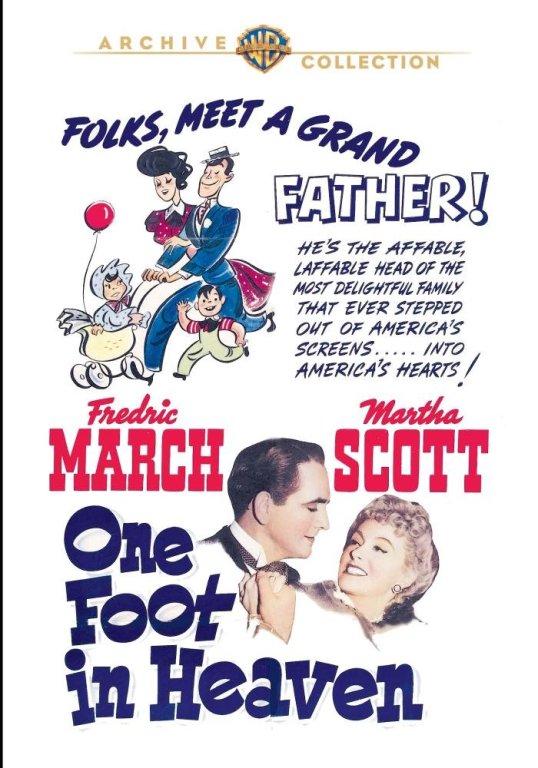
Lisa Reviews An Oscar Nominee: One Foot In Heaven (dir by Irving Rapper)


I have to admit that One Foot In Heaven is a film that I probably never would have watched if not for the fact that it received an Oscar nomination for Best Picture.

This film from 1941 tells what I presume to be a true — or, at the very least, a true-ish — story.  Fredric March plays William Spence.  The film opens in 1904 with Spence explaining to his future in-laws that he’s spontaneously decided to drop out of medical school because he feels that he’s been called to become a Methodist minister.  Though no one is happy or particularly encouraging about William’s decision to abandon the financial security of medicine to work as a minister, William feels that it’s what he was meant to do.

We follow William and his wife, Hope (Martha Scott), as they move from town to town, living in dingy parsonages and barely paying the bills by doing weddings.  Though Hope is frustrated by the constant moving and the less-than-ideal living conditions, she remains supportive of William.  They start a family and William goes from being a stern and somewhat judgmental man to becoming an inspiring minister.  He even changes his opinion about the sinfulness of going to the movies.  (All things considered, that’s probably for the best.)  Eventually, William, Hope, and the family end up ministering to a congregation in Colorado.  Determined to finally give his wife the home that she deserves, William tries to rebuild both the church and the parsonage.  It turns out to be more difficult than he was expecting.

That’s pretty much the film.  There’s not really much conflict to be found, until the final 30 minutes or so when William struggles to convince a bunch of snobs to help him achieve his dream of building a new church.  The film opens with a title card thanking the Methodists for their help in the production of the film, which should tell you everything you need to know about the film’s attitude towards Protestantism.  William does debate an agnostic at one point but it’s not much of a debate.  William, after all, is played by the authoritative Fredric March while the agnostic’s name isn’t even listed in the credits.  It’s a well-made film, in that sturdy way that many 1941 studio productions were, but — unless you’re just crazy about the history of Methodism — it’s not particularly interesting.

On the plus side, Fredric March gives a good performance as William Spence.  March was one of the best actors of Hollywood’s Golden Age and he gives a sympathetic performance as a stern but well-meaning man who respects tradition but who is still willing to admit that he has much to learn.  Probably the film’s most effective scene is when William reluctantly watches a movie with his son.  March captures William’s transformation from being a disapproving father to an entertained filmgoer.  It’s one of the few moments when the film really feels alive.

So, how did One Foot In Heaven receive a Best Picture nomination in the same year that saw nominations for films like Citizen Kane, The Little Foxes, Suspicion, and The Maltese Falcon?  One Foot In Heaven is well-made and totally uncontroversial.  It’s the type of film that, if it were made today, it would probably be directed by Ron Howard and it would star someone like James Marsden or Garrett Hedlund.  One Foot In Heaven is not particularly memorable but there’s nothing particularly terrible about it either and it probably felt like a “safe’ film to nominate.  Still, it’s probably significant that One Foot In Heaven didn’t receive any nominations other than one for Best Picture.  It lost that Oscar to another film about family, How Green Was My Valley.

Lisa Reviews An Oscar Nominee: The Snake Pit (dir by Anatole Litvak)


The 1948 film, The Snake Pit, tells the story of a writer named Virginia Cunningham.

Virginia (Olivia de Havilland) is a patient at the Juniper Hill State Hospital, a psychiatric hospital that only treats female patients.  Some days, Virginia knows where she is and some days, she doesn’t.  Some days, she knows who she is and other days, she doesn’t.  Sometimes, she hears voices and other times, the silence in her head is her only companion.  Sometimes, she’s paranoid and other times, she’s quite lucid.

Virginia has been admitted against her will.  Her husband, Robert (Mark Stevens), visits frequently and sometimes, she knows him and sometimes, she doesn’t.  Through flashbacks, we see how Virginia and Robert first met.  Robert worked at a publishing house.  Virginia was a writer whose work kept getting rejected.  Robert and Virginia fell almost immediately in love but Virginia always refused to consider marrying him.  In fact, she even disappeared at one point, because things were getting too serious.  However, one day, Virginia suddenly declared that she wanted to get married.  Afterwards, her behavior became more and more erratic.

In the hospital, Virginia is treated by Dr. Kik (Leo Genn), who is depicted as being a compassionate and progressive psychiatrist, even as he puts Virginia through electroshock treatment.  (Remember, this film was made in 1948.)  With Dr. Kik’s guidance, Virginia starts to piece her life together and get to the cause of nervous breakdown.  Unfortunately, it often seems like every step forward leads to two steps back and Virginia still reacts to every bit of pressure by acting out, even biting one unhelpful doctor.

The hospital is divided into levels.  With each bit of progress that a patient makes, she’s allowed to move to a new level that allows her just a bit more freedom.  Everyone’s goal is to make it to the final level, Level One.  Unfortunately, Level One is run by Nurse Davis (Helen Craig), a tyrant who is in love with Dr. Kik and jealous of the amount of time he spends on Virginia.  Davis starts to goad Helen, trying to get her to lose control.  And what happens if you lose control?  You end up in the Snake Pit, the dreaded Level 33.  Being sent to Level 33 means being abandoned in a padded cell, surrounded by patients who have been deemed untreatable.

At the time that it was released, The Snake Pit was a groundbreaking film, the first major American studio production to deal seriously and sympathetically with mental illness.  Seen today, it’s still effective but you can’t help but cringe at some of the techniques that are used in Virginia’s treatment.  (Electroshock treatment, for instance, is portrayed as being frightening but ultimately necessary.)  The film works best as a showcase for Olivia de Havilland, who gives an absolutely brilliant and empathetic performance as Virginia.  Neither the film not de Havilland shies away from the reality of Virginia’s condition nor does it make the mistake of sentimentalizing her story.  For me, de Havilland’s best moment comes when she learns that she bit another doctor.  At first, she’s horrified but then she starts to laugh because the doctor in question was such a pompous ass that he undoubtedly deserved it.  de Havilland handles the character’s frequent transitions from lucidity to confusion with great skill, without indulging in the temptation to go over-the-top.  Arguably, The Snake Pit features de Havilland’s best lead performance.

(Olivia de Havilland is, at 103 years old, still with us and living, reportedly quite happily, in France.)

Olivia de Havilland was nominated for Best Actress but she lost to Jane Wyman in Johnny Belinda.  (A year later, De Havilland’s won an Oscar for The Heiress.)  The Snake Pit was also nominated for Best Picture but ultimately lost to Laurence Olivier’s adaptation of Hamlet.

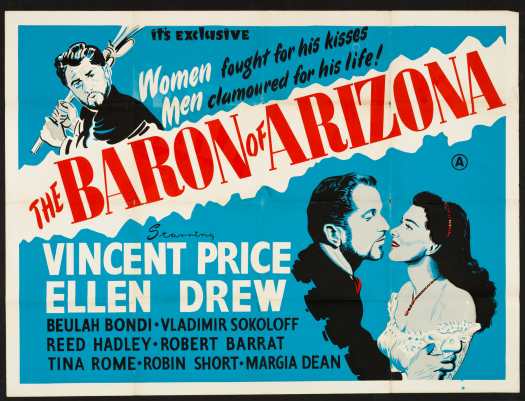
Monster Con: Vincent Price in THE BARON OF ARIZONA (Lippert 1950)


gary loggins's avatarcracked rear viewer

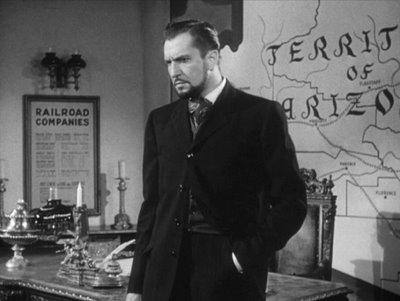
We all know and love Vincent Price for his creepy performances in horror films, from his demented Henry Jarrod in HOUSE OF WAX, to all those AIP/Roger Corman/Edgar Allan Poe shockers, to his turn as The Inventor in EDWARD SCISSORHANDS. But the actor was more than just a screen fiend, playing in many a filmnoir, comedies, costume swashbucklers, and even the Western genre. Our Man Vinnie got top billing in a strange little oater titled THE BARON OF ARIZONA, and as a bonus for film fans the director is a young tyro by the name of Samuel Fuller!

In this bloodless but gripping outing, Price plays James Addison Revis, a swindler, con man, and forger who  concocts an elaborate, grandiose scheme to gain control over the Arizona Territory in 1882. He begins his con game ten years earlier by grooming an orphaned waif named Sofia to later be…

View original post 545 more words

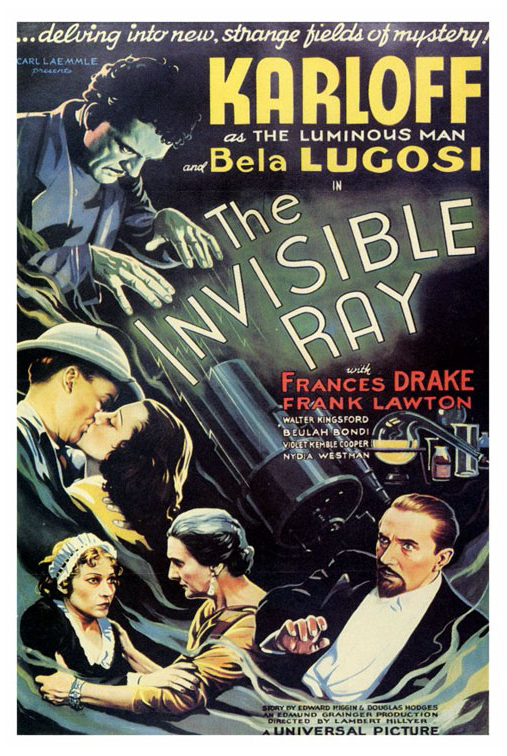
Halloween Havoc!: THE INVISIBLE RAY (Universal 1936)


gary loggins's avatarcracked rear viewer


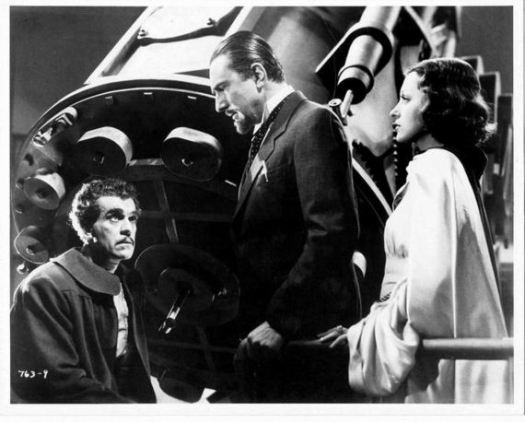
THE INVISIBLE RAY, the third Universal teaming of Boris Karloff and Bela Lugosi , is probably the least discussed of their seven films together. And I don’t quite know why, because I find it an entertaining meld of horror and science fiction that holds my interest for its 80 minute running time. The two stars are well spotlighted, with Bela as one of the good guys (for a change!) and Boris giving a hammy but well crafted performance as a scientist unhinged by his newest discovery.

A curly-haired Karloff stars as Dr. Janos Rukh, awaiting the arrival of a group of his fellow scientists for a demonstration of his Invisible Ray as a storm rages outside. Rukh’s wife Diana and blind Mother Rukh greet them: Sir Francis Stevens and his wife Lady Arabella, French astro-chemist Dr. Felix Benet, and Lady Arabella’s nephew Ronald Drake, who’s along for the ride. Rukh…

View original post 426 more words

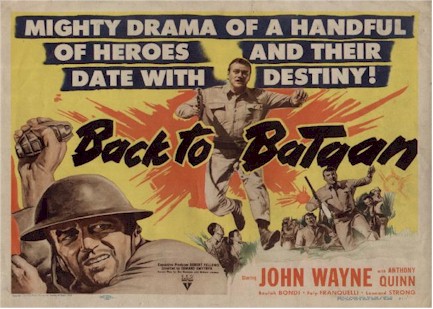
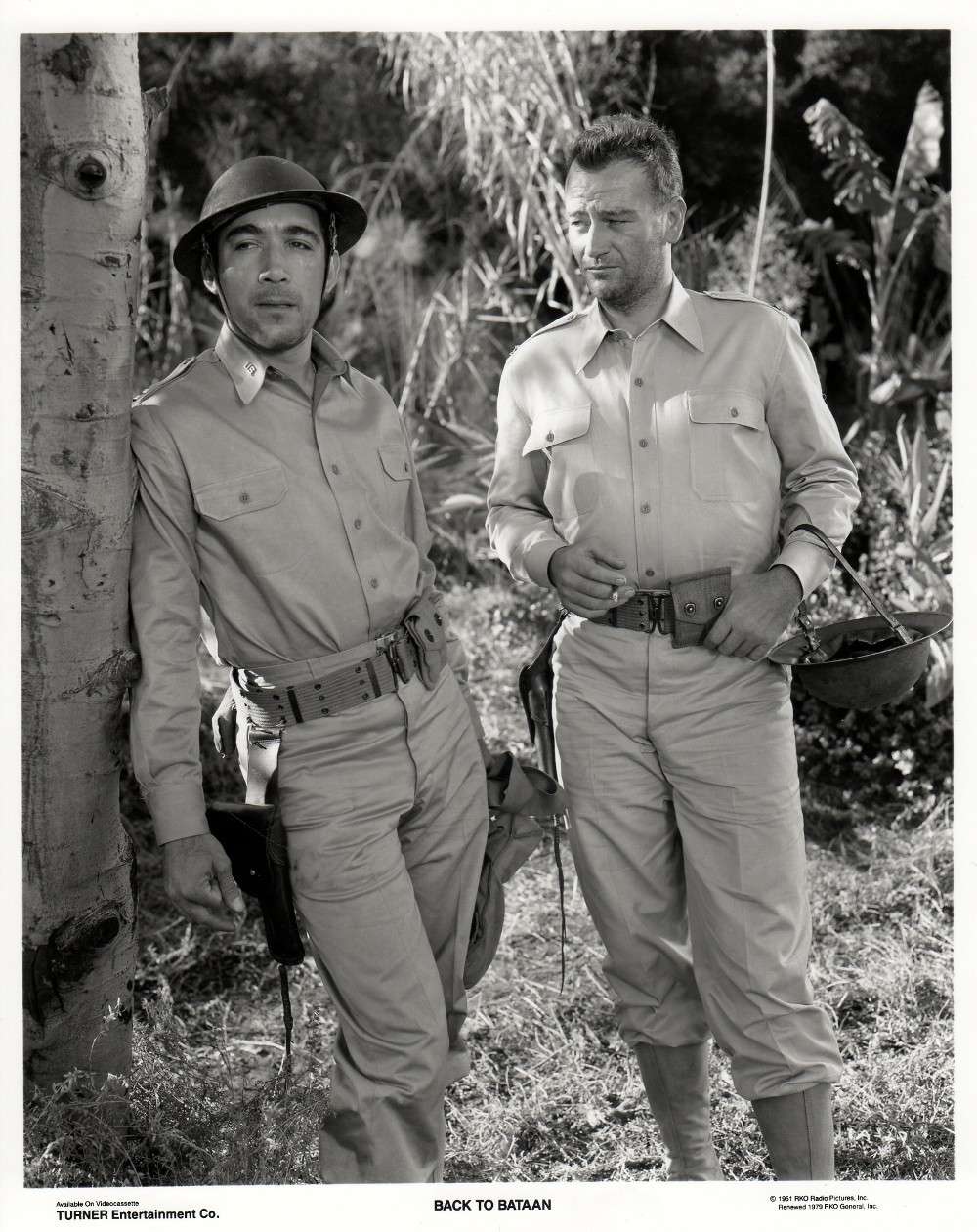
Special Veteran’s Day Edition: BACK TO BATAAN (RKO 1945)


gary loggins's avatarcracked rear viewer

btb1

John Wayne  and Anthony Quinn fight World War II on the backlots of RKO (subbing for the jungles of the Philippines) in BACK TO BATAAN, a stirring exercise in propaganda ripped from headlines of the era. The film was made to stoke audience’s patriotic fires, and succeeds in it’s objective. It’s well directed and shot, has plenty of action, and superb performances by all, including a standout from 14-year-old Ducky Louie.

btb2

Wayne plays Col. Madden, assigned to train Filipino freedom fighters (try saying that three times fast!) to battle the invading Japanese.  Quinn is Capt. Bonifacio, grandson of Filipino revolutionary hero Andres Bonifacio. He’s having issues with his girlfriend Dalisay, who’s the island version of Tokyo Rose (what he doesn’t realize is she’s secretly sending coded messages to the Allies through her broadcasts). Madden and his ragtag crew are out to destroy a Japanese gas depot, but first they encounter schoolteacher…

View original post 647 more words

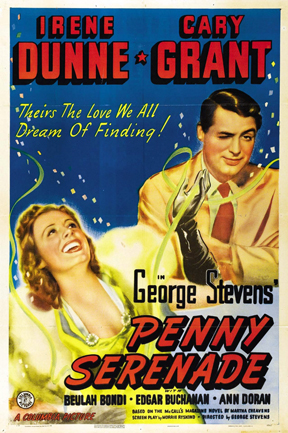
The Fabulous Forties #37: Penny Serenade (dir by George Stevens)


Penny_Serenade_1941_Poster

How many tears can be jerked by one tear jerker?

How melodramatic can one melodrama get?

These are the type of questions that I found myself considering as I watched the 36th film in Mill Creek’s Fabulous Forties box set, 1941’s Penny Serenade.

Penny Serenade opens with Julie (Irene Dunne) announcing that she’s planning on leaving her husband, Roger (Cary Grant).  Fortunately, before Julie goes through with her plan, she listens to a song called You Were Meant For Me.  Perhaps not coincidentally, the song is included on an album called The Story Of A Happy Marriage.  As she stares at the spinning vinyl, Julie starts to have flashbacks!

No, not flashbacks of the LSD kind.  (Though, interestingly enough, Cary Grant was reportedly a big fan of LSD…)  Instead, she has flashbacks of her marriage to Roger.  We see how she first met Roger while she was working in a music store.  Roger stopped by the store to tell her that a record was skipping and it was love at first sight.  However, Roger had no interest in getting married.  Or, at the least, he didn’t until Julie opened up a fortune cookie and read the fortune: “You get your wish — a baby!”

Julie continues to stare at the spinning record and we discover that eventually, she and Roger did get married.  Julie did get pregnant but, as the result of an earthquake, she lost the baby.  (Curse you, fortune cookie!  CURSE YOU!)  Meanwhile, Roger took over a small town newspaper and revealed himself to have absolutely no idea how to handle money.

Because of the earthquake, Julie will never be able to have a child.  (DAMN YOU, FORTUNE COOKIE!  DAMN YOU FOR YOUR LIES!)  However, they can still adopt!  She writes to Miss Oliver (Beulah Bondi), the head of the local orphanage.  Julie demands to be given a baby with “blue eyes and curly hair.”  Fortunately, Miss Oliver apparently has a surplus of curly-haired, blue-eyed babies but she’s still reluctant to approve the adoption.  After all, Julie is such a terrible housekeeper!  However, she is impressed by how much both Julie and Roger want a baby so Miss Oliver puts aside her concerns and allows them to have a baby for two years.

At the end of the two years, Roger and Julie have to go to an adoption hearing.  Unfortunately, the paper has gone out of business, the family has absolutely no money, and the fortune cookie has stopped giving advice.  Fortunately, Roger is Cary Grant and who can say no to Cary Grant?  Roger promises the judge that he’ll always love and take care of the baby…

But that’s not all!  The movie is not over yet.  And even as Roger makes his plea, we can’t help but think about the fact that this movie is being told in flashback and that present day Julie is still planning on leaving Roger.  Now, I’m not going to spoil the movie by going into why or revealing what happens in the end.  I’ll just say that it involves more tragedy and more melodrama.  In fact, it includes so much tragedy and so much melodrama, that it starts to get a little exhausting.  How much bad stuff can happen to Cary Grant!?

And the record just keeps spinning…because what goes up must come down, spinning wheel got to go round…

Over the course of his long career, Cary Grant only received two Oscar nominations.  Penny Serenade was his first nomination and, as a fan of Cary Grant’s comedies, it saddens me to say that Cary’s nominated performance really wasn’t that good.  Watching this film, you can tell that Cary felt that this was his chance to prove himself as a dramatic actor and, as a result, he acts the Hell out of every scene.  Of course, Cary’s undying popularity comes from the fact that he rarely seemed to be acting.  His charm was in how natural he was.  In Penny Serenade, he never seems natural.  He’s trying too hard and it’s just odd to see Cary Grant trying too hard.

If you want to see Cary Grant at his best, check out The Awful Truth.  Or maybe The Philadelphia Story.  Those are two great films that prove that Cary Grant was a great actor.  Even a rare misfire of a performance can’t change that fact.

Until next time…

Ride a painted pony, let the spinnin’ wheel spin. … Ride a painted pony, let the spinnin’ wheel turn.

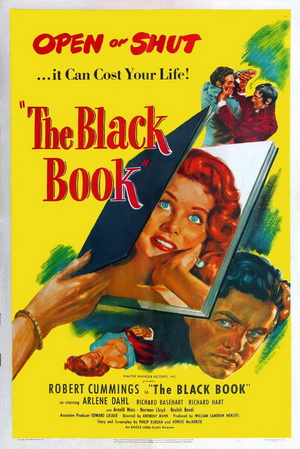
The Fabulous Forties #3: The Black Book (dir by Anthony Mann)


The_Black_Book_Poster

The third film in Mill Creek’s Fabulous Forties box set was 1949’s The Black Book, which was also released under the title Reign of Terror.

The Black Book takes place during the French Revolution.  It is, to quote Dickens, both the best of times and the worst of times.  Actually, mostly it’s just the worst of times.  The Black Book portrays revolutionary France as being a dark and shadowy country, one where the only things that hold the people together are paranoia and terror.  It’s a country where anyone can be executed at any moment and where power mad tyrants excuse their excesses by saying that they are only doing the people’s will.  Considering that the The Black Book was made in 1949, its vision of revolutionary France can easily been seen as a metaphor for Nazi Germany or Communist Russia.  Or perhaps even America at the start of the Red Scare.

(It’s probably not a coincidence that the Nazis also had a document known as the Black Book, one that listed everyone who was to be arrested and executed if Hitler succeeded in conquering Great Britain.)

Maximilien Robespierre (Richard Basehart, giving a disturbingly plausible performance that will make you think of more than a few contemporary political figures) is on the verge of having himself declared dictator of France.  Unfortunately, his little black book has disappeared.  Inside that black book is the name of everyone that he is planning to send to the guillotine.  If the book ever became public, then Robespierre would be the one losing his head.

Robespierre summons a notorious prosecutor named Duval (Robert Cummings) to Paris and gives him 24 hours to track down the book.  He gives Duval the authority to imprison and interrogate anyone in France.  He also informs Duval that, if the book is not found, Duval will be the next to lose his head.

However, what Robespierre does not know is that Duval is not Duval.  He is Charles D’Aubigny, a rebel against the Revolution.  Charles murdered Duval and took his place.  Now, Charles has to find the book without his own identity being discovered.  Not only do some of Robespierre’s allies suspect that Duval may not actually be Duval but some of Charles’s former allies also start to suspect that Charles may secretly be working for Robespierre, even as he claims that he’s trying to bring him down.  At times, even the viewer is unsure as to who is actually working for who.

Oh my God, this is such a good film!   In fact, it was so good that I was surprised that I hadn’t heard of it before watching it last night.  The chance to discover a hidden gem like The Black Book is the main reason why I continue to take chances on Mill Creek box sets.

The Black Book was definitely made on a very low-budget but director Anthony Mann (who is best known for directing several landmark westerns) uses that low-budget to his advantage.  There’s little spectacle to be found in this historical epic but then again, there was little spectacle to be found in the reign of terror.  This is a film that takes place in shadowy rooms and dark, almost claustrophobic streets.  It’s a historical film that looks and plays out like the most cynical of film noirs.  Despite the fact that all of these well-known French figures are being played by very American actors, the cast all does an excellent job of capturing the fear and desperation of people living under oppression.  The subtext of The Black Book was undoubtedly clear in 1949 and it’s just as clear today.  Fanaticism remains fanaticism, regardless of when it happened or what ideology is used to justify it.

There is a somewhat awkward moment towards the end of the film when a French army officer is asked for his name.

“Bonparte,” the officer replies, “Napoleon Bonaparte.”

“I’ll remember that name,” someone snarkily replies.

But, other than that one moment (which immediately made me think of Titanic‘s infamous “Something Picasso” line), The Black Book is an intelligent and effective thriller.  And because it’s in the public domain, you watch it below!


Cleaning Out The DVR #6: Watch On The Rhine (dir by Herman Shumlin)


After I finished watching Around The World In 80 Days, I decided to watch the 1943 film, Watch on the Rhine.  Though both films are immortalized in the record books as a multiple Oscar nominee, Watch on The Rhine might as well have taken place in a totally different universe from Around The World In 80 Days.  Based on a play by the always politically outspoken Lillian Hellman, Watch On The Rhine is as serious a film as Around The World In 80 Days is frivolous.

It’s also somewhat infamous for being the film for which Paul Lukas won an Oscar for best actor.  When Lukas won his Oscar, he defeated Humphrey Bogart, who was nominated for his iconic performance in Casablanca.  This is justifiably considered to be one of the biggest mistakes in Oscar history and, as a result, there are people who will tell you that Watch On The Rhine is a totally undeserving nominee, despite having never actually seen the film and not being totally sure who Paul Lukas was.

Up until I watched the film yesterday, you could have included me among those people.

What’s interesting is that Watch On The Rhine almost feels like a companion piece to Casablanca.  Both films were resolutely anti-fascist, both of them dealt with a member of the Resistance trying to escape from a German agent, and both films climaxed with a gunshot.  The part played by Paul Lukas, a German engineer named Kurt Muller, feels like he could be an older version of Casablanca‘s Victor Laszlo.  Finally, whereas Casablanca centered around “letters of transit,” Watch On The Rhine centers around money.  Kurt is smuggling money to the Resistance.  Teck de Brancovis (George Coulouris), a dissolute Romanian count, demands money in exchange for not informing the Germans of where Kurt’s location.

(Of course, both Casablanca’s letters and Watch on the Rhine’s money are an example of what Hitchcock called the MacGuffin.  The letters and the money are not important.  What’s important is that both films use the thriller format to inspire viewers to support the war effort.)

The film takes place in 1940, when America was still officially neutral.  Kurt and his American wife, Sara (Bette Davis), have secretly entered the United States through Mexico.  Officially, they are only visiting Sara’s brother (Donald Woods) and mother (Lucille Watson) in Washignton, D.C.  Unofficially, they are looking for political sanctuary.  However, Kurt still finds himself drawn back to Germany, especially after he finds out that one of his friends in the Resistance has been arrested by the Gestapo.

Not surprisingly, considering its theatrical origins, Watch On The Rhine is a very talky and a very stage-bound film.  Almost all of the action takes place in one location and a good deal of the film’s running time is devoted to Kurt giving speeches.  Don’t get me wrong, that’s not a complaint.  Though the film may have been released at the height of the war, the play was written at a time when America was still officially neutral and many elected officials were adamant that, even if it meant Hitler taking over the entire continent, America should never get involved in the affairs of Europe.  Watch On The Rhine was Hellman’s attempt to both expose what was happening in Germany and to rally them to the anti-fascist cause.  Watch On The Rhine may be propaganda but its anti-Nazi propaganda and who can’t appreciate the importance of that?

When it was originally released, Watch On The Rhine was sold as a Bette Davis vehicle.  To be honest, Davis doesn’t really do much in the film.  She supports her husband and she has a few sharp words for Teck but, otherwise, her role is definitely secondary to Paul Lukas.  Davis took the role because she believed in the film’s message.  It’s a good message and, for that matter, Watch On The Rhine is a pretty good film.  It’s well-acted, intelligently written, and perfectly paced.

But what about Paul Lukas’s Oscar?  Well, let’s state the obvious.  Humphrey Bogart should have won the award for Casablanca.  That doesn’t mean that Paul Lukas doesn’t give a worthy performance.  He originated the role on stage and he does a good job of bringing the character to life on film, bringing a sincere intensity to even the most stagey of Kurt’s monologues.  Whenever Lukas speaks, he’s explaining to the filmgoers why the U.S. must take a stand against Hitler and his followers.  Considering that Watch On The Rhine was released at the height of World War II, I imagine that this, more than anything, led to Lukas winning his Oscar.

Watch On The Rhine was also nominated for Best Picture.  It was deserved nomination but, in this case, the Academy made the right decision and gave the Oscar to Casablanca.

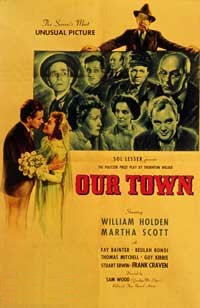
Lisa Reviews an Oscar Nominee: Our Town (dir by Sam Wood)


Original_movie_poster_for_the_film_Our_Town_(1940_film)

(SPOILERS BELOW!  THE END OF THIS FILM WILL BE REVEALED!  I will also be revealing who played George Gibbs but that’s probably not as big a spoiler.  It depends how you look at it.)

I was only 15 years old when I first read Our Town.  Because I was a theater nerd, I knew a little about the play.  For instance, I knew it took place in a small town.  I knew that it was narrated by a character known as the Stage Manager.  I knew that the play was meant to be performed on a bare stage, with no sets or props.  What I did not know, as I innocently opened up that booklet, is that Our Town is probably one of the most traumatically depressing plays ever written.

When the stage manager appears at the start of the play and talks about the town of Grover’s Corner, he lulls you into believing that you’re about to see a sentimental, comedic, and old-fashioned celebration of small town life.  We meet the characters and they all seem to be quirky in a properly non-threatening way.  Joe Crowell shows up delivers a newspaper to Doc Gibbs.  The stage manager mentions that Joe will eventually grow up to attend to M.I.T.

“Awwwww!  Good for Joe!” the audience says.

And, the Stage Manager goes on to inform us, as soon as Joe graduates, he will be killed in World War I, his expensive education wasted.

Okay, the audience thinks, that was a dark moment but this play was written at a time when World War I was still fresh on everyone’s mind.  Surely the rest of the play will not be quite as dark…

And fortunately, George Gibbs and Emily Webb show up.  They’re young, they’re likable, and they’re in love!  George and Emily get married and they’re prepared to live a long and happy life in our town!  Good for them!  YAY!

And then Act III begins…

Oh my God, Act III.  Act III begins with almost everyone dead.  Emily died in child birth so she hangs out at the local cemetery and talks to all the other dead people, the majority of whom only have vague memories of their former lives.  Emily relives the day of her 12th birthday and discovers that it’s too painful to remember what it was like to once be alive.  Emily asks the Stage Manager if anyone truly appreciates life.  The Stage Manager replies, “No.”  In the world of the living, George Gibbs sobs over his wife’s grave….

And the play ends!

OH MY GOD!

Seriously, reading Our Town was probably one of the most traumatic experiences of my life!

The 1940 film version of Our Town is a little less traumatic because it changes the ending.  In the film version, Emily doesn’t die.  She nearly dies while giving birth to her second child and the entire third act of the play is basically portrayed as being a near-death hallucination.  But, in the end, she survives and she comes through the experience with a new found appreciation for life.

And it’s certainly the type of happy ending that I was hoping for when I first read the play but, as much as I hate to admit it, the story works better with Emily dying than with Emily surviving.  The play presents death as being as inevitable as life and love and it makes the point that there’s nothing we can do to truly prepare for it.  By allowing Emily to live, the film gives us a ray of hope that wasn’t present anywhere else in Our Town.  The happy ending feels inauthentic.  If Emily could live then why couldn’t Joe Crowell?  For that matter, why did Emily’s younger brother have to die of a burst appendix on a camping trip?

But, other than the changed ending, Our Town is a pretty good adaptation of the stage play.  While the film features an actual set (as opposed to the bare stage on which theatrical versions of Our Town are meant to be performed), director Sam Wood does a good job of retaining the play’s surreal, metatheatrical style.  Making good use of shadow and darkness, Wood and cinematographer Bert Glennon made Grover’s Corner seem like a half-remembered memory or a fragment of a barely cohesive dream.

Frank Craven, who originated the role on Broadway, is properly dry as the Stage Manager and, in the role of Doc Gibbs, Thomas Mitchell is so sober and respectable that it’s hard to believe that, in just 6 years, the same actor would play the delightfully irresponsible Uncle Billy in It’s A Wonderful Life.  Emily and George are played by Martha Scott and an impossibly young William Holden, both of whom give wonderfully appealing performances.

With the exception of that changed ending, Our Town is a worthy adaptation of a classic play.  It was nominated for Best Picture but lost to another literary adaptation, Alfred Hitchcock’s Rebecca.

Shattered Politics #4: Mr. Smith Goes To Washington (dir by Frank Capra)


mr-smith-goes-to-washington

So, when you read that I was going to be reviewing 94 political films here at the Shattered Lens, you probably knew that one of them would have to be the 1939 best picture nominee, Mr. Smith Goes To Washington.

So, we all know that story right?  The senator from an unnamed state dies.  The weak-willed Governor (Guy Kibbee) has to appoint a new senator.  Political boss Jim Taylor (Edward Arnold) demands that the governor appoint one of his cronies.  The state’s reformers demand that the Governor appoint a never-seen crusader named Henry Hill (who, whenever I hear his name, makes me think of Ray Liotta snorting cocaine in Goodfellas).  The Governor’s children demand that he appoint Jefferson Smith (James Stewart, of course!), who is the head of something called the Boy Rangers.  The Governor flips a coin.  The coin lands on its edge but it also lands next to a newspaper story about Jeff Smith.

So, of course, Mr. Smith goes to Washington.

Now, as the movie quickly makes clear, Jeff Smith is immediately out-of-place in Washington.  For one thing, he’s actually excited to be there.  He’s convinced that he’s there to make America a better place.  When a bunch of drunken reporters (led by the great Thomas Mitchell) make Smith look foolish, Smith responds by running around Washington and punching them out.  (That whole sequence probably serves as wish fulfilment for a lot of politicians.)  When his cynical legislative aide Saunders (Jean Arthur) tells him that he’s too naive to survive in Washington, he wins her over with the purity of his idealism.  When his mentor, Senator Paine (Claude Rains), is revealed to be a part of Washington’s corrupt culture, Smith is stunned.  When Taylor tries to destroy his political career, Smith responds by giving the filibuster to end all filibusters.  He’s one man standing up against a culture of corruption and…

And there’s a reason why, 76 years later, aspiring political candidates still attempt to portray themselves as being a real-life, modern Jefferson Smith.

This is one of those films that everyone seems to agree is great and, of course, there’s many reasons to love Mr. Smith Goes To Washington.  There’s the lead performance of Jimmy Stewart, of course.  While this may not be his best performance (I prefer the more layered characterization that he brought to It’s A Wonderful Life and Anatomy of a Murder), it is Stewart at his most likable and, most importantly, he makes you feel Jeff Smith’s pain as he discovers that Washington is not the great place that he originally assumed it to be.  Claude Rains was always great when it came to playing good men gone wrong and he’s perfect as Sen. Paine.  Thomas Mitchell and Jean Arthur are perfectly cast and I always enjoy seeing the bemused smile on the face of Vice President Harry Carey as Smith conducts his filibuster.

But I think the best thing about Mr. Smith Goes To Washington is that it actually makes you believe that there are Jeff Smiths out there who actually could make a difference.  And, until Judd Apatow gets around to remaking the film with Adam Sandler, audiences will continue to believe.

http://www.youtube.com/watch?v=sm9qaEJ3MBc