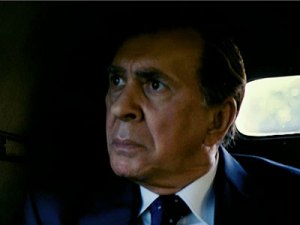
Two Post Presidents Day Reviews: Frost/Nixon (dir. by Ron Howard) and All The President’s Men (dir. by Alan J. Pakula)


“Now Watergate doesn’t bother me/does your conscience bother you?” — Lynard Skynard, Sweet Home Alabama

As part of my continuing quest to see and review every film ever nominated for best picture, I want to devote my first post Presidents Day post to two films: 2008’s Frost/Nixon and 1976’s All The President’s Men.

During my sophomore year of college, I had a political science professor who, every day of class, would sit on his desk and ramble on and on and on about his past as a political activist.  He protested Viet Nam, he hung out with revolutionaries, he loved Hugo Chavez, and I assume he probably had a Che Guevara poster hanging in his office.  Whenever he wanted to criticize George W. Bush, he would compare him to Richard Nixon and then pause as if he was waiting for the class to all start hissing in unison.  He always seemed to be so bitterly disappointed that we didn’t.  What he, and a whole lot of other people his age, didn’t seem to understand was that Richard Nixon was his boogeyman.  The rest of us could hardly care less.

That was the same problem that faced the 2008 best picture nominee Frost/Nixon

Directed rather flatly by Ron Howard, Frost/Nixon tells the true story about how a light-weight English journalist named David Frost (played by Michael Sheen) managed to score the first televised interview with former President Richard Nixon (Frank Langella).  Both Frost and Nixon see the interviews as a chance to score their own individual redemptions while Frost’s assistants (played by Oliver Platt and Sam Rockwell) see the interview as a chance to put Richard Nixon on trial for Watergate, the Viet Nam War, and every thing else under the sun.  That may not sound like a very exciting movie but it does sound like a sure Oscar contender, doesn’t it?

I’ve always secretly been a big history nerd so I was really looking forward to seeing Frost/Nixon when it was first released in 2008.  When I first saw it, I was vaguely disappointed but I told myself that maybe I just didn’t know enough about Richard Nixon or Watergate to really “get” the film.  So, when the film later showed up on cable, I gave it another chance.  And then I gave it a chance after that because I really wanted to like this film.  Afterall, it was a best picture nominee.  It was critically acclaimed.  The word appeared to be insisting that this was a great film.  And the more I watched it, the more I realized that the world was wrong.  (If nothing else, my reaction to Frost/Nixon made it easier for me to reject the similarly acclaimed Avatar a year later.)  Frost/Nixon is well-acted and slickly produced but it’s not a great film.  In fact, Frost/Nixon is epitome of the type of best picture nominee that inspires people to be cynical about the Academy Awards.

Before I get into why Frost/Nixon didn’t work for me, I want to acknowledge that this was a very well-acted film.  By that, I mean that the cast (Frank Langella, Michael Sheen, Kevin Bacon, Sam Rockwell, and Oliver Platt) all gave very watchable and entertaining performances.  At the same time, none of them brought much depth to their characters.  Much like the film itself, nobody seems to have much going on underneath the surface.  Frank Langella may be playing a historic figure but, ultimately, his Oscar-nominated performance feels like just a typically grouchy Frank Langella performance.  Michael Sheen actually gives a far more interesting performance as David Frost but, at the same time, the character might as well have just been identified as “the English guy.”  In fact, a better title for this film would have been The Grouchy, the English, and the Superfluous.

For all the time that the film devotes to Rockwell and Platt blathering on about how they’re going to be giving Richard Nixon “the trial he never had,” this film is ultimately less about politics and more about show business.  Ron Howard devotes almost as much time to the rather boring details of how the interviews were set up and sold into syndication as he does to the issues that the interview brings up.  Unfortunately, for a movie about show business to succeed, the audience has to believe that the show is one that they would actually enjoy watching,  This, ultimately, is why Frost/Nixon fails.  While the filmmakers continually tell us that the Frost/Nixon interviews were an important moment in American history, they never show us.  Yes, everyone has hideous hair and wide lapels but, otherwise, the film never recreates the period or the atmosphere of the film’s setting and, as a result, its hard not to feel detached from the action happening on-screen.  For all the self-congratulatory claims made at the end of the film, it never convinces us that the Frost/Nixon interviews were really worth all the trouble.  Much like my old poli sci professor, Frost/Nixon never gives us a reason to care. 

For a far more interesting and entertaining look at the Watergate scandal, I would recommend the 1976 best picture nominee All The President’s Men.  Recreating the story of how two Washington Post reporters (played by Robert Redford and Dustin Hoffman) exposed the Watergate scandal that eventually led to Nixon’s resignation, All The President’s Men is the movie that Frost/Nixon wishes it could be.  Despite being made only two years after Watergate, All The President’s Men doesn’t take the audience’s interest for granted.  Instead, director Pakula earns our interest by crafting his story as an exciting thriller.  Pakula directs the film like an old school film noir, filling the screen with menacing shadows and always keeping the camera slightly off-center.   Like Frost/Nixon, All The President’s Men is a well-acted film with a bunch of wonderful 70s character actors — performers like Ned Beatty, Jason Robards, Jack Warden, Martin Balsam, and Robert Walden, and Jane Alexander — all giving effectively low-key and realistic performances.   The end result is a film that manages to be exciting and fascinating to those of us who really don’t have any reason to care about Richard Nixon or Watergate.

Both of these two films were nominated for best picture.  Frost/Nixon quite rightly lost to Slumdog MillionaireAll The President’s Men, on the other hand, lost to Rocky.

What Lisa Marie Watched Last Night: Trader Horn (dir. by W.S. Van Dyke)


Last night, as I attempted to drift off to sleep, I switched over to TCM and watched the 1931 film Trader Horn.

Why Was I Watching It?

I’m on a mission to see every film ever nominated for best picture and Trader Horn was nominated back in 1931.  (It lost to the first western ever to win best picture, Cimarron.)  Trader Horn is a bit of an oddity among Oscar contenders in that it received no other nominations save for best picture and it has never been released on DVD.  When I saw it on TCM’s schedule last night, I figured that might very well be my only chance to see this forgotten best picture nominee.

What’s It About?

So Trader Horn (Harry Carey) is a heroic ivory hunter.  Yes, this film was made a long time ago. He makes his living in Africa where he spends his time killing animals and explaining how, whenever the natives start playing their drums, it means that “every black devil is in the bush.”  Again, this film was made a very loooooooong time ago.

Anyway, at the start of the film, Trader Horn is introducing his apprentice (Duncan Renaldo) to the facts of life in Africa.  Eventually, they meet a missionary (Olive Golden) who is looking for daughter who was kidnapped by a tribe years ago.  When Golden is killed, Trader Horn takes it upon himself to find her daughter (played by Edwina Booth) and bring her back to civilization.

What Worked?

Trader Horn was the first non-documentary to be filmed on location in Africa and, as you watch the movie, it quickly becomes apparent that the film’s plot is really just an excuse to show off all the nature footage that director W.S. Van Dyke managed to capture.  Countless time the film’s story comes to a complete halt while Carey and Renaldo simply stop to watch a grazing giraffe or to watch a leopard hunt a wildebeest.  Normally, this is the sort of thing I would complain about but, in this case, the story was so predictable and silly that I was happy for the interruption.  It helps that the 80 year-old nature footage is still visually impressive and exciting to watch.   According to the research I did on the Internet after seeing the film, Trader Horn’s footage was used as a stock footage in countless “jungle” films over the next three decades in much the same way that the same old distressing mondo footage tends to show up in every single Italian cannibal film.

There’s a scene were Renaldo finds a lion cub and oh my God, it’s just the most adorable little kitty ever!

Trader Horn actually has an interesting production history and I enjoyed reading about it after I watched the movie.  Apparently, Van Dyke spent seven months in Africa making this film and almost the entire crew ended up falling ill.  At least two cameramen were killed while filming the wild animals and Edwina Booth returned so sick that her film career was pretty much ended. 

On one final note, there was apparently a pornographic remake of this film in the late 60s.  Its title?  Trader Hornee.

What Didn’t Work?

Did I mention this film was made a really looooooong time ago?  Because, seriously, it was.  On occasion, I’ve heard an old film described as being “creaky.”  I never really understood what that meant until I saw Trader Horn because, quite frankly, this film is amazingly creaky.   It moves slowly, the performers are rather melodramatic (though Harry Carey does a good job), and. while the cultural attitudes may have been acceptable in 1931, they now come across as extremely racist and its hard not to feel really uncomfortable with scenes where Renaldo ogles the bare-breasted native women and says, “Why, they’re not savages at all!  They’re like little children!”

Bleh.

“Oh My God!  Just Like Me!” Moments:

I would have wanted to adopt that lion cub too.

Lessons Learned:

1931 was a long, long time ago.

A Quickie With Lisa Marie: The Ox-Bow Incident (directed by William A. Wellman)


As part of my continuing mission of see every single movie ever nominated for best picture, I’ve been watching a lot of TCM this month.  Last week, I caught the 1943 best picture nominee, The Ox-Bow Incident.

Taking place in Nevada in the 1880s, The Ox-Bow Incident is a western that examines both the mob mentality and takes on the issue of lynching.  (It should be remembered that when the Ox-Bow Incident was first released, lynchings were still a regular occurrence.)  Henry Fonda and Henry Morgan play two prospectors who ride into town one day and discover that everyone is on edge because there are apparently cattle rustlers about.  When it’s reported that a rancher has been murdered, the townspeople form a posse and go searching for the rustlers.  Realizing that until the real rustlers are caught they’ll be considered prime suspects, Fonda and Morgan join the posse.  Led by Major Tetley (Frank Conroy), who falsely claims to be a Confederate veteran, the posse comes across a camp with three men.  Though it quickly becomes obvious that the three men are probably innocent, the posse immediately makes plans to lynch the men.  Fonda and Morgan find themselves forced to either side with the bloodthirsty posse or to stand up to the mob.

To be honest, I’ve never been a big fan of Westerns.  On a personal note, Some of that is because whenever anyone from up north finds out that I’m from Texas, they always ask me if I’ve ever ridden a horse.  (For the record, I do not own a horse, I do not ride horses, and I’m pretty sure I’m allergic to them.)  On another note, Westerns often strike me as being predictable.  All of the dark strangers and the old maid school teachers and the tight-lipped gunslingers spitting tobacco all over the place — it all just makes me want to go, “Bleh!” 

However, I was surprised to discover that I really enjoyed The Ox-Bow Incident.  While the film’s well-intentioned message was a bit heavy-handed, director William Wellman emphasizes the psychological aspects of the story and the movie itself was well-acted by a large cast who brought a surprising amount of depth to characters who, in lesser hands, could have easily just been stereotypes.  Henry Fonda and Henry Morgan were both excellent and sympathetic leads while Jane Darwell dominated the film as one of the more bloodthirsty members of the lynching party.  A very young and very suave Anthony Quinn also shows up as one of the accused men.  Five decades before either Quentin Tarantino or the Coen Brothers, Wellman and his cast use the standard tropes of the western genre to comment on some very real issues and the end result is a fast-paced film that succeeds in making a moral debate just as exciting as any gunfight or stampede.

Released in 1943, The Ox-Bow Incident was nominated for best picture but, ultimately, it lost to Casablanca.  It’s hard to complain about any film losing to Casablanca but taken on its own terms, the Ox-Bow Incident remains an entertaining and intelligent film and one that I’m thankful that TCM gave me a chance to discover.

Lisa Marie Bowman Does Michael Clayton (dir. by Tony Gilroy)


As part of my continuing mission to see and review every single film ever nominated for best picture, I recently rewatched the 2007 Best Picture nominee Michael Clayton

The title character (as played by George Clooney) is a sleazy attorney who “fixes” problems for one of the biggest law firms in New York.  When Arthur Edens (Tom Wilkinson), one of the firm’s partners and Michael’s mentor, has a nervous breakdown while at a deposition in Minnesota and ends up in jail, Michael is sent to retrieve him.  Michael soon discovers that Arthur’s mental collapse was due to a class action law suit involving an evil, faceless corporation.  Before he reveals any more details, Arthur flees and is subsequently murdered by two assassins.  With the police calling Arthur’s death a suicide, Michael soon finds himself being pursued by the same assassins.

Though I’ve owned the DVD for a couple of years, this was only the second time that I had ever actually sat down and watched this film.  (The first time was during its initial theatrical run.)  There have been many insomnia-filled nights when I’ve gone to my DVD collection, fully intending on grabbing Michael Clayton and allowing the images of an unshaven George Clooney to flicker in my dark bedroom.  However, every time, I always ended up suddenly remembering a film that I wanted to see more. 

That’s the thing with Michael Clayton.  Having seen the film a second time, I can say that it remains a well-made film and an entertaining film and I can also say that I noticed a whole lot of small details that I had either missed the first time or had subsequently forgotten about.  Like a lot of best picture nominees, Michael Clayton is a good film.  It’s just not a very memorable one.  Seriously, is anyone surprised when business executives and attorneys turn out to be the villains in these type of films?  And if you couldn’t guess that Tom Wilkinson was going to end up dead from the minute he turned up on-screen then you may need to surrender your filmgoer card.

That said, Michael Clayton remains a fun little film and I enjoyed watching it even if it was predictable.  In fact, I may have enjoyed it even more the second time around because I currently work for an attorney so I was able to spend the whole movie playing the “What would my boss do in this situation?” game.  (Hopefully, the first thing he would do would be to send his loyal and capable red-headed assistant on a nice, long, all-expense paid vacation Italy.)  Beyond that, Tony Gilroy’s direction is efficient and fast-paced, George Clooney gives one of his less-smug performances (It can be argued that Michael Clayton — along with Up In The Air and The Descendants — forms Clooney’s Mediocre White Man Trilogy) and Tilda Swinton deserved the Oscar she won for playing a villain who isn’t so much evil as just really insecure.   However, for me, the best performances in this film come from two unheralded actors by the name of Robert Prescott and Terry Serpico.  Playing the two assassins who pursue both Wilkinson and Clooney, Serpico and Prescott play their roles with a nonchalant sort of respectability that is both compelling and genuinely frightening.  During those brief moments when Serpico and Prescott are on-screen, Michael Clayton actually becomes the film that it is obviously trying so hard to be.

What Lisa Watched Last Night: Rocky (dir. by John G. Avildsen)


A few days ago, I set the DVR to record the 1976 Best Picture winner Rocky off of TCM.  Last night, I finally got a chance to sit down and actually watch it.

Why Was I Watching It?

I’ll be honest here and admit that I wasn’t watching it because I’ve ever had any great desire to see this movie or, for that matter, any other Sylvester Stallone film.  (Though, for the record, I thought the Expendables was vaguely entertaining.)  However, this being Oscar season, my mind right now is pretty much dominated by 1) a mental list of all 493 best picture nominees and 2) an obsessive need to see every single one of those films. 

And since we’re focusing on reviewing best picture nominees this month, I figured why not take this opportunity to watch Rocky.  After all, I thought, this is the film that managed to win best picture over Network, Taxi Driver, and All The President’s Men.  How bad can it be?

What’s It About?

So, there’s this guy named Rocky Balboa (Sylvester Stallone) and he’s got to be the nicest Mafia goon alive.  He spends his time collecting debts for the local loan shark (played by the Maniac himself, Joe Spinell) but he refuses to break anyone’s thumbs while doing so and even offers up helpful advice like, “Yo, you got to start thinking.”  Spinell’s all like, “Rocky, why aren’t you breaking anyone’s thumbs?” and Rocky says he doesn’t want to and Spinell’s all like, “That’s okay,” because oddly enough, Joe Spinell is the only guy in the Mafia who is nicer than Rocky.

Anyway. Rocky is also a boxer who fights “bums” (as his trainer Burgess Meredith is fond of bellowing) and who is sweetly courting Adrian (Talia Shire), a shy girl who works in the local pet store.  Adrian’s brother (played by Burt Young) is named Paul but since everyone in the film is Italian, he’s called “Paulie” instead.  (I can say this because I’m a fourth Italian and if your name is Paul, I’m going to call you “Paulie” whether you like it or not.) 

Anyway, there’s another boxer (played by Carl Weathers) and he’s named Apollo Creed.  Apollo is the champ because when you’ve got a name like Apollo Creed, you better be the best or else you’re just going to look silly.  For publicity reasons, Apollo gives the unknown Rocky the chance to fight him for the championship.  Apollo is expecting an easy fight but he hasn’t taken into consideration that Rocky is not only willing to run every morning but he’s willing to run up steps as well!

What Worked?

(WARNING: SPOILERS BELOW.)

The love story between Rocky and Adrian was kinda sweet, largely because Talia Shire and Sylvester Stallone both had a very genuine chemistry and Shire gave such a good performance that Stallone (who spends most of the film coming across like a parody of a method actor) gives a better performance when he’s sharing the screen with her.  I spent a lot of this movie rolling my eyes at just how shamelessly manipulative it was but I have to admit that the final scene — with Adrian going “I love you, Rocky,” and a bloody and kinda gross-looking Rocky replying with a heartfelt, “I love you!” — brought tears to my multi-colored eyes.

What Didn’t Work?

Rocky has got to be one of the most shamelessly manipulative films ever made.  Director John G. Avildsen (who won best director while Martin Scorsese wasn’t even nominated for Taxi Driver) pushed every obvious button and used every technique at his disposal to force the audience to root for Rocky.  Hence, we get the famous training montage set to soaring music and the subtle appeals to racism that are inherent in the portrayals of Apollo Creed and his entourage.  Admittedly, one reason that a lot of these scenes fell flat is because I’ve seen them duplicated in thousands of other sports films.  I know its possible that the reason I’ve seen them duplicated is because of Rocky’s success but still, it doesn’t make those scenes feel any less obvious and vaguely silly.

Do you know how sometimes you just watch a movie and you go, “There is absolutely nothing in this movie for me to relate to and I really should be watching the Real Housewives of Beverly Hills right now?”  Well, my reaction to Rocky wasn’t that extreme but it was pretty close.  I watched this film — which I’ve seen described as one of the most emotional films ever made — feeling oddly detached from everything I was seeing on-screen, my attention only being held by a clinical fascination concerning just how shamelessly manipulative this film was.  Try as I might, I simply could not get emotionally invested in what I was watching.  Some of that, undoubtedly, has to do with the fact that I’m not into sports films in general.  However, I think most of it comes down to the fact that I have a vagina and, quite frankly, the appeal of Sylvester Stallone is lost on me.

Speaking of the appeal of Sylvester Stallone…

“Oh my God!  Just like me!” Moments:

None.  It’s rare that I say that because I can usually find a way to relate any movie I see to my life but Rocky was just too alien to me.

Lessons Learned:

Best is a subjective term.

Let’s Second Guess The Academy: 2006 Best Picture


Hi there and welcome to the latest, long-delayed edition of Let’s Second Guess The Academy.  Previously, we second-guessed the Academy’s choice for best picture of 1990, 1994, 1998, and 2002.  It seems only fitting that we now jump ahead another 4 years and reconsider the race for best picture of 2006.

The Academy nominated five films for best picture 0f 2006.  Those films were Babel, The Departed, Letters from Iwo Jima, Little Miss Sunshine, and The Queen.  They ultimately named The Departed the best film of 2006.  Were they right?

And now, here’s my favorite part of second guessing the Academy.  What if none of the five nominated films had been released in 2006?  Which other films would you have nominated?  Below is a list of some of 2006′s most acclaimed and memorable films.  You can vote for up to 10 replacement nominees and write-in votes are allowed.

As always, vote once, vote often, and have fun!

Let’s Second Guess The Academy: 1998 Best Picture Nominees


Hi and welcome to this week’s edition of Let’s Second Guess The Academy.  Previously, we reconsidered the best picture nominees for both 1990 and 1994.  This week, we jump forward 4 more years to consider the race for best picture of 1998.

1998 saw one of the greatest upsets in Academy history when Shakespeare in Love was named best picture over Steven Spielberg’s Saving Private Ryan.  Even after more than a decade, this decision remains a controversial one.  Some people — including this site’s founder — will tell you that Saving Private Ryan was robbed.  Others, like my sister Megan, loved Shakespeare in Love so much that they still have the sepia-toned movie poster hanging in their house.  And then there are people like me who will tell you that Shakespeare was better than Ryan but Thin Red Line was better than Shakespeare and that, finally, Elizabeth is the best of them all.

So, looking back with the benefit of hindsight (I love that word!), which of 1998’s best picture nominees would you have voted for?

And here’s the part of Let’s Second Guess The Academy that I really love — if none of the five actual nominees had been released in 1998, which other films would you have nominated in their place?  You can vote for up to 5 films.

(If the 2nd poll isn’t showing up on your browser, please click here and you will be redirected to it.)

Let’s Second Guess The Academy: 1994 Best Picture


For this week’s edition of Let’s Second Guess the Academy, let’s consider the contest for Best Picture of 1994.

The Academy nominated Forrest Gump, Four Weddings and a Funeral, Pulp Fiction, Quiz Show, and The Shawshank Redemption.  Ultimately, they named Forrest Gump the best picture of 1994. 

Were they right?

Also, which five films would you have nominated for best picture if the five actual nominees had not been options?  Again, you can vote for up to five films.

Let’s Second Guess The Academy: 1990 Best Picture Nominees


Let’s be honest — the Academy Awards are rarely presented to the best in film.  That’s part of why I love them — you can spend a lifetime debating and second guessing the films, performers, and craftsman. that the Academy annually chooses to recognize with an Oscar.

With that in mind, here’s the first entry in a  little something that I like to call Let’s Second Guess The Academy.

In this post, I’m focusing on the contest for Best Picture of 1990.  In that contest, the Academy nominated five films — Awakenings, Dances With Wolves, Ghost, The Godfather Part III, and Goodfellas.  In the end they named Dances With Wolves the best film of 1990.  Were they right?

You tell me.

And now, let’s make things really interesting by considering which films you would have nominated if those five nominees had never been made.  Vote for up to five and let’s show the Academy how it’s done.

The Lost Best Picture Nominee: The Patriot (dir. by Ernst Lubitsch)


So, in case you hadn’t noticed, I’ve got a love for film trivia in general and Oscar trivia in particular.  I also love to make lists.  Last night, these twin loves led to me staying up way too late making a list of every single film ever nominated for best picture.  As I looked down at that list, I thought to myself, “That’s not even a 1,000 movies.  Why it would only take a few years for me to see and then review every single film ever nominated.”  So, I am now a woman on a mission.  Well, actually, I’m on several missions but this is definitely one of them.

Unfortunately, there is one nominee that its doubtful that I — or anyone else will ever see — and that is 1928’s The Patriot.  Not only was it the last silent film to be nominated for best picture but it’s also the only nominee to subsequently become a “lost” film.  With the exception of a few publicity stills and the film’s trailer, all trace of The Patriot has vanished.  Maybe there’s a copy of it sitting in the corner of someone’s attic.  It has happened in the past, after all.  More likely though, the Patriot is simply gone. 

Here’s the trailer:

The Patriot was based on the 1801 assassination of Tsar Paul I of Russia.  Paul was played by Emil Jannings who, the previous year, had won the very first Academy Award for Best Actor for his performance in The Last Command.  Paul’s assassin — the patriot of the title — was played by character actor Lewis Stone who later played almost everyone’s father in the 1930s.  Director Lubitsch was, like Jannings, a relatively recent arrival from Germany.

The Patriot was an expensive, “prestige” presentation that was pretty much doomed the moment that Al Jolson spoke in The Jazz Singer.  With audiences now obsessed with “talking pictures,” the silent Patriot was a box office bomb.  Paramount hastily withdrew the film from circulation, added a few sound effects (though no dialogue because of Jannings’s thick German accent), and then re-released the film with the little success.  The Patriot — the last silent film nominated — lost to the first sound film to win Best Picture, Broadway Melody.

The box office failure of The Patriot pretty much drove the last nail into the coffin of the silent film era.  Jannings reacted to the coming of sound by returning to his native Germany and continuing his film career there.  He co-starred with Marlene Dietrich in Josef von Sternberg’s The Blue Angel.   As Germany’s most distinguished actor, Jannings was a supporter of Adolf Hitler and he appeared in several Nazi propaganda films during World War II.  In 1945, following the fall of the Third Reich, Jannings reportedly carried his Oscar with him as he walked through the streets of Berlin.  He died in Austria in 1950 at the age of 65. 

Lewis Stone, meanwhile, prospered in sound films and was a busy character actor until he died of a heart attack in 1953.  Reportedly, he dropped dead while chasing some neighborhood children who had been throwing rocks at his garage.

Ernest Lubitsch also had a very succesful career in Hollywood and specialized in sophisticated romantic comedies and musicals.  While Jannings was making propaganda films for Hitler, Lubitsch was directing the anti-Nazi comedy, To Be Or Not To Be.  He died of a heart attack in 1947, reportedly while having sex with a starlet who was auditioning for a role in his latest film.

The Patriot remains lost.