Retro Television Reviews: Miami Vice 1.1 “Brother’s Keeper: Part One”


Welcome to Retro Television Reviews, a feature where we review some of our favorite and least favorite shows of the past!  On Mondays, I will be reviewing Miami Vice, which ran on NBC from 1984 to 1989.  The entire show is currently streaming on Tubi!

Legend has it that Miami Vice was originally pitched as being “MTV Cops.”  That may or may not be true but what is known is that it was a show that, for many people, continues to epitomize the 80s.  Its cynical and frequently surrealistic portrait of life in Miami continues to be influential to this day.  With Florida currently being at the center of so many discussions, it just seemed like a natural pick for Retro Television Reviews.

(Up until a few days ago, the mayor of Miami was running for President and two other Florida residents are currently the front runners for one party’s presidential nomination.  As I sit here writing this, national politics are often described as Florida vs California.  Even more than in the past, America revolves around Florida.)

Though Miami Vice is often describe as being a Michael Mann production, the show itself was actually created by Anthony Yerkovich, who felt that Miami in the 80s had become the American equivalent of Casablanca during World War II.  Mann served as executive producer and he played a big role in creating the show’s trademark visual style.  And, of course, the theme song was provided by Jan Hammer:

Episode 1.1 “Brother’s Keeper, Part One”

(Dir by Thomas Carter, originally aired on September 16th, 1984)

Though the show is considered, to this day, to be the epitome of the Southern Florida aesthetic, Miami Vice actually begins in New York City.

On a dark and wet New York Street, a detective named Tubbs (Philip Michael Thomas) sits in his car.  When a group of young men approach the car and demand that Tubbs give them some money, Tubb responds by coolly pointing a shotgun at them.  The men take the message and leave.

Tubbs is staking out a Colombian drug dealer named Calderone (Miguel Pinero).  Tubbs follows Calderone and his associates to a club, the type of place where even the neon lighting seem to be shadowy.  When Tubbs gets into a fight with some of Calderone’s bodyguards, Calderone flees into the dark night.

The action moves to Miami, which is as bright and sunny as New York was cold and dark.  Undercover vice cop Sonny Crockett (Don Johnson), wearing a white suit and a green t-shirt, gives advice to his partner, Eddie Rivera (a young and charismatic Jimmy Smits, making his television debut).  Eddie talks about how his wife is nervous about him being a cop.  Sonny tells Eddie to call her after they get finished dealing with a local drug dealer named Corky.

Corky knows Crockett as “Sonny Burnett” and he believes Eddie is a buyer from California.  When Corky arrives, they drive out to an underpass.  Corky and Eddie walk over to another car to check out Corky’s product.  Sonny spots the bomb that’s been taped under car’s hood but he’s too late to keep it from blowing up both Corky and Eddie.

When Lt. Rodriguez (Gregory Sierra) arrives on the scene, he’s not amused to discover two of his detectives — Stan Switek (Michael Talbott) and Larry Zito (John Diehl) — joking about how the police dogs are going to get hooked on all of the cocaine residue.  However, he’s even more annoyed with Sonny, who is quickly established as being the type of cop who does not “do it by the book!”  Rodriguez also says that Sonny hasn’t changed since his “football days.”  Sonny says that Eddie was killed by a mysterious dealer known as The Colombian.  Rodriguez replies that Sonny can’t even prove that the Colombian exists.  Rodriguez is particularly angered when Sonny says that there must be a mole working in the department.

While Sonny tells Eddie’s wife the bad news and then heads over to his son’s birthday party (it’s established that Sonny is divorced), Tubbs lands in Miami.  Hanging out at a strip club and doing an elaborate dance to Rockwell’s Somebody’s Watching Me, Tubbs is approached by a man named Scott Wheeler (Bill Smitrovich).  Pretending to be a Jamaican named Teddy Prentiss, Tubbs arranges to meet a drug dealer that Wheeler claims to know.
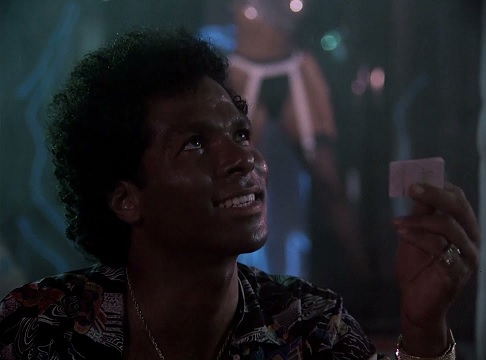
What Tubbs doesn’t know is that Wheeler is an undercover DEA agent and that he’s also Sonny Crockett’s former partner.  Sonny is the “dealer.”  That night, Sonny and a real-life drug dealer, Leon (Mykelti Williamson) show up at the meeting with Wheeler and “Teddy.”  Unfortunately, Zito and Switek show up earlier than expected and they end up arresting everyone before Leon can lead Sonny to the Colombian.  Tubbs makes a run for it, jumps into the boat that Sonny drove to the meeting, and speeds away.  Sonny jumps into his own car and chases the boat while the Miami Vice theme song plays in the background.  (Trust me, it’s a supercool scene.)

Finally confronting Tubbs on a bridge, Sonny reveals that he’s a detective.  Tubbs produces his own badge and introduces himself as Raphael Tubbs of the NYPD.  He explains that he’s in Miami because he’s after a Colombian drug dealer named Calderone.  Sonny explains that he’s too busy searching for the Colombian to worry about Tubbs’s search.  Finally, Lt. Rodriguez shows up and helps them to understand that they’re both looking for the same guy.  Rodriguez suggests that they work together but Sonny refuses.

The next morning, Tubbs tracks Sonny down on the houseboat on which he lives.  It’s a tense meeting, with Sonny punching Tubbs for suggesting that he wasn’t a good enough cop to save Eddie’s life.  Sonny apologizes afterwards and Tubbs accepts the apology and then punches Sonny so that they’ll be even.  Sonny then introduces Tubbs to his pet alligator, Elvis.  It’s male-bonding, 80s style!

Sonny and Scott head over to the courthouse so that they can be “arraigned,” along with Leon.  I really liked the performance of Howard Bergman, who played the eccentric judge, Clarence Rupp.  At one point, the lights went out in the courtroom and when they came back, everyone from the judge to the bailiffs to the court reporter had drawn a gun.  After mentioning his appreciation of the second amendment, Judge Rupp announces that Leon is free to go without bail because he’s cooperating with the police.  A panicked Leon yells that he’s not cooperating.

Later, a fearful Leon calls Rodriguez and offers to cooperate in return for protective custody.  Leon is hiding out at the beach, where Tubbs is keeping an eye on him.  When Sonny arrives, he’s not amused to see Tubbs there.  Meanwhile, a hitman who has disguised himself as a woman shoots and kills Leon while Girls Just Want To Have Fun plays on the soundtrack.

And so ends part one of Brother’s Keeper.  And you know what?  Even after all this time, it’s still easy to see why Miami Vice took off and why it continue to inspire a slew of imitators.  The pilot was genuinely exciting, with the perfect mix of music, visuals, and charismatic performances.  Jimmy Smits broke my heart in his tiny role.  Mykelti Williamson made Leon into an almost sympathetic character as he realized that the cops were willing to sacrifice him to get at his boss.  From the start, Don Johnson’s gruff performance as Sonny feels like a perfect match for Philip Michael Thomas’s more earnest portrayal of Tubbs.  If Sonny is a cynic, Tubbs seems to feel that he can make a difference by taking down men like Calderone. We’ll have to see how long that lasts.

Next week, we’ll finish up the pilot with part two of Brother’s Keeper!
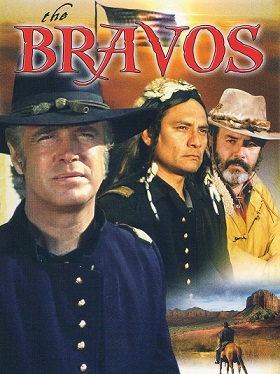
The Bravos (1972, directed by Ted Post)


Major John David Harkness (George Peppard) is the commander of Fort Bravo, a small and ill-equipped frontier fort.  Despite having only 77 soldiers and not many supplies, Harkness has managed to keep an uneasy peace between the local Indian tribes and the settlers who move through the area.  The peace, however, is disturbed when an arrogant wagon master (Pernell Roberts) kills the son of the tribal chief.

That’s not all that Harkness has to worry about.  A German outlaw (Bo Svenson) is hiding out at the camp.  His head scout (L.Q. Jones) suspects that something is forcing the local tribes out of the area.  Two settlers from Missouri (played by Barry Brown and Belinda Montgomery) are at the fort and trying to decide whether they should continue westward or return to Missouri.  Finally, Harkness’s 12 year-old son, Peter (Vincent Van Patten), has been expelled from his New England boarding school and is being sent to Fort Bravo to live with his father.  When Major Harkness refuses to turn the wagon master over to the Indians, they kidnap his son instead.

The Bravos was made for television and originally aired on ABC in 1972.  It was apparently meant to serve as the pilot for a television series, one that would have followed the daily adventures of the Major, his son, and all of the men at Fort Bravo (who were played by television mainstays like Dana Elcar, Randolph Mantooth, and George Murdock.)  For all intents and purposes, Pernell Roberts, Bo Svenson, Belinda Montgomery, and Barry Brown are all “special guest stars” and are meant to serve as examples of the type of television-friendly actors who would visit Fort Bravo on a weekly basis.  That the pilot didn’t lead to a series isn’t surprising.  TV westerns may have dominated the ratings in the 50s and the 60s but they quickly went out of fashion in the 70s as networks realized that they could make more money selling ad space for Norman Lear sitcoms and cop shows.  In the 70s, the people that advertisers were wanting to reach were watching Archie Bunker and Starsky and Hutch, not George Peppard.

Because of its TV origins, The Bravos is a fairly bland western.  It would be a few years before George Peppard would reinvent himself as a grizzled character actor and he’s sincere but fairly dull here.  Pernell Roberts is more effective as the headstrong wagon master and perhaps The Bravos would have worked better if Roberts and Peppard had switched roles.  In the end, the main reason to see the film is for the chance to see L.Q. Jones play a heroic role for once.  A member of Sam Peckinpah’s stock company, Jones brings some authentic grit to his role as the fort’s only scout.  Jones played a lot of villains but I always preferred him as one of the good guys.

The Bravos ends with a few major subplots unresolved.  Maybe they would have been resolved during the show’s first season but it was not to be.

Cleaning Out The DVR: Snowed-Inn Christmas (dir by Gary Yates)


(Hi there!  So, as you may know because I’ve been talking about it on this site all year, I have got way too much stuff on my DVR.  Seriously, I currently have 193 things recorded!  I’ve decided that, on January 15th, I am going to erase everything on the DVR, regardless of whether I’ve watched it or not.  So, that means that I’ve now have only have a month to clean out the DVR!  Will I make it?  Keep checking this site to find out!  I recorded Snowed-Inn Christmas off of Lifetime on December 16th!)

Oh, Christmas movies on Lifetime!

Seriously, Lifetime totally changes during the Christmas season.  For one month, everything that we normally associate with Lifetime disappears.  Gone are all of the films about being stalked by my doctor or betrayed by my lover or deceived by my house guest.  Suddenly, Eric Roberts is no longer plotting to kill Haylie Duff.  No one’s daughter is getting abducted and sold into slavery.  The houses remain grand and the clothes are still often to die for but, otherwise, Lifetime changes during Christmas.  Suddenly, it’s safe to fall in love with that handsome stranger.  The internet is no longer the root of all evil.  Instead, it’s now become a place where a harried single mother can find a handsome single father and hire him to play Santa Claus at a department store.  Lifetime changes for Christmas and we all love it.

Of course, there’s never anything surprising about Lifetime Christmas movies.  They pretty much all follow the same plot and that’s one reason why we love them.  The holidays can be stressful, especially when you can’t go on twitter without being implored to “take it to the streets.”  Lifetime films (and Hallmark films) provide an escape from all that.  They’re a trip into a much more innocent past.

Take Snowed-Inn Christmas for, example.  That’s not a typo.  While this film does deal with people being snowed in, it also largely takes place in an inn.  The inn is located in Santa Claus, Indiana.  It’s owned by Carol (Belinda Montgomery) and Chris (John B. Lowe).  Yes, they both wear red.  Yes, Chris has a white beard and an infectious laugh.  Did you expect any less?

Evil developers want to tear down the inn.  If there’s one thing that I’ve learned from watching Christmas Lifetime films, it’s that land developers never have the holiday spirit.  They always want to kick people out of their homes right before Christmas.  They always want to build a ski resort or a luxury condo or something.

The only thing that can save the inn is if proof is found that the inn is a historical landmark.  Fortunately, two online journalists, Jenna (Bethany Joy Lenz) and Kevin (Andrew Walker), are staying at the inn.  Kevin is the type of guy who eats a slice of pizza for breakfast.  Jenna uses an electric toothbrush.  That’s really all of the character development that they get but that’s okay.  Walker is handsome.  Lenz is pretty.  Both of them can deliver potentially silly lines with sincerity.  They’re likable and that’s all a film like this really requires.

Anyway, at the start of the film, neither Jenna nor Kevin have the Christmas spirit.  They’re not in love with each other, either.  How much you want to bet that will change as they work to save the inn from being bulldozed?  How much do you want to bet that their burgeoning relationship will be encourages by Carol and Chris, both of whom always have a twinkle in their eye regardless of how close their inn is to being destroyed.

Online, some critics have pointed out that Snowed-Inn Christmas is basically a remake of The Flight Before Christmas.  That may be true but who cares?  All of these Lifetime Christmas films are essentially remakes of each other.  That’s why we love them.  Snowed-Inn Christmas delivers exactly what it needs to deliver.  It’s a silly but sweet little movie.

A Movie A Day #154: The Day They Hanged Kid Curry (1971, directed by Barry Shear)


Welcome to the Old West.  Hannibal Heyes (Pete Duel) and Kid Curry (Ben Murphy) are two of the most wanted outlaws in the country, two cousins who may have robbed trains but who also never shot anyone.  After being promised a pardon if they can stay out of trouble for a year, Heyes and Curry have been living under the names Joshua Smith and Thaddeus Jones.

During a trip to San Francisco to visit his old friend, a con artist named Silky O’Sullivan (Walter Brennan), Heyes is told that Kid Curry is currently on trial in Colorado.  When Heyes goes to the trial, he discovers that the accused (Robert Morse) is an imposter and that the real Kid Curry is watching the trial from the back of the courtroom.  It turns out that the man of trial is just an attention seeker , someone who is so desperate for fame that he is willing to be hanged to get it.  At first, Curry thinks this is a great thing.  After the imposter hangs, everyone will believe that Curry is dead and they’ll stop searching for him.  Heyes, however, disagrees, especially after the imposter starts to implicated Heyes in crimes that he didn’t commit.

Obviously inspired by Butch Cassidy and the Sundance Kid, Alias Smith and Jones was one of the last of the classic TV westerns.  Though I originally assumed that it was the show’s pilot, The Day They Hanged Kid Curry was actually the first episode of the second season.  With commercials, it ran 90 minutes.  Because of its extended running time, The Day They Hanged Kid Curry was not included in Alias Smith and Jones‘s standard rerun package.  Instead, it was edited to remove the show’s usual opening credits and it was then sold as a motion picture, despite the fact that it is very obviously a television show.

As long as no one is expecting anything more than an extended television episode, The Day They Hanged Kid Curry is okay.  I have never been a big Alias Smith and Jones fan but this episode’s plotline, with Robert Morse confessing to crimes he didn’t commit just so he can have a taste of fame before he dies, feels prescient of today’s culture.  For classic western fans, the main reason to watch will be the chance to see a parade of familiar faces: Slim Pickens, Henry Jones, Paul Fix, and Vaughn Taylor all have roles.  Most important is familiar Western character actor and four-time Oscar winner, Walter Brennan, as Silky O’Sullivan.  This was one of Brennan’s final performance and the wily old veteran never loses his dignity, even when he’s pretending to be Kid Curry’s grandmother.

As for Alias Smith and Jones, it was a modest success until Pete Duel shot himself halfway through the second season.  Rather than retire the character of Hannibal Heyes, the show’s producers replaced Pete Duel with another actor, Roger Davis.  One day after Duel’s suicide, Davis being fitted for costumes.  This move was not popular with the show’s fanbase and Alias Smith and Jones was canceled a year later, though it lived on for years in reruns.