Retro Television Review: St. Elsewhere 3.3 “Two Balls And A Strike”


Welcome to Retro Television Reviews, a feature where we review some of our favorite and least favorite shows of the past! On Fridays, I will be reviewing St. Elsewhere, a medical show which ran on NBC from 1982 to 1988.  The show can be found on Daily Motion.
This week, the nurses go on strike.  Fire all of them!, I say.

Episode 3.3 “Two Balls and a Strike”

(Dir by David Anspaugh, originally aired on October 3rd, 1984)

It’s another depressing few days at St. Eligius.

When negotiations break down, all of the nurses — except for Shirley Daniels — go on strike.  Led by Nurse Rosenthal, they march out of the hospital and join a picket line in the rain.  Triumphant music plays on the soundtrack  Rosenthal gets on her bullhorn and announces that anyone making deliveries to the hospital will be crossing the picket line and not showing solidarity with the union.  Honestly, though?  Screw the union.  It’s a hospital!  It needs supplies.  There are people dying inside of that building and they’re not even going to have the dignity of clean linen because of Nurse Rosenthal and her stupid union.  And another thing …. Rosenthal is the head of union at St. Eligius.  So, why isn’t she marching in the rain and carrying a sign?  Why does she get to stand in the doorway and shout at people?  Get out there and suffer for your union, you British commie!

Obviously, the show wanted me to be inspired by Rosenthal and the union.  Whenever it switched over to the picket line, triumphant music started playing.  I’m with Nurse Daniels on this one, though.  Daniels didn’t vote the union so why should she have to suffer in the rain?  She stays on the job.  “Good luck,” Rosenthal tells her, “you’ll need it.”  And all I can say to that is that at least Shirley Daniels isn’t deserting the hospital’s patients.

While the nurses are on strike, Dr. Canavero is attacked by a hulking man wearing a ski mask.  Canavero is able to fight him off.  Westphall and everyone else at the hospital immediately assumes that the man was Peter White but Peter has an alibi.  He was in radiology when Canavero was attacked.  So, is there a new ski mask rapist haunting the hospital?  The first ski mask rapist storyline was pretty disturbing, especially since Peter got away with it.  I’m not sure I want to go through a second one.

Dr. Craig and Ellen went to couples therapy.  As usual, Dr. Craig got annoyed with the whole thing.  There’s really nothing more fun than watching Dr. Craig get annoyed.  No one gets annoyed better than William Daniels.  Still, it seemed to do Dr. Craig and Ellen some good, with Ellen making plans to go to Hawaii and Dr. Craig acknowledging that he’s not always the easiest person to deal with.

As for Dr. Westphall …. he spent most of this episode depressed.  Westphall is always depressed.

This is my final St. Elsewhere review for 2025.  Retro Television Review is taking a break for the holidays, so I can focus on Awards Season and Christmas movies!  St. Elsewhere will return on January 9th.
Late Night Retro Television Review: Highway to Heaven 3.13 “Basinger’s New York”


Welcome to Late Night Retro Television Reviews, a feature where we review some of our favorite and least favorite shows of the past!  On Thursdays, I will be reviewing Highway to Heaven, which aired on NBC from 1984 to 1989.  The entire show is currently streaming on Tubi and several other services!

New York, New York, it’s a heckuva town….

Episode 3.13 “Basinger’s New York”

(Dir by Michael Landon, originally aired on December 17th, 1986)

It’s Christmas in New York and veteran news columnist Jed Basinger (Richard Mulligan) has no idea what to write about.  Basinger has been recording the lives of the people of New York City for decades and he’s finally reached the point where he fears that there may not be anything good left to write about.  In short, Jed Basinger is a cynic and we know what this show thinks of cynicism!

While Basinger walks down a cold city sidewalk, he suddenly discovers Jonathan and Mark walking beside him.  Basinger worries that they’re fans, looking to harass him or tell him a long story that they think he should write about.  Instead, Jonathan introduces himself as an angel and explains that he’s here to show Basinger all the good things happening in the city.

I have to admit that I always groan a little whenever an episode of this show starts with Jonathan admitting that he’s angel.  The episodes where Jonathan makes no effort to hide his identity are usually the weakest, if just because they tend to be a bit more preachy than the typical episode of Highway to Heaven.  (Despite its reputation, Highway to Heaven was usually more earnest than preachy.)  Once Jonathan says those three words — “I’m an angel,” — the viewer is immediately aware that this episode has a message and it’s not going to be a subtle one either.

Jonathan, Mark, and Basinger make their way through New York.  They meet a cab driver who just wants to be reunited with his son.  They meet the saintly homeless people who live on the streets and take care of each other in their own quirky way.  They meet a nice cop.  They meet not one but two women who are in labor and who end up at the same hospital.  One woman is poor and turned away because she doesn’t have insurance (which, technically, I think is illegal under federal law but whatever).  The other woman is the wife of a U.S. Senator who announces that she refuses to give birth in a hospital that turns away the poor.  Luckily, Basinger is there and threatens to write about it.  The scene in the hospital is typical of this episode.  It’s well-meaning but so heavy-handed that it’s nowhere near as effective as it should have been.  If I was in labor, would I take the time to demand that the hospital treat all of its patients fairly?  I’d like to think so but, realistically, my mind would probably be on other things.  Luckily, Basinger gets to write his column, despite showing up late at the newspaper.  It turns out that the presses went down while Basinger learned a lesson about New York and kindness.

I can’t really be too critical of this episode because its heart was in the right place.  That was this show’s biggest strength.  Michael Landon really did seem to believe he could make the world a better place, one episode at a time.  That said, this episode was a bit too heavy-handed for my tastes.  But again, how can I be too critical of a show about Christmas miracles?


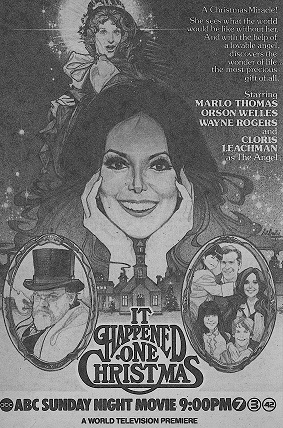
Holiday Film Review: It Happened One Christmas (dir by Donald Wyre)


The 1977 made-for-TV movie, It Happened One Christmas, opens in Heaven.  We hear the voice of Joseph (Charles Grodin), one of the top angels.  Joseph has noticed that, in the town of Bedford Falls, a lot of people seem to be praying and all of their prayers concern one person.  They are all worried about Mary Bailey Hatch (Marlo Thomas).

He requests that an angel be sent down to Earth to help Mary with her problems.  Unfortunately, the only angel available is Clara (Cloris Leachman) and Clara, despite her optimistic outlook and upbeat personality, is not considered to be a particularly smart angel.  She hasn’t even gotten her wings yet!  However, Joseph promises her that, should she convince Mary Hatch not to toss away her life on Christmas Eve, Clara will get her wings.

But first, Joseph shows Clara all of the important events in Mary’s life.  Clara watches as young Mary saves the life of her brother, Harry.  A few weeks later, Mary manages to keep Dr. Gower from accidentally poisoning a patient.  Though Mary dreams of leaving Bedford Falls and pursuing a career as a writer, she instead ends up taking over her late father’s old Building and Loan company.  With the help of her husband, George (Wayne Rogers), she helps hundreds of people move into affordable housing.  She is also one of the few people in town willing to stand up to Old Man Potter (Orson Welles)….

What was that?

Yeah, I know.  Just hold on.  I’m getting to that.

Anyway, everything is going great in Mary’s life until her irresponsible Uncle Willie (Barney Martin) accidentally loses a deposit on Christmas Eve.  Facing embezzlement charges and having yelled at her family, Mary considers jumping off a bridge.  Fortunately, Clara is there to show her what her life would be like if she had never been born….

Excuse me?  Did you say that this sounds familiar?

Yes, It Happened One Christmas is a remake of It’s A Wonderful Life.  The main difference is that the genders are swapped.  Jimmy Stewart’s role is played by Marlo Thomas.  Wayne Rogers plays the Donna Reed role.  This leads to a few changes in the story.  For instance, Mary still yells at ZuZu’s teacher but she doesn’t get sucker punched as a result.  Whereas the original Mr. Potter treated George Bailey with outright hostility, the remake’s Mr. Potter tends to use a tone of condescending concern when talking to Mary.  Since George Hatch doesn’t lose his hearing in one ear, he’s able to serve in World War II and he returns on crutches.  In the world where Mary was never born, George still never marries but, instead of working at the library, he becomes a boorish auto mechanic.  Violet is no longer an important character and Mary never tries to blame her visions of Pottersville on “bad liquor.”  These are cosmetic differences but, otherwise, it’s pretty much the exact same story.

To be honest, it probably sounds more interesting than it actually is.  It’s not that It Happened One Christmas is a poorly made or a badly acted film.  It’s fine, really!  But it’s not It’s A Wonderful Life.  Marlo Thomas plays her role with a lot of energy but she’s still no Jimmy Stewart.  Stewart, who was still dealing with his own World War II experiences, played up the haunting sadness behind George’s mild-mannered facade and that’s something that Thomas never accomplishes.  If Stewart’s George seems like he’s been beaten down by one lost dream after another, Marlo Thomas’s Mary just seems like she’s having a really bad night.  By that same token, Wayne Rogers is likable a the love of Mary’s life but he’s no Donna Reed.  Even the great Orson Welles can’t escape the shadow of Lionel Barrymore.  Barrymore’s Mr. Potter was a pure misanthrope who was at his happiest mocking the dead and approving men for the draft.  Oddly, Orson Welles brings an almost avuncular style to Mr. Potter.  One gets the feeling that Welles simply couldn’t resist winking at the audience and assuring them that he was still the bigger-than-life showman that they had grown up with.

So, you may be wondering ….. why remake It’s A Wonderful Life in the first place?  I was wondering about that so I did a little research and thanks to an obscure web site called Wikipedia (not many people have heard of it), I discovered that It Happened One Christmas was actually made before It’s A Wonderful Life started to regularly air during the holidays.  At the time it was made, it was aactually remake of a classic film that was no longer regularly watched.  Frank Capra angrily denounced It Happened One Christmas as being “plagarism” but, in 1977, it was enough of ratings success that it was re-aired in both 1978 and 1979.  But, by that time, It’s A Wonderful Life had started to regularly air during the holiday season and was being rediscovered by audiences young and old.  As a result, the okay remake was soon overshadowed by the vastly superior original.

And really, that’s the way it should be.  It Happened One Christmas isn’t a bad movie but it just no replacement for Capra’s Wonderful film.

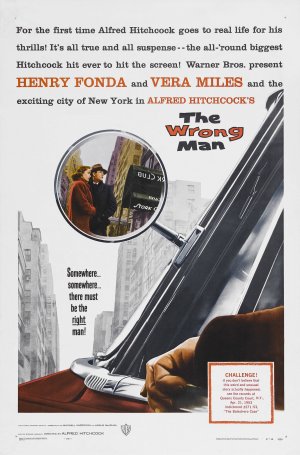
Lisa Marie Does The Wrong Man (dir by Alfred Hitchcock)


Since today is Alfred Hitchcock’s birthday, I figured why not take a few minutes to recommend one of his films that you may not have seen.  First released in 1956 but still painfully relevant today, The Wrong Man is one of Hitchcock’s best but it’s also one of his most underrated.

The Wrong Man deals with a common Hitchcock theme — i.e., an innocent man has been accused of a crime and, despite all of his efforts, cannot seem to convince anyone of his innocence.  The difference between The Wrong Man and something like Saboteur or Frenzy is that The Wrong Man is based on a true story.

Manny Ballestro (Henry Fonda) is a struggling musician.  He makes $85 a week, playing in a small jazz club.  But even though he may not be rich, he’s happy.  He loves his job.  He loves making music.  Even more importantly, he loves his wife, Rose (Vera Miles).  But Rose needs to have her wisdom teeth removed and it’s going to cost $300.  (As a sign of how much things have changed, I would have been relieved if it had only cost me $300 to get my wisdom teeth taken out.)  Desperate for money, Manny tries to borrow money on his wife’s life insurance plan.  What Manny doesn’t know is that the insurance office has been held up twice by a man who bears a vague resemblance to him.  A clerk calls the police and Manny soon finds himself being taken down to the police station.

Two detectives say that they need Manny’s help but they don’t tell him why.  But Manny knows he’s innocent of any crime and he believes that the police are on his side and he agrees to help.  When they tell him to walk into a liquor store, he does so.  When they take him to a deli, he goes in there as well.  When they demand to know why he was trying to borrow money on his wife’s life insurance, he tells them.  When they ask him about his financial difficulties, he tells them about that as well.  Why shouldn’t he?  He’s innocent and the police are just doing their job, right?  And when the cops finally ask him to copy down a few words that were used in the note that the robber slipped the clerk at the insurance company, Manny does so.  And when they then ask him to take part in a line-up, he does that as well…

And when Manny is arrested and charged with a crime … well, that’s when he finally understands that the system is not on his side.  His wife manages to hire a reputable attorney, Frank O’Connor (Anthony Quayle), to defend him but it quickly becomes obvious that the world has already decided that Manny is guilty.  When Manny and his wife try to track down some people who could provide Manny with an alibi, they discover that two of them are dead and one of them cannot be found.  For once, in a Hitchcock film, it’s not a case of conspiracy.  Instead, it’s just bad luck.

And, through it all, Rose continues to blame herself.  In fact, she is so wracked with guilt that she has a nervous breakdown.

It all leads to an amazingly disheartening courtroom scene.  As quickly becomes obvious, the judge has little interest in what’s happening in his court.  Even worse, the jury is unconcerned with the evidence.  Most of them are just annoyed at the inconvenience and punishing Manny seems like the perfect way to release their own frustrations…

It’s a bleak picture of the American justice system.  Watching The Wrong Man today, it’s tempting to say that the film is just a reflection of society in the 1950s and that things have changed today.  But really, have they?  True, the police may now be required to read someone their rights when they’re arrested.  A suspect can now ask for a lawyer.  We’ve got laws against entrapment and all the rest.  But that doesn’t matter.  We still live in a society where people are still widely presumed to be guilty, even after they’ve been found innocent in a court of law.  We still live in a society where the wrong man can have his life ruined because of one mistake.

The Wrong Man doesn’t get as much attention as some of Hitchcock’s other films.  In many ways, it’s an atypical example of his work.  Hitchcock was notorious for his dark sense of humor and his habit of waving away most plot points as just being mere “macguffins.”  With the exception of two scenes, both of which are meant to depict Manny’s mental state, The Wrong Man is filmed in a documentary style, one that occasionally seems more like Sidney Lumet than Alfred Hitchcock.  There’s next to no humor, nor are there any big or flamboyant twists.  In short, The Wrong Man finds the director of Psycho, Vertigo, and Rear Window at his most sincere.  It takes some getting used to.

But, once you do get used to it, The Wrong Man emerges as a powerful and bleak portrait of two innocent people at the mercy of a soulless system.  It’s a must see so be sure to see it!

The-Wrong-Man-poster