Made For TV Horror: Death Car On The Freeway (dir by Hal Needham)


I, for one, am tired of the stereotype that women cannot drive.

I’m a woman and I can tell you right now that I am an above average driver.  I’ve only had one major accident.  Admittedly, I did smash into a parked car but it was raining and I really couldn’t see that well because I was driving convertible and the window was fogged up.  Plus, whoever parked that car must have done a bad job and left it sitting out in the middle of the street.  For the record, my convertible flipped over on impact so the parked car did far more damage than I did.

Other than that, I usually manage to stop in time for red lights.  I’ve only driven through a few stop signs and that was just because I didn’t notice them. I’ve very rarely been given a speeding ticket.  Instead, the police have always been very polite about just giving me a warning.  And yes, it is true that I have trouble with curbs and turns and going in reverse and all that but I’ve seen plenty of men do the same thing.

The statistics show that, while women are involved in more accidents, the accidents are more likely to be fatal if a man is driving.  Men are also more prone to get upset and pull a gun during a road rage incident whereas women just give other drivers the finger.  Women are not inherently bad or dangerous drivers.  The one exception, at least down here in Texas, are middle-aged women who drive SUVs with faded Beto stickers.  You really don’t want to get stuck behind one of them in traffic.

I found myself thinking about the misogyny behind the “women-are-bad-drivers” stereotype as I watched 1979’s Death Car On The FreewayDeath Car On The Freeway features a madman who is so sick of women driving in Los Angeles that he starts using his Dodge van to cause them to have accidents.  We don’t actually see his face or really learn much about him.  What we do see are his black-gloved hands on his steering wheel, which is a nifty homage to the giallo genre.  (Giallo killers have a thing for black gloves.)  Whenever the driver does try to force a woman into a fatal accident, he pops in an 8-track of hyperactive fiddle music.  The fiddle has never sounded more menacing than it does in Death Car On The Freeway.  It’s almost like prog rock fiddling.  Imagine a country western fiddler who has just done a mountain of cocaine and you’ll get a feeling for this guy’s taste in music.

News reporter Shelley Hack thinks that the public has the right to know that there’s a man causing women to crash their cars.  Her ex-husband, played to smarmy perfection by George Hamilton, thinks that Shelley should quit her current job and come work with him.  Meanwhile, police inspector Peter Graves is concerned that the media going to start a panic and make it more difficult for him to track down the “Freeway Fiddler.”  (One gets the feeling that Graves feels this entire mess could have been avoided if women had never been allowed to drive in the first place.)  At one point, Hack meets with a defensive driver instructor and he’s played by the film’s director, Hal Needham.

Oh, how I love this film!  Seriously, it’s got car chases, car crashes, 70s outfits, George Hamilton, Peter Graves, and a genuinely frightening villain.  This is one of those films where you might be tempted to be dismissive.  Folks like Dinah Shore, Sid Haig, and Abe Vigoda show up in small roles, reminding you that this really is a 70s made-for-TV movie.  But then, that fiddling explodes on the soundtrack, that van starts tailgating someone, and Death Car On The Freeway suddenly becomes a cinematic nightmare.  It’s not a surprise that Hal Needham was able to stage some impressive driving stunts in Death Car On The Freeway.  That was Hal Needham’s thing.  But Needham also manages to craft a compelling and, at times, genuinely frightening film.  Anyone who has ever glanced into their rearview mirror and suddenly realized that another vehicle is following them will be able to relate to the fear of the Fiddler’s victims.

This is a great movie and a reminder that women are not the most dangerous drivers on the streets.  Unless, of course, they’re driving an SUV with a faded Beto sticker….
Retro Television Review: Fantasy Island 7.11 “Games People Play/The Sweet Life”


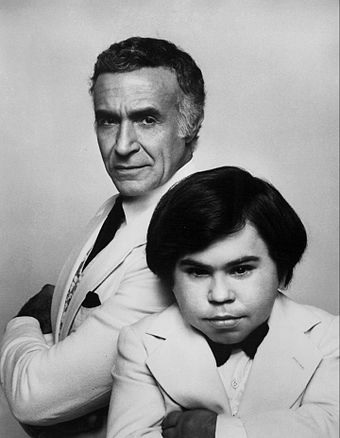
Welcome to Retro Television Reviews, a feature where we review some of our favorite and least favorite shows of the past!  On Tuesdays, I will be reviewing the original Fantasy Island, which ran on ABC from 1977 to 1984.  Unfortunately, the show has been removed from most streaming sites.  Fortunately, I’ve got nearly every episode on my DVR.

“Smiles, everyone …. SMILES, DAMMIT!”

Episode 7.11 “Games People Play/The Sweet Life”

(Dir by Cliff Bole and Don Weiss, originally aired on January 14th, 1984)

Three women who all work for a toy company come to Fantasy Island.  Nora Leonard (Lynda Day George) has closed off her heart after getting hurt in too many past relationships.  Barbara Jessup (Jenilee Harrison) wants her boss to look past her appearance and realize that she really does have a brain to go with her beauty.  Sandy Hoffman (Berlinda Tolbert) wants to have the courage to present her ideas….

Oh hey, it’s a Wizard of Oz thing!  Except it’s not.  There’s no Dorothy and there’s no Toto.  There’s a corporate spy named Steven Curry (John McCook), who wants the details of the company’s new video game and who also falls for Nora.  And there’s Dick York as Mr. Sutton, who wears a bowtie as all toy company execs do.

What there is not is an interesting fantasy.  Even with three separate fantasies in one, this storyline was pretty blah.  Everyone seemed a bit bored, even the usually dependable Lynda Day George.

The other fantasy was slightly more interesting, but only because it featured the great character actor Kevin McCarthy as Daniel Koster.  Daniel wanted to give his wife and his children the lifestyle they could have had if Daniel had been rich.  In fact, Daniel sent his family to Fantasy Island ahead of him so that they could enjoy being rich without him around.  (What?)  I was always under the impression that guests at the Island only stayed for a weekend.  Daniel comes to the Island and discovers that his family appears to be very happy, even if his son is still writing bad poetry.  (There’s no money in poetry, Daniel gruffly explains and, as a poet, I can say that’s very true.)  Along with his son’s rhyming habits, Daniel has other things to deal with, like his bad heart.

In fact, Daniel dies of a heart attack while on the Island but not before realizing that his family always loved him, even if they weren’t rich.  Having Daniel die was depressing.  What made it even worse is that Roarke apparently knew Daniel was probably going to die on the Island but he didn’t really seem to do anything to try to prevent it from happening.  Instead, he just made a bunch of cryptic comments to Lawrence about how Daniel’s weekend on Fantasy Island could be his last.  Lawrence looked concerned but didn’t do anything to help.  Why is Lawrence even there?

Eh, this episode.  I always enjoy watching Kevin McCarthy and he gives a typically solid performance but otherwise, this was a disappointing trip to the Island.

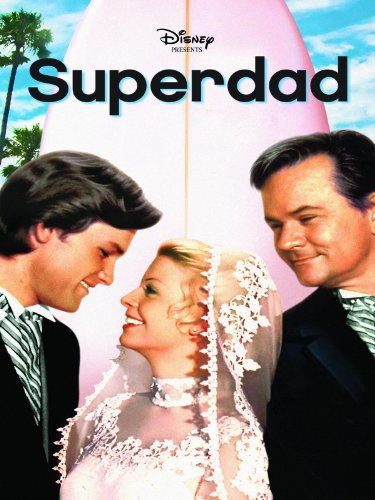
Life’s A Beach: Superdad (dir by Vincent McEveety)


In 1973’s Superdad, Disney takes on the generation gap.

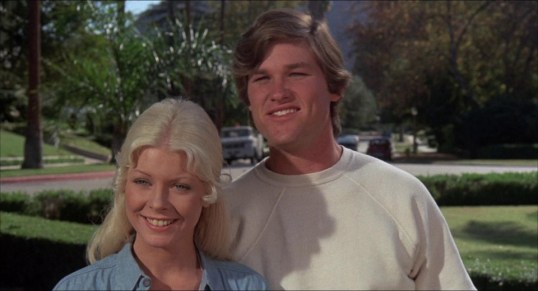
Charlie McCready (Bob Crane) just can’t understand what’s going on with his daughter, Wendy (Kathleen Cody).  She’s smart, pretty, and has the potential for a great future ahead of her but all she wants to do is hang out with her friends on the beach.  Eccentric Stanley Schlimmer (Bruno Kirby) drives everyone around in a souped-ambulance.  Ed Begley, Jr. (who plays a character who doesn’t even get a name) joins in whenever the group sings a folk song.  Wendy’s boyfriend, Bart (young and likable Kurt Russell), is a surfer and water skier.  Charlie is truly convinced that this extremely clean-cut group of teenagers is going to lead his daughter astray.  In fact, Wendy wants to marry Bart!  Charlie attempts to hang out with Wendy, Bart, and his friends on the beach and he can’t keep up.  He can’t water ski, he can’t play football, he can’t play volleyball.  All he can do is scream in this weird high-pitched voice.  The entire time is Bart is extremely nice to him and doesn’t even make fun of him for not being able to hit a volleyball over a net.  I mean, even I can do that!  But because Charlie’s not dealing well with becoming middle-aged, he decides that Bart is a threat.

(I’m going to assume that Charlie also teams up with a creepy friend and starts filming himself having threesomes with groupies, though we don’t actually see that happen in the film.  The subtext is there, though!)

Charlie decides that he has to get Wendy away from this group and the best way to do that would be to trick her into thinking she’s received a scholarship to …. Yes, this is just that stupid …. a scholarship to a prestigious university.  While Bart and his healthy, non-smoking, non-drinking friends are all going to City College and living at home with their parents, Wendy will be miles away at a college where she can do anything that she wants. Charlie thinks this is a great plan.  One gets the feeling that Charlie, for all of his overprotectiveness, hasn’t read a newspaper in 20 years.  Seriously, has he not been keeping up with what was happening on most college campuses in the late 60s and early 70s?

The main problem with this film is that Charlie is an incredible jerk.  It’s one thing to be overprotective.  Fathers are supposed to be overprotective of their daughters.  It’s one thing to worry about his daughter not having a good deal of ambition.  I can even understand him getting annoyed with Stanley because Stanley is kind of annoying.  (Watching this film, it’s hard to believe that Bruno Kirby was just one year away from playing the young Clemenza in The Godfather, Part II.)  But seriously, Charlie is freaking out over his daughter dating KURT RUSSELL!  In this film, Kurt Russell plays a character who is always polite, mild-mannered, sensible, and remarkably understanding of Charlie’s attempts to keep him from marrying Wendy.  There is one scene where Bart gets upset and he barely even raises his voice.  He’s incredibly likeable and, for all of this film’s flaws, it’s still easy to see why Kurt Russell became a star.

Of course, what really makes this film a cringe-fest is that it stars Bob Crane as a family man with a secretly manipulative side and, the whole time I was watching, I kept having flashbacks to Greg Kinnear in Auto-Focus.  Wendy, to make her dad really angry, gets engaged to an actual hippie named Klutch (Joby Baker) and there’s a scene in which Klutch and Charlie get into a fight in Klutch’s artist studio.  Every time Klutch swung anything near Charlie’s head, I definitely cringed a bit.  Red paints get spilled everywhere, though luckily it ends up on Klutch and not Charlie.  Still, watching the film, I couldn’t help but think that there are worse things that could happen to someone than having their daughter marry Kurt Russell.

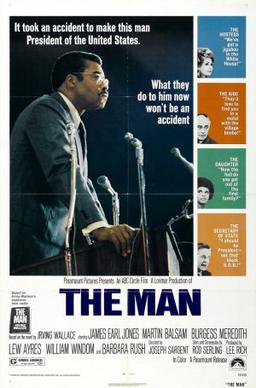
Starring James Earl Jones: The Man (dir by Joseph Sargent)


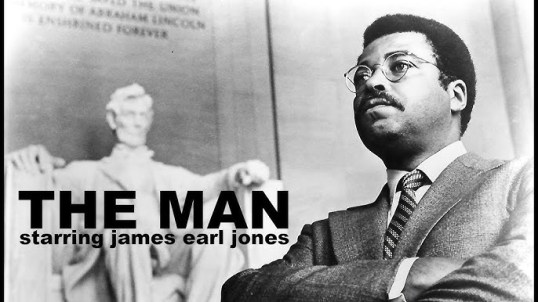
In 1972’s The Man, James Earl Jones stares as Douglass Dilman.

Dilman is a black college professor and a U.S. Senator.  To his friends, he’s a symbol of progress.  To his enemies, he’s a sell-out who is viewed as being improperly radical.  The U.S. Senate, eager to prove that it’s not a racist institution, has elected Dilman as the President Pro Tempore.  He is now fourth in line for the presidency but that doesn’t concern racist senators like Senator Watson (Burgess Meredith).  A lot would have to happen before Dilman would ever become President.

Needless to say, a lot does happen.

The President and the third-in-line Speaker of the House are attending a conference at a historic building in Frankfort when the roof collapses on them.  We don’t actually see this happen.  We just hear the people in the White House talk about how it’s happened.  We also don’t really learn many details about why the roof collapsed.  Someone nonchalantly says, “It’s an old building.”  Myself, I spent the entire movie waiting for some sort of big revelation of a conspiracy behind the roof collapse but it didn’t happen.  Apparently, in 1972, the Secret Service just let the President go anywhere without checking the place out first.  That said, it’s not a good thing when a serious movie opens with a dramatic plot development that, at the very least, draws a chuckle from the audience.  Seriously, we lost our President because a roof fell on him?  How is America ever going to live that down>

Vice President Noah Calvin (Lew Ayres) is wheeled into the White House cabinet room.  This was not the first time that a Ayres played a Vice President called upon to succeed the President.  Unlike in Advice and Consent, the Vice President announced that he cannot accept the honor of being sworn in because he’s too sick.  (Since when does the Vice President have the option to refuse to do his Constitutional duty?)  With Calvin putting the country ahead of his own ambition, Senator Watson announces that Secretary of State Eaton (William Windom) will be the new President.  No, Eaton says, Dilman will be the new president.  But once Dilman screws up and is either impeached or resigns, fifth-in-line Eaton will be sworn in.

Except …. it wouldn’t work that way.  Excuse me while I put my history/political nerd hat on….

First off, Calvin is apparently still Vice President so if Dilman did step down, Calvin would once again be the successor.  What if Calvin refused a second time?  As soon as the Speaker of the House died, the House of Representatives would elect a new Speaker and that person would be third-in-line.  And, as soon as Dilman became President, the Senate would elect a new President Pro Tempore and that person would be fourth-in-line.  In other words, Eaton is no closer to being President than he was before.

My reason for going  into all of this is to illustrate that The Man is a film about American politics that doesn’t really seem to know much about American politics.  That said, it does feature the great James Earl Jones as Douglass Dilman and Jones gives such a good and thoughtful performance that it almost doesn’t matter that no one else in the film seems to be taking it all that seriously.  Jones plays Dilman as being a careful and cautious man, one who understands that he occupies a huge place in history (Barack Obama was only 11 years old when this film came out) but whose main concern is just doing a good job as President.  Dilman finds himself in the middle.  On one side, he has advisors warning him not to scare America by being too radical.  On the other side, his activist daughter (Janet MacLachlan) brands Dilman a sell-out.  When a black student named Robert Wheeler  (Georg Stanford Brown) is arrested for assassinating a South African government official, Dilman’s first instinct is to believe Wheeler’s been framed but, as the film progresses, doubts start to develop and Dilman must decide whether or not to risk an international incident.  It’s an interesting story, well-played by James Earl Jones and Georg Stanford Brown.

It was originally mean to be a made-for-TV movie but, in order to capitalize on the excitement on the 1972 presidential election, it was released into theaters.  As a result, the film often has the cheap look of a made-for-TV movie and quite a few members of the cast give performances that feel more appropriate for television than the big screen,  (Some members of the cast, like Burgess Meredith, just overact with ferocious abandon.)  In the end, The Man is mostly of interest from a historical point of view.  (In 1972, the idea of a black man being elected President seemed so unrealistic that the movie actually had to drop the roof on 50% of the government just to get Dilman into the Oval Office.)  James Earl Jones, who would have turned 94 today, is the main reason to watch.

Retro Television Review: Fantasy Island 6.1 “Curse of the Moreaus/My Man Friday”


Welcome to Retro Television Reviews, a feature where we review some of our favorite and least favorite shows of the past!  On Tuesdays, I will be reviewing the original Fantasy Island, which ran on ABC from 1977 to 1984.  Unfortunately, the show has been removed from most streaming sites.  Fortunately, I’ve got nearly every episode on my DVR.

Welcome to the sixth season of Fantasy Island!

Episode 6.1 “Curse of the Moreaus/My Man Friday”

(Dir by Bob Sweeney, originally aired on October 16th, 1982)

A new season has begun and the fifth season’s Julie experiment is officially over.  Mr. Roarke is back and Tattoo is once again his only assistant.  Julie is not only missing but she’s not even mentioned in this episode.  Personally, I think Julie went to college on the mainland or maybe she married Gopher from the Love Boat.  Either way, Julie is gone and Fantasy Island is back to normal.

This week’s fantasies both felt familiar.  It was another haunted house fantasy and another “secretary-becomes-the-boss fantasy.”  After spending nearly ten years as a secretary at an ad agency, Linda Whitney (Pamela Hensley) has watched as her stupid boss, Ed Turner (Avery Schrieber) has taken credit for all of her ideas and as everyone has gotten promoted but her.  Linda wants to be an executive and fortunately, Mr. Roarke knows the president of her company.  Linda has received a promotion to the executive suite.  She has 48 hours to prove herself or she’ll be “demoted” back to secretary.

(Demoted is in scare quotes because, right out of college, I worked as an administrative assistant and let me just say that a good assistant is the most important person in any office.)

What’s odd about this fantasy is that Mr. Roarke arranges for Linda’s office to be transported to Fantasy Island.  But all of Linda’s co-workers are transported to the Island as well.  In fact, the entire building seems to now be on Fantasy Island.  I mean, at this point, we all know that Mr. Roarke can pretty much do anything but even this seems a bit extreme for a fantasy that is clearly established as not being something that’s just happening in Linda’s head.  Mr. Roarke is somehow transporting office buildings now.  Were Linda’s co-workers given any warning before being transported to the Island?

It’s not easy being an executive.  Her old boss wants her to fail.  All of her former secretarial colleagues want her to fail.  Can Linda get land the big account?  Sure, she can.  Luckily, she has a male secretary named Jack Friday (James Houghton) to help out!  By the end of the episode, Linda has come to realize that she treated the handsome Jack almost as poorly and objectified Jack almost as much Ed Turner did to her.  Then again, Jack does introduce himself by saying that he likes working for women because they have “better legs.”  All that said, I liked the fantasy.  I liked that Linda kept her promotion.  I liked that she worked with Jack without falling in love with him.  I like that she left the Island on her own, satisfied with her new career.

As for the other fantasy, Jack Moreau (Stuart Whitman) is haunted by nightmares in which he kills his wife, Kathy (Barbara Rush).  Agck!  It turns out that Moreau men are cursed.  They murder their wives on their 50th birthday.  Jack failed to mention this to Kathy when they got married.  That’s probably grounds for divorce.  Anyway, Mr. Roarke sends them to spend Jack’s birthday weekend in the Moreau plantation, where they are watched by a mysterious servant (Raymond St. Jacques) who seems to be all about driving Jack to murder his wife.  Fortunately, Jack does not murder his wife.  Kathy tells Jack that she loves him and the curse is broken.  Hey, that was easy!  That said, I enjoyed this fantasy.  The Fantasy Island haunted house stories always have a lot of atmosphere to them.  They’re fun to watch.

This was a good start of the season.  It was nice to see Tattoo and Roarke joking again.  Tattoo points out that a good boss needs good people working for him and Tattoo’s absolutely right.

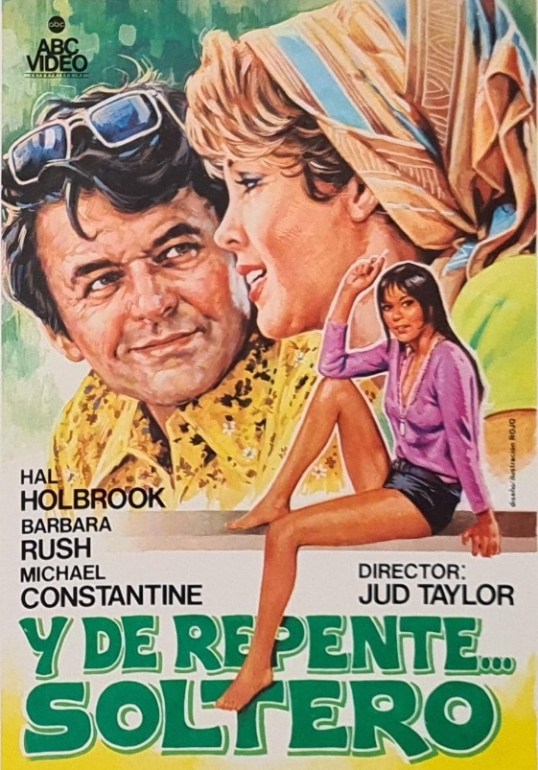
Retro Television Reviews: Suddenly Single (dir by Jud Taylor)


Welcome to Retro Television Reviews, a feature where we review some of our favorite and least favorite shows of the past!  On Sundays, I will be reviewing the made-for-television movies that used to be a primetime mainstay.  Today’s film is 1971’s Suddenly Single!  It  can be viewed on YouTube.

Suddenly Single opens with middle-aged Larry Hackett (Hal Holbrook) loading his suitcases into the back of his car.  His neighbors (David Huddleston and Pamela Rodgers) come over to say goodbye.  Larry has just gotten divorced and, as a result, he’s lost his perfect house in the suburbs.  Now, he’s going to have to move into the city and start a new life but he assures his neighbors that he’ll be okay and that there aren’t any hard feelings between him and his ex, Joanne (Cloris Leachman).  Sometimes, marriages just don’t work out….

Then Joanne shows up….

With her new husband, Ted (Fred Bier)!

While Larry can only watch, Ted insists on picking up Joanne and carrying her over the threshold of what used to be Larry’s house.  As it dawns on him that Joanne was having an affair during the final days of their marriage, Larry is understandably miffed.

Larry just isn’t ready to find himself in the world of the early 70s.  He’s an extremely conservative pharmacist who will now have to deal with hippies and the single scene.  His co-worker (Harvey Korman) encourages Larry to hit the bars.  Marlene (Agnes Moorehead) encourages him to figure out what he wants to do with his life.  His new and much younger neighbor, Jackie (Margot Kidder), tells him that he needs to get a gym membership and be more open-minded.  At first, Larry pursues a relationship with the classy Evelyn Baxter (Barbara Rush) but then he’s drawn to Jackie.  And Jackie, oddly enough, is drawn to him….

Quicker than you can say Breezy, Larry is dating the much younger Jackie and he’s starting to wear hip clothes and hang out with cool, long-haired people.  When he runs into his old neighbors on the street, he discovers that he no longer has much in common with them.  However, Larry still finds himself becoming jealous and possessive of Jackie, who is not the type of to give up her freedom for a relationship.  In the end, Larry is forced to admit that, while he has become more open-minded following his divorce, he still can’t magically change who he is.

Suddenly Single has a great cast and it’s not surprising that it’s a well-acted film.  At the same time, Larry can be a bit of a jerk.  Evelyn is the nicest person in the entire movie and Larry basically breaks her heart so that he can pursue an obviously doomed relationship with the younger Jackie.  It’s a bit sad to watch because everyone but Larry can see what he’s doing.  Larry may be wiser by the end of the film but that’s small solace to Evelyn.  Suddenly Single is about flawed characters and, as such, it can be easy to get annoyed with Larry and Jackie while also appreciating the fact that, like all of us, they’re just trying to figure out life as they go along.

Suddenly Single acts as a bit of time capsule and watching it is as probably as close as one can get to 1971 without a time machine.  It’s a trip to the past with some of the best actors of the era.

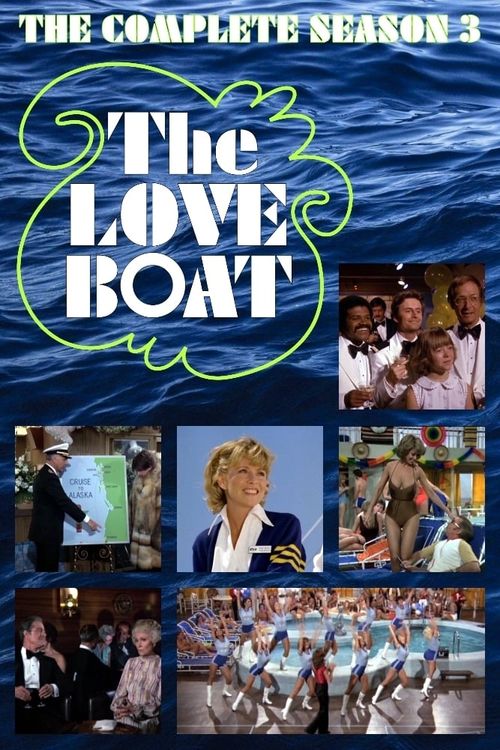
Retro Television Reviews: The Love Boat 3.13 “Not Now, I’m Dying/Too Young to Love/Eleanor’s Return”


Welcome to Retro Television Reviews, a feature where we review some of our favorite and least favorite shows of the past!  On Wednesdays, I will be reviewing the original Love Boat, which aired on ABC from 1977 to 1986!  The series can be streamed on Paramount Plus!

This week, Captain Stubing’s in love again.  Things don’t work out.

Episode 3.13 “Not Now, I’m Dying/Too Young To Love/Eleanor’s Return”

(Dir by Alan Rafkin and Roger Duchowny, originally aired on November 24th, 1979)

The first thing that I noticed about this episode is that the name of guest star Jon Cypher was misspelled as “Jon Cyphers” on his intro card.  I’m sure that Cypher appreciated that.  Jon Cypher may never have been a household name but he appeared in several movies and a ton of television shows, usually cast as autocratic authority figures.  Misspelling his name is an odd error for a guest star-driven show like The Love Boat to make.

The other thing I noticed was that Jill Whelan was not listed in the opening credits and indeed, Vicki is not in the episode.  The simple explanation is that this episode was originally meant to air before Stubing adopted Vicki.  Still, I did find myself wondering if maybe Captain Stubing finally realized that it was kind of weird for a 12 year-old to live on a cruise ship.  Vicki living on the ship has always confused me.  I mean, she’s 12 and she’s apparently now working for the cruise line.  Shouldn’t she be in school?  Does she have a tutor on the boat?  I mean, how is any of this legal?

Captain Stubing didn’t say anything about Vicki in this episode but that’s because he was devoting most of his attention to Eleanor (Barbara Rush).  Eleanor previously appeared during the second season, during which Stubing fell for her.  Stubing is excited that Eleanor will be taking the cruise for a second time but, before he can ask her out, Eleanor is approached by Russell Evans (Jon Cyphers Cypher).  Russell asks Eleanor to dance with him and Stubing can only watch helplessly as Eleanor has a whirlwind romance with Russell.  Unfortunately, Russell turns out to be a bit of a cad but, by the time time Eleanor realizes this, the cruise is almost over!  Stubing chastely comforts her and I did appreciate that the show didn’t have her just magically get over her broken heart and have her hook up with the Captain.  At the end of the cruise, Eleanor says goodbye once again and Stubing can only hope that she’ll take a third trip on the boat.

While this is going on, Doc is excited because his friend, Lucy (Barbi Benton), has boarded the boat with her fiancé, Peter Welch (Dack Rambo).  Lucy is really enthusiastic about getting married but Peter’s not sure if he wants to settle down.  So, in an example of incredibly weird thinking, Peter lies and tells Lucy that he’s dying of a tropical disease and it wouldn’t be fair of him to marry her.  When Lucy tells Doc the news, Doc informs Lucy that Peter’s disease doesn’t exist.  In order to get back at Peter, Lucy arranges for Peter to be examined by Doc.  The plan is for Doc to violate his Hippocratic oath and risk his medical license by giving Peter a false diagnosis.  However, Doc discovers that Peter actually is sick.  He has Lou Gehrig’s Disease.  This leads to Peter and Lucy realizing that they really do love each other.

Finally, two underage kids — Terry (Timothy Patrick Murphy) and Monica (Christen Kauffmann) — board the boat under false names and check into the honeymoon cabin so that they can take their relationship to the next level.  However, Monica is the daughter of one of the cruise line’s executives and, when he discovers what is going on, he orders Stubing to keep the kids apart.  Since Stubing is more interested in pursuing Eleanor, he gives the job to Gopher.

Instead of just confronting the kids about lying to get the honeymoon suite and assigning them to different cabins, Gopher decided to rely on his mastery of disguise.  Gopher disguises himself as both an old man and a bearded Scotsman and continually makes sure that Terry and Monica never get any time alone.  Terry is annoyed but Monica is happy because she’s not sure if she actually wants to lose her virginity to a handsome and considerate guy who has enough money to afford a luxurious cabin on a cruise ship.

This episode was …. well, it was okay.  It was a typical episode of The Love Boat, in that everyone was attractive and the boat looked really nice.  With the exception of Eleanor’s story, this was a fairly superficial 45 minutes.  That said, it was a pleasant episode even if it wasn’t particularly memorable.

Retro Television Reviews: The Love Boat 2.15 “My Sister, Irene / The ‘Now’ Marriage / Second Time Around”


Welcome to Retro Television Reviews, a feature where we review some of our favorite and least favorite shows of the past!  On Wednesdays, I will be reviewing the original Love Boat, which aired on ABC from 1977 to 1986!  The series can be streamed on Paramount Plus!

This week, The Love Boat becomes …. THE DIVORCE BOAT!

Episode 2.15 “My Sister, Irene / The ‘Now’ Marriage / Second Time Around”

(Dir by Roger Duchowny, originally aired on January 13th, 1979)

Dr. Todd Gardiner (Peter Marshall) is the author of a best-selling book that advocates for open marriage but he’s never had one himself.  He’s determined to finally have an affair while sailing on The Love Boat and, just to prove that he’s not a hypocrite, he’s brought along his wife, Eleanor (Barbara Rush), and he’s encouraging her to have an affair as well!  Initially, Eleanor is not particularly enthusiastic about the idea of cheating on her husband, with or without his permission.  But then she meets Captain Stubing!

The Captain and Eleanor have a very chaste shipboard romance.  He gives her a tour of Puerto Vallarta but that’s it.  As the Captain explains it, he’s a traditionalist at heart and, even though he’s fallen in love with Eleaonor, he’s not the type to take part in an adulterous affair.  Eleanor realizes that the same is true for her.  And, of course, Todd realizes that he doesn’t want an open marriage either!

However, it’s too late for Todd.  Both Eleanor and Todd’s cruise girlfriend, Nancy Bishop (Phyllis Davis), reject him.  Eleanor announces that she’s going to file for divorce.  Since that was The Love Boat, I was expecting Eleanor to suddenly change her mind but the episode ended with Todd alone and Eleanor promising that she would see the Captain again in the future.

I believe this is the first episode of The Love Boat to end with a breakup instead of a romance.  This episode also came out very much against open marriage, which isn’t surprising.  For all the innuendos and the jokes about people hooking up during each cruise, The Love Boat was a pretty conservative show at heart.  If you hooked up on the boat, you were expected to get married on shore.

Speaking of marriage and divorce, another passenger on this cruise was Doc Bricker’s ex-wife, Betty (Tina Louise).  Doc Bricker found himself falling once again for Betty, which was a problem as Betty was traveling with her fiancé, Lance (Lyle Waggoner).   Except, of course, Lance was just an actor that Betty hired to make Doc jealous.  But then Lance and Betty fell in love for real and decided to get married.  It was incredibly silly but Lyle Waggoner’s dumb-but-earnest actor schtick did make me laugh.

Finally, Irene Austin (Martha Raye) boarded the ship with plans to reunite with her old college classmate, Andy (Ray Bolger).  However, upon discovering that Andy was still as spry and funny as he was in college, Irene panicked and introduced herself as being her own sister.  Andy saw through the ruse and he and Irene left the ship as a couple, which was sweet.  I mean, it was another silly story but the old school, showbiz veteran charm of Raye and Bolger carried the story.

All in all, it was a good cruise this week.

Retro Television Reviews: Fantasy Island 2.10 “The Flight of the Great Yellow Bird” / “The Island of Lost Women”


Welcome to Retro Television Reviews, a feature where we review some of our favorite and least favorite shows of the past!  On Tuesdays, I will be reviewing the original Fantasy Island, which ran on ABC from 1977 to 1986.  The entire show is currently streaming on Tubi!

Smiles, everyone, smiles!  It’s time to search for Bigfoot!

Episode 2.11 “The Flight of the Great Yellow Bird / The Island of Lost Women”

(Dir by Joseph Pevney, originally aired on November 25th, 1978)

This week’s episode is all about people looking for things.

Tattoo, for instance, is looking for success on the stock market.  He thinks he’s got a hot tip on how to make a lot of money.  Mr. Roarke rolls his eyes when Tattoo speaks about it.  Obviously, Mr. Roarke has heard a lot about Tattoo’s hot tips and he’s given up on pretending to have any respect whatsoever for his loyal assistant.  Later, Mr. Roarke will order Tattoo to get his stock ticker out of the office.  One gets the feeling that, much like Joseph P. Kennedy in the 1920s, only Mr. Roarke will be smart enough to escape the collapse of the world’s economy.

(Legend has it that Joseph Kennedy — father of the Kennedy children — got out of the Stock Market when the guy who was shining his shoes started giving him stock tips.  Kennedy figured that if even the shoe shine guy was playing the market, that meant there were too many deals being made.  Kennedy turned out to be correct and, as a result, his family suffered not at all during the Great Depression.  Of course, after the Great Depression, there would be suffering all around.)

While Tattoo looks for money, this week’s guests look for ancient legends.

For instance, Barney Shore (Robert Morse) is a sailor who spent two years on an atomic submarine.

“He went two years without seeing a woman!?”  Tattoo says, “Boss, what did he do?”

Well, what do you think he did!?  Mr. Roarke, being a gentleman, says that Barney spent all of his time reading and researching legends of an island that was populated only by women.  Barney’s fantasy is to discover the island and indeed, he does.  Barney is dropped off on a tropical island that is populated by women who all dress as if they’re extras in an Italian Hercules movie.

Unfortunately, for Barney, Queen Delphia (Cyd Charisse), has very strict rules about men on the island.  Only one man is allowed to be around the women per year.  That man is crowned the Harvest King and his job is to …. well, make sure that the population continues to grow.  Of course, once the Harvest King has done his job, there’s no reason to keep him around and he’s sacrificed.  Barney falls in love with one of the women and he convinces the rest of the tribe that it’s okay for men and women to live together on the same island.  Good for Barney….

“But what about Bigfoot!?”

I hear you, I’m getting to him.  Barney’s a nice guy and I’m glad he survived his trip to the island but obviously, the main attraction here is to watch Peter Graves play the world-renowned adventurer Singapore Eddie Malone.  Eddie comes to Fantasy Island to give a lecture about his hunt for Bigfoot.  However, he’s hired to help Prof. Smith-Myles (Barbara Rush) explore an isolated area of the island where Bigfoot may indeed live.  Eddie is here to help the professor experience her fantasy of finding Bigfoot while Eddie’s fantasy is to be a true explorer and everyone’s fantasy comes to true!  Of course, Eddie is also an old friend of Rourke’s and, at the end of the episode, Tattoo suggests that maybe the whole thing was just Roarke’s fantasy to make Eddie feel better about his life.

But what about Bigfoot!?

The actual Bigfoot doesn’t really get much screen time, sorry.  Then again, I think that’s why Bigfoot is so intriguing.  He’s elusive!  He’s fun to search for.  He’s fun to talk about.  But spending too much time with him would just take away the mystery.  Besides, who needs Bigfoot when you have Peter Graves glowering and doing his whole “international man of mystery” routine?

This was a silly episode and both stories felt a bit rushed but Peter Graves gave such a grave, deep-voiced performance that the episode was still entertaining.  Hopefully, Bigfoot will return!

Embracing the Melodrama Part III #1: No Down Payment (dir by Martin Ritt)


Back in 2014 and 2015, I did a series of reviews that I called Embracing the Melodrama, in which I reviewed some of the best (and worst) melodramas ever made.  All together, I reviewed 186 films as a part of Embracing the Melodrama, everything from Sunrise to Reefer Madness to The Towering Inferno to Cocaine: One Man’s Seduction.  I had so much fun doing it that I’ve decided to do it again.

No, don’t worry.  I’m not going to attempt to review 186 films this time.  Instead, for Embracing The Melodrama Part III, I am going to limit myself to reviewing 8 films.  I’ll be posting one Embracing the Melodrama review a day, from now until next Sunday.

Let’s kick things off with 1957’s No Down Payment, a film about life in … THE SUBURBS!

(cue dramatic music)

The suburbs!

Is there any place in America that’s more dramatic?  Is it any wonder that, since the early 50s, films have regularly been using the suburbs as an example of everything that’s apparently wrong with America?  Every year sees at least one major film about how terrible life is in the suburbs.  Last year, for instance, George Clooney directed a film called Suburbicon, which was regularly cited as a possible Oscar contender before it was released and everyone was reminded of the fact that George Clooney is a terrible director.  That said, I can understand why filmmakers continue to be drawn to the suburbs.  Secret affairs.  Dangerous drugs.  Duplicitous children.  Fractured families.  Barbecuing alcoholics.  Undercover occultists.  You can find them all in the suburbs!

No Down Payment opens with David (Jeffrey Hunter) and Jean Martin (Patricia Owens) driving down a California highway and looking at the billboards that dot the landscape.  Every billboard advertises a new community, inviting people to make a new and better life away from the crowded city.  David and Jean smile, amused by how blatant all of the ads are.  That’s when they see the billboard that’s advertising their new home:

Sunrise Hill Estates

A Better Place For Better Living

Soon, David and Jean are moving into their new home and meeting their new neighbors.  It turns out that most of the houses in Sunrise Hill Estates are available for “no down payment” and the majority of the residents are struggling financially.  Though David may look at all of his neighbors and say, “Looks like everybody here is living a wonderful life,” the truth is something far different.

(If David’s line sound a bit too on the nose and obvious, that’s because almost all of the dialogue in No Down Payment was too on the nose and obvious.  As a side note, “on the nose” is an extremely strange expression.)

David’s neighbors include:

Herm Kreitzer (Pat Hingle) and his wife, Betty (Barbara Rush).  Herm owns an appliance store and sits on the town council.  Herm is gruff but likable.  He’s the leader of his neighborhood and he welcomes the Martins with a backyard party.  Herm’s employee, Iko (Aki Aleong), wants to move to Sunrise Hill but no one is willing to give him a reference because he’s not white.

Troy Boone (Cameron Mitchell) and his wife, Leola (Joanne Woodward).  We know that Troy is going to be trouble because he’s played by Cameron Mitchell.  We know that we’re going to like Leola because she’s played by Joanne Woodward.  Troy’s an auto mechanic and a veteran.  He wants to be appointed the chief of police but the town is reluctant to hire him because he doesn’t have a college education.  Leola wants to have a child but Troy says that they can’t even think about that until he has a good job.

And then there’s Jerry Flagg (Tony Randall) and his wife, Isabelle (Sheree North).  Jerry is a used car salesman and he’s also a drunk.  Jerry spends most of the movie hitting on other women and embarrassing Isabelle.  Jerry has no impulse control and, as a result, he’s heavily in debt.  His only hope is that he can convince a family to buy an expensive car that they really don’t need.  When last I checked, that’s what a used car salesman is supposed to do.

The film deals with a lot of issues — prejudice, sexism, economic insecurity — that are still relevant today.  Unfortunately, the film itself is a bit slow and what was shocking in the 50s seems rather jejune today.  Watching the film, you get the feeling that, as with many films of the 50s, all of the interesting stuff is happening off-screen.  That said, the film has an interesting cast.  Jeffrey Hunter and Patricia Owens are a bit dull as the Martins but then you’ve got their neighbors!  Any film that features Cameron Mitchell glowering can’t be all bad but the best performance comes from Tony Randall, who is memorably sleazy and desperate as Jerry Flagg.  For a fun experiment, watch this film right before watching Will Success Spoil Rock Hunter?

Tomorrow, we’ll continue to embrace the melodrama with 1961’s Common Law Wife!