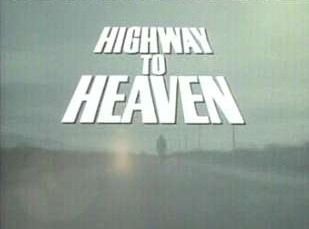
Welcome to Late Night Retro Television Reviews, a feature where we review some of our favorite and least favorite shows of the past! On Thursdays, I will be reviewing Highway to Heaven, which aired on NBC from 1984 to 1989. The entire show is currently streaming on Tubi and several other services!
This week, Jonathan and Mark get into the detective business.
Episode 5.9 “Choices”
(Dir by Michael Landon, originally aired on June 30th, 1989)
Working as private investigators, Mark and Jonathan are approached by a Vietnamese couple who are looking for the two sons that they gave up for adoption many years ago. They gave the boys up so that they could escape Vietnam and live in America, safe from communism. Now, the father (Dr. Haing S. Ngor) wants to bring his sons back to Singapore, despite the fact that both of them have been adopted by good people and the oldest has been accepted to a prestigious college.
This was an above average episode of Highway to Heaven. It was undoubtedly heavy-handed and there were more than a few minutes where the dialogue was a bit too spot-on for its own good. But ultimately, the episode was so earnest and heartfelt that the viewer couldn’t help but forgive the show’s flaws. This particular episode was very well-acted, especially by Dr. Haing S. Ngor. A Cambodian who lost most of his family after the Khmer Rogue came to power and attempted to return the country to “Year Zero” by killing off anyone who was considered to be too educated or cosmopolitan, Dr. Ngor survived by disguising the fact that he was an educated doctor. After the fall of the Khmer Rogue, Ngor made his way to Thailand and eventually to America. He won an Oscar for playing a character who suffered much as he suffered in The Killing Fields (a film about communist atrocities that has the gall to unironically include John Lennon’s Imagine on the soundtrack). In this episode, Ngor gives a strong performance as a stubborn man who struggles with the fact that his sons have grown up in his absence. Tragically, seven years after this episode aired, Dr. Ngor was murdered in his driveway. Though a group of gang members were arrested and convicted of his murder, it’s always been known that his murder was ordered by Pol Pot, the leader of the Khmer Rogue.
The final season of Highway to Heaven has been uneven but this was a good episode.
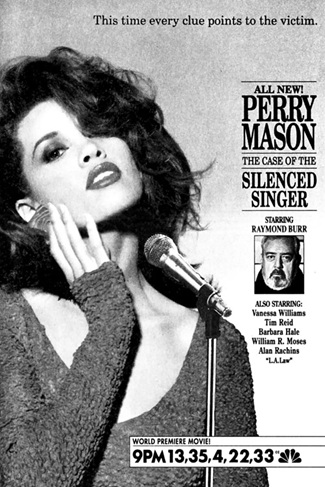
When singer Terri Knight (Vanessa Williams) is shot and murdered, her husband and manager, Jack (Tim Reid), is arrested. It’s a good thing that Jack’s professor in law school was Perry Mason (Raymond Burr)! Perry and Ken Malansky (William R. Moses) take the case and investigate to see who silenced the singer. (Does Perry know anyone who hasn’t been accused of murder? Someone even tried to fame Della!)
This Perry Mason movie was slightly different than those that came before it. It was full of flashbacks, showing how Terri became a star and went from being nice and innocent to being a diva. Every time that Perry or Ken would interrogate someone, it would lead to scene of Vanessa Williams wearing a wig and playing Terri at a different time in her life and career. There was also a lot singing and the movie actually seemed to be more focused on the music and showing Terri’s rise to fame than it did on solving the actual mystery. It was was if Perry Mason got dropped into the middle of a production of Dreamgirls. It didn’t really work for me because Terri wasn’t an interesting enough character to carry the flashbacks but it was still interesting to see a Perry Mason movie trying to do something different.
The most memorable thing about this movie was Angela Bassett, playing a fellow singer and a former friend of Terri’s. She even told off Perry Mason at one point! It was early in her career but it was easy to see that, from the start, Angela Bassett was obviously going to be a star.
Yesterday, after it was announced that actor John Heard had been found dead in a Palo Alto hotel room, I lost track of how many people declared that Cutter’s Way, a 1981 film in which Heard co-starred with Jeff Bridges, was one of their favorite movies of all time. (That includes quite a few people who write for this very site.) In fact, people were so enthusiastic about Cutter’s Way that I quickly decided that this was a film that I needed to watch for myself. So, last night, after watching All About Eve on TCM and My Science Project with the Late Night Movie Gang, I curled up on the couch and I watched Cutter’s Way.
Technically, Cutter’s Way is a murder mystery but it’s actually a lot more. In the grand noir tradition, the mystery is less important than the milieu in which it occurs. Cutter’s Way takes place in Santa Barbara, California, which the film presents as being a microcosm of America. It’s place where the rich are extremely rich and the poor are pushed to the side and expected not to complain. The Santa Barbara of Cutter’s Way is controlled by new money and haunted by old sins. It’s a world that is perfectly captured, by director Ivan Passer and cinematographer Jordan Cronenweth, in the film’s haunting opening scene:
John Heard plays Alex Cutter. Years ago, Cutter served in Vietnam and returned with one less eye, one less arm, and one less leg. An angry alcoholic, the type who always looks like he’s in desperate need of a shower and a shave, Cutter exists on the fringes of society. Like many alcoholics, Cutter is a master manipulator. When he has to, he can turn on the charm. When the police are called after a drunken Cutter purposefully destroys his neighbor’s car, we suddenly see a totally different Alex Cutter. He’s polite and apologetic, explaining that he was merely swerving to avoid something in the road and, by the way, he served his country in Vietnam. As soon as the police leave, the real Cutter comes out. He gets his bottle and starts to rant about how much the world owes him. Watching the film, you find yourself understanding why some people might want to push this one-legged, one-armed, one-eyed veteran down a flight of stairs, that’s how obnoxious Alex Cutter can be.
And yet, there are people who love Alex Cutter. There’s his long-suffering wife, Mo (Lisa Eichhorn). Mo lives in squalor with Cutter, taking care of him and putting up with his bitterness. There’s the local bar owner, who could probably put his kids through college on Cutter’s bar tab. (He even drives Cutter home in the morning, after everyone else has deserted him.) And finally, there’s Richard Bone (Jeff Bridges).
Bone is Cutter’s best friend. Whereas Cutter is perpetually pissed off, Bone is almost always laid back. Whereas Cutter feels that everything is his business, Bone prefers to remain detached from the world. Mention is made of Bone being a graduate of the Ivy League but he spends most of his time giving tennis lessons and sleeping with wealthy women. Bone takes care of Cutter, though their friendship is occasionally hard to figure out. Why does Bone stick with Cutter despite all of Cutter’s abuse? Perhaps Bone feels guilty because he avoided being drafted while Cutter lost half of his limbs in Vietnam. Or maybe it’s because Bone is in love with Mo.
One night, when Bone is leaving a hotel, he sees a man in an alley. The man appears to be hiding something in a dumpster. Later, when the body of a woman is found in that same dumpster, Bone realizes that he probably saw the murderer. Even more so, Bone thinks that the man resembled J.J. Cord (Stephen Elliott), one of the richest men in Santa Barbara.
Bone, however, isn’t sure that Cord’s the murderer. Even more so, even if Cord was the murderer, Bone prefers to not get involved. However, Cutter is sure that Cord’s the killer. To Cutter, it makes perfect sense. If men like Cord were willing to send boys to Vietnam and then refuse to take care of them when they returned both physically and mentally maimed by the experience, then why wouldn’t they also think that they could get away with murdering some hitchhiker?
Soon, Cutter has met the dead girl’s sister, Valerie (Ann Dusenberry). Cutter says that his plan is to blackmail Cord. He badgers the reluctant Bone into working with him. It quickly becomes obvious, however, that Cutter is after more than money. He is obsessed with proving that this rich and powerful man is a murderer. And he’s not going to let anyone stand in his way. Not even a stuffed animal:
As I said, Cutter’s Way is about much more than just a murder. It’s a film about class differences, with even the otherwise slick Bone discovering how difficult it is to infiltrate Cord’s wealthy world. It’s a film about disillusionment, cynicism, and the fleeting promise of happiness. As angry as Cutter is, he still ultimately possesses the idealism that both Bone and Mo have lost. He still believes in right and wrong. While that angry idealism may make Cutter a pain in the ass, it’s also his redeeming feature. As the youngest of them, Valerie is still an optimist but she is also the least prepared to deal with the sordid reality of the world around her. Bone and Mo, meanwhile, both appear to have surrendered their belief that the world can be and should be a better place. Ultimately, Cutter’s Way is a film that forces you to consider what you would do if you were in the same situation. Cutter’s Way is not a great title, largely because it makes the film sound like a CW western, but it’s an appropriate one. The entire film is about Cutter’s way of viewing the world and whether or not Bone will follow Cutter or if he’ll continue to refuse to get involved.
(The novel that the film’s based on was called Cutter and Bone. According to Wikipedia, the title was changed because audiences thought the movie was a comedy about surgeons.)
I have to agree with those who have called Cutter’s Way a great film. Not only is it gorgeous to look at but it’s one of the best acted films that I’ve ever seen, from the stars all the way down to the most minor of roles. John Heard dominates the film, giving a performance of almost demonic energy but he’s perfectly matched by Jeff Bridges. Bridges, back in his incredibly handsome younger days, gives a subtle and powerful performance as a man struggling with his conscience. In the role of J.J. Cord, Stephen Elliott doesn’t get much screen time but he makes the most of it. When he first see him, he’s riding a white horse and rather haughtily looking down on the world around him. When he last see him, he delivers a line of such incredible arrogance that it literally left me stunned. Though, when compared to Bridges and Heard, their roles are underwritten, both Lisa Eichhorn and Ann Dusenberry more than hold their own, providing able and poignant support.
Cutter’s Way is a great film and one that everyone should watch if they haven’t.
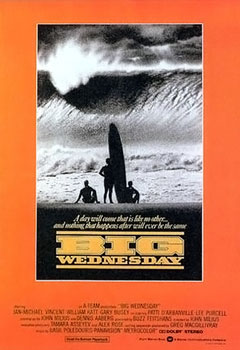
If there is a male bonding hall of fame, Big Wednesday has to be front and center.
This episodic movie follows three legendary surfers over twelve years of change and turmoil. Jack Barlowe (William Katt) is the straight arrow who keeps the peace. Leroy “The Masochist” Smith (Gary Busey) is the wild man. Matt Johnson (Jan-Michael Vincent) is the best surfer of them all but he resents both his fame and the expectation that he should be some sort of role model for the younger kids on the beach. From 1962 until 1974, the three of them learn about love and responsibility while dealing with cultural turmoil (including, of course, the Vietnam War) and waiting for that one legendary wave.
After writing the screenplays for Dirty Harry and Apocalypse Now and directing The Wind and The Lion and Dillinger, John Milius finally got to make his dream project. Big Wednesday was based on Milius’s own youth as a California surfer and he has said that all three of the main characters were based on different aspects of his own personality. Expectations for Big Wednesday were so high that Milius’s friends, George Lucas and Steven Spielberg, exchanged percentages points for Star Wars and Close Encounters of The Third Kind for a point of Big Wednesday. The deal turned out to be worth millions to Milius but nothing to Lucas and Spielberg because Big Wednesday was a notorious box office flop. Warner Bros. sold the film as a raunchy comedy, leaving audiences surprised to discover that Big Wednesday was actually, in Milius’s words, a “coming-of-age story with Arthurian overtones.”
I can understand why Big Wednesday may not be for everyone but it is one of my favorite movies. It is one of the ultimate guy films. Some of the dialogue and the narration may be overwrought but so are most guys, especially when they’re the same age as the surfers in Big Wednesday. We all like to imagine that we are heroes in some sort of epic adventure. The surfing footage is amazing but it is not necessary to be a surfer to relate to the film’s coming-of-age story or its celebration of the enduring bonds of friendship. Katt, Vincent, and Busey all give great performances. Considering their later careers, it is good that Big Wednesday is around to remind us of what Gary Busey and Jan-Michael Vincent were capable of at their best, before their promising careers were derailed by drugs and mental illness. Be sure to also keep an eye out for infamous 70s character actor Joe Spinell as an army psychiatrist, a pre-Nightmare on Elm Street Robert Englund, playing a fellow surfer and providing the film’s narration, and Barbara Hale, playing the patient mother of her real-life son, William Katt.
One final note: At a time when the shameful stereotype of the psycho Vietnam vet was becoming popular and unfairly tarnishing the reputation of real-life vets, Big Wednesday was unique for featuring a character who not only joins the Army but who appears to return as a better person as a result.
As a general rule, I don’t watch the news. However, a few nights ago, I made an exception and I watched CNN. The reason was because it was snowing in New York City and apparently, CNN anchorman Don Lemon was broadcasting from something called the Blizzardmobile. I just had to see that!
Well, the Blizzardmobile turned out to be huge letdown. I was hoping for something like the Snowpiercer train but instead, it just turned out to be a SUV with a camera crew and a pompous anchorman who hilariously kept insisting that he was knee-deep in a blizzard when even a Texas girl like me could tell that the Blizzardmobile was only encountering a few snow flurries.
So, I flipped around to see if any of the other news stations had anyone in a blizzardmobile. What I discovered was that only CNN had a blizzardmobile but one thing that every news station did have was a panel of experts. An anchorperson would say something like, “What does the future look like?” and the panel of experts would tell us what the future looked like to them. What I found interesting was that I had no idea who these experts were but yet I was supposed to just believe that their opinions were worth considering.
I mean, for all I knew, those experts could have just been people who were spotted wandering around New York at night. But, because they were introduced as experts and looked directly at the camera whenever they spoke, they were suddenly authoritative voices.
Oddly enough, the very next night, I watched a movie from 1979 that dealt with the exact same issue.
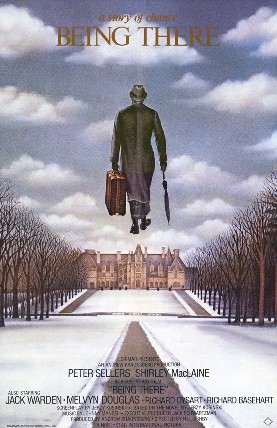
Being There tells the story of Chance (Peter Sellers), a dignified, middle-aged man who lives in Washington, D.C. and works as a gardener for a wealthy older man. Chance cannot read. Chance cannot write. Chance goes through life with a blank smile on his face. Chance has never experienced the outside world. Instead, he spends all of his time working in the old man’s garden and obsessively watching TV. When the old man dies, Chance finds himself exiled from the house. Wandering around Washington D.C., Chance asks a random woman to make him dinner. He politely speaks with a drug dealer who pulls a knife on him. Finally, he finds himself entranced by a window display of televisions. Backing away from the window, Chance stumbles into the street and is struck by a car.
Though he’s not seriously injured, the owner of the car, Eve Rand (Shirley MacClaine), insists that Chance come back to her mansion with him so that he can be checked out by her private physician (Richard Dysart). As they drive back to the house, Eve asks Chance for his name.
“Chance the Gardner,” Chance replies.
“Chauncey Gardiner?” Eve asks.
Chance blankly nods.
Back the house, Chance meets Eve’s husband, Ben (Melvyn Douglas). Ben is a wealthy industrialist who is dying of leukemia. Ben takes an immediate liking to Chance. Because Chance is wearing the old man’s suits, everyone assumes that Chance is a wealthy businessman. When Chance says that he had to leave his home, they assume that his business must have failed due to government regulation. When Chance talks about his garden, everyone assumes that he’s speaking in metaphors.
Soon, Ben is introducing Chance to his friend, Bobby (Jack Warden). Bobby happens to be the President and when he quotes Chance in a speech, Chance the Gardner is suddenly the most famous man in the country. When he appears on a TV talk show, the audience mistakes his emotionless comments for dry wit. When he talks about how the garden reacts to different seasons, they assume that he’s an economic genius. By the end of the film, Bobby has become so threatened by Chance’s popularity that he’s been rendered impotent while wealthy, rich men plot to make Chance the next President of the United States.
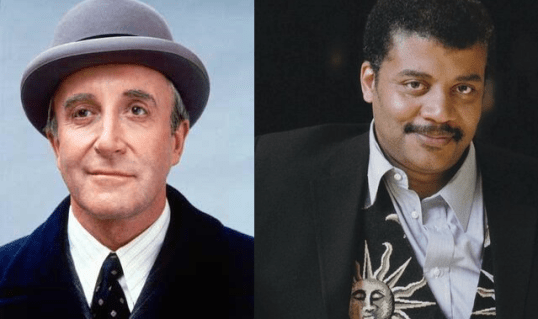
In many ways, Chauncey Gardiner was the Neil deGrasse Tyson of his era.
Being There is a one joke film and the idea of someone having no emotional skills beyond what he’s seen on television was probably a lot more mind-blowing back in 1979 than it is in 2015. But I still enjoyed the film. Peter Sellers gave a great performance as Chance, never sentimentalizing the character. As well, the film’s point is still relevant. If Being There were made today, Chance would be the subject of clickbait articles and Facebook memes. (Chauncey Gardiner listed his ten top movies and number 8 will surprise you! Or maybe This boy asked Chauncey Gardiner about his garden and his response was perfect.)
At its best, Being There is a film that will encourage you to question every expert you may see. Especially if he’s just stepped out of a blizzardmobile…

 If there is a male bonding hall of fame,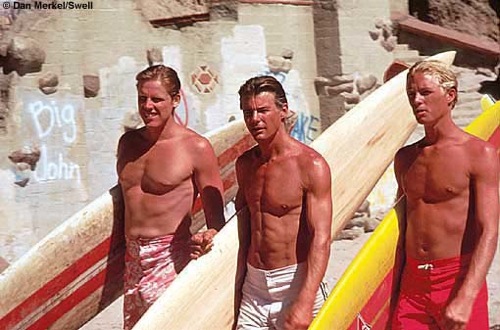
 Through the Shattered Lens