Retro Television Review: Miami Vice 5.17 “Freefall”


Welcome to Retro Television Reviews, a feature where we review some of our favorite and least favorite shows of the past!  On Mondays, I will be reviewing Miami Vice, which ran on NBC from 1984 to 1989.  The entire show can be purchased on Prime!

This week, Crockett and Tubbs are burned out.

Episode 17 “Freefall”

(Dir by Russ Mayberry, originally aired on May 12th, 1989)

As this episode begins, we find Crockett and Tubbs at their most cynical.  After five years as partners, they’ve seen a lot of bad guys go down.  They’ve seen a lot of innocent people die.  Larry Zito was killed by drug dealers.  Switek has developed a gambling addiction.  Gina has shot numerous men in cold blood.  Trudy was kidnapped by aliens.  Castillo has never once smiled.  None of it seems to make any difference.

When the government approaches them and orders Crockett and Tubbs to go into a war-torn island country and smuggle out dictator General Manuel Borbon (Ian McShane), Crockett is not happy about the assignment.  Tubbs, however, believes that the government is telling the truth about Borbon having information that could take down the world’s biggest drug cartel.  The government, for their part, think that Crockett and Tubbs have the undercover experience to pull off the operation.  Has the government not noticed that Crockett and Tubbs have had their covers blown in nearly every episode?

Of course, it turns out that the government is lying.  They just wanted Borbon out of the country so he wouldn’t reveal what he knows about American intelligence’s activities in Central America.  Crockett and Tubbs manage to get Borbon to Miami but they then find themselves under constant attack from the drug gangs that want Borbon dead.  Borbon proves to be untrustworthy.  Because of his gambling addiction, Castillo suspects that Switek may have sold out his partners.  Switek responds by tracking down three hitmen and gunning them down.  Did Switek sell out Crockett and Tubbs?  The answer isn’t clear but it does seem like his time as a detective is coming to an end.

Finally, Tubbs and Crocket do what they have to do.  They go on a “suicide” mission that involves them firing their weapons at Borbon’s sea plane until it explodes.  Borbon is killed and so are several of his American associates.  When the CIA man in charge of the operation threatens to have their badges, Crockett and Tubbs toss their badges on the ground.  Castillo offers to back them up if they chose to stay on the force.  Tubbs says thanks but no thanks.  Tubbs is going back to New York.  Crockett is heading further south, presumably to live in the Florida everglades.

And so, Miami Vice ends.

Except it doesn’t!  There were four so-called “lost episodes” that aired in syndication.  We’ll take a look at them over the next four weeks.

As for Freefall, it’s not a terrible conclusion to the story of Crockett and Tubbs.  It stays true to the cynicism that ran though the entire series.  Crockett and Tubbs finally admit that the War on Drugs is a sham and they quit.  It’s a shame that Gina and Trudy didn’t get to do much in the finale.  I wasn’t happy with the idea of Switek being a traitor but it actually did work for his character.  Switek had been spiraling ever since Zito was killed.  This episode has a lot of surprisingly violent action, the show’s trademark political subtext, and Johnson and Thomas bringing their characters to life one last time.

Apparently, this episode was originally envisioned as ending with both Crockett and Tubbs dying.  That actually would have been a totally appropriate ending as both characters have often seemed as if they had a death wish.  However, the network turned down that idea because they were hoping to do a spin-off series.  Crockett and Tubbs were spared by the higher-ups.  The series ends — or it would end if not for the four extra episodes — with Crockett and Tubbs speeding through the streets of Miami and it’s had not to feel that’s the way it should be.

THE BLOOD OF HEROES (1989) – Rutger Hauer and Joan Chen play in the Jugger Super Bowl! 


As an obsessed Rutger Hauer fan of the early 90’s, I was working my way through the man’s back catalogue of films when I came across THE BLOOD OF HEROES (1989) on the shelves at my local video store. With its post-apocalyptic setting and its strange sport of jugger, I’ll admit that it was not the kind of film that I’m most drawn to. I generally preferred watching Hauer taking down the bad guys in movies like WANTED DEAD OR ALIVE (1986) and BLIND FURY (1989), which was released the very same year. However, it was a relatively recent Hauer film, so I rented it, cautiously optimistic that it would be entertaining. At the time, it was not my favorite Hauer film, but I remember an 18-year-old version of myself thinking it was okay. I’ve watched it a couple of times over the last 30 years, and even own the DVD, but it’s not one that I pull off the shelf very often. I decided it was time for a fresh viewing. 

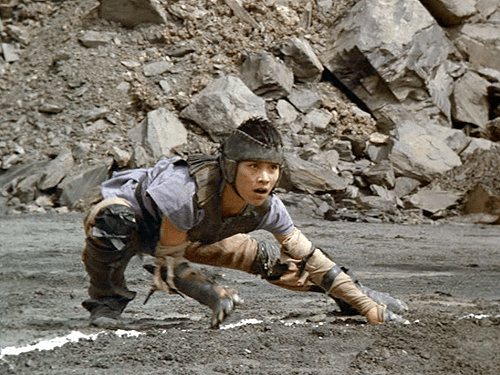
In the bleak, desolate, futuristic world of THE BLOOD OF HEROES, Rutger Hauer plays Sallow, the leader of a team of juggers. They go from town to town challenging the local team in a sport where you win by placing a dog skull securely on a stake. It’s an extremely violent game consisting of two teams with five players. Four players basically beat the crap out of the opposition with clubs and chains, in hopes that they can provide protection to their one player, the “quick,” who can get the skull on the stake. We meet Sallow’s team who consists of Dog Boy (Justin Monjo), Mbulu (Delroy Lindo), Big Cimber (Anna Katarina), and Young Gar (Vincent D’Onofrio) as they enter a town ready for a match. They win, but Dog Boy, their quick, has his leg broken in the process. Luckily for them, the opponent’s quick Kidda (Joan Chen), who was at least partially responsible for Dog Boy’s gruesome injury, is available to head towards the next town with the ragtag crew! She turns out to be a hell of a player, who’s willing to do whatever it takes to win, including biting an ear off when it’s required. This is what I call dedication. During the course of the story, we find out that Sallow used to be a professional jugger who played in “The League” in the underground cities where the rich, aristocratic people live and treat their champion juggers “almost” like one of them. He got banished when he engaged in a forbidden relationship with one of the overlord’s daughters. With his team of juggers, especially the super talented Kidda and Gar, Sallow leads them to the big city where they will challenge the professionals. For Sallow, it’s a shot at redemption. For the others, it’s a chance to be noticed by the League, which will lead to a much more luxurious life, when they’re not bashing their opponents brains in of course. I may have exaggerated a bit in my headline when I referred to this challenge as the “Jugger Super Bowl,” but it’s still kind of a big deal! 

After rewatching THE BLOOD OF HEROES again, while it’s still not my favorite kind of film, I can confidently say that I enjoyed it very much this time around. Most of that joy stems from watching Rutger Hauer in his prime. He’s such a charismatic actor and that even comes across in such a grim setting. I also like his character type, that of the disgraced former hero searching for redemption against a system that had previously discarded him. There’s usually much satisfaction to be had with this type of character, and this movie delivers on that premise. Joan Chen is very good as the new addition to the team who dreams of escaping her town and becoming a jugger star! She and Hauer really carry the film. The rest of the cast also added to my enjoyment of the movie. For me, It’s a lot of fun watching actors like Vincent D’Onofrio and Delroy Lindo in relatively early roles in their long and distinguished careers. I really enjoyed seeing Australian actors Hugh Keays-Byrne and Max Fairchild, both veterans of the MAD MAX series, appear near the end of the film when they make it to the city. Max Fairchild is especially impressive as one of the League juggers and former friend to Hauer. I wanted to give one more shout out, and this one goes out to actor Gandhi MacIntyre, who plays the team manager and doctor in the film. He has a very likable presence and made me smile on multiple occasions. The movie’s pretty serious and dark, and Gandhi’s sense of humor is a welcome presence. 

THE BLOOD OF HEROES is written and directed by David Webb Peoples. To date, it’s the only feature length film that Peoples has directed. In my opinion, he does a fine job. He certainly creates an interesting world, with huge contrasts between the barren, rocky outside landscapes and the overcrowded, underground cities. This is not a world I want to live in, but Peoples brought his vision to the screen, albeit within clear budget limitations. Considering it’s from the same guy who wrote BLADE RUNNER (1982) and UNFORGIVEN (1992), the story is pretty simple. And this is fine by me. The story of redemption for some, and of the dream of newfound glory for others, is a story that all of us can relate to at some point in our lives. At this point in my own life, I can relate to both! The movie features some ugly and violent images, but I found myself emotionally pulling for the ragtag group of underdogs in the big game at the end. It’s also pretty cool that Peoples made up his own game when writing the screenplay, albeit a game I would never want to play. The game Jugger, a less violent version of the game introduced in the film, is currently played all over the world. 

One final thing I wanted to point out about THE BLOOD OF HEROES is the fact that an author named Danny Stewart has written a book called “Saluting the Blood of Heroes – Behind the Apocalyptic Film.” I just learned of this book while researching the film today for this review. It was published in July of 2024. I just love a world where a person is able to get a book published about the making of an obscure, low budget film from the late 80’s. I won’t be surprised if this ends up in my Amazon cart really soon. 

I’ve included the trailer for THE BLOOD OF HEROES (AKA – THE SALUTE OF THE JUGGER) below:

The Death of the Incredible Hulk (1990, directed by Bill Bixby)


David Banner (Bill Bixby), still hoping to find a cure for the condition that causes him to turn into the Hulk (Lou Ferrigno) whenever he gets injured or stressed out, heads up to Portland.  Pretending to be a simple-minded janitor named David Bellamy, Banner gets a job working in the lab of Dr. Ronald Pratt (Philip Sterling).  Banner hopes that Dr. Pratt’s research holds the secret that can release him from being the Hulk.  When Dr. Pratt learns Banner’s secret, he and his wife (Barbara Tarbock) work with Banner to try to cure him and to understand the Hulk.

David Banner is not the only person who has infiltrated the lab.  KGB agent Jasmin (Elizabeth Gracen) has also been sent to the lab with orders to steal Pratt’s research.  Jasmin hates working for the KGB but she’s been told that her sister will be killed unless she complete one final mission.  When Jasmin meets and falls in love with David, she starts to reconsider her loyalties.  When the KGB finally makes their movies, Jasmin is going to have to decide who to help and the Hulk is going to have to come through and save the day one final time.

David Banner’s saga finally comes to a close in The Death of the Incredible Hulk, the third and last of the Incredible Hulk television movies.  It’s also the best of the three, though that might not by saying much when you consider the quality of the first two.  While the other two movies both served as backdoor pilots for other heroes and the Hulk was barely even present in the 2nd movie, The Death of the Incredible Hulk keeps the focus squarely on David Banner and the Hulk.  (Though Jasmin does seem like she could be a version of the Black Widow, I think the similarities between the two characters are a coincidence.  Beautiful and conflicted KGB agents were a popular trope in the 80s and early 90s.)  Both Bixby and Ferrigno get to show off what they can do in their signature roles.  Bixby is especially good at capturing Banner’s tortured and lonely existence and his performance helps to make The Death of the Incredible Hulk something more than just another cheap sci-fi TV movie.

Though the film stays true to its title and ends with a mortally wounded Banner saying that he’s finally free, it was not intended to be the final Hulk film.  There were plans to bring David Banner back to life and presumably, the Hulk would have come back with him.  Unfortunately, Bill Bixby himself died in 1993, before shooting could begin on The Return of the Incredible Hulk.