Icarus File #25: 1941 (dir by Steven Spielberg)


In the year 1979, a young Steven Spielberg attempted to conquer comedy in the same way that he previously conquered horror with Jaws and science fiction with Close Encounters of The Third Kind.  Working from a script written by Robert Zemeckis and Bob Gale, Spielberg made a film about the days immediately following Japan’s attack on Pearl Harbor.  The name of the film was 1941 and it remains Steven Spielberg’s only attempt to direct a full-out comedy.  There’s a reason for that.

The film follows a large group of characters over the course of one day and night in 1941.  It’s been six days since Pearl Harbor was attacked and the streets of Los Angeles are full of young men who are preparing to ship out and older man who are paranoid about when the next attack is going to come.  However, Major General Joseph Stilwell (Robert Stack) just wants to see Dumbo at the local theater.  Meanwhile, his womanizing aide (Tim Matheson, giving the same performance here that he did in National Lampoon’s Animal House) just wants to get Stillwell’s aviation-lusting secretary (Nancy Allen) into an airplane.

Elsewhere, Ward Douglas (Ned Beatty) is happy to allow Sgt. Tree (Dan Aykroyd) and his men (including John Candy) to set up on an anti-aircraft gun in his front yard.  Ward’s daughter, Betty (Dianne Kay), is only concerned about entering a dance contest with her friend, Maxine (Wendie Jo Sperber).  Cpl. Sitarski (Treat Williams) and dishwasher Wally Stephens (Bobby D iCicco) both hope to be Betty’s partner and their rivalry leads to a massive (and seemingly never-ending) brawl.

While Ward deals with the gun in his front yard, another concerned citizen — Claude Crumm (Murray Hamilton) — keeps watch from atop of Ferris wheel, along with amateur ventriloquist Herbie Kazlminsky (Eddie Deezen).

But that’s not all!  Susan Backilinie recreates her role from a previous Spielberg film, skinny dipping while the Jaws theme plays in the background and running straight into a submarine that is commanded by Commander Akiro Mitamura (Toshiro Mifune, trying to maintain his dignity).  Mifune decides to attack Hollywood but no one on the submarine is sure where that is.  Christopher Lee appears as an arrogant German who is along for the ride.  Slim Pickens shows up as a lumberjack who is temporarily captured by the Japanese.  John Belushi plays Wild Bill Kelso, who flies his airplane through Los Angeles.  Warren Oates yells and laughs.  Dick Miller, Elijah Cook Jr. and Lionel Stander show up in small roles.

“Since when is Steven funny?”  According to Peter Biskind’s Easy Riders, Raging Bulls, this was the reaction that most of Spielberg’s friends had when he announced that his next film would be a screwball comedy set during World War II.  Watching the film, one gets their point.  The majority of the film’s humor comes from people looking at the camera and screaming.  There’s a lot physical comedy, which would undoubtedly work in small amounts but which grows rather tiring when it’s dragged out to the extent that Spielberg’s drags it out.  (A brawl at a USO show seems like it should be funny but Spielberg allows it to go on for too long and the careful choreography takes away any element of spontaneity.)  The film attempts to duplicate the style of Animal House (and it’s probably not a coincidence that Matheson, Belushi, and director John Landis all have roles in the film) but Spielberg often seems as if he’s trying too hard.  There’s nothing subversive about the humor.  It’s more antic than funny.

A huge problem is that there really isn’t much of a story here.  Spielberg, who is normally one of Hollywood’s best storytellers, attempts to do a loose, Altman-style ensemble film and the result is that none of the characters feel alive and there’s never any sense of narrative momentum.  There are a few performers who manage to make an impression amongst all the explosions and the yelling.  John Belushi has the advantage of not having to share the majority of his scenes with anyone else.  Warren Oates’s manic energy is more than welcome.  Wendie Jo Sperber deserved more screentime.  Murray Hamilton and Eddie Deezen frequently made me laugh.  There’s a wonderful moment where Robert Stack’s intense general cries while watching Dumbo.  But, for the most part, the film never comes together.

That said, 1941 is definitely a Steven Spielberg film.  It received three Academy Award nominations, for Cinematography, Sound, and Visual Effects.  (All three of those categories, not surprisingly, are more associated with spectacle than with comedy.)  The film looks great!  Spielberg’s attention to detail is there in the production design and the costumes.  Watching 1941, you can see Spielberg’s talent while also seeing why he never directed another comedy.

Previous Icarus Files:

  1. Cloud Atlas
  2. Maximum Overdrive
  3. Glass
  4. Captive State
  5. Mother!
  6. The Man Who Killed Don Quixote
  7. Last Days
  8. Plan 9 From Outer Space
  9. The Last Movie
  10. 88
  11. The Bonfire of the Vanities
  12. Birdemic
  13. Birdemic 2: The Resurrection 
  14. Last Exit To Brooklyn
  15. Glen or Glenda
  16. The Assassination of Trotsky
  17. Che!
  18. Brewster McCloud
  19. American Traitor: The Trial of Axis Sally
  20. Tough Guys Don’t Dance
  21. Reach Me
  22. Revolution
  23. The Last Tycoon

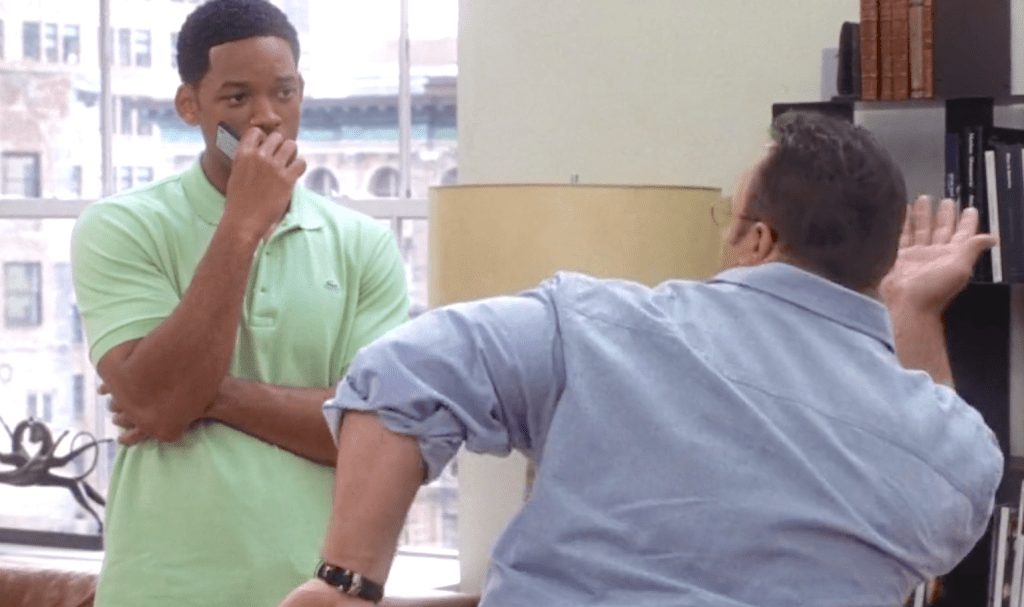
Brad reviews HITCH (2005), starring Will Smith and Kevin James!


I guess you can call this the holiday season of love for me, as I turn my attention today toward the 2005 romantic comedy HITCH. Will Smith stars as Alex “Hitch” Hitchens, a somewhat legendary and highly discreet consultant based in New York City. His specialty… helping less than perfect, even slightly awkward, men win the hearts of beautiful women. His methods are very effective, but he only works with men who are genuinely in love and not just chasing a one-night stand. His latest lovelorn client, the sweet and clumsy tax accountant Albert Brennaman (Kevin James), is smitten with a famous heiress named Allegra Cole (Amber Valletta), a client of the tax firm he works for. As Hitch works his magic for Albert, he also meets the cynical, but extremely beautiful tabloid journalist Sara Melas (Eva Mendes). Hitch finds himself falling for Sara at the same time that she’s on the trail of an urban myth of a “Date Doctor,” mistakenly believing that he is exploiting the emotions of women in the city for his own personal gain. When Sara and Amber discover who Hitch really is, will the guys’ true love win the day, or will the ladies believe it was all just a sleazy, manipulative setup?

HITCH is one of my favorite romantic comedies, and I watch it every year, usually multiple times. I’m a romantic at heart, and I really enjoy a film that plays with the idea of characters who truly care about, and respect, each other. This dynamic plays out through several different relationships. My favorite is the genuine friendship that develops between Hitch and Albert Brennamen. Hitch recognizes the sincere feelings that Albert has for Allegra, and he then goes all in to help him win her heart. While Will Smith is effortlessly charming and in peak movie star form, unsurprisingly, the character I identify the most with is Kevin James as Albert. His character is so sweet and earnest in his pursuit of Allegra that you just can’t help but pull for him. Balance that part of his character with James’ excellent physical comedy, whether it be his natural clumsiness or his unfounded confidence in his dance moves, and James gives the performance that takes this movie over the top for me. When teaching Albert the dance moves that he should stick with when he’s out on a date with Allegra, Hitch utters the line, “Don’t you bite your lip. Stop it!” It was that moment when I realized that, like Albert, I never dance without biting my own lip!

While the fraternal love between Hitch and Albert is my favorite relationship in the film, I also like the romantic relationship that develops between Hitch and Sara. I appreciate the way both characters step out of their comfort zones and risk their own hearts for each other. This is not easy for either of them, as Hitch’s charm and confidence actually masks deep insecurities based on his past relationships. Sara, on the other hand, has allowed herself to become very cynical towards all men, building walls so tall that no man can climb them. The fact that they truly open themselves up to each other, even if there are some serious complications along the way, gave me a strong rooting interest in their happiness.

The last performance I wanted to highlight in HITCH is that of Jeffrey Donovan, who plays sleazy narcissist Vance Munson. Munson tries to hire Hitch to help him get a vulnerable woman into bed, and in a moment of pure audience satisfaction, he pays the price for his disrespect. About the time I watched HITCH, Donovan was starring in a T.V. series that I really enjoyed called BURN NOTICE. I’m a big fan of Donovan, and he’s perfect here as a man you love to hate. In a movie full of likable characters, Vance Munson was a needed counterpoint, and his A-hole character really stands out.

No movie is perfect, but if you’re in the mood for something that’s lighthearted, funny, and makes you want to fall in love, then HITCH is about as close as it gets.

Brad’s “Scene of the Day” – Chow Yun-Fat dances with Jodie Foster!


Chow Yun-Fat is one of the most charismatic men on earth. I’ve always enjoyed his performance in ANNA AND THE KING (1999) with Jodie Foster. He’s wonderful in this big budget American film, and he doesn’t even have to fire two guns! I know several women here in Arkansas who don’t know the first thing about Hong Kong movies, but they still love Chow based on this one film. On a side note, ANNA AND THE KING made over $113 Million at the worldwide box office, which means quite a few people in this world appreciate a more romantic Chow.

Enjoy this scene where the King of Siam surprises Foster’s English schoolteacher, and breaks all kinds of cultural norms, when he asks her to dance. It’s quite a charmer.

Love On The Lens: The Amy Fisher Story (dir by Andy Tennant)


Poor Mary Jo Buttafuoco!

As seen in the 1993 made-for-tv movie, The Amy Fisher Story, Mary Jo (Laurie Paton) was just a normal Long Island housewife.  She was married to an auto mechanic named Joey (Anthony John Denison).  She had a family and a nice house and a seemingly perfect life.  But, one day, a teenage girl named Amy Fisher (played by a young Drew Barrymoe) showed up at her front door and claimed that her younger sister was having an affair with Joey.  When Mary Jo accused Amy of lying and then said she was going to call her husband, Amy pulled a gun and shot Mary Jo in the head.  That Mary Jo survived, albeit with partial facial paralysis, was a miracle.

The Amy Fisher Story was the third of the movies to be based on the true story of Amy Fisher and her affair with Joey Buttafuoco.  If Casualties of Love portrayed Amy as being an obsessed stalker who targeted a saintly man and if Amy Fisher: My Story portrayed Amy as a vulnerable teen who was groomed by a sleazy older man, The Amy Fisher Story suggests that perhaps the truth was somewhere in between.  As played by Drew Barrymore, Amy Fisher is immature, unstable, and self-destructive even before she meets Joey Buttafuoco.  As played by Anthony John Denison, Joey is a cocky and arrogant womanizer who grooms a teenage girl and leads her to believe that the only thing keeping them from being truly together is the fact that he has a wife.  (If Casualties portrayed Joey as being a dumb, salt-of-the-Earth type of guy and Amy Fisher: My Story portrayed him as being coldly manipulative and cruel, The Amy Fisher Story portrays him as being a self-centered idiot who did whatever he felt like doing without thinking about any possible consequences.)  Of all the performers who played Amy and Joey, Drew Barrymore and Anthony John Denison are the most convincing.  On the one hand, that lends a credibility to this film’s version of the events that led to the shooting of Mary Jo.  On the other hand, it also means that neither of the main characters is particularly likable.

The film instead tries to make a hero out of a reporter named Amy Pagnozzi (Harley Jane Kozak), who finds herself assigned to follow the Amy Fisher story when she would much rather be reporting on the upcoming presidential election.  Pagnozzi pops up throughout the story, commenting on the media feeding frenzy and generally acting annoyed by the whole thing.  The problem with this approach is that, for all of Pagnozzi’s condemnation of the country’s tabloid mentality, she’s still a part of the monster.  It’s hard to have sympathy for someone complaining about how a story is covered when they’re the one doing the covering.

Interestingly, for a film that condemns that way the story was covered, The Amy Fisher Story is probably the most tabloid-y of the three films.  Every sordid detail — from Amy and Joey’s motel meetings to Amy’s work as an escort to her subsequent dalliance with a gym owner — is provided in artfully filmed detail.  The result is a film that can feel a bit over-the-top but that’s exactly the right approach to take when it comes to a story like this.  When you’re making a movie about a suburban teenage escort who shoots her boyfriend’s wife, there’s really not much need or room for subtlety.  The Amy Fisher Story works because it fully embraces the melodrama and it features a performance from Drew Barrymore that remind us that, back before she became a permanently cheerful talk show host, Drew was a force of pure chaos.

When it comes to the story of the Fishers and the Buttafuocos, this is the film to see.