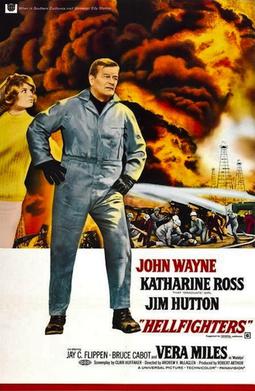
Hellfighters (1968, directed by Andrew McLaglen)


Chance Buckman (John Wayne) is the best there is when it comes to fighting oil fires.  Along with Greg Parker (Jim Hutton), Joe Horn (Bruce Cabot), and George Harris (Edward Faulkner), Chance travels the world and puts out fires that the regular authorities can’t handle.  Chance loves his job but he also loves his ex-wife, Madelyn (Vera Miles).  When Madelyn indicates that she wants to remarry Chance but only if he pursues a less dangerous line of work, Chance retires from firefighting and becomes an oil executive.  He leaves his firefighting company to his new son-in-law, Greg.  When Greg and Chance’s daughter (Katharine Ross) head down to Venezuela to battle a fire and find themselves not only having to deal with the flames but also with a band of revolutionaries, Chance is the only one who can help them.

When I was growing up, Hellfighters was one of those movies that seemed to turn up on the local stations a lot.  The commercials always emphasized the idea of John Wayne almost single-handedly fighting fires and made it seem as if the entire movie was just the Duke staring into the flames with that, “Don’t even try it, you SOB” look on his face.  As a result, the sight of John Wayne surrounded by a wall of fire is one of the defining images of my childhood, even though I didn’t actually watch all the way through until recently.  When I did watch it, I discovered that Hellfighters was actually a domestic drama, with an aging Wayne passing the torch to youngster Jim Hutton but then taking it back.

The fire scenes are the best part of Hellfighters and I wish there had been more of them.  The movie gets bogged down with all of Chance’s family dramas but it comes alive again as soon as John Wayne and his crew are in the middle of a raging inferno, putting their lives at risk to try to tame the fire.  Wayne was always at his best when he was playing strong, no-nonsense men who were the best at what they did.  Hellfighters is slow in spots but the fire scenes hold up well.  There’s no one I’d rather follow into an inferno than Chance Buckman.
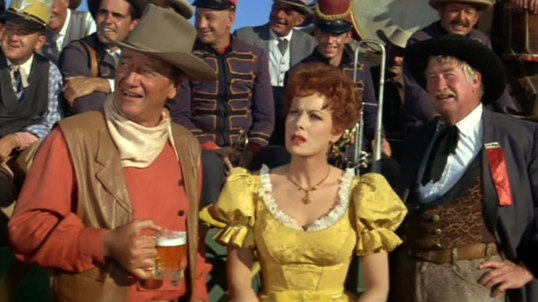
4 Shots From 4 Films: Special Andrew V. McLaglen Edition


4 Or More Shots From 4 Or More Films is just what it says it is, 4 shots from 4 of our favorite films. As opposed to the reviews and recaps that we usually post, 4 Shots From 4 Films lets the visuals do the talking!

Today, the Shattered Lens remembers director Andrew V. McLalgen, born 105 years ago on this day.  It’s time for….

4 Shots From 4 Andrew V. McLaglen Films

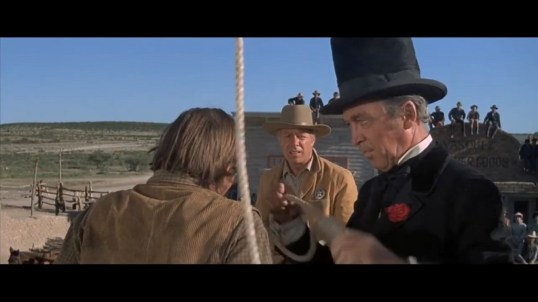
McLintock! (1963, dir by Andrew V. McLaglen, DP: William H. Clothier)

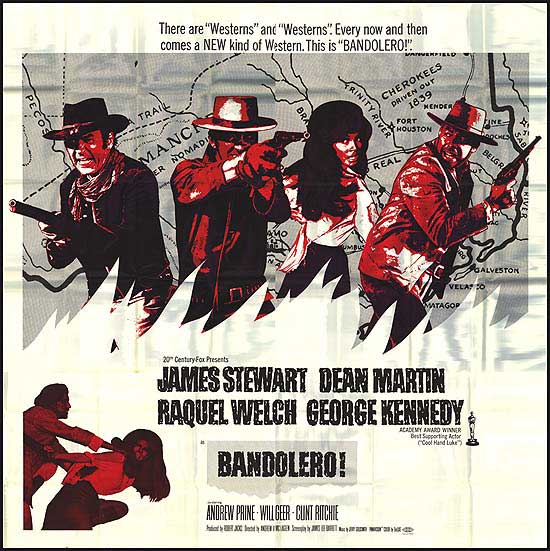
Bandolero! (1968, dir by Andrew V. McLaglen, DP: WIlliam H. Clothier)

Hellfighters (1968, dir by Andrew McLaglen, DP: William H. Clothier)

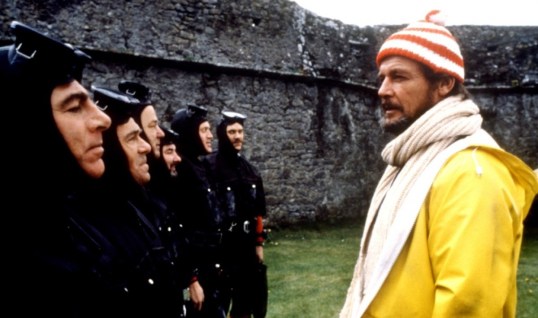
Ffolkes (1980, dir by Andrew V. McLaglen, DP: Tony Imi)

The TSL Grindhouse: Mitchell (dir by Andrew V. McLaglen)


I come here to defend Mitchell.

First released in 1975, Mitchell does not have a great reputation.  It’s often described as being one of the worst of the 70s cop films and Joe Don Baker’s performance in the lead role is often held up to ridicule.  A lot of that is due to the fact that Mitchell was featured on an episode of Mystery Science Theatre 3000.  Last year, for my birthday, my friend Pat McCurry actually hosted a showing of the MST 3K version of Mitchell.  I laughed all the way through it.  It was a funny show and most of the jokes uttered by Joel and the Bots landed.  That said, I wish they hadn’t been so hard on Joe Don Baker.  Baker was an outstanding character actor, one whose good ol’ boy persona sometimes kept people from realizing just how fiercely talented he actually was.

Here’s the thing with Mitchell.  Just because a film is snarkable, that doesn’t mean that it’s a bad film.  Just because there are moments in a film that inspire you to talk back to the screen, that doesn’t make it a bad film.  Some of the most enjoyable films that I’ve ever watched were enjoyable specifically because they were made to inspire the audience to talk back to the characters.  Whatever flaws you may want to find in Mitchell, it’s an entertaining film.  The plot may be impossible to follow but who cares?  When you’ve got Joe Don Baker, John Saxon, and Martin Balsam all in the same film, does the plot really matter?

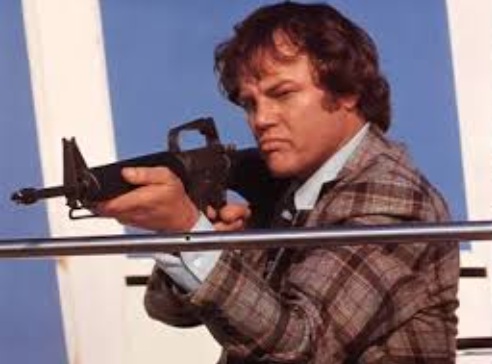
This is a film that you watch for the personalities involved.  Balsam plays a wannabe drug lord who always seems to be somewhat annoyed.  Someone once describes Bernie Sanders as always coming across as if he was about send his meal back to the kitchen because it was too cold and that’s a perfect description of Balsam’s performance in Mitchell.  John Saxon plays a sleazy rich guy who murders a burglar and then tries to cover up his crime.  Saxon is calm, cool, collected, and completely confident that his wealth will get him out of anything.  And then you’ve got Joe Don Baker as Mitchell, wearing an ugly plaid suit, drinking beer the way that I drink Diet Coke, and continually pretending to be dumber than he actually is.  There’s an interesting subtext to these three characters and how they interact.  Saxon and Balsam play criminals who are both rich and who both think they can get away with anything because they’ve got money.  Mitchell is a complete and total slob, a guy with a cheap apartment, a cheap suit, and absolutely no refinement at all.  Mitchell uses his good old boy persona to get the bad guys to continually underestimate him.  He ultimately turns out to be smarter and actually more ruthless than any of them.

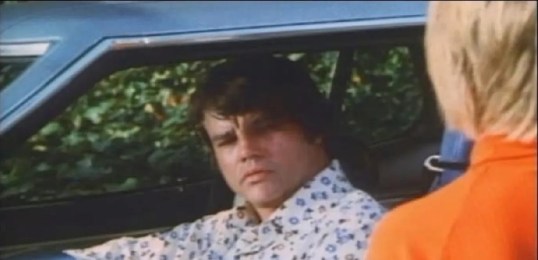
Joe Don Baker throws himself into the role of Mitchell and there’ actually a lot of intentional humor to be found in his performance.  Baker doesn’t play Mitchell as being a supercop.  Instead, he plays Mitchell as being a blue collar guy who gets absolutely no respect.  Even when he’s on a stakeout, a random kid starts arguing with him.  (Mitchell loses the argument.)  Mitchell’s a jerk who busts his hooker girlfriend (Linda Evans) for having weed on her but he’s also the only one who could stop Balsam from doing whatever it is that Balsam thinks he’s trying to do.  (Again, don’t spend too much time trying to understand the plot.)  Mitchell’s super power is that he’s a slob who doesn’t give up.  To paraphrase Road House‘s Dalton, he plays dumb until it’s time not to be dumb.

As I said, it’s an entertaining film.  Where else are you going to see a not particularly high-speed chase between two station wagons?  Where else are you going to see John Saxon in a dune buggy or Joe Don Baker in a helicopter or Martin Balsam as the captain of a yacht?  Where else are you going to see a film that features its hero saying, “Yep, that’s grass,” before arresting his lover?  Mitchell is fun and entertaining and I’ll always defend both the movie and its star.

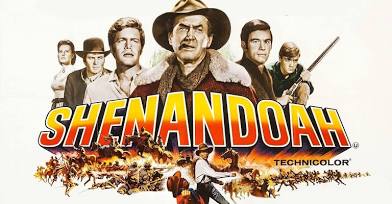
I review SHENANDOAH (1965), starring James Stewart! 


Jimmy Stewart plays Charlie Anderson, the patriarch of a large farming family in Virginia during the time of the Civil War. His family doesn’t own slaves, so he doesn’t figure it’s any of their business what all the fighting is about. He wants to keep working the land in hopes that the war will pass them by. Besides, he has six sons, a daughter, and a daughter in law that he wants to keep safe. He’s trying to keep the family together on his own as his beloved Martha had passed away sixteen years earlier giving birth to their youngest son, who we only know as Boy (Phillip Alford). Aside from the war that’s going on all around them, things seem pretty good for the Anderson’s. They all sit down for a big delicious meal every night. They attend Church every Sunday where they’re usually late and given the side-eye by Pastor Bjoerling (Denver Pyle). One of the sons, James Anderson (Patrick Wayne) and his wife Ann (Katharine Ross), have a precious newborn baby to take care of. The beautiful daughter Jennie (Rosemary Forsyth) is being courted by, and eventually marries, a lovestruck confederate officer named Sam (Doug McClure). Unfortunately the war won’t just go away, and when Boy is taken prisoner by Union soldiers, Charlie can’t stand idly by any longer. They head out to find him and bring him home. 

In the guise of an entertaining semi-western, SHENANDOAH does a great job of illustrating how futile and randomly tragic war can be. The movie starts out lighthearted and fun as the family goes about its normal life, with Jimmy Stewart’s Charlie Anderson giving his homespun advice and rolling his cigars. This is a self-sufficient family that loves, respects and enjoys each other even if they don’t agree on everything. But the war keeps inching its way into their lives. First in the form of small group of confederate soldiers who come by to get some water and try to convince the boys to join up. None of the boys will join up, but they do help bury the soldiers when they’re ambushed and killed just down the road. Next a group of men come to the ranch to try to confiscate their horses for the Union army. Of course, Charlie Anderson isn’t going to let that happen and this turns into the type of brawl that seems to come right out of John Wayne western comedy like MCLINTOCK. Everybody joins in with the participants punching and being punched repeatedly, while Boy keeps getting knocked into the horse trough. This shouldn’t be a surprise because Director Andrew V. McLaglen directed MCLINTOCK and many other John Wayne films. Finally, Boy is taken prisoner because he is wearing a confederate cap that he found floating down the steam while he was out fishing one day. Once Charlie and most of his family head out to search for Boy, the movie begins a turn into tragedy. I won’t give the specifics away, but some members of the family will die, and not a single one of their deaths will be based on the actual fighting of a war. Rather, their deaths will be based on the chaos and depravity that surrounds the war. It’s tough to see, especially when they were all so happy just a little bit earlier. For me, the movie’s changes in tone make the tragedy more powerful and really drive home its message about the futility of war. But the Anderson family, like the United States of America after the Civil War, is made up of tough, resilient folks, and the movie ends on a hopeful note that definitely brought some extra moisture to my eyes. 

Jimmy Stewart commands the screen in SHENANDOAH. You simply can’t take your eyes off of him, and his performance alone would make the movie worth watching. But with its powerful message, excellent cast, and solid direction, the movie is much more than just Stewart’s strong performance. I highly recommend it. 

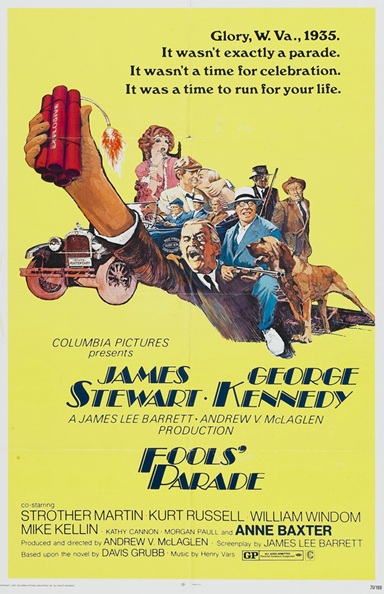
Film Review: Fools’ Parade (dir by Andrew V. McLaglen)


1971’s Fools’ Parade opens in 1935.

Three men are released from the West Virginia state penitentiary and given a train ticket out of town by the prison captain, Council (George Kennedy).  The men are a bank robber named Lee Cottrill (Strother Martin), a young man named Johnny Jesus (a young Kurt Russell), and a courtly older man named Mattie Appleyard (James Stewart).  Despite his polite tone of voice and his folksy manner, Appleyard is actually the most notorious of the three men being released.  Convicted of murdering two men, Appleyard has spent the past 40 years in prison.  Both Appleyard and Cottrill are looking to go straight.  Every day of his sentence, Appleyard worked and earned money.  Along with a glass eye, Appleyard leaves prison with a check for $25,000 dollars.  Appleyard plans to cash the money at the bank and then open a store with Cottrill.

Unfortunately, Appleyard has been released at the height of the Great Depression.  The streets are full men desperately looking for work.  People will do anything to feed their families or to make a little extra money.  Salesman Roy K. Sizemore (William Window) transports guns and dynamite.  Willis Hubbard (Robert Donner) works as a conductor on the train.  Aging prostitute Cleo (Ann Baxter) offers to sell the virginity of her adopted daughter, Chanty (Katherine Cannon).  Junior Killfong (Morgan Paull) sings on the radio and occasionally takes on deadlier work with his friend, Steve Mystic (Mike Kellin).  As for Captain Council, he’s decided that he’s going to make his money by ambushing the train carrying the three men that he has just released from prison.  After killing the men, Council will cash Appleyard’s check himself.

Of course, it doesn’t quite work out as simply as Council was hoping.  Willis Hubbard has a crisis of conscience and lets Appleyard, Cottrill, and Johnny know what Council is planning.  The three men narrowly make their escape but Council frames Appleyard for a murder that he didn’t commit.  Now wanted once again, the three men must not only get the money but also clear their names.  It won’t be easy because, as Hubbard explains, they may be free from the penitentiary but now, they’re trapped in “the prison of 1935.”

Fools’ Parade really took me by surprise.  I watched it because it featured two of my favorite actors, James Stewart and Kurt Russell.  And both Stewart and Russell give very good performances in the film.  Stewart was always at his best when he got a chance to hint at the melancholy behind his folksiness and the young Kurt Russell plays Johnny with a sincerity that makes you automatically root for him.  For that matter, the normally sinister Strother Martin is very likable as Lee Cottrill, a bank robber who is still struggling with the idea of going straight.  But, beyond the actors, Fools’ Parade is a genuinely sad portrait of desperate people trying to survive.  At one point, Sizemore and Cottrill watch as their train passes a camp of people who have been displaced by the Great Depression and it’s even implied that the villainous Council has some regret over what he’s become.  (There’s a small but poignant scene in which Council and Cleo acknowledge the passage of time and, for a minute, the viewer realizes these two people were, at one time, maybe as idealistic and optimistic as Johnny.)  It’s a well-acted film, one in which moments of humor are mixed with moments of true sadness.  I may have picked the film for Jimmy and Kurt but, in the end, the film’s story and performances drew me in.  The 63 year-old Stewart proved that he could still give a memorable performance and the 20 year-old Kurt Russell proved that he was a future star in the making.  If you haven’t seen it, this is definitely a film to check out.

Banjo Hackett: Roamin’ Free (1976, directed by Andrew V. McLaglen)


The great Don Meredith will always be remembered for a few things.

He’s remembered for being the first Dallas Cowboys quarterback, leading the team to multiple championship games but sadly never making it to the Super Bowl.  If you’ve seen North Dallas Forty, the quarterback played by Mac Davis was based on Meredith.  North Dallas Forty was based on a book by Phil Gent, a former Cowboys wide receiver.  When asked about the book and Gent’s portrayal of himself as being the best player on the team, Meredith reportedly said, “Hell, if I had known Phil was that good, I would have thrown him the ball more often.”

Don Mereidth was also one of the first players to make the jump from playing on the field to calling plays in the broadcast booth.  He was the good old boy who served as a foil to Howard Cosell and who sang “Turn out the lights, the party’s over” whenever it became obvious that one team was going to win the game.

He will also always be remembered for an incident in 1979 when, while covering a game in Denver, he supposedly said, “Welcome to Mile High Stadium — and I am!”  This is actually an urban legend.  Meredith never actually said he was high on national television but if a member of the original Monday Night Football Team was going to say that, it probably would have been Dandy Don.

Don Meredith is less remembered for his acting career but, like a lot of retired football players in the 70s, he tried his hand at performing.  As an actor, Don Meredith was a very good quarterback.  His performances were superior to Joe Namath’s but his range was undeniably limited.  Smart producers essentially had Don Meredith play himself, a laid back good old boy who liked his beer and enjoyed hanging out with his buddies.

Banjo Hackett was typical of Don Meredith’s films.  In this made-for-TV movie, Meredith plays the title character.  He’s the nicest horse trader in the old west but not even someone as laid back as Banjo Hackett is going to stand for someone stealing from him.  When he learns that his nephew, Jubal (Ike Eisenmann), has been put into an orphanage and that evil bounty hunter Sam Ivory (Chuck Conners) has stolen Jubal’s favorite horse, Banjo steps up to the huddle.  First, he engineers Jubal’s escape from the orphanage. Then he and his nephew track Sam across the frontier, determined to catch up with him before he sells Jubal’s horse.

Banjo Hackett was obviously meant to serve as a pilot for a television series.  The series never happened but Banjo Hackett itself is a likable film that will be best appreciated by western fans who are looking for something harmless to watch.  Don Meredith may not have been a versatile actor but he had a sincere screen presence and Chuck Conners was always an effective bad guy.  The cast is full of familiar western actors, including Slim Pickens, L.Q. Jones, and Jeff Corey.  As a movie, Banjo Hackett is as amiable as its lead character.

Sahara (1983, directed by Andrew V. McLaglen)


The year is 1927 and famed automobile designer R.J. Gordon (Steve Forrest) dies before he can enter his latest creation into the Trans-African Auto Race across the Sahara Desert.  Wishing to keep her father’s dream alive and prove that she’s just as good a driver as the boys, R.J.’s daughter, Dale (Brooke Shields), enters the race in his place.  Since women are not legally allowed to compete, Dale has to pretend to be a man.  She does this by wearing a fake mustache, which she tosses off as soon she drives over the start line.  It has to be seen to be believed.

Dale and her team set out on the race and they quickly get caught up in a tribal war between two separate factions of Bedouins.  Dale is captured by the lascivious Rasoul (John Rhys-Davies), who attempts to have his way with her.  Fortunately, Dale is rescued by Rasoul’s nephew, Sheikh Jafar (Lambert Wilson).  Jafar is enchanted by Dale’s beauty and wants her to marry him.  Dale eventually agrees but, the morning after the wedding, she sneaks out of Jafar’s tent, jumps back in her car, and rejoins the race.  When she gets captured by the other Bedouins, they force her to stand on a rock while surrounded by panthers.  Like Brooke with a mustache, it has to be seen to be believed.

Sahara was produced by Cannon Pictures.  Menahem Golan, who gets a story credit along with his usual producers credit on this film, was a self-described fan of Rudolph Valentino and Sahara was his attempt to pay homage to Valentino’s performance in The Sheik, as well as cashing in on the adventure zeitgeist that had been launched by the box office success of Raiders of the Lost Ark.  With a budget of $15 million, Sahara was one of Cannon’s most expensive films and the end result was a mix of high production values and typical Golan-Globus goofiness.  The desert cinematography may be impressive but this is still a strangely old-fashioned movie starring Brooke Shields as a race car driver who speeds through the desert without once getting a hair out of place.  As attractive as she was, Brooke was never much of an actress and requiring her to show more than one emotion at a time, as Sahara often does, seems like the ultimate act of hubris.  Say what you will about the films that Cannon made with Bronson and Norris, the two Chucks always seemed like they were perfectly cast.  Shields also has no chemistry with Lambert Wilson, who looks embarrassed at having to pretend to be Rudolph Valentino.  On the plus side, Raiders of the Lost Ark alumni Rhys-Davies and Ronald Lacey are both present in the film and seem to know better than to take any of it seriously.  Rhys-Davies especially always seems to be on the verge of laughing at his terrible dialogue.

Though the view may be impressive, the script is bad and the lead actors are lost.  Avoid Sahara at all costs.

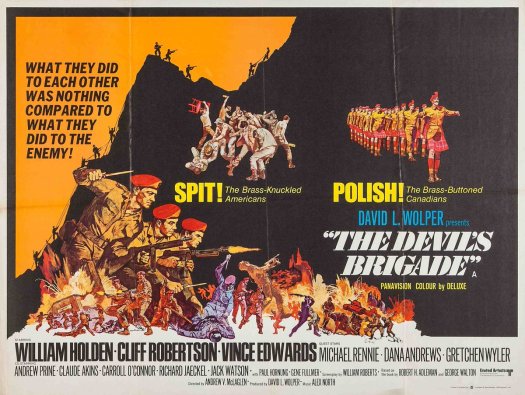
Special Memorial Day Edition: THE DEVIL’S BRIGADE (United Artists 1968)


gary loggins's avatarcracked rear viewer

In the wake of 1967’s THE DRITY DOZEN came a plethora of all-star, similarly themed films. THE DEVIL’S BRIGADE is one of those, though just a bit different: it’s based on the true-life exploits of the First Special Service Force, a collection of American misfits straight from the stockades and the crack, highly disciplined Canadian military, forging them into one cohesive fighting unit.

William Holden  heads the cast as Lt. Col. Robert Frederick, tasked with putting the units together. His seconds-in-command are the cigar chomping American Major Brecker (Vince Edwards) and proud Canadian Major Crown (Cliff Robertson). The Americans, as rowdy a bunch of reprobates as there ever was, include Claude Akins , Luke Askew, Richard Jaeckel, and Tom Troupe, while the Canadians are represented by the likes of Richard Dawson, Jeremy Slate, and Jack Watson , war movie vets all.  Andrew Prine is also aboard as an AWOL…

View original post 365 more words

A Movie A Day #5: ffolkes (1979, directed by Andrew V. McLaglen)


A group of terrorists, led by Lou Kramer (Anthony Perkins, at his bitchiest) and Harold Schulman (Michael Parks), have hijacked Esther, a supply ship that services two North Sea oil rigs, Ruth and Jennifer.  Kramer demands that the British government pay him 25 millions pounds.  If he’s not paid, he’ll blow up the two oil rigs, destroying the British economy and causing a catastrophic environmental disaster.  Kramer has also rigged the Esther with explosives.  If anyone tries to board the boat, he will blow both the ship and himself up, taking the crew with him.

The British Prime Minister (Faith Brook, playing Margaret Thatcher) could pay the ransom or she could call in counter terrorism expert, Rufus Excalibur ffolkes (Roger Moore).

(Though the name undoubtedly looked odd to American audiences, ffolkes is a common Welsh surname and is often spelled with both fs lowercase.)

Made in between The Spy Who Loved Me and Moonraker, ffolkes was Roger Moore’s attempt to defy the typecasting that had defined his career.  Other than his loyalty to Queen and country, ffolkes has very little in common with James Bond.  James Bond was a suave smoker who bedded several women per film, lived in a hip London flat, drank Martinis, and was always ready with a quip.  ffolkes is humorless, drinks Scotch, hates cigarette smoke, and lives in an isolated castle.  The biggest difference between Bond and ffolkes?  Embittered by one bad marriage, ffolkes has no interest in women and refuses to work with them.  Instead, ffolkes loves cats.

ffolkes had always been overshadowed by Moore’s work as James Bond but it holds up well as a good, old-fashioned adventure film.  In many ways, Anthony Perkins’s Kramer feels like a predecessor to Die Hard‘s Hans Gruber and, if ffolkes had been released ten years later, it probably would have been referred to as being “Die Hard at sea.”  If you can get used to him playing someone other than James Bond, Roger Moore does a good job as the eccentric ffolkes and James Mason provides welcome support as ffolkes’s only friend.

Though ffolkes was a box office disappointment, it retains a cult following and it used to show up regularly on British television.  (I saw it at least once every summer that I went to the UK.)  When it was originally released in the U.K., it was called North Sea Hijack.   When it was released in the U.S., presumably under the assumption that American audiences wouldn’t be able to find the North Sea on a map, the title was changed to ffolkes, which probably left audiences more confused than the North Sea ever would have.  When the movie was first broadcast on American television, the title was changed yet again, this time to Assault Force.

To quote Roger Moore: “The film has so many title changes that I’ve lost count.  But everyone seems to like the character I played.”

For tomorrow’s movie a day, it’s another film where Roger Moore did not play James Bond, The Cannonball Run.

roger-moore-is-ffolkes

On the Border: BANDOLERO! (20th Century-Fox 1968)


gary loggins's avatarcracked rear viewer

bandolero1

BANDOLERO! was made at an interesting time in the history of Western movies. Sergio Leone’s “Man With No Name” trilogy had begun to exert their influence on American filmmakers (HANG EM HIGH, SHALAKO). Traditional Hollywood Westerns were still being produced (FIRECREEK, 5 CARD STUD), but in a year’s time, Sam Peckinpah’s THE WILD BUNCH would change the Western landscape forever. Andrew V. McLaglen’s BANDOLERO! is more on the traditional side of the fence, though it does exhibit a dash of Spaghetti flavor in its storytelling.

Outlaw Dee Bishop and his gang attempt to rob a bank in Valverde, Texas. The heist is going well until rich Nathan Stone walks in with his beautiful Mexican wife, Maria. Stone tries to break it up, and gets shot for his troubles, thus alerting the attention of Sheriff July Johnson and his deputy, Roscoe. The lawmen successfully catch the gang as they’re leaving the bank. Stone dies, and Dee and…

View original post 782 more words