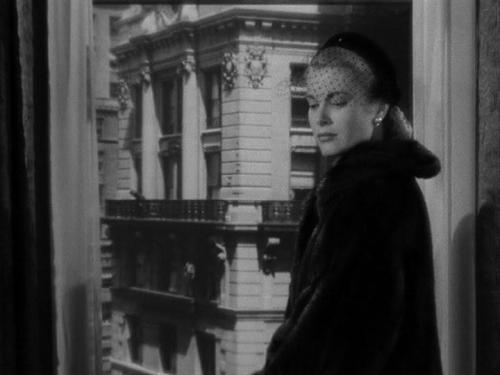
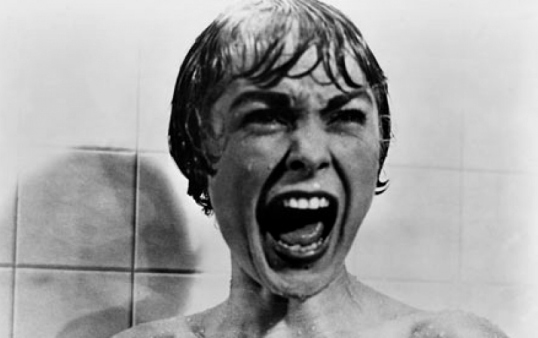
It would be difficult to get through October and not point out one of the best scenes in horror ever.
There’s Janet Leigh’s performance which conveyed the utter terror the scene wanted to convey. We have Bernard Hermann’s discordant film score highlighting the attack. Despite being a very bloodless sequence the way Hitchcock filmed the scene made audience imagine that they were actually witnessing something more violent and gory.
We all have Alfred Hitchcock to thank for this most iconic of all horror scenes.
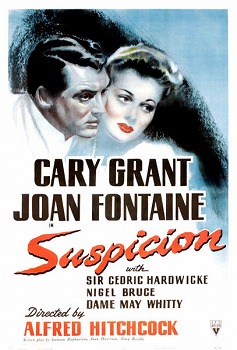
First off, a warning. The following review of the 1941 best picture nominee Suspicion will include spoilers. So, if you haven’t seen the film and you’re obsessive about avoiding major spoilers, then don’t read the review. Simple, no?
Two years ago, I was having lunch with some of my fellow administrative assistants. One of them was talking about how she had watched an “old movie” the previous night. From listening to the vague details that she offered up, I was able to figure out that she had apparently stumbled across TCM for the first time in her life. From listening to her talk, I would not be surprised if she was literally describing the first time she had ever actually seen a black-and-white movie. Needless to say, my first instinct was to correct everything she was saying but I resisted. (For some reason, at that time, I was feeling self-conscious about being perceived as being a know-it-all.) But, as she kept talking, I found it harder and harder to keep quiet. Listening to her talk about old movies was like attending an art history lecture given by someone who had flunked out of a finger painting class. Finally, when the conversation had moved on to someone who we all knew was sleeping with her much older boss, our self-proclaimed old film expert announced that age didn’t matter. “I’d go out with Cary Grant,” she said, “and he’s old.”
Before I could stop myself, I added, “He’s also dead.”
Oh my God, the look of shock on her face! I actually felt really guilty because I could tell that she had apparently taken a lot of happiness from the idea that suave, witty, and handsome Cary Grant was still out there. And can you blame her? In a career that spanned three decades and included several classic dramas and comedies, Cary Grant epitomized charm. Some of his movies may seem dated now but Grant was such a charismatic and natural actor that it’s impossible not to get swept up in his performances.
(Who would be the contemporary Cary Grant? I’ve heard some people compare George Clooney to Grant. And it’s true that Clooney has Grant’s charm but, whereas Grant always came across as very natural, you’re always very aware that George Clooney is giving a performance.)
It was Grant’s charm that made him the perfect choice for the male lead in Suspicion but it was that same charm that made the film so controversial. In Suspicion, Grant plays Johnnie. Johnnie meets, charms, and — after the proverbial whirlwind courtship — marries Lina (Joan Fontaine), a sheltered heiress. It’s only after Lina marries Johnnie that she discovers that he’s broke, unemployed, and addicted to gambling. With everyone from her family to her friends telling her that Johnnie is only interested in her money, Lina starts to worry that Johnnie is plotting to kill her. Lina starts to view all of Johnnie’s actions with suspicion, wondering if there’s an innocent explanation for his occasionally odd behavior or if it’s all more evidence that he’s planning to kill her. When he brings her a glass of milk, Lina has to decide whether or not to risk drinking it…
Suspicion was based on a novel in which Johnnie was a murderer and which ended with Lina voluntarily drinking that poisoned milk. In the film, however, Johnnie is not a murderer. Apparently, it was felt that Grant was so charming and so likable that audiences would never accept him as a murderer. Instead, he’s an embezzler and all of his strange behavior is due to him being ashamed of his past and feeling that he’s not worthy of Lina. Once Lina realizes that Johnnie isn’t trying to kill her, she promises him that she’ll stay with him.
And a lot of people (including director Alfred Hitchcock, who claimed it was forced on him by the film’s producers) have criticized that ending but you know what?
It works. If I had to choose between Joan Fontaine essentially committing suicide or Joan Fontaine promising to love Cary Grant even if Grant goes to prison, I’m going to go with the second choice. Ultimately, Suspicion works because you can imagine being swept off your feet by Grant’s character. But what makes Suspicion enjoyable, to me, is that Johnnie ultimately turns out to be exactly who we were hoping he would be.
Needless to say, Suspicion works as a great double feature with Rebecca. Watch one after the other and have a great night of menace and romance.
Well, here we are, less than a week into Embracing the Melodrama, Part II, and I’m already running behind! The plan, as I mentioned back on Monday, is to review 128 melodramatic films over the next three weeks. And, even though I know that sounds a like a lot, I had it all planned out so that I’d be able to get all that done in just 21 days. All I had to do was make sure that I reviewed 6 films a day.
And …
Well, life happened.
But no matter! It may now take me 3 and a half weeks to review 128 films but that’s no great tragedy. And besides, regardless of how long it takes, I’ve got some pretty good films scheduled.
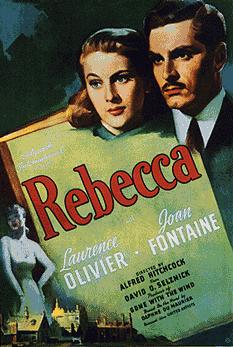
Take, for instance, the 1940 best picture winner Rebecca.
Rebecca is a film that all women can relate to. The heroine is played by Joan Fontaine. I say “heroine” because we never actually learn the character’s name, nor do we learn much about her background. When we first see her, she’s defined by her job, which is to basically be a paid companion to a wealthy woman. Later, she’s defined by her whirlwind romance with the brooding and aristocratic widower Maxim de Winter (Laurence Olivier). When, after two weeks, they get married, she becomes known as the second Mrs. de Winter. She becomes defined by both who she married and who she is not.
She’s not Rebecca, the first Mrs. de Winter.
As soon as Maxim takes his new wife to his estate, the second Mrs. de Winter discovers that she’ll always live in the shadow of the deceased Rebecca. Everyone she meets describes Rebecca as being a vibrant, lively figure — in other words, the complete opposite of the meek second Mrs. de Winter. The coldly imperious housekeeper, Mrs. Danvers (Judith Anderson), has perfectly preserved Rebecca’s room and makes little attempt to hide the scorn that she feels for the second Mrs. de Winter. Even worse, once they return to the estate, Maxim reveals himself to be moody and tempermental. With the help of the manipulative Mrs. Danvers, the second Mrs. de Winter becomes convinced that Maxim will never love her as much as he loved Rebecca.
Making things even more complicated, a man claiming to be Rebecca’s cousin comes by the house when Maxim is away. Jack Flavell (played by George Sanders, at his most serpent-like) suggests that there may have been more to Rebecca’s death than the second Mrs. de Winter was originally told…
Rebecca is a classic film, for many reasons. It’s well-acted, with Fontaine, Olivier, Anderson, and Sanders all bringing their characters to vibrant life. It’s a gothic romance. It’s a thriller. It’s a mystery. It is the epitome of old Hollywood style. But, for me, the main reason that Rebecca is a classic is because it tells a story to which almost everyone can relate. Every relationship that I’ve ever had, I’ve always been curious and occasionally even jealous of who came before me. There’s nothing more intimidating than living in the shadow of someone who you will never get a chance to meet personally. The second Mrs. de Winter’s insecurities are everyone’s insecurities and, in some fashion or another, we’ve all had a Mrs. Danvers in our life. The second Mrs. de Winter’s struggles are our struggles and, as she grows stronger, the viewer grows stronger with her.
Alfred Hitchcock is one of the most influential and acclaimed filmmakers of all time but he never won a directing Oscar. Rebecca was the only one of his films to win Best Picture. Producer David O. Selznick brought Hitchcock over from England to direct Rebecca and it’s been reported that Hitchcock resented Selznick’s interference. (And, while Rebecca is undoubtedly a good film that was directed by Alfred Hitchcock, it’s not exactly a Hitchcock film in the way that Shadow of a Doubt, Rear Window, or Vertigo are Hitchcock films.) As a result, Hitchcock subsequently made it a point to edit future pictures in camera so that the studios would not be able to re-edit his films.
But, whether you consider it to be a Hitchcock picture or a Selznick production, Rebecca remains a wonderfully watchable melodrama.
For today’s entry in the 44 Days of Paranoia, we take a look at the 1942 Alfred Hitchcock film, Saboteur.
Saboteur opens at an aircraft factory in Glenda, California. Co-workers Barry Kane (Robert Cummings) and Ken Mason (Virgil Summers) notice a stand-offish new guy named Frank Fry (Norman Lloyd, who appropriately looks something like a rodent). When a fire breaks out at the factory, Fry hands Barry a fire extinguisher which Barry then hands off to Ken. The extinguisher, however, is full of gasoline, both causing the fire to turn into an inferno and killing Ken.
When questioned by the FBI, Barry explains that Fry handed him the extinguisher, just to then be informed that no one named Fry worked at the plant and that no one saw Fry — or anyone else — hand Barry the extinguisher. Realizing that Fry has framed him and also remembering the address on an envelope that Fry was carrying, Barry runs. With the FBI and police pursuing him, Barry tries to track down the real saboteur. Along the way, he discovers a friendly rancher (Otto Kruger) who is actually a Nazi agent and gets some help from a group of circus freaks, a blind man, and the blind man’s model daughter (Peggy Cummings). He also discovers that the U.S. is crawling with Nazi double agents who hide behind a veil of respectability and are plotting to destroy historic landmarks across the country. It all eventually leads to a genuinely exciting climax atop the Statue of Liberty.
Saboteur doesn’t get as much attention as some of the other films that Hitchcock directed in the 40s and perhaps that’s not surprising. It’s not as technically audacious as Notorious nor is it as thought-provoking as Shadow of the Doubt or as flamboyant as Spellbound. While Robert Cummings and Priscilla Lane make for perfectly likable leads, they certainly don’t generate the chemistry of Cary Grant and Ingrid Bergman. When one looks at the masterpieces that Hitchcock directed in the 40s, it’s easy to dismiss Saboteur as being a well-made B-movie.
And yet, I love Saboteur. The film is pure non-stop melodrama and, over 70 years since it was first made, it remains an exciting and entertaining film. Despite the fact that some critics may not hold Saboteur in as high regard as some of Hitchcock’s other films, Saboteur is full of moments of the director’s trademark ambiguity and irony. This is one of Hitchcock’s wrong man films, where innocent men are chased across a shadowy landscape by the forces of law and order who, in many ways, are portrayed as being just as menacing as the film’s nominal villains. Meanwhile, the Nazi agents hide behind warm smiles and friendly words, their evil only apparent when it’s too late to stop them. Despite his rather fearsome reputation, Hitchcock’s sympathies always lay with the powerless and the wrongly accused.
It’s those sympathies that make Saboteur into far more than just another B-movie.
Today’s ghost of Christmas past comes to use from the year 1955.
Alfred Hitchcock Presents was an anthology show, in which director Alfred Hitchcock would sardonically present a weekly tale of suspense and surprise. The series’ 12th episode was a Christmas-themed episode in which character actor Barry Fitzgerald played a recently paroled convict who gets a job as a department store Santa Claus. Though Fitzgerald starts out as a rather grumpy and cynical St. Nick, he starts to get into the holiday spirit after he meets an equally cynical young shoplifter. It’s a surprisingly sweet little story that’s well-worth watching for Fitzgerald’s excellent lead performance.
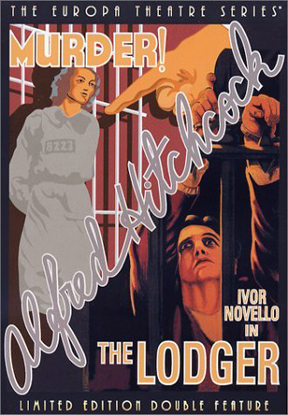
A serial killer known as “The Avenger” is murdering blonde women in London (which, once again, proves that its better to be a redhead). And while nobody knows the identity of the Avenger, they do know that the enigmatic stranger (Ivor Novello), who has just recently rented a room at boarding house, happens to fit his description. They also know that the lodger’s landlord’s daughter happens to be a blonde…
Released in 1927, the silent The Lodger was Alfred Hitchcock’s third film but, according to the director, this was the first true “Hitchcock film.” Certainly it shows that even at the start of his career, Hitchcock’s famous obsessions were already present — the stranger accused of a crime, the blonde victims, and the link between sex and violence.
Also of note, the credited assistant director — Alma Reville — would become Alma Hitchcock shortly before The Lodger was released.
Alfred Hitchcock is one of those iconic cultural figures who will never go out of style. Though he’s been dead longer than I’ve been alive, he’s still one of my favorite directors. If I see a Hitchcock film listed in the TV schedule, I can guarantee that I will find the time to watch it. Whether its The 39 Steps, Rebecca, Strangers On A Train, Topaz, or Frenzy, if it’s Hitchcock, I’m there. And I’m not alone as far as this is concerned. If Hitchcock hadn’t made The Birds, James Nguyen would never have made Birdemic. If Hitchcock hadn’t made Psycho, hundreds of low-budget horror films would never have had a chance to be distributed on DVD by Anchor Bay.
While it may have been Vertigo that was recently named the best film of all time by the Sight and Sound Poll, Psycho remains Hitchcock’s best known and most popular film. Psycho is certainly my favorite Hitchcock film, which is why I was certainly curious when I first heard about Hitchcock, a new movie that claims to tell the true story behind the making of Psycho.
Hitchcock opens with 60 year-old Alfred Hitchcock (Anthony Hopkins) trying to figure out how to follow up the success of North By Northwest. Hitchcock settles on adapting a little-regarded pulp novel that’s based on the true life crimes of serial killer Ed Gein. Over the objections of the censors, the studio, and all of his associates, Hitchcock makes Psycho his next film. At the same time, his wife Alma (Helen Mirren) deals with living in the shadow of her famous husband. While Hitchcock devotes all of his time to his film and obsessing over his leading actresses, Alma find herself tempted by a slick screenwriter named Whitfield Cook (Danny Huston).
(Has anyone good ever been named Whitfield Cook?)
As a film, Hitchcock is likable but shallow. Anthony Hopkins and Helen Mirren have great chemistry and they’re a lot of fun to watch but you never truly believe that you’re watching the true story of the making of a movie that changed cinematic history. Whenever Hitchcock threatens to become truly insightful about the artistic process, the story abruptly cuts away to another scene of Alma writing on the beach with Whitfield Cook. It doesn’t help that Danny Huston plays Cook as such an obvious cad that it actually diminishes Alma as character when she doesn’t immediately see through him.
Similarly, in the role of Alfred Hitchcock, Anthony Hopkins gives a performance that is very likable and quite watchable but, in the end, still feels rather shallow. His performance feels like a good and entertaining impersonation but it never quite feels real. The closest that the film (and Hopkins) comes to suggesting any of Hitchcock’s inner demons is when he imagines having a conversation with Ed Gein (played by Michael Wincott). These scenes feel terribly out-of-place when compared to the rest of the film.
The actresses playing the women in Hitchcock’s life fare a little bit better. Jessica Biel and Scarlett Johansson are well-cast as Vera Miles and Janet Leigh, respectively. Helen Mirren is widely expected to earn an Academy Award nomination for her performance as Alma and she does have several strong scenes in Hitchcock. As I watched the film, I certainly could relate to Alma’s desire to be taken seriously as an individual and her frustration with being defined solely by the vows of marriage. It’s a feeling that Mirren captures perfectly.
In the end, Mirren aside, Hitchcock is entertaining but forgettable.
In 2009 Liam Neeson began a new phase of his career as an actor. Before 2009 he was always put into roles as the father figure and mentor to a younger protagonist. He did quite well in handling these roles. Most of the time he was the only good thing about the films he was in and it was due to how he handled the supporting role given to him. But 2009 changed everything as Liam Neeson arrived on the film scene as a bonafide action hero in his role as a former CIA Special Activities Division operative in the action-thriller, Taken. That film surprised many and Neeson’s badass portrayal of a father out to save his daughter opened the eyes of many filmgoers who always saw him as the calm, wise elder. He has taken on the mantle of older, action-hero characters from Harrison Ford who lived off and became rich doing roles such as the one in Taken.
Two years later we have another film where we get to see Liam Neeson in another role which cements his place in the action-hero pantheon. Also like Pierre Morel’s film, this one takes place in Europe and directed by another European filmmaker trying to make a name for himself in Hollywood, Jaume Collet-Serra. It would be disingenious to say that Collet-Serra had it in him to direct a film as tight and fast-moving as Unknown. His two Hollywood productions were the remake of the classic horror film, House of Wax, and the underappreciated horror film from 2009, Orphan. With this new action-thriller, Unknown, Collet-Serra and Neeson create a film which owes much of its film dna to Hitchcock and his mistaken-man classic, North by Northwest. I would also say that this film also owes much of its action and characters to one of the early 1990’s best sci-fi action films, Paul Verhoeven’s Total Recall.
The film begins with Neeson’s character, Dr. Martin Harris, and his wife Liz (played by Mad Men‘s January Jones) arriving in Berlin to attend a biomedical conference. Right from the start Neeson makes us believe in Harris being an everyman. The good professor doesn’t seem the alpha male-type. But after certain seemingly random circumstances and events puts Harris in a coma for four days we begin to see signs and glimpses that Neeson’s character may have more to him than meets the eye.
It’s when Harris’ awakens from his coma that the meat of the film’s story begins. We know going in that Neeson’s character knows he’s not crazy and that someone out there has made things appear as if he is becoming insane. Maybe the accident in the beginning of the film have given us a false perspective on the film. What we might be seeing could be a manifestation of Harris’ mental breakdown from the accident and subsequent coma. But little clues in the film’s dialogue keeps things vague, but not so much that our initial stance that Harris’ is being manipulated won’t be the final endgame.
It is the endgame in the film which may make or break the whole production for some people. The screenplay by Oliver Butcher and Stephen Cromwell is not the strongest out there and it tries to be too complex with its red herrings when trying to keep it simple would’ve sufficed. One could almost sense that the two writers were trying to be too Hitchcock that they lost sight of how Hitchcock’s films were simple affairs which only appeared to be complex. Yet, despite some necessary leaps of logic that audiences needed to make to continue believing in the film, Unknown manages to keep the core story moving forward to it’s inevitable conclusion.
The performances by everyone involved is what keeps this film from spiralling out of Collet-Serra’s capable hands. One would almost certainly point out the strong work by Neeson as the Harris. January Jones’ Liz Harris, at first, seemed like an extension of her Betty Draper character from Mad Men, but as the story moves forward we get to see more layers of personalities in her character to make her interesting beyond the dutiful and supportive wife. But the standout performance outside of Neeson has to go to Diane Kruger as Gina, the taxi driver who was involved in Neeson’s character getting in his accident in the beginning of the film.
Kruger arguably is one of Hollywood’s classic beauty, but she has an ability to actually keep that beauty in check with her acting that we believe her to be the “everywoman” in some of the roles she plays. Beauty doesn’t come into the Gina character’s personality. Kruger does a great job of playing the pawn in a much larger game being played on Neeson’s character. Her reluctance to help him gradually crumbles as she soon realizes that her own safety and survival is now inextricably linked to unraveling the mystery of who Martin Harris really is.
Unknown is one of those films that actually has an advantage being released in the so-called dead season which runs from January and into March. It’s a film season when studios put out films they have no faith in being a major blockbuster which means summer and Holiday season release are out. It’s not prestigious enough to be put out in the Fall and early Winter. But as a piece os well-done escapist fare it’s perfect for this so-called dead season. Jaume Collet-Serra has shown that even when working from an average screenplay he knows how to get the best out of his cast to sell the film to the audience. He also has a firm grasped on pacing and how to handle action sequences.
In the end, the film still loves or dies by how the audience reacts to Liam Neeson’s character. While his Martin Harris is not the Bryan Mills from Taken, by the time the final scene fades to black we begin to see how similar the two characters really are and how much they share. Until the big name films start dropping in beginning in March (blockbuster season seem to come earlier and earlier with each passing year), Unknown is one of those films that should help make this early months of the film season more entertaining than it usually is in year’s past.
As an aside, for those who know their films would understand why I say that, in addition to this film having aspirations of being Hitchcockian, Unknown definitely borrows or has been influenced by some of the story and character developments of Verhoeven’s Total Recall. I almost half-expected for a half-mutant seer named Kuato to make an appearance to explain it all to Neeson’s ccharacter.
Earlier tonight, I read on twitter that veteran character actor and Prom Night co-star Leslie Nielsen had passed away. While people seem to know him best as a former “serious” actor turned deadpan comedian, it is forgotten that Nielsen was — during the 70s — an exploitation and grindhouse mainstay.
Along with playing Jamie Lee Curtis’s father (and no-nonsense high school principal) in Prom Night, Nielsen was also the star of the kung fu classic Project: Kill and the bad guy in Day of the Animals.
The clip below comes from Day of the Animals and it shows Nielsen at his exploitation best:
Here’s a little bit of the movie history trivia that I live for: In 1959, along with famously auditioning for a role in Ben-Hur, Nielsen also came close to being cast in another iconic film. He was among the finalists for the role of Sam Loomis (eventually played by John Gavin) in Alfred Hitchcock’s Psycho.
What better way to bring back a new daily grindhouse than the film which started the teen slasher genre. I speak of John Carpenter’s Halloween.
The film was truly a child of 1970’s independent filmmaking. With a budget of just $320,000 (even adjusting for inflation it’s still quite low) Carpenter made what’s considered one of horror’s defining films. Carpenter’s film was a smash hit when it was released in 1978. It played mostly in drive-in’s, grindhouse cinema houses before finally appearing in more mainstream venues. By then the film had become one of those must-see titles that many films both independent and mainstream try for but fail to do.
Some have commented that since Halloween was such a success in the box-office then it shouldn’t be considered grindhouse. I look at such thinking as quite narrow. Grindhouse was never synonymous with bad filmmaking. If one said the term meant cheap filmmaking then I would agree. Carpenter’s film has all the trappings of what makes a great grindhouse. It’s violent (though it really has less blood than what audience really remember) and uses sex as a storytelling tool (again the sex is quite chaste compared to later teen slashers).
While some film historians credit Hitchcock’s Psycho as the granddaddy of the slasher genre it wasn’t primogenitor of the teen slasher subgenre which has become an industry onto itself since Carpenter’s breakthrough hit. A hit that set many of the basic rules of teen slasher horror for decades to come. We get the nigh-unstoppable killer who seems more like a force of nature than human. The notion that teenage girls who have premarital sex will die horribly because of it while the chaste and virginal girl survives and inevitably stops the killer (until the subsequent sequel that is).
Halloween is grindhouse through and through. The fact that Carpenter’s obvious talent and skill as a director, editor, film composer and cinematographer shouldn’t DQ this film from being called grindhouse.