Retro Television Review: The Love Boat 5.25 “Burl of My Dreams/Meet the Author/Rhymes, Riddles, and Romance”


Welcome to Retro Television Reviews, a feature where we review some of our favorite and least favorite shows of the past!  On Wednesdays, I will be reviewing the original Love Boat, which aired on ABC from 1977 to 1986!  The series can be streamed on Paramount Plus!
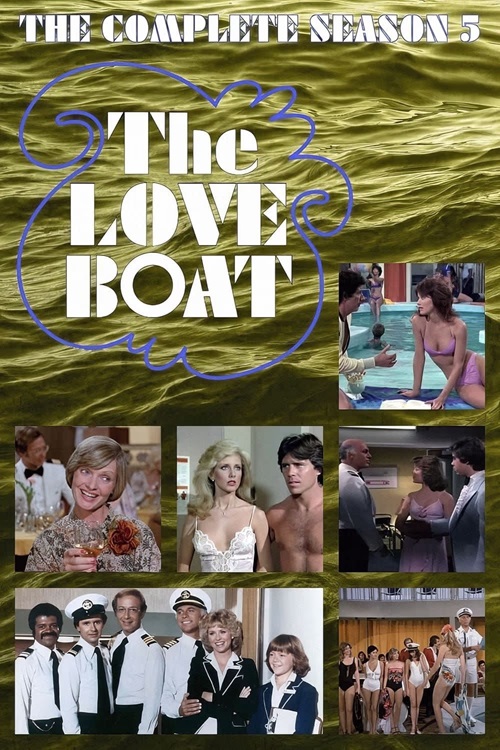
This week, someone needs to call Family Services.

Episode 5.25 “Burl of My Dreams/Meet the Author/Rhymes, Riddles, and Romance”

(Dir by Richard Kinon, originally aired on March 27th, 1982)

Poor Vicki!

Here she is, living on the Love Boat, surrounded by the middle-aged crew and the largely elderly passengers, and without a single friend her own age.  (Seriously, how does Captain Stubing get away with this?)  She’s excited when an old school friend, Scott Nelson (Rad Daly), boards the boat but Scott, being 14 and a boy, is totally clueless about the fact that 1) Vicki is no longer a tomboy and 2) Vicki totally has a crush on him.

Gopher sees that Vicki is upset so he tries to cheer her up by telling her that she deserves better than Scott and also sending her flowers.  Gopher may have had good intention but now Vicki is convinced that she’s in love with Gopher and that Gopher is in love with her!  Captain Stubing is not amused.  And Vicki is also not amused when she overhears Gopher explaining that he was just trying to make Vicki feel better.  And then she’s truly, truly unamused when Scott kisses her and then reveals that Gopher paid him to do so.

Seriously, poor Vicki!  I relate to Vicki more than to Julie because I’ve never been a cruise director but I have been a teenager.  I will never understand how the Captain is getting away with raising his daughter on a cruise ship.  I can see where it would sometimes for fun for Vicki but doesn’t she miss having friends her own age?  Doesn’t she wish she could explore something other than the Aloha Deck?  This storyline once again reminded the viewer that Vicki really deserves a life on the mainland.

As for the other two stories, Paul Reese (Jared Martin) is a publishing executive who wants to sign an author named Gus Dolan (Alan Hale, Jr.).  Gus is known for his tough crime novels.  In order to get close to Gus, Paul strikes up a romance with Gus’s daughter, Kathy (Georgia Engel).  Kathy is upset when she discovers that Paul works in publishing but, when Paul throws away the contact that he just got Gus to sign, she realizes that Paul does love her.  And then Paul discovers that Kathy is the one who is actually writing Gus’s books.  This storyline featured a good performance from Alan Hale, Jr. but there was next to zero romantic sparks between Jared Martin and Georgia Engel.

Meanwhile, Brian (Paul Williams) and Lenore (Joanna Pettet) searched the ship for a secret treasure and fell in love.  Isaac’s cabin got ransacked twice.  This was a pretty boring story and one of the biggest parts of it — Captain Stubing telling Brian and Lenore not to disturb anyone else’s cabin — took place off-screen.

So, this cruise left me feeling very sorry for Vicki and also for poor Gus Dolan.  Vicki wants friends her own age.  Gus wants to be a real writer.  Not all dreams come true, even on the Love Boat.
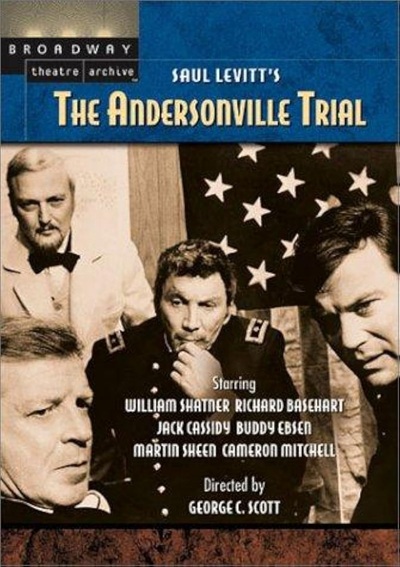
On Stage On The Lens: The Andersonville Trial (dir by George C. Soctt)


1970’s The Andersonville Trial takes place in one muggy military court room.  The year is 1865.  The Civil War is over but the wounds of the conflict are still fresh.  Many of the leaders of the Confederacy are still fugitives.  Abraham Lincoln has been dead for only a month.  The people want someone to pay and it appears that person might be Captain Henry Wirz (Richard Basehart).

Originally born in Switzerland and forced to flee Europe after being convicted of embezzlement, Henry Wirz eventually ended up in Kentucky.  He served in the Confederate Army and was eventually named the commandant of Camp Sumter, a prison camp located near Andersonville, Georgia.  After the war, Captain Wirz is indicted for war crimes connected to his treatment of the Union prisoners at the camp.  Wirz and his defense counsel, Otis Baker (Jack Cassidy), argue that the prison soon became overcrowded due to the war and that Wirz treated the prisoners as well as he could considering that he had limited resoruces.  Wirz points out that his requests for much-needed supplies were denied by his superiors.   Prosecutor Norton Chipman (William Shatner) argues that Wirz purposefully neglected the prisoners and their needs and that Wirz is personally responsible for every death that occurred under his watch.  The trial is overseen by Maj. General Lew Wallace (Cameron Mitchell), the same Lew Wallace who would later write Ben-Hur and who reportedly offered a pardon to Billy the Kid shortly before the latter’s death.  Wallace attempts to give Wirz a fair trial, even allowing Wirz to spend the trial reclining on a couch due to a case of gangrene.  (Agck!  The 19th century was a scary time!)

The Andersonville Trial started life as a 1959 Broadway production.  On stage, George C. Scott played Chipman, an experience he described as difficult because, even though Chipman was nominally the play’s hero, Wirz was actually a much more sympathetic character.  When the play was adapted for television in 1970, Scott returned to direct.  Admittedly, the television version is very stagey.  Scott doesn’t make much effort to open up the play.  Almost all of the action is confined to that courtroom.  We learn about the conditions at Fort Sumter in the same way that the judges learned about the conditions.  We listen as the witnesses testify.  We listen as a doctor played by Buddy Ebsen talks about the deplorable conditions at Fort Sumter.  We also listen as a soldier played by Martin Sheen reports that Wirz has previously attempted to suicide and we’re left to wonder if it was due to guilt or fear of the public execution that would follow a guilty verdict.  We watch as Chipman and Baker throw themselves into the trial, two attorneys who both believe that they are correct.  And we watch as Wirz finally testifies and the play hits its unexpected emotional high point.

As most filmed plays do, The Andersonville Trial demands a bit of patience on the part of the viewer.  It’s important to actually focus on not only what people are saying but also how they’re saying it.  Fortunately, Scott gets wonderful performances from his ensemble cast.  Even William Shatner’s overdramatic tendencies are put to good use.  Chipman is outraged but the play asks if Chipman is angry with the right person.  With many of the Confederacy’s leaders in Canada and Europe, Wirz finds himself standing in for all of them and facing a nation that wants vengeance for the death of their president.  Wirz claims and his defense attorney argues that Wirz was ultimately just a soldier who followed orders, which is what soldiers are continually told to do.  The Andersonville Trial considers when military discipline must be set aside to do what is morally right.

Admittedly, when it comes to The Andersonville Trial, it helps to not only like courtroom dramas but to also be a bit of a history nerd as well.  Fortunately, both of those are true of me.  I found The Andersonville Trial to be a fascinating story and a worthy production.

Retro Television Reviews: Fantasy Island 3.16 “Rogues and Riches/Stark Terror”


Welcome to Retro Television Reviews, a feature where we review some of our favorite and least favorite shows of the past!  On Tuesdays, I will be reviewing the original Fantasy Island, which ran on ABC from 1977 to 1986.  Almost entire show is currently streaming is on Youtube!

Smiles, everyone!  Smiles!

Episode 3.16 “Rogues and Riches/Stark Terror”

(Dir by Cliff Bole, originally aired on January 19th, 1980)

Our latest weekend on Fantasy Island is both strange and entertaining!

Attorney Mark Hendicks (John Schuck) comes to the Island with a briefcase full of papers.  He’s searching for his former law partner, Pete Gilbert (singer Robert Goulet).  Years ago, Pete came to Fantasy Island with a simple fantasy.  He wanted to be an 18th century British outlaw.  However, Pete had so much fun in the past that he decided that he never wanted to leave.  Mark needs to get Pete’s signature on some official forms so that Mark can sell some land that he and Pete bought before Pete’s fateful trip to the Island.

Mr. Roarke explains to Mark what’s going on with Pete and Mark is surprisingly accepting of Roarke’s explanation.  Roarke drives Mark out to a bridge.  He tells Mark that crossing the bridge will transport Mark to Pete’s fantasy.  Mark crosses the bridge and immediately sees Pete being chased by a bunch of British soldiers.  Pete is having a grand ol’ time in the 18th century but he’s more than willing to take some time out from plundering so that he can sign the papers so that will allow Mark to become a millionaire once he returns to the present.  However, after a dinner scene that is basically lifted shot-for-shot from Tom Jones, Mark falls in love with Margaret Winston (Dolly Read), the wife of sword-wielding Judge Winston (Alan Hale, Jr).  Mark is tempted to remain in the past but, in the end, he decides that his place is in the present.  Fortunately, it turns out that Margaret was having a fantasy of her own and she and Mark leave the Island together.

While that silly but enjoyable fantasy plays out out, Amy Marson (Melissa Sue Anderson) searches for the solution to a mystery that was so traumatic that it caused her to lose her ability to speak.  Amy’s mother (Elinor Donahue) died in front of her and Amy hopes to discover not only who killed her mother but also to recover her ability to speak.  This leads to Amy visiting the lighthouse where she grew up and having a reunion with the kindly lighthouse keeper, Joshua Templar (Michael Constantine).  Amy’s flashbacks lead her to the solution to the mystery of her mom’s death and also to Joshua’s secret son (David Drucker).

This storyline, much like last week’s battle against Elizabeth Bathory, was enjoyably creepy and it featured good performances from Anderson, Constantine, Donahue, and Drucker.  In the best tradition of Fantasy Island, the storyline was both macabre and also rather life-affirming.  Fantasy Island was always at its best when it revealed the hidden humanity at the heart of each fantasy.  Amy learns the truth of her mother’s death and she regains her ability to speak.  Tattoo tells her that she has a beautiful voice.  Awwwwww!

This was a great weekend on Fantasy Island!

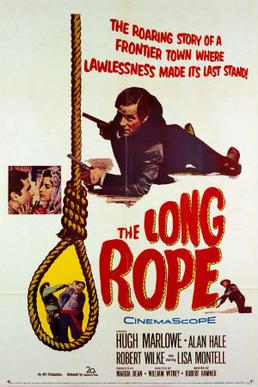
The Long Rope (1961, directed by William Whitney)


The time is the late 19th century and there’s been a murder in the territory of New Mexico.  Someone has gunned down Jim Matthews (Steve Welles) and store owner Manuel Alvarez (John Alonzo) has been arrested.  Everyone in town says that Jim was fooling around with Manuel’s beautiful wife, Alicia (Lisa Montell).  Manuel insists that he’s innocent but Jim was the brother of the town’s most powerful and richest land owner, Ben Matthews (Robert J. Wilke).  Ben is already having a gallows built so that Manuel can be hanged in the town square and it doesn’t look like there’s anything that Sheriff John Millard (Alan Hale, Jr. — yes, the Skipper) can do to stop him.

However, Federal Judge Jonas Stone (Hugh Marlowe) is determined to make sure that Manuel gets a fair trial.  When it becomes obvious that the Matthews family has no intention of letting that happen, Judge Stone launches his own investigation.  Believing Manuel to be innocent, Stone knows that he has to find the real killer before the gallows are built and Manuel is lynched by the mob.

A low-budget western with a 61-minute running time, The Long Rope is a surprisingly adult western, one that comes out strongly and directly against both lynching and the town’s racism.  With the Matthews family representing the brutal “old ways,” and Judge Stone representing a more enlightened and fair system of justice, it’s up to the town to decide who they will follow.  Hugh Marlowe brings a lot of gravitas to his role as the stern but compassionate Judge Stone while Lisa Montell makes a strong impression as Manuel’s rebellious wife.  Robert J. Wilke is an effective villain and even Alan Hale, Jr. gives a good performance once you stop thinking of him as being the Skipper.

One final note of interest: John A. Alonzo, who played Manuel in The Long Rope, went on to become an award-winning cinematographer.  Among Alonzo’s credits, as a cinematographer: Harold and Maude, Chinatown, The Bad News Bears, Black Sunday, Scarface, Norma Rae, and Close Encounters of Third Kind.