Lisa Reviews An Oscar Nominee: 49th Parallel (dir by Michael Powell)


Hello and welcome to the TSL’s continuing coverage of Oscar Sunday!  Today, along with some other Oscar-related things, I’m going to post reviews of some of the films that have been nominated for best picture over the years!  Let’s start things off with the 1941 Best Picture nominee, 49th Parallel!

Before anything, I should clear up some confusion about this film.  This is a British film about Nazis trying to reach the border between Canada and the U.S.  When it was first released in the UK, it was named after the coordinates of the border.  However, in the actual film, the Nazis never actually go to the 49th Parallel.  Instead, the film concludes at Niagara Falls.  However, it was probably reasonable assume that British audiences would not necessarily know or care whether Niagara Falls was actually located on the 49th Parallel.  Considering that they were currently at war with Germany, they had more important things to concern themselves with.

However, it was apparently felt that American audiences would notice that Niagara Falls wasn’t actually located on the 49th Parallel.  (Personally, I think the British may have been giving us too much credit.)  So, when the film was released in the United States, the title was changed to The Invaders.  When the film was subsequently nominated for Best Picture, it was nominated under the name The Invaders.  I’ve actually come across some online sources that claim that The Invaders and 49th Parallel are two separate films.  No, they’re the same film, it’s just that the film in question has two different titles.  Out of respect to the people who actually made the movie, I’ve decided to use the original title in this review.

When watching 49th Parallel (it’s available on YouTube), it helps to know something about history.  Today, there’s a tendency to overlook the fact that World War II had already been raging for nearly two years before the United States got involved.  Though the U.S. was an ally to Britain, it remained officially neutral until the Japanese bombed Pearl Harbor.  Up until that moment, many prominent Americans were isolationists and took the attitude that the war was Europe’s problem.  (On the other hand, Canada, as a Dominion of the British Empire, followed Britain into the war in 1939.)  Though the 49th Parallel may have been a British film that was largely set in Canada, it was also meant to frighten Americans and hopefully bring them over to the British side.

(When interviewed about the film, screenwriter Emeric Pressbruger said, “”Goebbels considered himself an expert on propaganda, but I thought I’d show him a thing or two.”)

Directed by Michael Powell, 49th Parallel opens with a German U-boat creeping into the waters around Canada.  The Nazis are hoping to disrupt shipping operations but it turns out that they’re no match for the Royal Canadian Navy.  (GO CANADA!)  When the U-boat sinks into the Hudson Bay, only six Nazis manage to survive.  Led by the arrogant Lt. Hirth (Eric Portman), the Nazis attempt to make their way to the border and to the safety of America.

Of course, it doesn’t turn out to be an easy journey.  Not only are the Germans in an unfamiliar country but they also keep running into Canadians.  Without fail, nearly every Canadian they meet is polite but willing to fight and die for his country.  The Canadians themselves are played by actors who, in the 40s, would have been familiar faces.  Laurence Olivier plays a fur trapper, getting top-billing for his cameo appearance.  Raymond Massey, who was best known for playing Abraham Lincoln, shows up as a Canadian solider.  Leslie Howard is the writer who discovers that Nazis have no respect for art.  Anton Walbrook is a German-Canadian farmer who rejects the attempts of Lt. Hirth to bring him over to the Nazi side.  The Canadians are so sympathetic that one of the Nazis is even moved to reject the Third Reich and is promptly executed by his compatriots, showing the audience the foolishness of hoping that the “good Germans” would ever be able to overthrow the bad ones.

It’s pure propaganda but it’s anti-Nazi propaganda so that’s not really a problem.  Powell keeps the story moving at a steady pace and all of the actors get impassioned performances.  You can tell this movie was more than just a job for them.  Instead, it was their way of fighting for their country and hopefully inspiring others to join in the battle against Hitler.  The film is both a love letter to Canada and a plea to the United States to renounce neutrality.  (Interestingly enough, by the time 49th Parallel made it to U.S. screens, America had finally declared war on the Axis Powers.)

49th Parallel was nominated for best picture but it lost to another World War II propaganda film, Mrs. Miniver.

Happy Oscar Sunday From All The Humans And Cats At The Shattered Lens!


It’s Oscar Sunday!

For many humans and cats, today is an unofficial holiday!  Today is the day that we find out who and what the Academy has selected for the best of last year!  We may agree.  We may disagree.  But a lot of us will be watching!

Happy Oscar Sunday, everyone!  Please enjoy today’s Oscar-related posts.  Who knows?  We might even toss in some non-Oscar related posts as well!  You never know!

Scenes That I Love: Tony Bennett Has A Meltdown in The Oscar


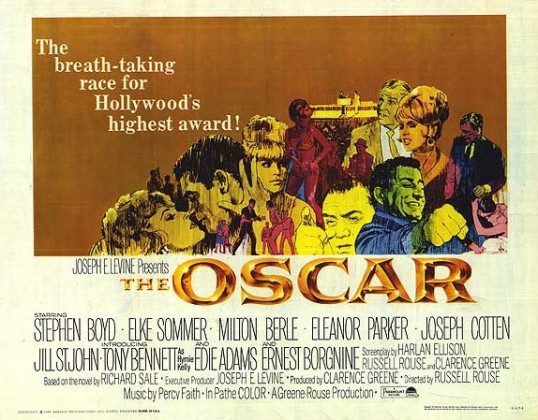
Have you ever wondered what it takes to win an Oscar?  The 1966 film, The Oscar, revealed to audiences just how sleazy a world Hollywood can be.  Frankie Fane (Stephen Boyd) does everything he can to win an Oscar and he doesn’t care who he hurts!

But fear not — Hollywood may not be perfect but it has no room for someone like Frankie Fane!  At the end of the movie, a man named Frank does win the Oscar but his last name is Sinatra and Frankie Fane is left humiliated.  That’ll teach him to try to take advantage of Hollywood!

Yes, The Oscar is an incredibly silly film but it’s also a lot of fun.  In this scene that I love, Frankie’s best friend — played by Tony Bennett of all people — confronts Frankie about the type of star that he’s become.

Six Other Films From Crown International Pictures That Deserved An Oscar Nomination!


An hour ago, I told you about the only Oscar nomination that was ever received by Crown International Pictures, one of the most prolific B-movie distributors of the 70s and 80s.  That nomination was for Best Original Song for Crown’s 1972 film, The Stepmother.

Here are 6 more films from Crown International Pictures that I think deserved some Oscar consideration:

The Teacher (1974)

“She corrupted the youthful morality of the entire school!” the poster screamed but actually, The Teacher was a surprisingly sensitive coming-of-age story about a relationship between a younger man and an older woman.  Jay North and Angel Tompkins both give excellent performances and Anthony James shows why he was one of the busiest character actors of the 70s.

2. The Sister In Law (1974)

John Savage has been acting for several decades.  He’s appeared in a number of acclaimed films but he’s never received an Oscar nomination.  One of his best performances was in this melancholy look at love, betrayal, and ennui in the early 70s.

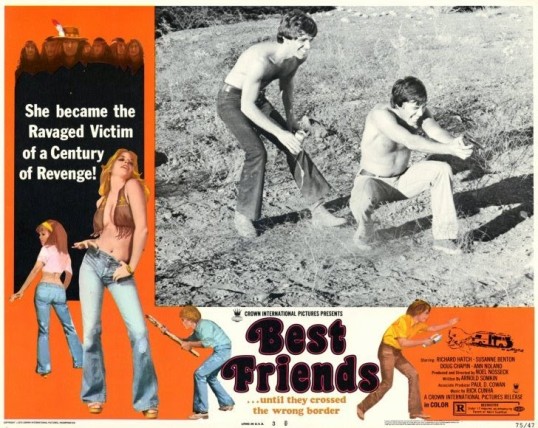
3. Best Friends (1975)

One of the strangest films ever released by Crown International, Best Friends is also one of the best.  A road trip between two old friends goes terribly wrong when one of the friends turns out to be a total psycho.  This well-acted and rather sad film definitely deserves to be better-known than it is.

4. Trip With The Teacher (1975)

Zalman King for Best Supporting Actor?  Hell yeah!

5. Malibu High (1979)

Surely Kim Bentley’s performance as a high school student-turned-professional assassin deserved some sort of consideration!

6. Don’t Answer The Phone (1980)

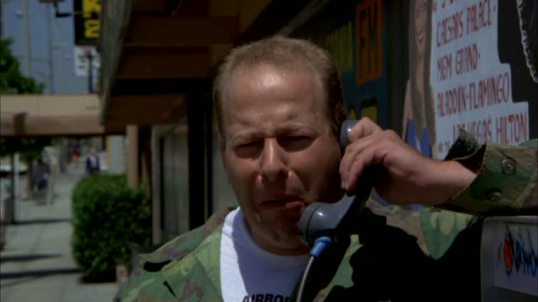
Don’t Answer The Phone is not a particularly good movie but it certainly is effective.  It made me want to go out and get a derringer or some other cute little gun that I could carry in my purse.  That’s largely because of the performance of Nicholas Worth.  Worth plays one of the most perverse and frightening murderers of all time and Worth throws himself into the role.  It’s one of the best psycho performances of all time and certainly worthy of a Best Supporting Actor nomination.

Crown International Pictures’s Only Oscar Nomination


If you’re fan of old movies that used to play in the grindhouses or at the drive-ins, you’re familiar with the Crown International Picture logo.

This logo appeared at the start of some of the most entertaining and cheaply made exploitation films of all time.  These were movies with titles like Malibu Beach, The Teacher, Cavegirl, They Saved Hitler’s Brain, The Sidehackers, My Tutor, Trip With The Teacher, Best Friends, and The Sister-in-Law.  These films may have never been critically acclaimed but they’re still being discovered and loved by viewers today.

Crown International Pictures was founded in 1959 and ceased operations in 1992.  Over the course of 43 years, the studio only received one Oscar nomination.  That was in 1972, for Best Original Song.  Written by Sammy Fain and Paul Francis Webster, Strange Are The Ways Of Love played over the credits for The Stepmother.

In honor of both the Oscars and Crown International Picture, here is Strange Are The Ways Of Love

Music Video of the Day: She Said by Brie Larson (2005, dir by Chris Applebaum)


With this being Oscar Sunday, it’s good to be reminded that everyone had to start somewhere!  Brie Larson rightly won an Oscar for Room but, before that movie, she was just another singer pretending to be a waitress and singing songs of empowerment.

Need proof?

Watch today’s music video of the day and…

ENJOY!

Lisa’s Final 2017 Oscar Predictions


Since the Oscars are tomorrow, I guess now would be the time for me to make my final guesses as to what will win!  So, without further ado:

Best Picture — Three Billboards Outside Ebbing, Missouri

Best Director — Guillermo Del Toro, The Shape of Water

Best Actor — Gary Oldman, Darkest Hour

Best Actress — Frances McDormand, Three Billboards Outside Ebbing, Missouri

Best Supporting Actor — Sam Rockwell, Three Billboards Outside Ebbing, Missouri

Best Supporting Actress — Laurie Metcalf, Lady Bird

Best Original Screenplay — Get Out

Best Adapted Screenplay — Call Me By Your Name

Best Animated Feature — Coco

Best Production Design — The Shape of Water

Best Cinematography — Mudbound

Best Costume Design — Phantom Thread

Best Film Editing — Dunkirk

Best Makeup and Hairstyling — Wonder

Best Sound Mixing — Dunkirk

Best Sound Editing — Dunkirk

Best Visual Effects — War For The Planet of the Apes

Best Original Score — Phantom Thread

Best Original Song — “Remember Me” from Coco

Best Documentary Feature — Icarus

Best Foreign Language Film — The Square

Best Animated Short — Negative Space

Best Live Action Short — DeKalb Elementary

Best Documentary Short — Heroin(e)


Lisa Reviews An Oscar Winner: Cimarron (dir by Wesley Ruggles)


(With the Oscars scheduled to be awarded on March 4th, I have decided to review at least one Oscar-nominated film a day.  These films could be nominees or they could be winners.  They could be from this year’s Oscars or they could be a previous year’s nominee!  We’ll see how things play out.  Today, I take a look at the 1931 best picture winner, Cimarron!)

“Be careful, Hank!  Alabaster may be a little dude but he’ll mess you up.”

“No offense … but he’s from Oklahoma.”

— King of the Hill Episode 5.13 “Ho Yeah”

Some best picture winners are better remembered than others.  Some, like The Godfather, are films that will be watched and rewatched until the end of time.  Others, like Crash, seems to be destined to be continually cited as proof that the Academy often picks the wrong movie.  And then you have other films that were apparently a big deal when they were first released but which, in the decades to follow, have fallen into obscurity.

1931’s Cimarron would appear to be a perfect example of the third type of best picture winner.

Based on a novel by Edna Ferber (who would later write another book, Giant, that would be adapted into an Oscar-nominated film), Cimarron is an epic about Oklahoma.  The film opens in 1889 with the Oklahoma land rush.  Settlers from all across America rush into Oklahoma, searching for a new beginning.  Among them is Yancey Cravat (Richard Dix) and his wife, Sabra (Irene Dunne).  Yancey is hoping to become a rancher but, upon arriving at the settlement of Osage, he discovers that the land he wanted has already been claimed by Dixie Lee (Estelle Taylor).

So, Yancey gives up on becoming a rancher.  Instead, he becomes a newspaper publisher and an occasional outlaw killer.  Soon, Yancey and Sabra are two of the most prominent citizens in Osage.  Under the guidance of Yancey, Osage goes from being a wild outpost to being a respectable community.  It’s not always easy, of course.  Criminals like The Kid (William Collier, Jr.) still prey on the weak.  As the town grows more respectable, some citizens try to force out people like Dixie Lee.  Struck by a combination of personal tragedy and wanderlust, Yancey occasionally leaves Osage but he always seems to return in time to make sure that people do the right thing.  When even his wife reveals that she’s prejudiced against Native Americans, Yancey writes a vehement editorial demanding that they be granted full American citizenship.

The film follows Sabra and Yancey all the way to the late 1920s.  Oklahoma becomes a state.  Sabra becomes a congresswoman.  Oil is discovered.  Throughout it all, Yancey remains a firm voice in support of always doing the right thing.  In fact, he’s such a firm voice that you actually start to get tired of listening to him.  Yancey may be a great man but he’s not a particularly interesting one.

By today’s standards, Cimarron is a painfully slow movie.  The opening land rush is handled well but once Yancey and Sabra settle down in Osage, the film becomes a bit of a chore to sit through.  Richard Dix is a dull lead and the old age makeup that’s put on Dix and Dunne towards the end of the movie is notably unconvincing.  Considering some of the other films that were eligible for Best Picture that year — The Front Page, The Public Enemy, Little Caesar, Frankenstein — Cimarron seems even more out-of-place as an Oscar winner.

And yet, back in 1931, it would appear the Cimarron was a really big deal.  Consider this:

Cimarron was not only well-reviewed but also a considerable box office success.

Cimarron was the first film to ever receive more than 6 Academy Award nominations.  (It received seven and won 3 — Picture, Screenplay, and Art Direction.)

Cimarron was the first film to be nominated in all of the Big Five categories (Picture, Actor, Actress, Director, and Screenplay).

Cimarron was the first film to be nominated in every category for which it was eligible.

Cimarron was the first RKO film to win Best Picture. The second and last RKO film to win would be The Best Years of Our Lives, a film that has held up considerably better than Cimarron.

Cimarron was the first Western to win Best Picture.  In fact, it would be 59 years before another western took the top award.

Though Cimarron may now be best known to those of us who watch TCM, it’s apparent that it was a pretty big deal when it was first released.  Though it seems pretty creaky by today’s standards, they loved it in 1931.

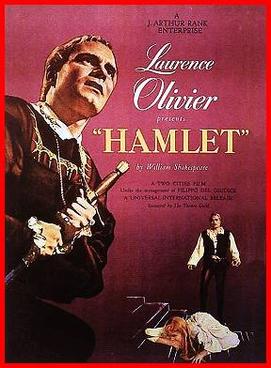
Lisa Reviews An Oscar Winner: Hamlet (dir by Laurence Olivier)


(With the Oscars scheduled to be awarded on March 4th, I have decided to review at least one Oscar-nominated film a day.  These films could be nominees or they could be winners.  They could be from this year’s Oscars or they could be a previous year’s nominee!  We’ll see how things play out.  Today, I take a look at the 1948 best picture winner, Hamlet!)

Hamlet is a film of firsts.

It was the first British production to win the Oscar for Best Picture.  In winning, it beat out three American films (Johnny Belinda, The Snake Pit, and The Treasure of the Sierra Madre) and one other British film (The Red Shoes).

It was also the first adaptation of Shakespeare to win Best Picture.  Of course, it wasn’t the first Shakespeare adaptation to be nominated.  That honor would go to 1935’s A Midsummer Night’s Dream.  Adaptations of Romeo and Juliet would be nominated in 1936, 1961, and 1968.  Henry V (which, like Hamlet, was directed by and starred Laurence Olivier) was a 1946 nominee.  Then there was 1953’s Julius Caesar.  The Dresser featured scenes from Shakespeare.  Shakespeare in Love imagined the circumstances behind the writing of Romeo and Juliet.  However, Hamlet was the first to win.

It also remains the only traditional Shakespearean adaptation to win.  West Side Story updated Romeo and Juliet while Shakespeare in Love … well, let’s just not get into it.

It was the first Best Picture winner to be directed by the man starring in the movie.  Laurence Olivier was nominated for both Best Director and Best Actor.  He lost the directing Oscar to John Huston but he won for his performance as Hamlet.  In winning, he became the first actor to direct himself to an Oscar.

Finally, Hamlet was the first of 24 films to feature both Peter Cushing and Christopher Lee!  In fact, this was Lee’s film debut.  Now, before anyone gets too excited, I should point out that Cushing and Lee don’t actually interact.  In fact, Lee doesn’t even speak in the film.  He appears in the background as a Spear Carrier and it’s pretty much impossible to spot him.  He has no dialogue and wasn’t even listed in the final credits.  From what I’ve read, I don’t think Lee and Cushing even knew each other at the time and, when they later met, they were surprised to learn that they had both appeared in the film.  For his part, Cushing plays Osiric, the courtier who everyone remembers because he had such a cool name.

It’s always fun to play “what if.”  Rosencrantz and Guildenstern do not appear in Olivier’s adaptation of the play.  To modern audiences, that might seem strange but, really, that’s just because we’re all familiar with the two characters from Tom Stoppard’s Rosencrantz and Guildenstern Are Dead.  When Olivier filmed Hamlet, he excised portions of the play in the interest of time.  (Hamlet uncut runs over four hours.  Olivier’s version clocks in at nearly three.)  Rosencrantz, Guildenstern, Fortinbras, and the second gravedigger are all dropped from Olivier’s version and, to be honest, none of them are particularly missed.

And yet … as I watched Hamlet, I found myself wondering what would have happened if Olivier had kept Rosencrantz and Guildenstern around and had cast Cushing and Lee in those roles.  It probably wouldn’t have happened, of course.  Cushing maybe but Lee was a total unknown at the time.  Still, how amazing would that have been?

As for the actual film, Olivier’s Hamlet turned out to be far more cinematic than I was anticipating.  Olivier’s camera snakes through the darkened hallways of Elsinore Castle while Olivier’s Hamlet veers between self-righteous fury and apparent madness as he seeks revenge on his Uncle Claudius (Basil Sydney).  As Hamlet grows more obsessed with death and vengeance, the castle seems to grow darker and the hallways even more maze-like, as if the castle’s changing shape to conform with the turmoil in Hamlet’s mind.  Among the cast, Jean Simmons is poignantly fragile as Ophelia while Eileen Herlie is the perfect Gertrude, despite being 12 years younger than the actor playing her son.  Olivier gives a wonderfully physical performance as Hamlet, killing Polonious with a demented gleam in his eye and literally leaping towards his uncle at the end of the film.

If you’re one of those people who thinks that Shakespeare is boring … well, Olivier’s Hamlet probably won’t change your mind.  One thing I’ve noticed about the “Shakespeare is boring” crowd is that nothing can change their minds.  But, for the rest of us, Olivier’s Hamlet is an exciting adaptation of Shakespeare’s more difficult play.

You won’t miss Rosencrantz and Guildenstern at all.  And seriously, Fortinbras who?

Lisa’s Way, Way, Way Too Early Oscar Predictions For February


Could Black Panther be the first comic book movie to receive an Oscar nomination?

Last year, around this time, we were asking the exact same question about LoganLogan didn’t pick up a Best Picture nomination but it was nominated for Best Adapted Screenplay, which would seem to suggest that the Academy is slowly coming around to accepting that so-called “Super Hero Films” can also be legitimate Oscar contenders.

As for Black Panther, it is currently the most critically acclaimed and financially successful film of 2018.  For those who say that there’s no way the Academy will ever nominate a comic book film for best picture, it should be remembered that there was a time when people said that Academy would never nominate a horror comedy for Best Picture.  Much like Get Out, Black Panther could prove the naysayers wrong.

Anyway, here are my Oscar predictions for February.  As always, it ‘s really way too early to be making these predictions.  Usually, Sundance provides at least a little bit of a guide but this year, Sundance was pretty low-key.  The most obvious Sundance Oscar contender — Burden — doesn’t even have a release date yet.

Also, the uncertain status of The Weinstein Company has thrown a lot of films into limbo.  Some of the unreleased TWC films might find homes with other studios.  Others will probably be left in limbo.  Then again, even if those films do get a release, I doubt the Academy is going to nominate any films stained with the noxious fingerprints of the Weinsteins.

Even more than usual, the guesses below are random.  At this time next year, we’ll probably look at this list and laugh.  Some of you might laugh today.

Check out January’s picks here!

Best Picture

Black Panther

Boy Erased

Burden

Colette

First Man

Mary, Queen of Scots

A Star is Born

Where’d You Go, Bernadette?

Widows

The Women of Mawren

Best Director

Ryan Coogler for Black Panther

Andrew Heckler for Burden

Richard Linklater for Where’d You Go, Bernadette?

Steve McQueen for Widows

Josie Rourke for Mary, Queen of Scots

Best Actor

Christian Bale in Untitled Adam McKay/Dick Cheney film

Lucas Hedges in Boy Erased

Ryan Gosling in First Man

Jake Gyllenhaal in Wildfire

Garrett Hedlund in Burden

Best Actress

Cate Blanchett in Where’d You Go, Bernadette?

Viola Davis in Widows

Keira Knightley in Collette

Chloe Grace Moretz in The Miseducation of Cameron Post

Saorise Ronan in Mary, Queen of Scots

Best Supporting Actor

Jeff Bridges in Bad Times at the El Royale

Robert Duvall in Widows

Michael B. Jordan in Black Panther

Rami Malek in Papillon

Forest Whiteaker in Burden

Best Supporting Actress

Claire Foy in First Man

Nicole Kidman in Boy Erased

Leslie Mann in The Women of Mawren

Lupita Nyong’o in Black Panther

Margot Robie in Mary, Queen of Scots