The Films of 2024: Horizon: An American Saga: Chapter One (dir by Kevin Costner)


Horizon: An American Saga: Chapter One is the rather unwieldy title of the first part of what Kevin Costner has said will be an epic four-part movie about the settling of the American frontier.

It’s very, very long.

It has a running time of three hours, during which time a lot of characters are introduced and a lot of plotlines are initiated but, because this is the only first chapter, none of them come to a close.  In fact, as the film ends, it’s still a mystery as to how some of the characters are even related.  I watched all three hours and I took my ADD meds this morning so you can be assured that I was actually paying attention.  That said, I still struggled to keep track of who everyone was or even where they were in proximity to each other.  Indeed, it was only towards the end of the film that I realized that several years were supposed to have passed over the course of the first chapter’s running time.

That’s not to say that the film is a disaster.  While it’s not quite the nation-defining epic that Costner obviously envisioned it as being, it’s also not quite the cinematic atrocity that several critics made it out to be.  It’s a throwback of sorts, to the epic westerns of old.  As such, the film features taciturn gunslingers, a woman with a past, dangerous outlaw families, fierce Indian warriors, and a wise Indian chief who has dreamed of the coming of the white man.  The film is full of actors — like Michael Rooker, Sienna Miller, Sam Worthington, Danny Huston, Will Patton, James Russo, Dale Dickey, and Kevin Costner himself — who feel as if they belong to a different era of filmmaking.  Just about everyone in the film is heading to the settlement of Horizon, which sits in Apache territory.  Despite the efforts of the Indians to kill every settler who shows up, they keep coming.  As one army officer explains it, the Indians have made the mistake of thinking that the settlers will come to believe the land is cursed while the settlers, all of whom are full of American optimism, instead chose to believe that the previous settlers were unlucky but that the next wave of settlers will make it work.  Costner has the right visual sensibility for a western.  The film reveals a director who is obviously in love with the Western landscape and the film is at its best when it simply frames the characters against the beauty of the frontier.  But when it comes to actually telling a compelling story, he struggles.  There are a lot of moving parts to the first chapter of Horizon and the problem is not that they don’t automatically connect but instead that Costner never gives us any reason to believe that they’ll ever connect.  There are no visual clues or bits of dialogue to assure the viewer that everything they’re watching is going to eventually pay off.  Costner asks his audience to have faith in him and remember that he directed Open Range and Dances With Wolves while forgetting about The Postman.

The first hour, which features a brutal raid on the settlement by a group of Indians, is the strongest.  It really drives home the brutality of what we now call the old west.  In the style of Michael Cimino’s The Deer Hunter, Costner closely observes the individual customs of the film’s settlers and carefully introduces several appealing characters who leave the viewer feeling as if they’ve met a very special and very unique community of people.  That makes it all the more devastating when the majority of those characters are subsequently wiped out with casual cruelty in a raid led by the Indian warrior Pionsenay (Owen Crow Shoe).  (Later — much later — a tracker played by Jeff Fahey will show similar brutality while wiping out a group of Apaches.)  The first hour establishes the frontier as being beautiful but also dangerous and it also drives home the mix of determination, desperation, and even madness that led so many to follow Horace Greeley’s advice and “Go west!”  Though the film was shot in early 2023, the brutality of the raid brought to mind the terrible images of the October 7th attacks on Israel.  The subsequent scenes in which Pionesenay and his followers ridiculed those in the tribe who wanted peace mirrored the current schism that’s driving apart the worldwide Left.  The U.S. Army, for their part, arrives a day late and can only offer up not-so subtle condescension.  The surviving settlers, however, remain determined to make a home for themselves.

The second hour focuses on Hayes (played by Costner), who rides into a mining town and gets involved with a family of outlaws who are looking for the woman who shot their father.  The second hour is a bit more of a traditional western than the first hour, though some of the violence is still shockingly brutal.  (Even being comedic relief won’t save you in this film.)  Abbey Lee gives a good performance as the woman with a past and a baby and Kevin Costner is  …. well, he’s Costner.  He could play this type of role in his sleep.

The third hour is a mess, introducing a wagon train and featuring a miscast Luke Wilson as the leader of the settlers and Jeff Fahey giving a strong performance as a ruthless tracker.  The third hour meandered as a whole new set of characters were introduced and I was left to wonder why the film needed new characters when the characters from the first two hours were perfectly adequate.  It was during the third hour that I started to really get impatient with the film and its leisurely approach to storytelling.

The film ends with a montage of what we can expect from the next few chapters of Horizon and I will say that the montage actually looked pretty cool.  That’s because the montage was almost totally made up of action scenes, with none of the padding that caused Chapter One to last an unwieldy three hours despite only having 90 minutes worth of story.  Still, one has to wonder if we’ll actually get to see the next three chapters.  The first chapter bombed at the box office and didn’t exactly excite critics.  Costner is producing and financing the films himself and I doubt he’ll give up on them.  The Horizon saga will be completed but will it made it to theaters or will it just end up on streaming?  Personally, I think the whole thing would work best as a miniseries but who knows?  (If Horizon was airing on Paramount, it would probably be a Yellowstone-style hit.)  All I really do know is that Chapter Two has yet to be released.  And that’s a shame because, for all of Chapter One‘s flaws, I’d still like to see how the story turns out.
Horror Film Review: Old (dir by M. Night Shyamalan)


An odd film, Old.

Seriously, 2019’s Old is so odd that I feel the need to point out repeatedly just how strange it is.  As I watched the film, I respected it’s dedication to being odd but, at the same time, I was a bit surprised that it was directed by M. Night Shyamalan.  For all of the fame that he’s gained for his twist endings and his suspenseful films, Shyamalan has always aspired to being a member of the Hollywood mainstream.  As such, his films are usually twisty without being transgressive.  He’s usually careful about alienating the audience.

But then, he makes something like Old, which features a group of people going to the beach and aging a year every 30 minutes.  This group includes middle-aged people (and wow, are they ever in trouble) but it also includes young children who quickly become teenager and then quickly become adults and, by the end of the film, are middle-aged and walking around in ill-fitting swim suits.  Along the way, there’s a 10-minute pregnancy, a baby that only lives for a few seconds because it’s aging too quickly, and a blood infection that kills within seconds.  Eyesight and hearing fades.  Bones snap.  Bodies quickly decay.  Aging sucks.

It’s not a happy film at all.  Yes, the movie does end with a minor victory but it still leaves the remaining characters in a sort of mental and emotional limbo, the type that you know they’re never going to escape.  The majority of the characters die and often, they die graphically and painfully.  Under normal circumstances, they would have died over the course of several years and, at the very least, people would have time to grieve in between.  On the cursed beach of Old, people die one after the other and there’s no time to grieve.  Two character do manage to make some sort of peace with themselves before they age to death but the majority of the characters go out railing against that dark night.  One of the most disturbing things about the film is that the characters have no control over what is happening to them.  Even when they try to leave the beach, they pass out and reawaken on the sand, a few years older.  I guess it’s like life.  There is no escape and there’s no way to prevent getting older.  Some will age well and live a full life.  Others will randomly get sick and die and, in the end, there’s no way to control which will be which.

Seriously, that’s depressing!  I’m not used to M. Night Shyamalan being that depressing!  But then I discovered that this movie was based on a French-language graphic novel and it all made sense.

The people on the beach are played by a talented group of actors, with several different performers playing the rapidly aging children over the course of the film.  Rufus Sewell gives a good performance as a surgeon who cracks under the pressure.  I was happy to see one of my favorite actors, Ken Leung, on the beach but I wasn’t particularly happy with what happened to his character.

It’s a strange film.  Say what you will about Shyamalan and his career has definitely been uneven, he can still deliver when he has the right material.

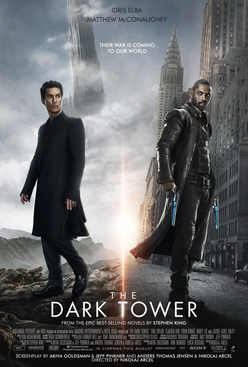
Playing Catch-Up With The Films of 2017: The Dark Tower (dir by Nikolaj Arcel)


What the Hell was The Dark Tower about, anyway?

It’s a legitimate question.  I know that the film was technically a continuation of Stephen King’s overrated Dark Tower books.  Matthew McConaughey was Walter, the Man in the Black, the man who is kidnapping psychic children so that he can weaponize their powers and destroy The Dark Tower.  Idris Elba was Roland, the last of the gunslingers, who is obsessed with killing Walter because Walter killed his father.  And Tom Taylor is Jake, an eleven year-old boy who lives in New York City and who keeps having visions of the Tower, Walter, and Roland.  Walter wants Jake.  Roland wants Walter.  Jake wants to understand it all…

And that’s pretty much the entire movie.  Jake switches back and forth between his world and Roland’s world.  Walter occasionally pops up in New York so that he can kill Jake’s family and assure that Jake won’t have any reason not to continue traveling with Roland at the end of the movie.  It all basically feels like the pilot for a television series and, to be honest, it probably wouldn’t be that bad of a show.  For one thing, if The Dark Tower was a tv show, there would be more of an opportunity to develop the characters of Roland, Walter, and Tom.  The Dark Tower movie only last 95 minutes and the majority of those minutes feel very rushed.

Obviously, if you’ve read Stephen King’s Dark Tower books, this film will be easier for you to follow than it will be for people who have never had to suffer through them.  I know I’m in the minority as far as this is concerned but I find The Dark Tower series to be King at his most pretentious.  Interestingly enough, a little bit of pretension probably would have helped the film version of The Dark Tower.  As it is, The Dark Tower is almost too workmanlike and straight-forward.  It could have really used a pointless Stephen King-style soliloquy about faith, innocence, and horror.  At the very least, they could have had someone in the background, droning on about politics in a Maine accent.

I have to admit that I really, really, really wanted to like The Dark Tower.  I love Idris Elba.  I love Matthew McConaughey.  Even more importantly, I love being a contrarian.  Whenever a film gets as many negative reviews as The Dark Tower, my natural instinct is always to assume that it has to be a secret masterpiece.  I mean, seriously, who trusts critics?  I really wanted to watch The Dark Tower and then write a 1,000-word defense of it.  I was hoping that, much like The Counselor, it would turn out to be a masterpiece that only I could recognize.

Sadly, that didn’t turn out to be the case.  I will say that Matthew McConaughey seemed to be having a sincerely good time playing the bad guy.  And Idris Elba had just the right mix of weariness and compassion to play Roland.  But otherwise, the movie just felt so pointless.

Overall, this has been a pretty good year for Stephen King film adaptations.  It deserves to be nominated for an Oscar, though it won’t be.  Gerald’s Game made people thankful for Netflix.  The Dark Tower, though, will be quickly forgotten.

Playing Catch-Up With The Films of 2016: Alice Through The Looking Glass, Gods of Egypt, The Huntsman: Winter’s War, Me Before You, Mother’s Day, Risen


Here are six mini-reviews of six films that I saw in 2016!

Alice Through The Looking Glass (dir by James Bobin)

In a word — BORING!

Personally, I’ve always thought that, as a work of literature, Through The Looking Glass is actually superior to Alice’s Adventures in Wonderland.  That’s largely because Through The Looking Glass is a lot darker than Wonderland and the satire is a lot more fierce.  You wouldn’t know that from watching the latest film adaptation, though.  Alice Through The Looking Glass doesn’t really seem to care much about the source material.  Instead, it’s all about making money and if that means ignoring everything that made the story a classic and instead turning it into a rip-off of every other recent blockbuster, so be it.  At times, I wondered if I was watching a film based on Lewis Carroll or a film based on Suicide Squad.  Well, regardless, the whole enterprise is way too cynical to really enjoy.

(On the plus side, the CGI is fairly well-done.  If you listen, you’ll hear the voice of Alan Rickman.)

Gods of Egypt (dir by Alex Proyas)

I don’t even know where to begin when it comes to describing the plot of Gods of Egypt.  This was one of the most confusing films that I’ve ever seen but then again, I’m also not exactly an expert when it comes to Egyptian mythology.  As far as I could tell, it was about Egyptian Gods fighting some sort of war with each other but I was never quite sure who was who or why they were fighting or anything else.  My ADHD went crazy while I was watching Gods of Egypt.  There were so much plot and so many superfluous distractions that I couldn’t really concentrate on what the Hell was actually going on.

But you know what?  With all that in mind, Gods of Egypt is still not as bad as you’ve heard.  It’s a big and ludicrous film but ultimately, it’s so big and so ludicrous that it becomes oddly charming.  Director Alex Proyas had a definite vision in mind when he made this film and that alone makes Gods of Egypt better than some of the other films that I’m reviewing in this post.

Is Gods of Egypt so bad that its good?  I wouldn’t necessarily say that.  Instead, I would say that it’s so ludicrous that it’s unexpectedly watchable.

The Huntsman: Winter’s War (dir by Cedric Nicolas-Troyan)

Bleh.  Who cares?  I mean, I hate to put it like that but The Huntsman: Winter’s War felt pretty much like every other wannabe blockbuster that was released in April of last year.  Big battles, big cast, big visuals, big production but the movie itself was way too predictable to be interesting.

Did we really need a follow-up to Snow White and The Huntsman?  Judging by this film, we did not.

Me Before You (dir by Thea Sharrock)

Me Before You was assisted suicide propaganda, disguised as a Nicolas Sparks-style love story.  Emilia Clarke is hired to serve as a caregiver to a paralyzed and bitter former banker played by Sam Claflin.  At first they hate each other but then they love each other but it may be too late because Claflin is determined to end his life in Switzerland.  Trying to change his mind, Clarke tries to prove to him that it’s a big beautiful world out there.  Claflin appreciates the effort but it turns out that he really, really wants to die.  It helps, of course, that Switzerland is a really beautiful and romantic country.  I mean, if you’re going to end your life, Switzerland is the place to do it.  Take that, Sea of Trees.

Anyway, Me Before You makes its points with all the subtlety and nuance of a sledge-hammer that’s been borrowed from the Final Exit Network.  It doesn’t help that Clarke and Claflin have next to no chemistry.  Even without all the propaganda, Me Before You would have been forgettable.  The propaganda just pushes the movie over the line that separates mediocre from terrible.

Mother’s Day (dir by Garry Marshall)

Y’know, the only reason that I’ve put off writing about how much I hated this film is because Garry Marshall died shortly after it was released and I read so many tweets and interviews from people talking about what a nice and sincere guy he was that I actually started to feel guilty for hating his final movie.

But seriously, Mother’s Day was really bad.  This was the third of Marshall’s holiday films.  All three of them were ensemble pieces that ascribed a ludicrous amount of importance to one particular holiday.  None of them were any good, largely because they all felt like cynical cash-ins.  If you didn’t see Valentine’s Day, you hated love.  If you didn’t see New Year’s Eve, you didn’t care about the future of the world.  And if you didn’t see Mother’s Day … well, let’s just not go there, okay?

Mother’s Day takes place in Atlanta and it deals with a group of people who are all either mothers or dealing with a mother.  The ensemble is made up of familiar faces — Jennifer Aniston, Julia Roberts, Kate Hudson, and others! — but nobody really seems to be making much of an effort to act.  Instead, they simple show up, recite a few lines in whatever their trademark style may be, and then cash their paycheck.  The whole thing feels so incredibly manipulative and shallow and fake that it leaves you wondering if maybe all future holidays should be canceled.

I know Garry Marshall was a great guy but seriously, Mother’s Day is just the worst.

(For a far better movie about Mother’s Day, check out the 2010 film starring Rebecca De Mornay.)

Risen (dir by Kevin Reynolds)

As far as recent Biblical films go, Risen is not that bad.  It takes place shortly after the Crucifixion and stars Joseph Fiennes as a Roman centurion who is assigned to discover why the body of Jesus has disappeared from its tomb.  You can probably guess what happens next.  The film may be a little bit heavy-handed but the Roman Empire is convincingly recreated, Joseph Fiennes gives a pretty good performance, and Kevin Reynolds keeps the action moving quickly.  As a faith-based film that never becomes preachy, Risen is far superior to something like God’s Not Dead 2.